In the newly released The state of AI in early 2024: Gen AI adoption spikes and starts to generate value, McKinsey presents some of the trends in using AI in work as well as in life. Here are the key highlights from the report:
67% Organizations expect to invest more in AI in the next 3 years.
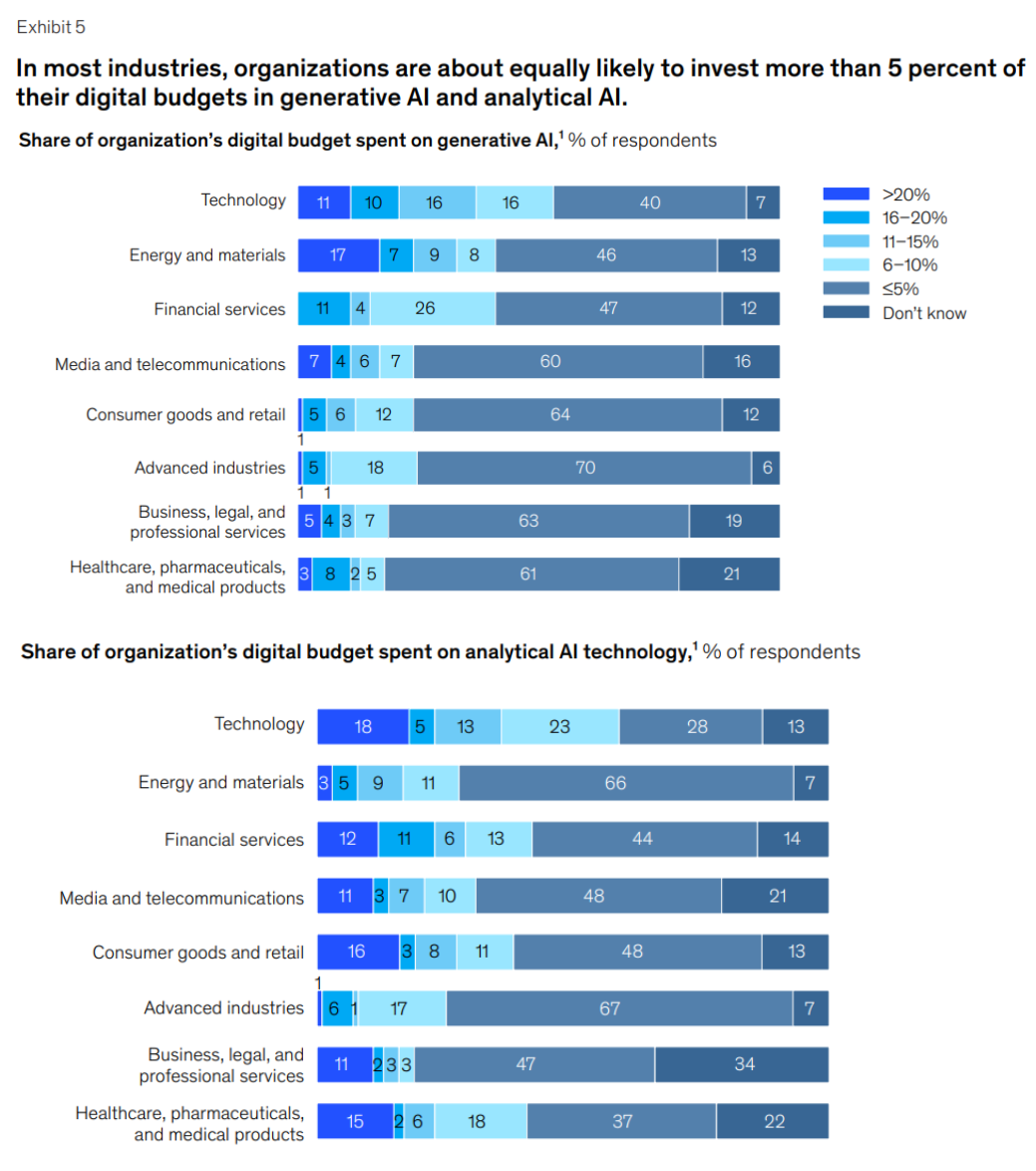
Each industry has different budgets for AI investment. In many industries, organizations are about equally likely to invest more than 5 percent of their digital budgets in generative AI as they are in analytical AI solutions. However, in most industries, a larger share of respondents report that their organizations spend more than 20 percent on analytical AI than on generative AI. Besides, in the industries of Technology, Energy and Materials, and Financial Services, the share of investment in both generative AI and analytical AI exceeds 40 percent.
Gen AI could have the greatest productivity impact on marketing & sales
The data highlights that AI, in both analytical and generative forms, is transforming Marketing and Sales by driving measurable financial benefits. Analytical AI shows strong results in both cost efficiency and revenue growth, with more than two-thirds of respondents witnessing increased revenue and one-third noting reduced costs. Generative AI, while newer, is also creating substantial value, especially in generating incremental revenue.
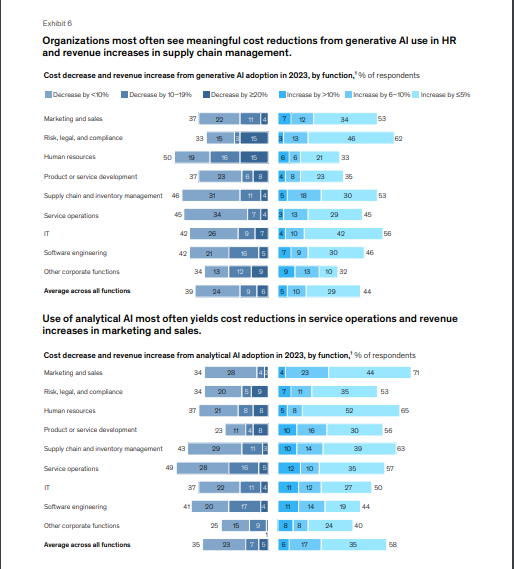
These findings underscore the strategic importance of AI in Marketing and Sales, not only as a tool for operational cost-cutting but also as a driver of top-line growth. For organizations looking to remain competitive, investing in AI capabilities in these functions can unlock both immediate gains and long-term potential as the technology matures.
Combining off-the-shelf generative AI with customized or proprietary models will be the trend.
Mr. Alexander Sukharevsky, Senior Partner and Global Co-leader of QuantumBlack, said, “Although it varies by industry, roughly half of our survey respondents say they are using readily available, off-the-shelf generative AI models rather than custom-designed solutions. This is a very natural tendency in the early days of a new technology—but it’s not a sound approach as generative AI becomes more widely adopted.”
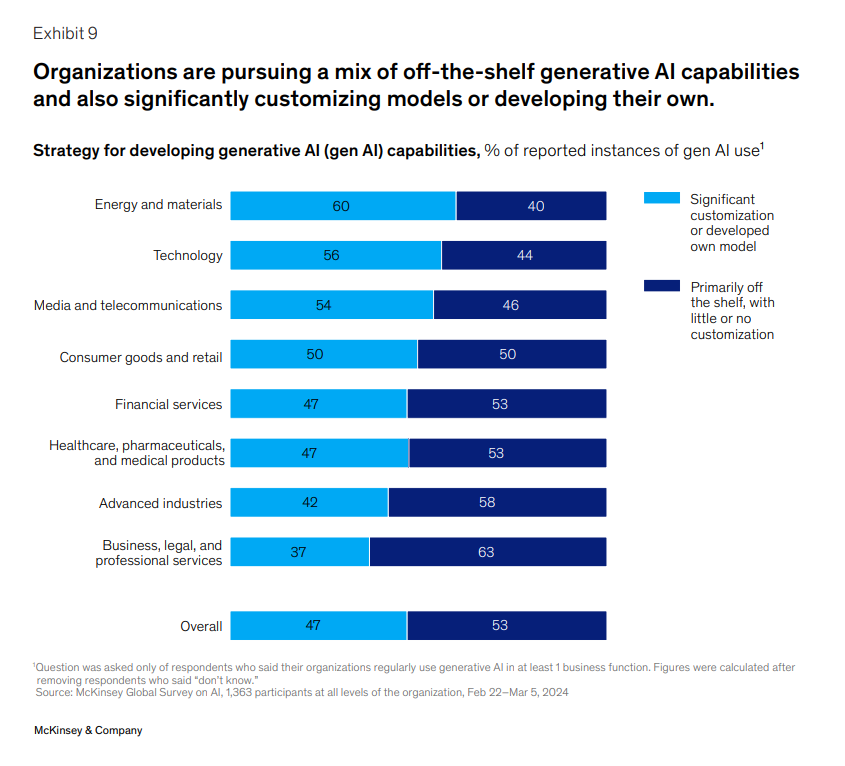
However, if AI becomes widespread, your competitors may have access to the same technology. So what will be your competitive advantage? The answer is Customization. Sukharevsky further explains, “In fact, with generative AI, we are moving from a binary world of ‘build versus buy’ to one better characterized as ‘buy, build, and partner,’ where the most successful organizations construct ecosystems blending proprietary, off-the-shelf, and open-source models. Finally, leaders must understand that generative AI models generally make up only 15 percent of any given solution. In other words: it’s not just tech. To create value, organizations must have all elements in place—domain reimagining abilities; relevant skill sets (including upskilling non-technical colleagues); a robust operating model; and proprietary data.”
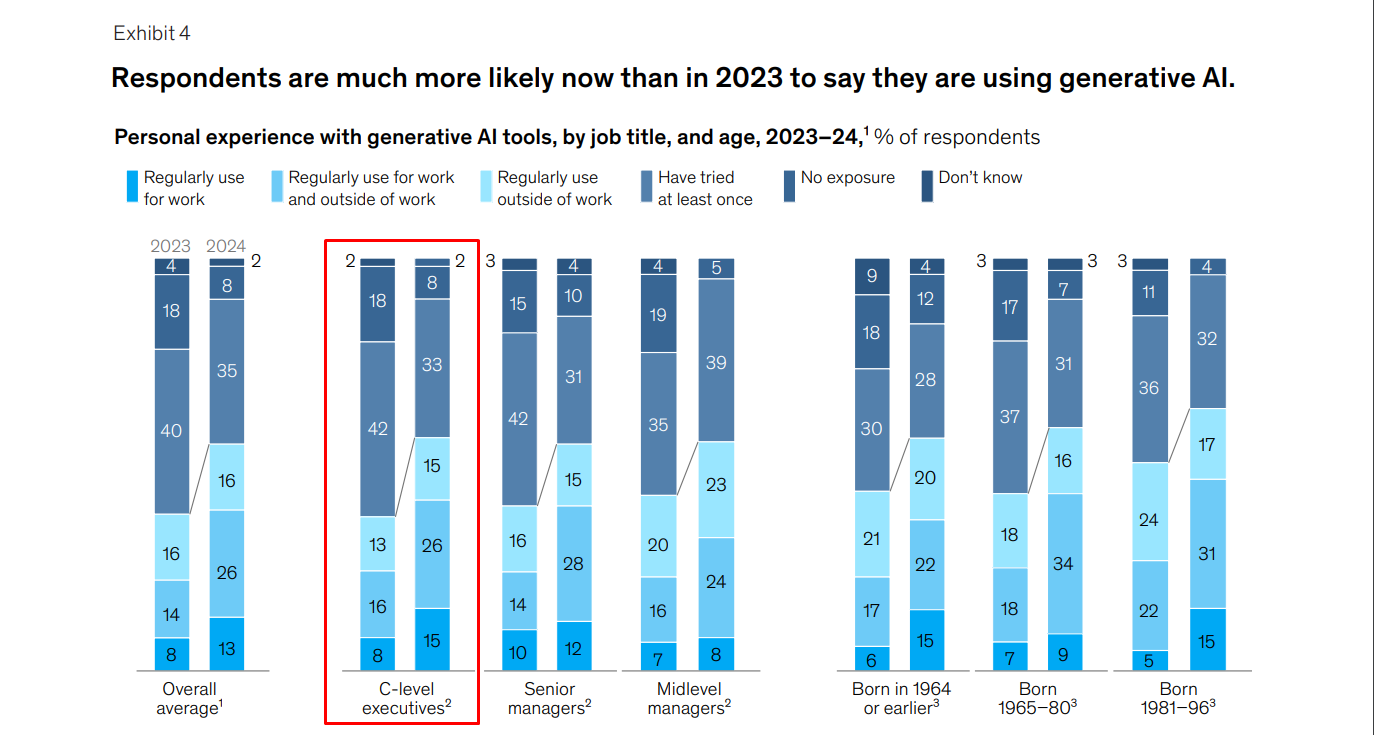
Within an organization, C-level executives are the primary users of Gen AI tools.
C-level executives demonstrate the highest adoption of generative AI tools, with 41% using them regularly for work, which is above the overall average. This group also has a notably low percentage (only 8%) with no exposure to generative AI, highlighting their proactive approach to embracing new technology. The increase in AI usage from 2023 to 2024 among C-level executives suggests they view generative AI as a strategic asset, essential for maintaining a competitive edge and driving innovation within their organizations.
Asia-Pacific and Greater China drive rapid generative AI adoption, signaling a competitive edge in 2024
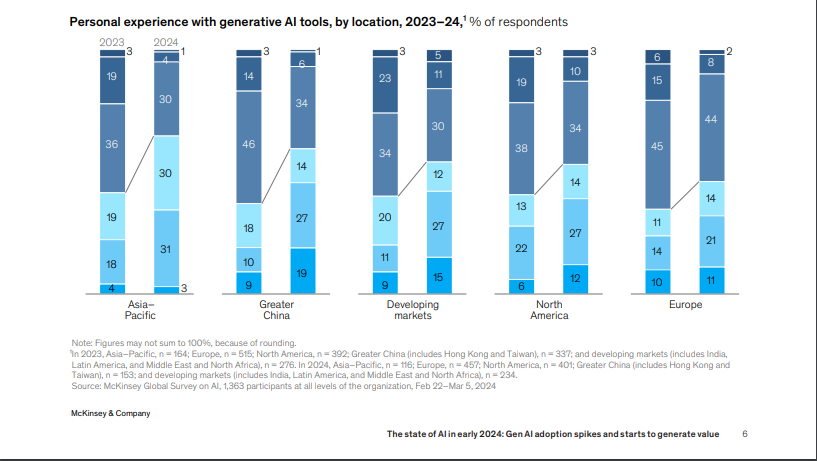
In 2024, the Asia-Pacific region shows a strong increase in generative AI adoption, with 30% of respondents using it regularly for work, up from 19% in 2023. Additionally, 31% report using generative AI for both work and personal purposes, highlighting the broad applicability and rapid uptake of the technology. In Greater China, the trend is even more pronounced, with 46% of respondents regularly using generative AI for work, a significant jump from 14% in 2023. This growth in both regions underscores a proactive approach to leveraging generative AI, indicating its critical role in driving innovation and competitiveness in Asia.
Related article: 5 Takeaways I Learned After Reading the A16z Report