The article is translated from the original author LilYang – Coin98.
In the newly released 2024 crypto market overview report, a16z crypto presents a series of optimistic perspectives on the industry’s future. Here are the key highlights from the report:
Crypto Adoption Is Growing Strongly:
User activity and network performance have reached record highs. As of September, 220 million wallet addresses interacted with blockchains—three times higher than the same period in 2023. Solana leads with 100 million addresses, followed by NEAR (31 million), Base (22 million), Tron (14 million), and Bitcoin (11 million). Among EVM-compatible blockchains, BNB Chain has 10 million active addresses, second only to Base, while Ethereum has 6 million. The sharp growth of Solana and Base is driven primarily by memecoin activities.
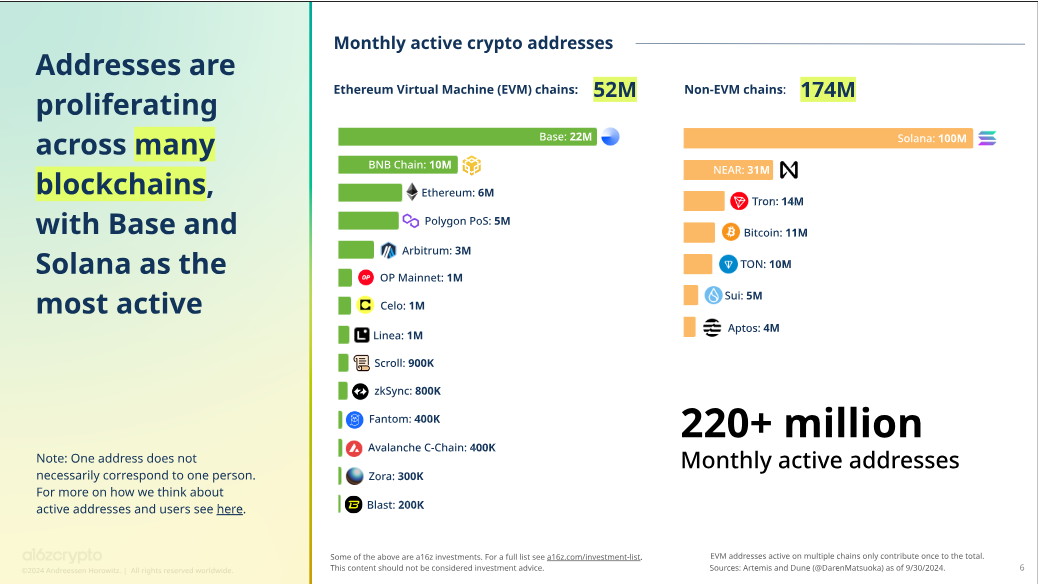
Solana leads with 100 million addresses, followed by NEAR (31 million), Base (22 million), Tron (14 million), and Bitcoin (11 million).
Among EVM-compatible blockchains, BNB Chain has 10 million active addresses, second only to Base, while Ethereum has 6 million. The sharp growth of Solana and Base is driven primarily by memecoin activities.
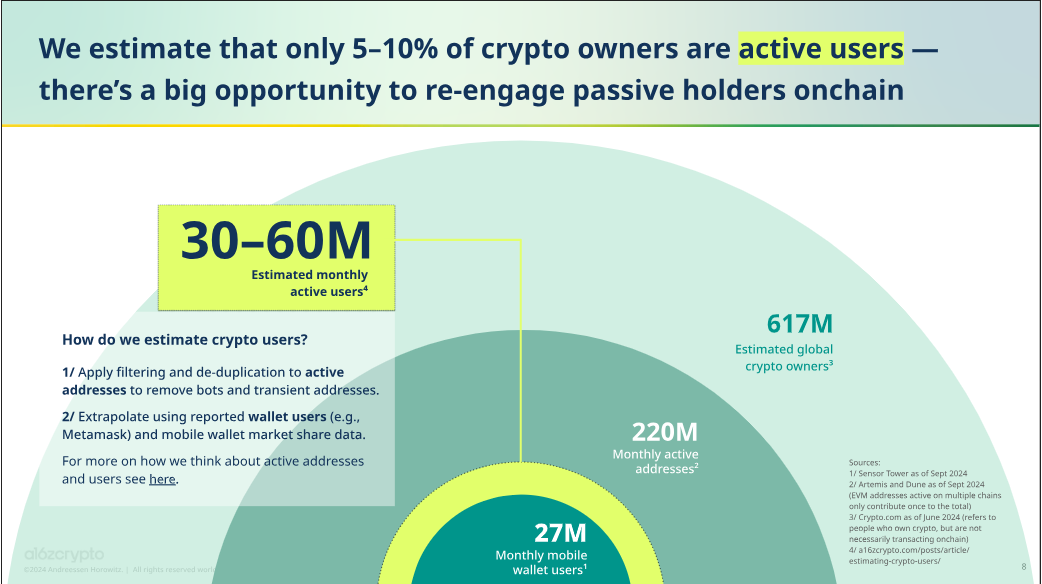
Due to the anonymity of crypto, users can create and use multiple wallets, making the number of wallets exceed the actual number of users. Through analysis and coordination with wallet providers, a16z estimates there are about 30-60 million monthly crypto users.
This figure represents only 14-27% of the 220 million active addresses in September and 5-10% of the 617 million global crypto holders (as of Crypto.com’s June report). This suggests significant potential to convert crypto holders into active users.
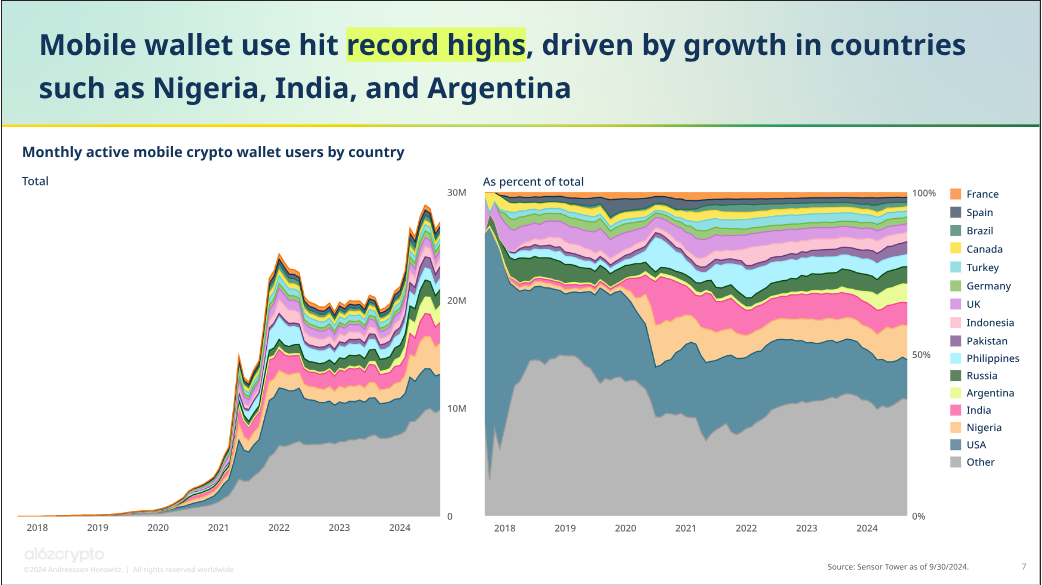
Notably, among the 30-60 million users, the trend of using crypto wallets on mobile devices has surged. The number of mobile crypto wallet users peaked at 29 million in June, with the highest user counts in the US, Nigeria, India, and Argentina.
Stablecoins Are Playing a Major Role:
Despite a decline in overall crypto trading volumes, the use of stablecoins continues to grow, expanding its range of applications. With fast transaction speeds and a clearer regulatory framework, stablecoins have evolved beyond simple trading tools to become viable alternatives for traditional remittance services.
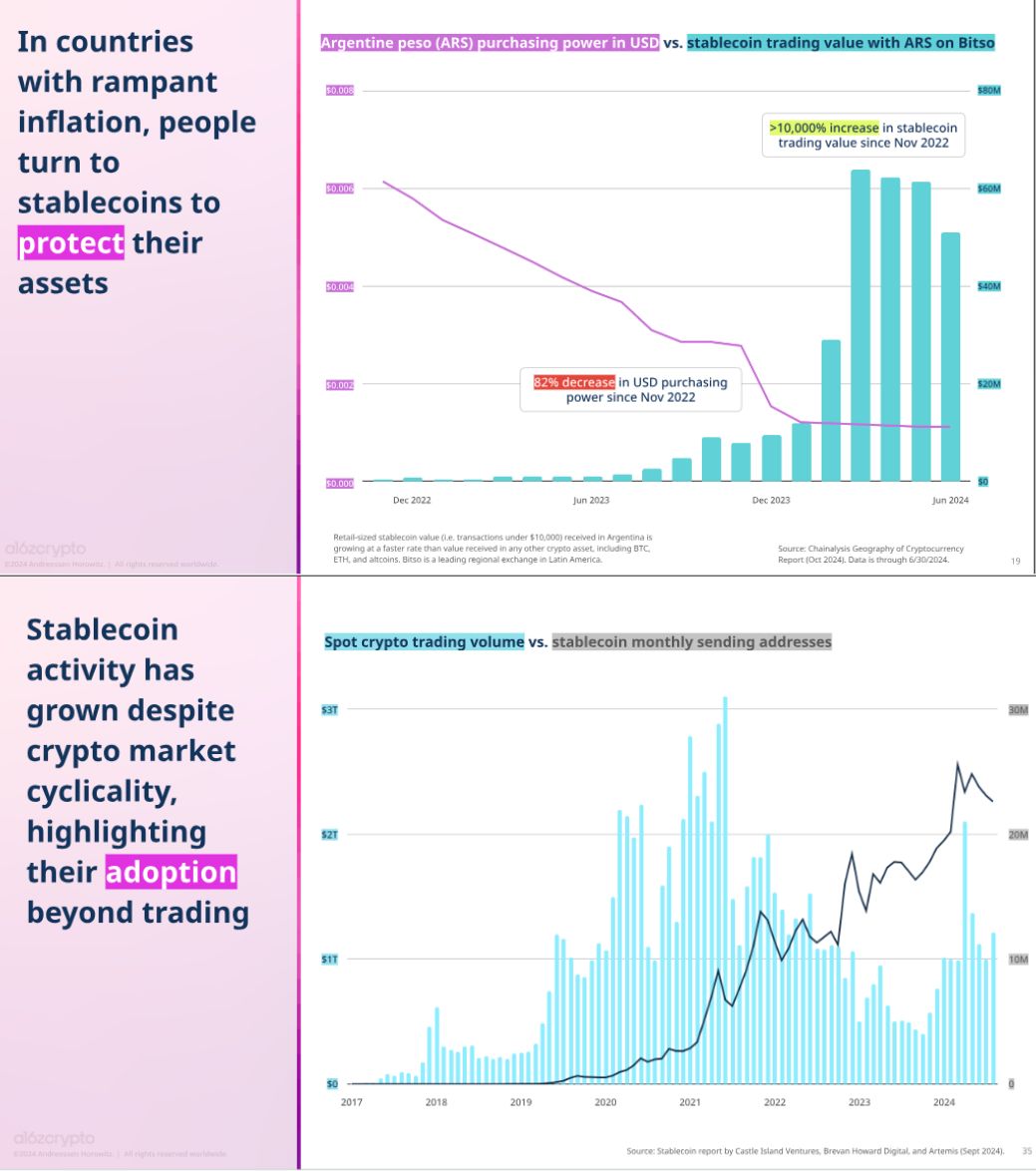
In countries with high inflation and currency devaluation, like Argentina, stablecoins serve as a substitute for local currencies and are used for indirect investments in government bonds amid rising interest rates.
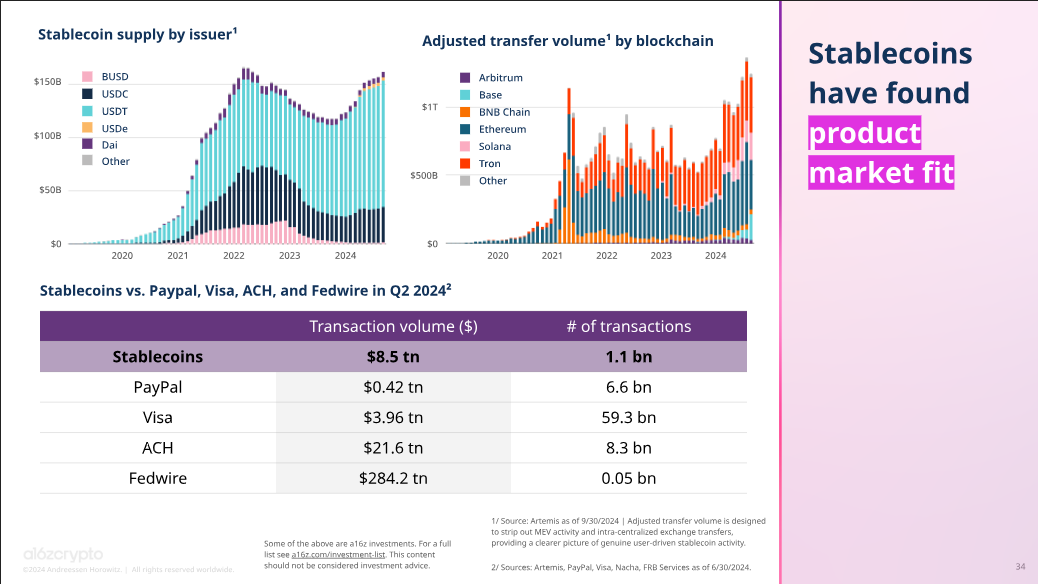
In Q2 2024, stablecoin transaction volume reached $8.5 trillion (double that of Visa), with only 1.1 billion transactions. This indicates stablecoins’ dominance in the realm of large-scale payments, while everyday small transactions are still primarily handled through Visa. The total stablecoin supply has been rising since early 2024, reaching new peaks, with various stablecoin types catering to different needs. Ethereum, Tron, Base, and Solana are the blockchains with the highest stablecoin supplies. Payment giants like PayPal and Visa have also quickly entered the race to develop or integrate stablecoin payments.
Infrastructure Has Made Significant Progress:
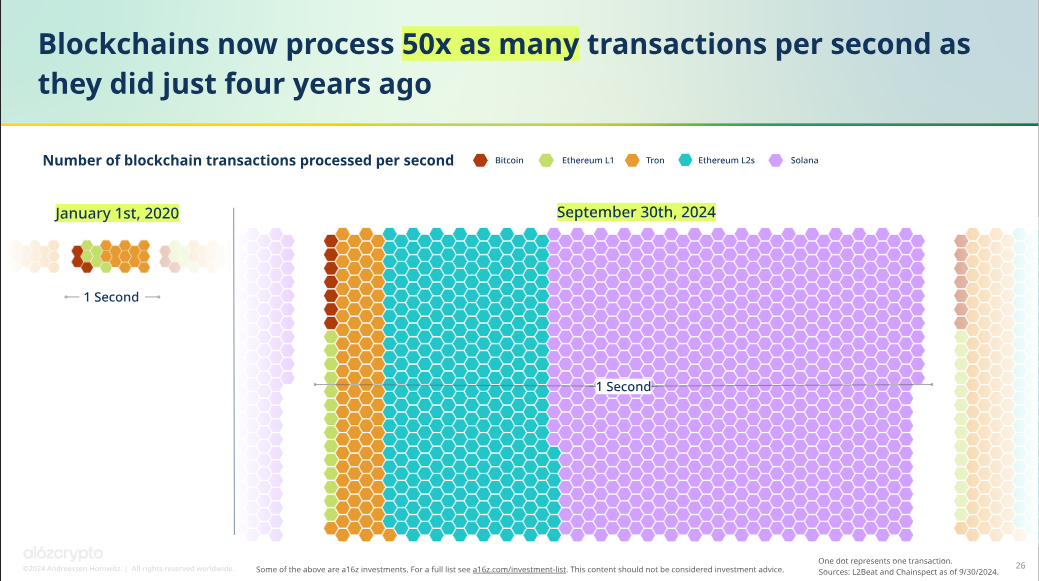
The increased adoption of stablecoins is supported by the rapid development of blockchain infrastructure. Current blockchains can handle over 50 times more transactions than they could four years ago, thanks to the expansion of Ethereum Layer 2 solutions and high-throughput Layer 1 blockchains.
Additionally, a16z report is optimistic about the development of Zero-Knowledge (ZK) technology, which opens up new possibilities for verifiable computation on the blockchain at lower costs for developers. However, ZK virtual machines (zkVMs) still have a way to go before they can match the performance of traditional computing systems.

Blockchain infrastructure remains one of the hottest areas of interest for developers, forming the foundation for applications that require fast transaction processing, such as new on-chain games and social media platforms.
DeFi Is Still Growing:
DeFi remains a key focus, attracting more developers than blockchain infrastructure. Approximately 34% of daily active addresses are engaged in DeFi activities, with trading on decentralized exchanges (DEXs) now accounting for over 10% of total crypto trading volume.
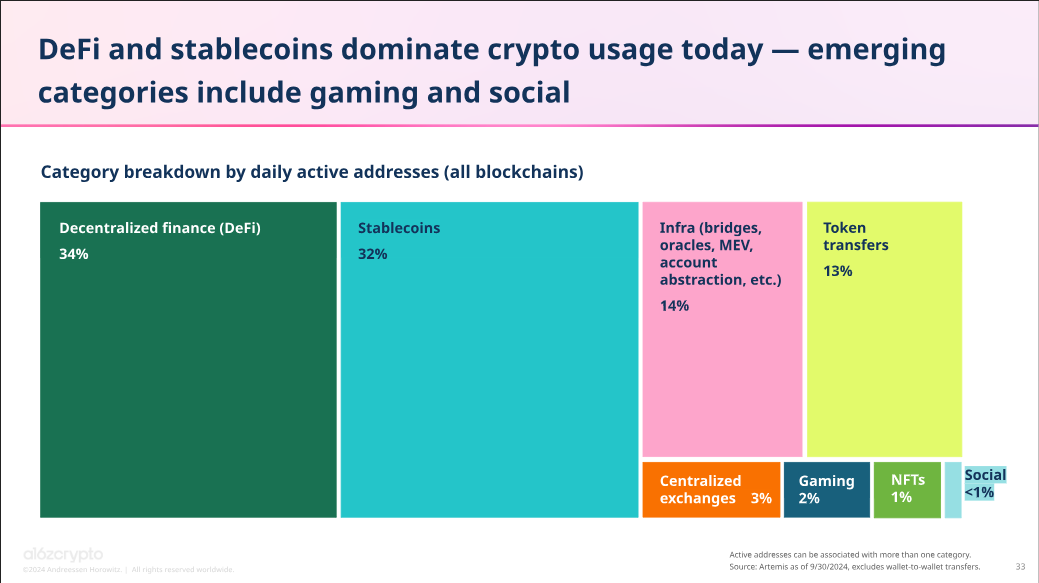
Over $169 billion is currently locked in thousands of DeFi protocols, with a significant portion concentrated in staking, lending, and real-world assets (RWA). Institutional investment flows have increasingly moved towards DeFi.
Lido, a leading staking project with the highest total value locked (TVL), has around 6,000 monthly users. Recent growth in DeFi is more closely related to the value deposited in platforms and large capital flows.
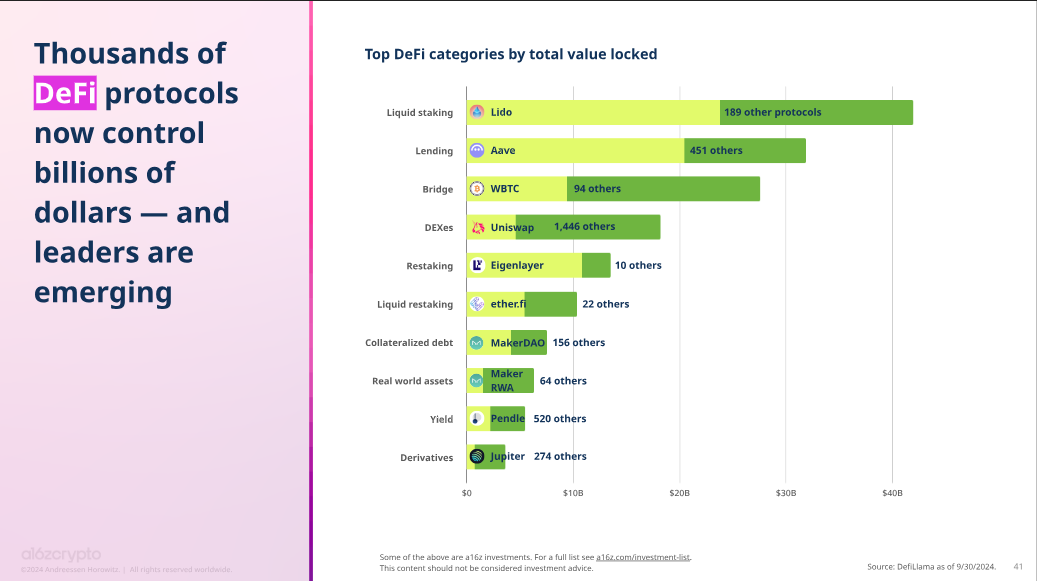
Despite being in its early stages, a16z views DeFi positively, seeing it as a promising alternative to the trend of centralization in the U.S. financial system, where the number of banks has decreased by two-thirds since 1990.
The Exciting Intersection of AI and Crypto:
The combination of AI and crypto holds great potential, offering a decentralized economy that could drive new community developments in AI. Notably, there is a significant overlap between users visiting chatGPT and leading crypto websites, indicating a strong connection between these two fields. Currently, crypto developers are increasingly integrating AI, with 34% of crypto projects incorporating AI into their products, regardless of their specific focus areas.
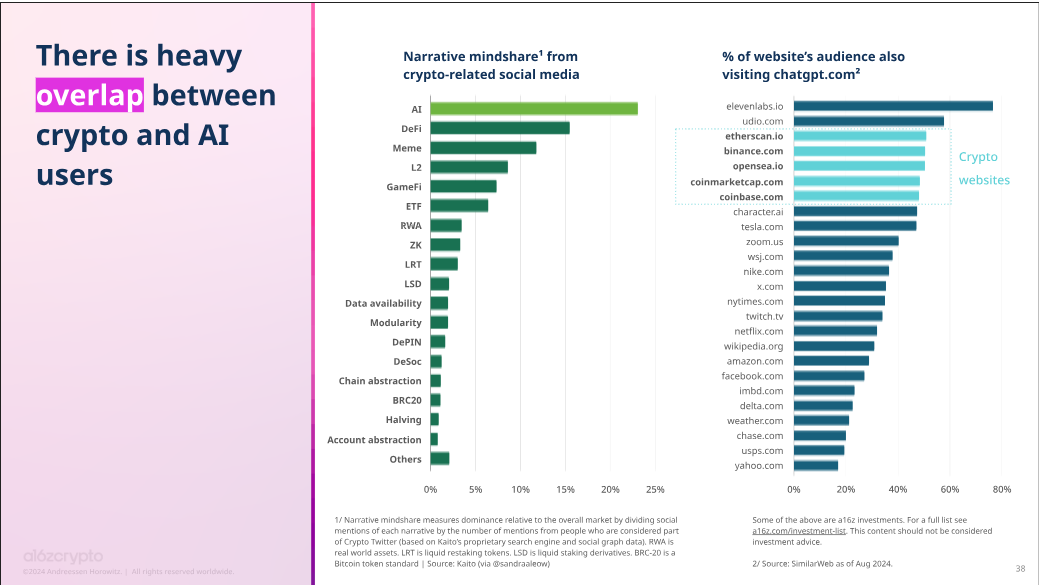
The most prominent applications of AI in the crypto space are in blockchain infrastructure, DeFi, and decentralized physical infrastructure networks (DePIN). Crypto and AI share many similarities: both are emerging technologies with significant speculative interest, cutting-edge advancements, and a sense of untapped potential. Given their shared user base, this combination presents a promising path for growth.
Furthermore, blockchain’s decentralized nature offers solutions to some of the challenges related to the centralization of AI. Current crypto projects aiming to address these challenges include:
- Gensyn: Democratizes access to AI computing resources.
- Story: Tracks intellectual property (IP) to help compensate creators.
- Near: Runs AI on user-owned open-source protocols.
- Starling Labs: Assists in verifying the authenticity and provenance of digital media.
- Grass: Facilitates data mining and sharing from across the internet.
These developments indicate that the integration of AI and blockchain can address many current challenges, offering new opportunities for innovation and community-driven growth.