Agentic AI is changing how people think about artificial intelligence. For a long time, AI was primarily used for data analysis, answering questions, or creating content. It was helpful, but it never took the initiative. Agentic AI differs because it can act independently. It can intelligently comprehend an objective, determine the actions to take, and continue working until the task is accomplished.
This shift matters because modern work is rarely simple or predictable. Business involves constant change, fragmented systems, and overwhelming information. Agentic AI serves as a capable assistant, not only responding but also completing tasks autonomously.
Let’s find out what Agentic AI is, how it works and why it’s important in 2026. As businesses seek ways to move faster without adding more people, Agentic AI is becoming a key part of their long-term strategy. That’s why Varmeta also provide you with case studies which businesses apply agentic AI in their operation.
What Agentic AI Really Means
Agentic AI refers to AI systems that work as independent agents. These systems do not handle tasks one at a time; they handle processes as a whole. They look at what is going on, decide what requires attention, and act without being instructed step by step.
In simple words, Agentic AI behaves more like a human worker than a traditional machine. It does not require precise instructions for each movement. It also calculates how to achieve a goal after it is aware of the objective.

Example:
An AI agent is the system a logistics company uses to handle deliveries. When a storm disrupts routes, the agent notices the problem, reroutes deliveries, reconfigures delivery schedules, notifies the customer, and automatically adjusts inventory orders. No human being needs to interfere unless something out of the ordinary occurs.
Conventional automation is effective when everything is guided by clear rules. When something unexpected occurs, those systems fail, or they require human assistance. Agentic AI was created to solve this problem.
- It integrates several skills into a single system.
- Realizing intentions rather than set principles.
- Sequencing activities in several steps.
- Application of various tools and systems where applicable.
- Realigning behavior on the basis of outcomes.
Because of this, Agentic AI can handle real-world situations where things change frequently.
Agentic AI represents the most powerful wave yet, as it shifts AI from being a responder or creator to a truly autonomous goal-seeking collaborator that can plan, act, adapt, and execute multi-step objectives in the real world.
| Wave | Main name | Core strength & difference |
| Wave 1 | Predictive / Traditional AI | Excellent at pattern recognition, prediction, and classification from labeled data |
| Wave 2 | Generative AI | Breakthrough in creative generation, produces high-quality text, code, images, audio on demand |
| Wave 3 | Agentic AI | Game-changer: self-directed goal achievement, autonomously plans, reasons, takes actions, uses tools, iterates, and pursues complex objectives over long horizons |
What Are the Benefits of Agentic AI?
AI agentic offers real, measurable gains over traditional tools and even generative AI. It does not merely assist with ideas or analysis, it owns tasks, is flexible in real time, and delivers results more quickly and reliably. These are the main benefits supported by how the business is used today.
Increased Effectiveness and Productivity
With agentic AI, complex multi-step processes are managed independently, eliminating wait times and handoffs. It is 24/7 and never tires, it works in parallel and frees human beings to do creative or strategic work.
BCG states that efficient agentic AI agents can speed up business processes by 30 to 50%, and McKinsey confirms that they eliminate waiting periods between stages and enable simultaneous completion.
In practice, an energy company such as Eneco (Europe) deployed an agentic AI support agent that handles more than 24,000 customer conversations per month and generates 70% of end-to-end responses without human assistance. This reduces response times and increasing team capacity. Likewise, IT support companies see ticket resolution times drop from hours to seconds and realize productivity gains of millions.
Cost Reduction and Scalability
The agentic AI minimizes operational expenses and eliminates the need for an additional employee by automating repetitive and complex processes. It also scales easily to handle surges in demand, such as during peak seasons or in emergencies.
Organizations are reporting up to 30% reductions in operational costs within months of implementation. Others are reporting staffing cost savings in the hundreds of millions (e.g., INR 362.84 million in service operations with 27% less handle time).
Amazon uses agent-like systems in its supply chains to optimize routes and inventory in real time, minimizing delays and costs during disruptions. For smaller firms, this translates to expansion without a proportional increase in staff; in one retail business, 70% of customer inquiries were handled without staff intervention as the service grew.
Anticipatory and Reactive Decision-Making
Unlike rule-based or passive generative AI, agentic AI can envision problems, adapt its plan in response to real-time feedback, and take action without instructions. This renders it suitable for dynamic settings.
Finance agentic agents screen transactions, cross-reference trends, and freeze accounts in real time, which is more effective and less risky for detecting fraud. In healthcare, agents constantly monitor patient data, identify anomalies, and proactively adjust treatments or raise alarms; in pilot programs, they may reduce response times by 30%. PwC estimates that by 2030, agentic AI may contribute 26.4 trillion dollars to the world’s GDP per year through smart, adaptive execution.
Better Customer Experience and Customization
The agentic AI offers faster, more accurate, and more personalized interactions by processing queries end-to-end and learning from each one. In customer service, agentic AI helps unhappy customers before they even complain. For example, if someone leaves items in their cart without checking out, the AI automatically follows up with a personalized discount or fixes potential issues right away. This makes customers much happier and more satisfied.
The surveys of Cisco indicate that 93% of leaders believe that more personalized services will be in place by 2028, and agentic AI will drive 15 – 30% productivity improvements in service teams.
A practical case study is, retailers with an agentic system of returns and orders experience faster processing and happier consumers. Some of them report a 20 – 25% increase in revenue through targeted, timely action.
Life-long learning and Human augmentation.
In agentic AI, the system improves through reflection loops: it learns from its results what to improve, so it does not need continual retraining. It enhances human beings rather than eliminating them, allowing them to focus on high-value decisions by undertaking mundane tasks.
In software engineering, code is debugged, features are tested, and updates are automatically deployed, accelerating releases and allowing developers to focus on innovation. In any industry, it results in increased accuracy, consistency, and innovation, making AI a full-fledged partner.
How Agentic AI Works in Everyday Terms
Let’s dive into Agentic AI workflows. The 4 steps that are involved include:
- Step 1: Users issue commands, such as “He wants AI to make a meeting.”
- Step 2: Agentic AI perceives the query and plans to act by using relevant tools.
- Step 3: Action is taken, e.g, a meeting is scheduled.
- Step 4: If the results are inaccurate, the plan is altered. Exact outcomes resolve the query. e.g, the meeting is organized and displayed to the user.

Every Agentic AI system relies on a framework that maintains organization. This framework enables the AI to consider context, track progress, and connect to a range of tools, including databases, software platforms, and APIs.
There are also frameworks that enable several AI agents to collaborate. A research agent may deal with the research, its execution, and another agent’s monitoring results. They work as one team, not as individual tools.
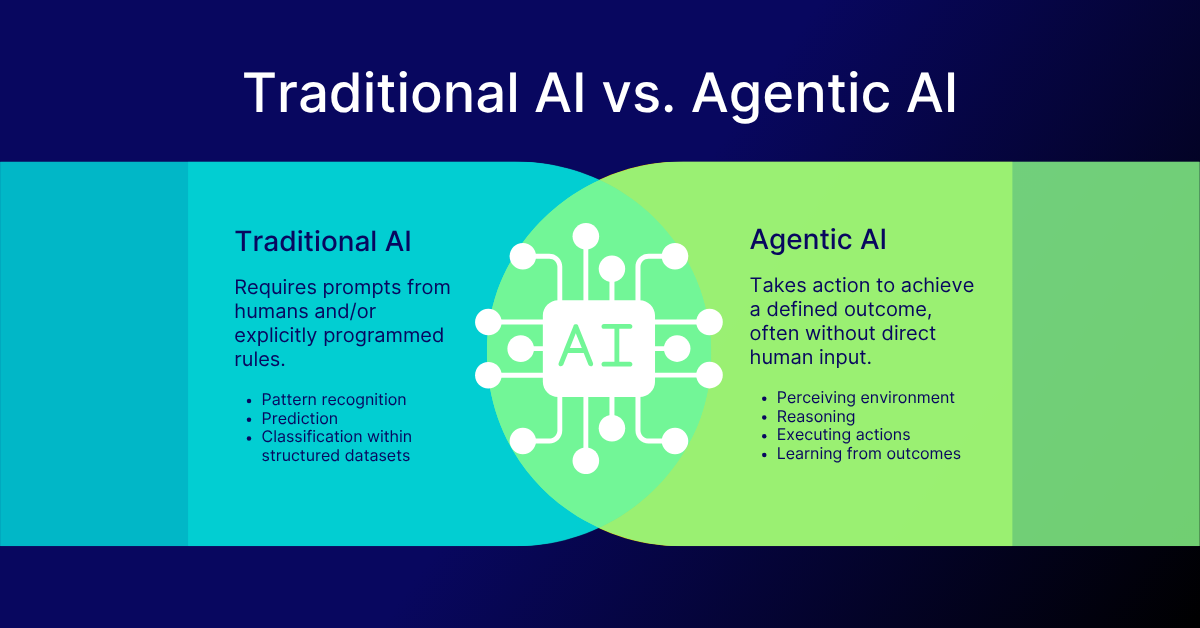
Agentic AI vs Traditional Automation
Standard automation adheres to procedures. When the rules indicate that step A must be completed before step B, the system cannot modify that. Agentic AI does not work this way.
Agentic AI decides the order of actions based on the situation. A task can change direction if it becomes less important or if a better option is found. This makes it much more applicable in complex settings, such as businesses, where priorities tend to change.
Agentic AI vs Generative AI
Generative AI is excellent at producing items such as text, images, or code. Nevertheless, it can only respond when a request is made. It is not the determiner of what should be done.
On the other hand, agentic AI focuses on decisions and actions. It determines what is important, when to do it, and how to do it. In many systems, generative AI is simply one tool that an Agentic AI agent uses to achieve its goal.
Why Some Agentic AI Projects Fail
Agentic AI projects fail when expectations are unrealistic. Leaving AI unregulated in the absence of specific objectives or boundaries tends to lead to problems. Failure is also caused by poor data quality and the absence of control.
Effective projects are small-scale, define boundaries, and become more autonomous over time as trust builds.
FAQs about Agentic AI
What is Agentic AI?
Agentic AI describes a type of artificial intelligence that can take responsibility for completing a task, not just assisting with it. It does not require continuous input; rather, it knows what it needs to accomplish and calculates the means to do so. In everyday terms, Agentic AI is AI that can make choices and follow through on them.
How does Agentic AI work?
Agentic AI operates in an ongoing feedback loop. It examines the situation, makes a rational decision, undertakes it, and reviews the outcome afterward before proceeding. It has no fixed step-by-step instructions. Its actions evolve in real time, which is why it differs from traditional systems.
How is Agentic AI different from traditional automation and generative AI?
The conventional type of automation is built on predetermined instructions and fails when conditions change. Agentic AI adjusts its actions based on context and goals. Generative AI, conversely, focuses on creating content (text or images). Agentic AI focuses on deciding what needs to be done and making it happen, sometimes using generative AI as just one of its tools.
What is Agentic AI designed to do, and where is it used?
Agentic AI is designed to handle tasks that involve multiple steps, changing inputs, and ongoing decision-making. It is widely used across business processes, data processing, customer support, healthcare, finance, and marketing. Its value lies primarily in minimizing manual work and ensuring processes run smoothly.
Why is Agentic AI important for businesses?
Agentic AI matters because it closes the gap between insight and execution. Businesses already possess the data and reports; it takes time and coordination to put the insights into action. Agentic AI helps automate that execution layer, allowing teams to focus more on planning and less on routine follow-ups.
When did Agentic AI start, and how long has it been around?
The thinking behind Agentic AI has been around for decades, but it has only become practical recently. At the beginning of the 2020s, there was a progressive advancement in AI models and system design that allowed AI to make and take decisions with consistent reliability. That is when Agentic AI began moving from theory into real business use.