In 2020, a milestone passed with barely a headline: for the first time in recorded human history, the number of people aged 60 and over surpassed the number of children under five. Not a dramatic event but a clear signal that the aging population problems quietly reshaping our world had crossed a threshold no one can reverse.
According to data from the World Health Organization (WHO), by 2030 just four years from now one in every six people on earth will be over 60. By 2050, the global population of older adults will reach 2.1 billion, double today’s figure. The UN Department of Economic and Social Affairs (UN DESA) projects that by 2050, one in six people will be over 65 up from one in eleven in 2019.
These numbers are not abstract statistics. They are a blueprint for a world where healthcare systems, labor markets, and public budgets are being pulled in opposite directions simultaneously while the resources to respond are not growing fast enough to keep pace with aging population problems that compound year on year.
This article breaks down the five core challenges driving this crisis, then asks the harder question: what is AI actually doing to help fill the gap and is it enough?
What are aging population problems?
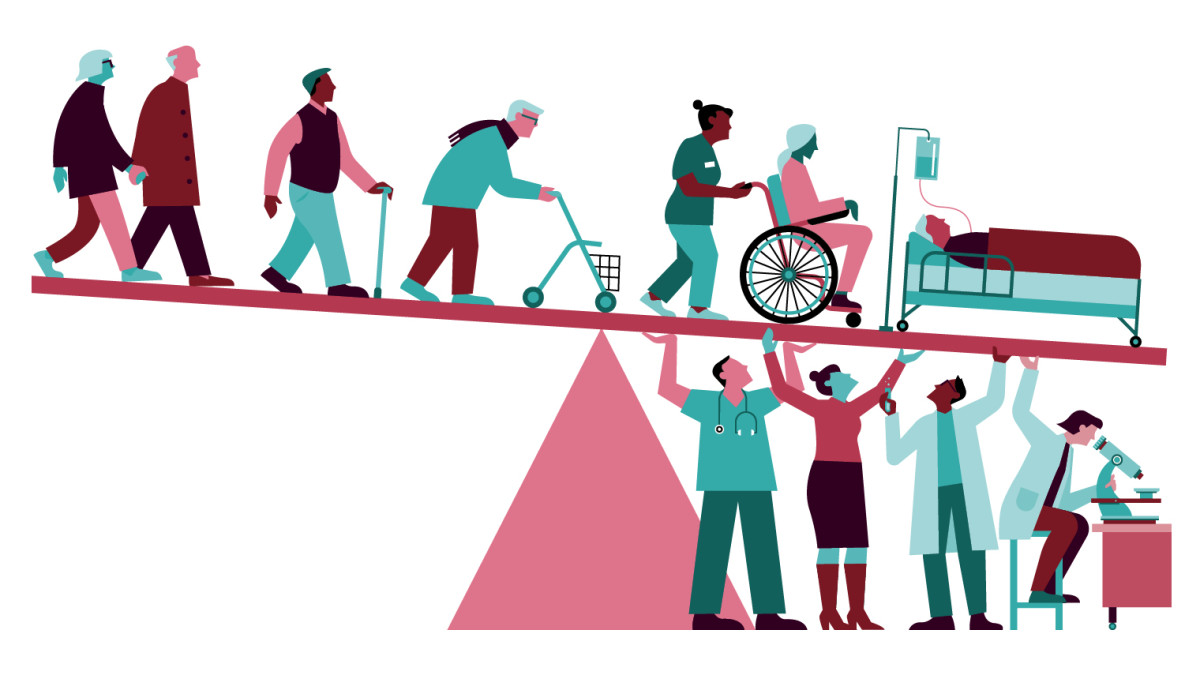
Aging population problems refer to the systemic social, economic, and healthcare challenges that arise when the proportion of elderly people in a society grows faster than the working-age population can sustain. This shift driven by falling birth rates and rising life expectancy puts mounting pressure on pension systems, healthcare infrastructure, labor markets, and social care networks all at once.
The term is often used interchangeably with aged population problems or demographic aging challenges, but the core meaning stays the same: a society is growing older faster than its institutions can adapt.
What makes the current wave of aging population problems different from anything before is the speed and scale. Previous demographic transitions took generations. Today, countries like Vietnam, South Korea, and China are completing in 20 years what took France and Sweden more than a century.
The 5 core aging population problems
1. Healthcare systems under mounting pressure
Older adults don’t just need more healthcare, they need it at an exponentially higher rate. Research from NBER found that per-capita healthcare spending for Americans aged 75 and above is 8 to 12 times higher than for the 50-64 age group. Even in countries with more contained figures (where the ratio is closer to 2-5x), the directional trend is consistent: aging populations are expensive to care for, and that share of the population is growing fast.
The fiscal consequence is already visible. Public health spending across OECD nations is projected to grow at an average annual rate of 2.6% from 2019 to 2040, reaching 8.6% of GDP, a 1.8 percentage point increase from 2018. That is not an abstract policy figure; it means less budget available for education, infrastructure, and the other social priorities competing for the same public funds.
Healthcare overload is one of the most immediate aging population problems because it is happening right now, not in some projected future. ICUs in Japan already turn away patients. Waiting times for elder care assessments in the UK run into months. Germany is importing nurses from the Philippines and Romania at scale. The system is not waiting for 2050.
2. A shrinking labor force
As the population ages, the old-age dependency ratio the number of retirees relative to working-age people rises. Fewer taxpayers are left to fund a welfare system that is simultaneously expanding to meet greater demand.
The World Economic Forum reports that by 2050, roughly 40% of the populations of South Korea and Japan will be 65 or older. That is a ratio where each active worker is effectively supporting an ever-growing number of pensioners and no combination of immigration policy or productivity gains can fully bridge that gap in the short term.
This is one of the aging population problems with the longest economic tail. A smaller working population means lower tax revenue, reduced consumer spending power, and declining domestic investment all compounding over time in ways that are difficult to reverse once the demographic window closes.
3. Pension systems and fiscal pressure
Pay-as-you-go public pension systems where current workers fund current retirees are structurally vulnerable to the aging population problems described above. When contribution bases shrink and benefit durations lengthen, the math simply stops working.
According to OECD Ecoscope, absent corrective policy action, fiscal pressure in the average OECD country will increase by nearly 6.25 percentage points of GDP between 2024 and 2060, with aging accounting for more than 40% of that pressure. This is piling onto governments already managing elevated post-pandemic debt levels.
Japan, South Korea, and several Southern European economies are already in the most acute phase of this pressure. But aging population problems are not confined to wealthy nations, emerging economies that built social protection systems assuming young demographics are now watching those assumptions erode faster than expected.
4. Social isolation and mental health
This is the least-discussed of the aging population problems and arguably one of the most humanly significant.
As more older adults live alone, chronic loneliness, depression, and cognitive decline rise in tandem. In Japan, researchers have documented that elderly men living alone after retirement often have almost no regular conversation partners, a condition increasingly linked to accelerated dementia onset. The number of people over 65 with dementia in Japan was estimated at around 6 million in 2020, with projections pointing to 7 million by 2025, approximately one in five elderly people.
Social isolation is not a soft or secondary issue. Its health consequences, elevated stress hormones, weakened immune response, faster cognitive decline are as measurable as any chronic disease. And the aging population problems it creates for social care systems are just as real as those created by physical illness.
5. Caregiver shortage
Perhaps the most operationally urgent of all aging population problems is the growing gap between the number of people who need hands-on care and the number of people available to provide it.
According to The AI Insider, a Global Coalition on Aging report projected a shortage of 13.5 million care workers across OECD countries by 2040. In Japan alone, the Ministry of Health, Labour and Welfare (MHLW) estimated a shortfall of 370,000 caregivers by 2025, rising to potentially 570,000 by 2040.
The issue is not just numbers. Caregiving demands patience, physical endurance, and genuine emotional labor, yet it is chronically underpaid and socially undervalued. The result is a sector that struggles to recruit, retain, and sustain the workforce it needs, even when the need is clearly visible and growing.
Aging population problems at a glance
| Problem | Severity | Hardest-hit regions | Where AI can assist |
| Healthcare system overload | Critical | Japan, Germany, Italy | AI diagnostics, automated triage, early disease detection |
| Shrinking labor force | High | South Korea, China, EU | Workflow automation, AI-assisted upskilling for older workers |
| Pension & fiscal stress | High | Global, esp. aging economies | Predictive fiscal modeling, budget optimization |
| Social isolation & mental health | Moderate-High | Urban areas globally | Companion AI, mental health monitoring apps |
| Caregiver shortage | Critical | US, UK, Japan, Vietnam (emerging) | Care robots, remote monitoring, IoT health systems |
Sources: WHO, OECD, Global Coalition on Aging, World Bank
How AI is stepping in

Before getting into specifics, one framing point matters: AI is not a magic fix, and no serious researcher claims otherwise. What AI can realistically do is address specific bottlenecks where human capacity, limited by scale, speed, or cost cannot reach on its own. The aging population problems outlined above are structurally too large for any single solution; AI is one lever among several that need to be pulled in parallel.
AI in elder healthcare
One of the highest-impact applications for the healthcare dimension of aging population problems is early detection of dementia and Alzheimer’s disease, a condition with no cure, but where earlier intervention can meaningfully slow progression and dramatically reduce long-term care costs.
In 2024, researchers at the University of Cambridge developed an AI model that correctly predicted 4 out of 5 cases of whether patients with mild cognitive symptoms would progress to Alzheimer’s and at what speed. The model relied only on cognitive test results and MRI scans, requiring no invasive or expensive procedures like lumbar puncture or PET imaging. This matters enormously for systems facing cost pressure from aging population problems: early, accessible detection is simply cheaper than late-stage treatment.
That same year, UCSF researchers published in Nature Aging that their machine learning model could predict Alzheimer’s up to seven years before symptoms appear, with 72% predictive accuracy, by analyzing clinical records from more than 5 million patients. These are not lab curiosities, they represent a philosophical shift in medicine: from treating illness after the fact to identifying risk while there is still time to act.
AI and the labor force
When the working population contracts, many governments and businesses turn to automation not out of preference but necessity. The conversation around this aspect of aging population problems is often framed as robots taking jobs but in aging societies, the more accurate framing is that automation fills roles where there are simply no longer enough young workers to go around.
In Japan, where demographic pressure is most acute, industrial robot adoption has accelerated in direct proportion to labor force aging. For older workers still in the labor force, AI tools that reduce cognitive load, simplify workflows, and provide decision support allow people to remain productive longer. Every additional productive year from a worker in their 60s is a year the pension system does not have to fund, a small but meaningful buffer against the fiscal dimension of aging population problems.
Companion AI and mental health
This is the most contested application when it comes to the social dimension of aging population problems and the one where the limits of AI show most clearly.
In a New York State pilot involving 800 elderly participants, the AI companion robot ElliQ (by Intuition Robotics) reported that 95% of users felt a reduction in loneliness. ElliQ proactively initiates conversations, sends medication reminders, and uses generative AI to produce more natural interactions, it does not wait to be addressed.
These results are real, but they require careful interpretation. AI can reduce the feeling of loneliness in the short term. It cannot replicate the warmth of genuine human connection, the kind that comes from someone who actually knows and cares for you as a person. Ethicists and researchers continue to raise a legitimate question: are we using technology to paper over failures of social policy rather than fixing them? The honest answer is that companion AI can serve as a useful bridge, particularly in acute isolation situations but it should not become the default response to what is fundamentally a human and systemic problem rooted in aging population problems that require structural solutions.
Remote care and home monitoring
One of the least controversial AI applications for aging population problems is the combination of IoT sensors and AI analytics to support independent living. Fall-detection sensors, irregular heartbeat alerts, smart medication dispensers, and AI-driven remote monitoring tools are helping older adults remain in familiar home environments longer, deferring or avoiding institutionalized care.
The financial case is straightforward. Long-term care facilities are among the fastest-growing cost items in OECD health budgets. The OECD’s 2024 report on long-term care affordability projects that demand for long-term care assistance will increase by more than one-third across OECD countries by 2050. Technology that delays institutionalization by even a few years per person represents meaningful fiscal relief at population scale and directly eases one of the most pressing aging population problems facing governments today.
Case study: Japan, learning from the world’s oldest society

Japan is the most instructive real-world laboratory for understanding what aging population problems look like in practice and where AI-driven solutions succeed or fall short.
In 2024, Japan’s population aged 65 and older reached a record 36.25 million, representing approximately 28.9% of the total population. The care workforce crisis runs parallel: Japan’s MHLW estimated a shortfall of 370,000 caregivers by 2025, potentially rising to 570,000 by 2040.
Japan’s response has been substantial investment in robotics and AI. Devices like PARO (a therapeutic robotic seal), Pepper (a humanoid social robot), and various mobility-assist tools have been deployed across hundreds of care facilities. A 2026 randomized controlled trial published in Alzheimer’s & Dementia found that thrice-weekly PARO sessions produced a statistically significant reduction in caregiver burden: a genuine, measurable outcome in managing aging population problems at facility level.
But Japan’s story also contains a crucial cautionary chapter. A 2023 MIT Technology Review investigation found that despite decades of investment, actual robot adoption rates in care facilities remain low. Robots frequently created additional work for staff, requiring transport between rooms, maintenance, and constant explanation to residents. More significantly: activities like physically lifting a resident, which previously created a moment of human connection, were replaced by robot-mediated processes that shortened that interaction to near zero.
This is the core lesson Japan is still processing and that other countries facing aging population problems should study before repeating: technology cannot replace care. It can only support it. AI and robotics products designed for elder care must place human connection at the center of their design logic, not operational throughput.
Vietnam: A race against time
Most discussions of aging population problems concentrate on Japan, South Korea, and Western Europe. But Vietnam presents a uniquely urgent case that deserves serious attention.
According to a World Bank and JICA joint report, Vietnam officially became an “aging society” in 2015 and is projected to become an “aged society” by approximately 2035 completing in roughly 20 years a demographic transition that took many Western countries 50 to 100 years. This makes it one of the fastest-aging countries in the world by this measure.
The core concern, as the World Bank frames it directly: Vietnam risks getting old before getting rich. With per-capita income at roughly 40% of the global average, the economy has not yet generated the fiscal capacity to build comprehensive elderly welfare infrastructure before the demographic pressure fully arrives. A UN Vietnam policy document projects that the potential support ratio of working-age people per person aged 65 and over will fall from 9.5 today to just 5.2 by 2035.
The preparation window is narrowing. But Vietnam has one advantage Japan did not when it started: the ability to observe what has worked and failed elsewhere, and to make deliberate technology and policy choices ahead of the crisis rather than reacting to it. For businesses and policymakers, the aging population problems arriving in 2035 are most cheaply and effectively addressed in 2025.
Conclusion
Aging population problems cannot be solved by any single technology or policy. Addressing them meaningfully requires parallel movement on three tracks: long-term structural policy (pension reform, selective immigration, labor participation incentives), social investment (care infrastructure, fair wages for caregivers, community-based support), and smart technology deployment (AI, IoT, and robotics that support rather than replace human care).
Of those three, AI is moving fastest not because it is the easiest answer, but because global capital and research attention are concentrated there. Japan’s experience is a reminder, though, that even the best technology fails when deployed incorrectly. Optimizing for operational efficiency while quietly eroding human connection is not a solution to aging population problems, it is a rebranded version of the same neglect.
The real question facing policymakers, technologists, and businesses working on aging population problems is not simply “what can AI do?” It is: “what do we want AI to do and are we prepared to invest in the rest of the solution alongside it?”
FAQs
1. What are the problems of aging populations?
An increased population of older people means that: there is an increased demand for health and social care. It becomes increasingly difficult for governments to provide satisfactory pensions, which are ultimately funded by taxes paid by the working population.
2. What are the common aging problems?
Older age is also characterized by the emergence of several complex health states commonly called geriatric syndromes. They are often the consequence of multiple underlying factors and include frailty, urinary incontinence, falls, delirium and pressure ulcers.
3. What are the biggest challenges of aging?
The 8 Challenges of Aging
– Engagement and Purpose. Ageism and outdated social norms have resulted in isolated and marginalized older adults in both rural and urban communities.
– Financial Wellness.
– Mobility and Movement
– Daily Living and Lifestyle
– Caregiving
– Care Coordination
– Brain Health
– End of Life.