AI agents are reshaping IT operations, bringing automation, predictive intelligence, and efficiency to resource management. These smart systems anticipate demand, streamline workflows, and optimize resource allocation, helping IT teams overcome challenges like cybersecurity threats, compliance requirements, and system complexity. By reducing manual tasks, AI allows IT professionals to focus on innovation and strategic growth.
Industries integrating AI agents have seen a 38% rise in profitability, especially in fraud detection, risk assessment, and cybersecurity. AI-driven solutions provide real-time monitoring, rapid threat response, and automated compliance tracking, ensuring secure and agile IT environments. Additionally, AI’s ability to analyze vast datasets enables smarter decision-making and improved IT governance.
More than just automation tools, AI agents are key drivers of IT transformation. This article explores their impact, key use cases, and future trends, redefining IT excellence in the digital era.
Understanding AI agents in IT optimization
What are AI agents and how do they work in IT infrastructure?
AI agents are intelligent software systems designed to automate, optimize, and enhance IT operations. Unlike traditional automation tools that follow predefined scripts, AI agents leverage machine learning, predictive analytics, and real-time data processing to make autonomous decisions, adapt to changing conditions, and continuously improve IT efficiency.
These agents function as digital assistants for IT teams, capable of monitoring systems, managing workloads, detecting anomalies, and resolving issues proactively. By integrating with IT infrastructure, AI agents analyze vast amounts of data, identify patterns and inefficiencies, and take automated corrective actions to ensure seamless performance, security, and resource allocation.
In modern IT environments, AI agents are deployed across cloud platforms, enterprise networks, and data centers, handling critical tasks such as:
- Predictive resource allocation: Anticipating system demand and dynamically adjusting resource distribution.
- Intelligent system monitoring: Continuously analyzing performance metrics to detect and resolve potential failures.
- Automated security responses: Identifying cyber threats and mitigating risks in real time.
- Self-healing infrastructure: Diagnosing and fixing IT issues before they impact operations.
By reducing manual intervention, optimizing efficiency, and enhancing system resilience, AI agents are revolutionizing IT management, making infrastructure more agile, secure, and cost-effective.
Core components of AI agents in IT
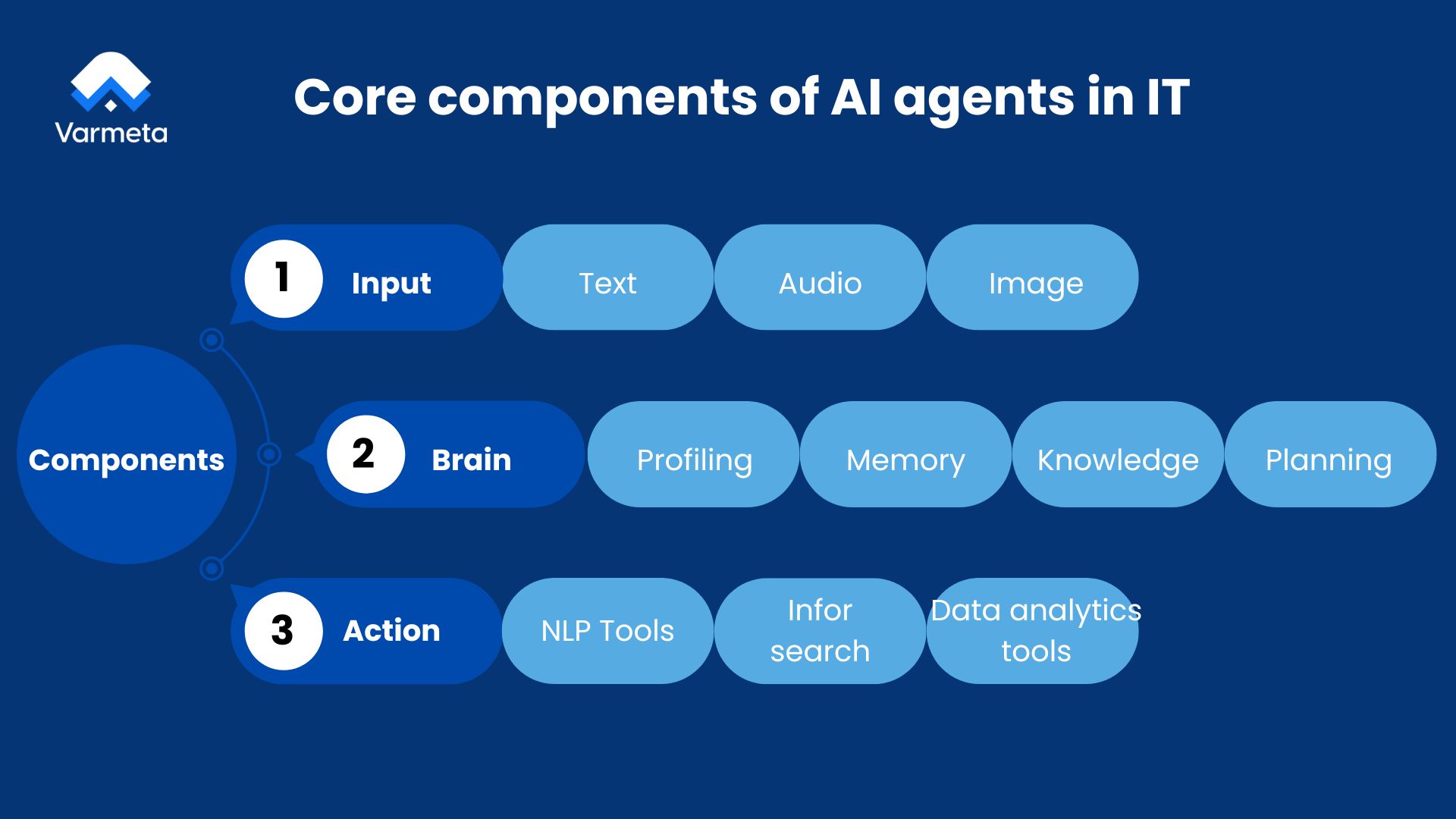
AI agents in IT operate through a structured system comprising data processing, cognitive intelligence, and strategic execution, all working together to enhance efficiency, precision, and automation in IT operations.
1. Input processing
AI agents gather and interpret diverse data inputs from IT systems, users, and environments, including text, audio, and visual data. These inputs guide the agent’s decisions, alerts, and automation processes in real time.
2. Cognitive intelligence (The AI brain)
The AI brain powers reasoning, decision-making, and adaptability through interconnected modules:
- Profiling: Defines the agent’s function, such as network security, system monitoring, or IT automation.
- Memory: Retains past interactions and system data to learn, adapt, and refine responses over time.
- Knowledge Base: Stores IT-specific information to support problem-solving and automated troubleshooting.
- Planning: Develops optimal strategies based on input data and predefined operational goals.
3. Action & execution
Once a decision is made, the AI agent executes tasks such as system monitoring, security threat mitigation, performance optimization, and incident response. It leverages intelligent automation tools to ensure IT environments run smoothly and efficiently.
This structured approach enables AI agents to proactively manage IT resources, enhance security, and drive operational excellence, making IT infrastructure more resilient and self-sustaining.
AI agents in IT: Key use cases
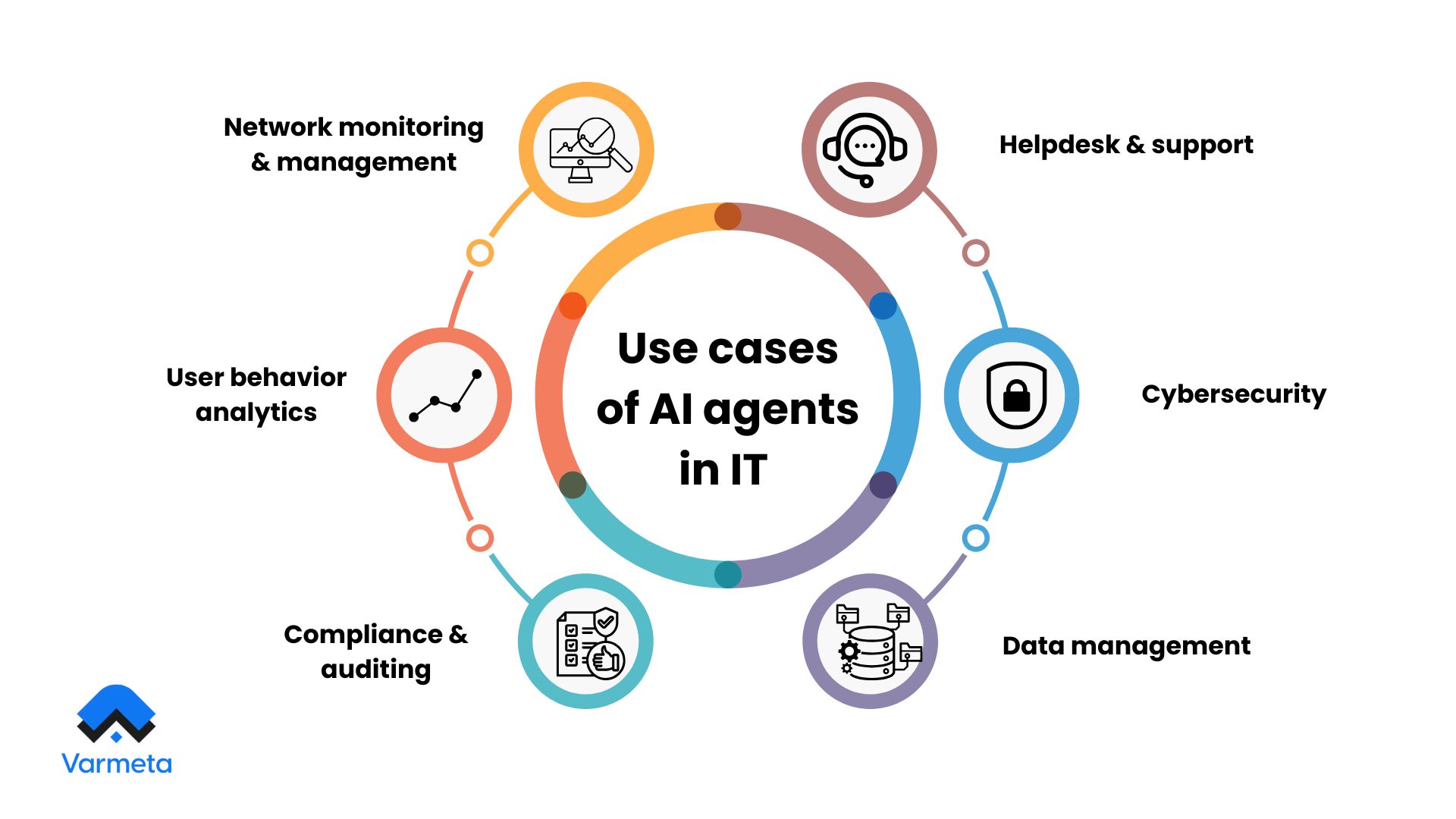
AI agents are revolutionizing IT by enhancing efficiency, security, and overall operational performance. Below are the most impactful use cases of AI in IT:
1. Network monitoring & management
- Anomaly detection: AI agents continuously monitor network traffic, identifying unusual patterns that may indicate security threats or performance issues.
- Automated troubleshooting: When issues arise, AI agents diagnose and resolve common network problems, minimizing downtime and ensuring smooth operations.
2. Cybersecurity
- Threat detection & response: AI-driven security systems analyze real-time data to identify and mitigate cyber threats before they escalate.
3. System performance optimization
- Resource allocation: While AI itself cannot directly allocate resources in real-time, it can integrate with resource management tools to optimize system performance.
- Predictive maintenance: AI analyzes system data to predict hardware failures, enabling proactive maintenance and reducing unexpected downtime.
4. IT helpdesk & support
- Automated ticket resolution: AI agents handle routine IT requests like password resets and software installations, freeing human support staff for more complex issues.
- User assistance: Virtual assistants and chatbots provide instant support, guiding users through troubleshooting steps and answering common queries.
5. Data management & analysis
- Log analysis: AI processes vast amounts of log data to detect trends, anomalies, and potential system vulnerabilities.
- Data integration: AI automates data unification from multiple sources, ensuring consistency and accuracy across IT systems.
6. DevOps & CI/CD automation
- Code review & quality assurance: AI assists in code analysis, identifying potential errors and suggesting improvements.
- Pipeline automation: AI streamlines continuous integration and deployment (CI/CD) workflows, accelerating software releases while ensuring reliability.
7. IT asset management
- Inventory tracking: AI monitors IT assets, maintaining accurate records and optimizing resource usage.
- Lifecycle management: AI manages the entire IT asset lifecycle, from procurement to decommissioning, reducing costs and enhancing efficiency.
8. Compliance & auditing
- Regulatory compliance: AI ensures IT systems adhere to compliance requirements, flagging potential violations and generating reports.
- Audit preparation: AI gathers and organizes audit documentation, simplifying compliance procedures.
9. Incident management
- Real-time detection & alerts: AI agents detect system incidents instantly, notifying relevant personnel for swift resolution.
- Post-incident analysis: AI evaluates incidents to identify root causes and prevent future occurrences.
10. User behavior analytics
- Security monitoring: AI analyzes user activity to detect insider threats or compromised accounts.
- Experience optimization: AI studies user interactions to suggest improvements for enhanced productivity and user experience.
11. IT project management
- Task automation: AI automates repetitive tasks like status tracking and reporting, streamlining project workflows.
- Risk assessment: AI identifies potential project risks by analyzing historical data and real-time metrics.
12. Data privacy & governance
- Data classification: AI categorizes data based on sensitivity and regulatory requirements, ensuring compliance.
- Privacy monitoring: AI tracks data access and usage to detect policy violations and potential breaches.
By integrating AI agents into these key areas, IT teams can enhance operational efficiency, strengthen security, and improve service quality. Leveraging AI-driven automation not only reduces manual workload but also drives innovation, ensuring long-term business success.
Key benefits of AI agents in IT
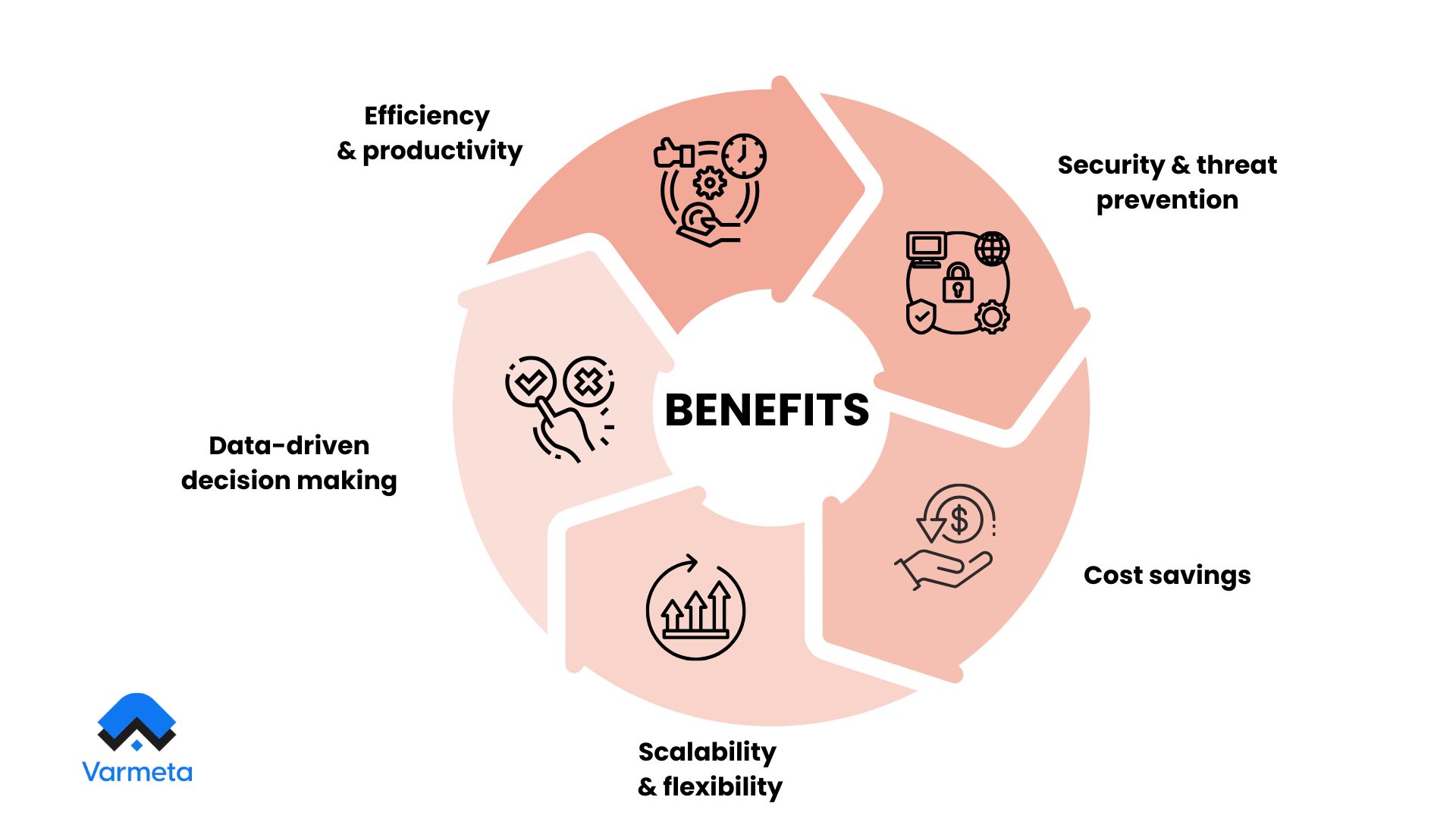
Integrating AI agents into IT operations offers a wide range of benefits, from enhanced efficiency to improved security and cost savings. Here are the most significant advantages:
1. Enhanced efficiency & productivity
- Automation: AI agents handle repetitive and time-consuming tasks, freeing IT staff to focus on higher-value activities. This leads to increased productivity and faster IT process execution.
- Speed: AI-powered automation accelerates routine tasks such as system monitoring, data backups, and software updates, significantly reducing manual workload.
2. Stronger security & threat prevention
- Real-time threat detection: AI agents continuously monitor IT environments, detecting and responding to potential cyber threats in real time.
- Advanced anomaly detection: AI identifies unusual patterns and behaviors that may indicate security breaches, allowing for rapid response and threat mitigation.
3. Cost savings
- Resource optimization: AI-driven insights help IT teams allocate resources efficiently, reducing unnecessary costs. AI detects usage trends and anomalies, optimizing system performance.
- Predictive maintenance: AI forecasts hardware and software failures, enabling proactive maintenance that minimizes downtime and extends the lifespan of IT assets.
4. Scalability & flexibility
- Dynamic resource management: AI agents ensure IT resources are scaled efficiently to meet fluctuating workloads without manual intervention.
- Automated scaling: AI analyzes usage patterns to predict demand, allowing cloud platforms and container orchestration tools to scale resources automatically, ensuring performance optimization and cost efficiency.
5. Data-driven decision making
- Actionable insights: AI processes vast amounts of data, providing IT teams with valuable insights to make informed decisions faster.
- Proactive risk management: AI identifies potential risks and vulnerabilities in advance, allowing IT teams to take preventive measures and enhance security strategies.
6. Improved user experience
- Instant support: AI-powered chatbots and virtual assistants provide immediate assistance, quickly resolving IT issues and improving user satisfaction.
- Personalized IT services: AI adapts to user needs, delivering customized solutions and optimizing user interactions.
7. Continuous learning & improvement
- Adaptive learning: AI agents improve over time by learning from past interactions, making them more efficient and responsive.
- Feedback integration: AI continuously refines its processes by incorporating user feedback and performance data, enhancing service delivery.
8. Compliance & governance
- Automated compliance monitoring: AI ensures regulatory compliance by continuously monitoring IT systems, flagging potential violations, and generating compliance reports.
- Data governance: AI agents assist in classifying and securing sensitive data, enforcing access controls, and monitoring privacy policies.
9. Increased system reliability & uptime
- Proactive monitoring: AI continuously monitors system health, detecting issues before they impact operations, ensuring stability and uptime.
- Predictive analysis: AI forecasts potential system failures and implements preventive measures, reducing downtime and maintaining business continuity.
10. Competitive advantage & innovation
- Driving innovation: With AI automating routine tasks, IT teams can focus on developing new technologies and exploring innovative solutions.
- Strategic growth: Organizations leveraging AI agents can enhance IT service quality, gain a competitive edge, and accelerate digital transformation.
By integrating AI agents into IT operations, organizations can achieve greater efficiency, stronger security, improved decision-making, and superior service quality. These benefits not only optimize IT management but also drive business innovation and long-term success.
How to build an AI agent for IT
Developing an AI agent for IT requires a structured approach, from defining objectives to continuous optimization. Follow this step-by-step guide to create a robust AI agent that enhances efficiency, security, and IT operations.
1. Define objectives
Start by outlining the primary goals of your AI agent. Determine whether it will:
- Automate network monitoring
- Enhance cybersecurity defenses
- Optimize system performance
- Improve IT helpdesk support
Clear objectives provide direction for model development, data collection, and deployment strategies.
2. Choose the right frameworks & libraries
Selecting suitable tools is crucial for efficiency and scalability. Consider:
- Machine learning frameworks: TensorFlow, PyTorch, or scikit-learn for AI model development.
- IT-specific libraries: Use tools specialized in anomaly detection, infrastructure management, and security automation.
Ensure compatibility with your existing IT ecosystem for seamless integration.
3. Select a suitable programming language
Python is the preferred language for AI development due to its vast ecosystem of libraries and ease of integration. However, depending on specific IT needs, other languages and frameworks may be more suitable.
4. Collect & prepare data
A high-quality dataset is essential for training an effective AI agent. Collect relevant IT data such as:
- Network traffic logs
- System performance metrics
- Security incident records
- User interactions from IT support systems
Ensure the data is clean, well-structured, and representative of real-world IT environments to improve model accuracy.
5. Design a scalable architecture
Develop a modular and scalable architecture that integrates with existing IT infrastructure. Consider:
- Flexibility: Ensure compatibility with monitoring tools, ticketing systems, and cloud services.
- Real-time processing: Support real-time data analysis for instant decision-making.
- Large-scale deployments: Plan for future scalability to accommodate business growth.
6. Train the AI model
Choose appropriate training techniques based on the AI agent’s role:
- Supervised learning: Ideal for classification tasks, such as identifying security threats or categorizing IT tickets.
- Unsupervised learning: Effective for anomaly detection in network traffic or log data.
- Reinforcement learning: Best for optimizing dynamic environments, such as automated resource allocation.
Fine-tune hyperparameters and validate the model to ensure high accuracy and reliability.
7. Deploy the AI agent
Ensure smooth deployment by:
- Using cloud & containerization: Deploy in cloud environments (AWS, Azure, Google Cloud) or containerized solutions (Docker, Kubernetes) for flexibility and scalability.
- Ensuring IT infrastructure compatibility: The AI agent should seamlessly integrate with existing IT workflows and security protocols.
- Maintaining compliance: Adhere to cybersecurity and data privacy regulations to mitigate risks.
8. Test for performance & security
Conduct rigorous testing to ensure the AI agent operates effectively across various IT scenarios. Test for:
- Scalability: Can it handle large data volumes and real-time processing?
- Reliability: Does it consistently perform as expected?
- Security: Is it resistant to adversarial attacks or potential exploitation?
Refine the model based on testing outcomes before full-scale deployment.
9. Monitor & optimize continuously
Post-deployment, continuous monitoring is essential for adaptability and security. Regularly:
- Analyze AI performance and fine-tune algorithms to improve efficiency.
- Update models to address emerging cybersecurity threats.
- Optimize responses based on real-time data and user feedback.
By following these steps, you can develop an advanced AI agent that automates IT processes, enhances security, and optimizes operations. These AI-driven solutions enable IT teams to manage challenges proactively, improve service delivery, and drive technological innovation.
Conclusion
AI agents are transforming IT operations by introducing automation, intelligence, and efficiency into resource management, cybersecurity, and system optimization. These advanced systems empower IT teams to proactively manage infrastructure, streamline workflows, and enhance decision-making through real-time insights. As organizations continue to adopt AI-driven solutions, they gain a competitive edge by improving security, ensuring compliance, and driving operational excellence.
The future of IT lies in AI-powered automation, where self-learning agents enhance resilience, reduce costs, and enable IT professionals to focus on innovation. By leveraging AI for IT optimization, businesses can navigate the complexities of modern technology environments with greater agility, security, and efficiency.