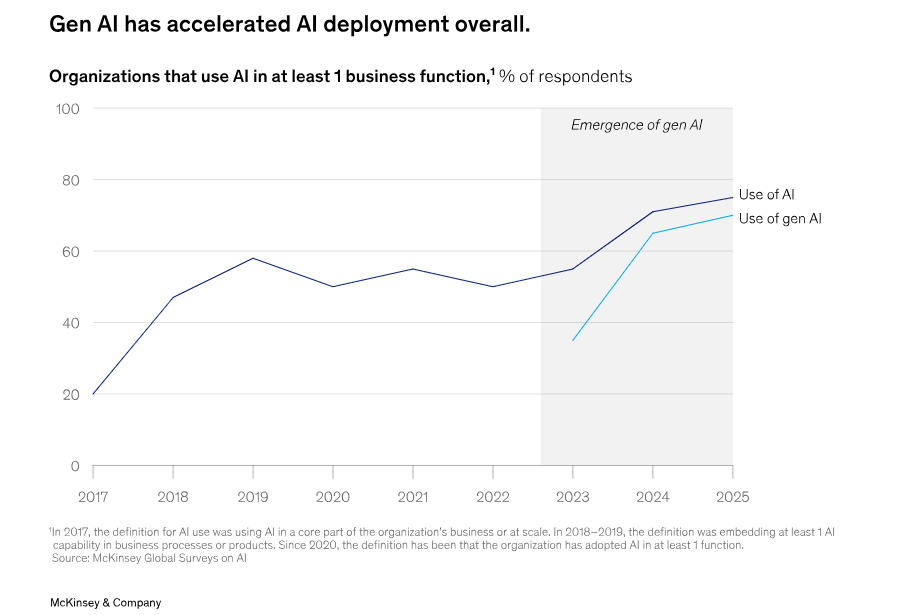
In recent years, artificial intelligence (AI) has rapidly evolved from an experimental technology on the periphery of business into a strategic centerpiece for many organizations. The latest McKinsey Global AI Survey reveals that over 80% of companies have integrated some form of AI into their operations. However, this widespread adoption has not yet translated into equally widespread business impact. Surprisingly, the same proportion of companies, more than 80%, report no significant financial contribution from their AI initiatives. This phenomenon, described by McKinsey as the “Generative AI Paradox,” highlights a central challenge: AI is everywhere, but its tangible value remains limited.
From 2018 to 2022, AI adoption remained relatively stagnant, with around half of companies deploying AI in only one business function. Only in the past two years, with the rise of generative AI and large language models (LLMs), has AI become mainstream. Yet for many enterprises, these investments remain stuck in isolated pilots, offering little measurable impact on core business outcomes such as revenue growth, cost reduction, or competitive differentiation.
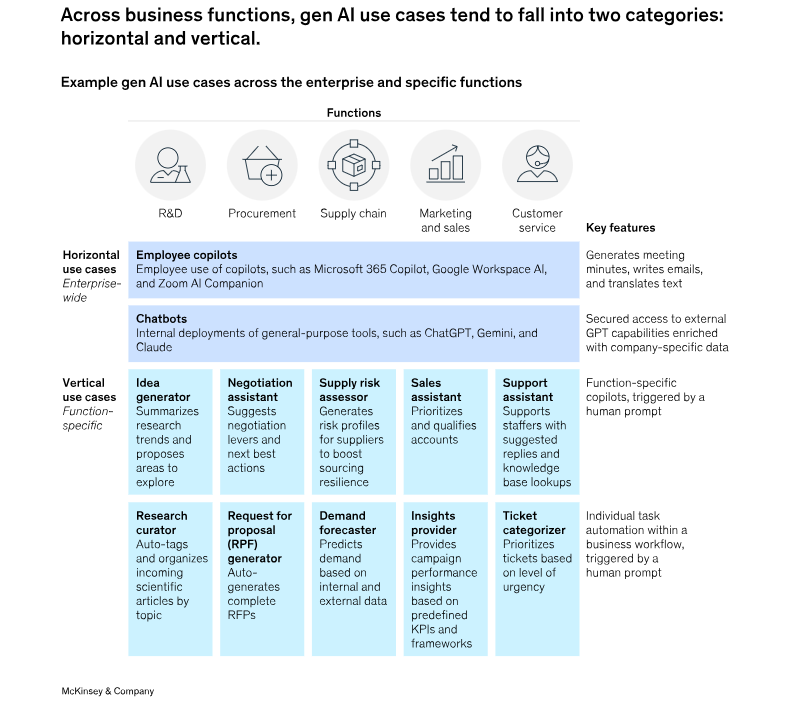
At the heart of this paradox lies an imbalance between horizontal and vertical AI use cases. Horizontal applications such as chatbots, copilots, and productivity assistants, enhance efficiency for individual workers but rarely transform organizational performance at scale. In contrast, vertical AI use cases where AI is embedded deep into core processes such as supply chain management, risk modeling, or customer engagement, hold far greater potential for financial impact. Yet 90% of these high value AI deployments never move beyond the pilot phase.
To overcome this stagnation, enterprises must move beyond generative AI as a content engine and embrace the next frontier: Agentic AI, AI systems that not only generate but also act, learn, and deliver outcomes autonomously.
The Rise of Agentic AI: Moving Beyond Passive Automation
Agentic AI refers to a new class of artificial intelligence systems capable of autonomous, goal-driven execution. Unlike traditional AI, which is passive and requires continuous human prompting, Agentic AI operates as an active decision-maker. These systems can:
- Understand objectives and decompose them into actionable tasks.
- Interact dynamically with both humans and digital systems.
- Execute decisions and adjust actions in real time based on feedback.
- Learn and improve over time without explicit reprogramming.
The technological leap enabling this shift lies in the convergence of large language models (LLMs) with additional capabilities such as memory, orchestration engines, reasoning layers, and integrations with enterprise systems. This allows AI agents to go beyond static task execution and take on entire workflows with minimal human intervention.
The implications of Agentic AI are far-reaching. By removing human bottlenecks from operations, these systems can significantly increase business agility, enhance personalization at scale, and even create entirely new revenue models.
Why Agentic AI Delivers Superior Business Impact
When deployed strategically, Agentic AI enables enterprises to unlock value across three key dimensions:
1. Accelerating Operational Agility
Agentic AI allows businesses to make faster decisions, adjust plans dynamically, and execute actions in parallel rather than sequentially. This is particularly valuable in environments such as:
- Supply chain logistics, where real-time adjustments to transportation, inventory, and demand planning can lead to substantial cost savings.
- Financial services, where AI agents can autonomously monitor market signals, assess risks, and trigger portfolio adjustments within seconds.
By accelerating execution, organizations can respond to disruption more effectively and improve service levels.
2. Delivering Personalization at Scale
Agentic AI systems can tailor decisions and actions to the preferences and contexts of individual customers, employees, or partners without requiring manual intervention. This creates:
- Hyper-personalized customer experiences.
- Dynamic pricing and offers in e-commerce.
- Customized support in service environments.
Such capabilities were previously too complex or resource-intensive to scale through human teams alone.
3. Creating New Business Models
Agentic AI can encapsulate an organization’s expertise and decision-making processes into autonomous services. This opens doors to:
- AI-driven advisory services in wealth management.
- Self-service insurance underwriting.
- Pay-per-use digital products built on autonomous AI layers.
For example, an AI agent in a manufacturing environment might independently monitor equipment health, schedule predictive maintenance, and order replacement parts reducing downtime while cutting costs.
Why Agentic AI Has Yet to Scale
Despite its potential, most organizations struggle to scale Agentic AI beyond pilot projects. Several barriers contribute to this challenge:
- Fragmented Ownership: Many AI initiatives lack direct CEO sponsorship and are confined to isolated business units or innovation teams, preventing alignment with enterprise-wide goals.
- Technology Limitations: Early generations of AI models lacked the accuracy, memory, and real-time reasoning required for autonomous execution. Even today, many off-the-shelf AI solutions need significant customization to meet industry-specific needs.
- Data Constraints: Agentic AI depends on high-quality, real-time, often unstructured data. Many companies continue to operate in fragmented data environments, undermining AI effectiveness.
- Governance and Trust: The shift toward autonomous AI raises legitimate concerns over trust, control, decision transparency, and regulatory compliance. Without robust governance models, scaling AI can create operational and reputational risks.
These barriers explain why many promising AI projects remain stuck in perpetual experimentation rather than driving measurable business transformation.
Reinventing Processes for Agentic AI
One of the most common reasons AI projects fail to scale is that organizations attempt to retrofit AI into existing processes without rethinking those processes from the ground up. To unlock the true potential of Agentic AI, enterprises must move from automation to process reinvention.
This involves:
- Mapping entire business workflows and identifying which steps can be delegated to AI agents.
- Redesigning processes to allow for parallel execution rather than sequential handoffs.
- Defining clear boundaries for human oversight versus AI autonomy.
For example, while adding an AI assistant to a customer support center may improve productivity by 10-15%, a complete reinvention where AI autonomously resolves common issues could automate up to 80% of interactions and reduce resolution time by 60% or more.
Building the Agentic AI Mesh: A Scalable Architecture
To deploy Agentic AI at scale, enterprises need more than standalone pilots. They require a modular, composable architecture what McKinsey calls the Agentic AI Mesh.
This architecture is built on four key principles:
- Composability: The ability to mix and match AI agents, models, and capabilities as business needs evolve.
- Distributed Intelligence: Avoiding over-reliance on any single AI model or provider.
- Governed Autonomy: Embedding control mechanisms to ensure safety, compliance, and human override when needed.
- Vendor Neutrality: Ensuring flexibility to avoid lock-in as AI technologies evolve.
Building this architecture allows organizations to industrialize AI safely while maintaining agility.
The Human Challenge: Earning Trust and Managing Governance
The technological aspects of Agentic AI are advancing rapidly, but the human side of the equation remains the greatest challenge. As AI agents take on more decision-making authority, organizations must focus on building trust, transparency, and accountability into their AI systems.
Key actions include:
- Defining when AI agents should act independently versus when humans must intervene.
- Embedding explainability into AI decisions to ensure stakeholders understand how outcomes are reached.
- Establishing clear escalation pathways for exceptions or ethical concerns.
Without these safeguards, organizations risk not only operational disruption but also reputational and regulatory fallout.
The CEO Imperative: From Experimentation to Industrialization
Ultimately, the successful adoption of Agentic AI is not just a technical journey, it is a leadership imperative. CEOs and boards must move from scattered AI experiments to strategic transformation programs that embed AI into the heart of business operations.
This means:
- Aligning AI efforts with top-line and bottom-line objectives.
- Investing in talent, infrastructure, and governance.
- Moving from pilot projects to scalable, measurable business impact.
As McKinsey rightly notes, the time for exploration is ending. The time for transformation is now. Those who act boldly will not only outperform their peers but redefine how organizations operate in the AI-driven economy.
Conclusion: Leading the Shift to Agentic AI
As the AI landscape evolves at unprecedented speed, the gap between early adoption and tangible business value is becoming increasingly apparent. To close this gap, organizations must move beyond experimentation and embrace Agentic AI as the next frontier of competitive advantage.
This shift demands not only new technologies, but also bold leadership, strategic vision, and the willingness to reinvent processes from the ground up. AI agents will not simply enhance how businesses operate, they will redefine the very foundations of how decisions are made, how services are delivered, and how value is created.
The organizations that act decisively today, embedding AI agents into their core operations, establishing robust governance, and scaling with purpose, will not just keep pace with change. They will shape it.
Varmeta – Excellent in every block
Website: var-meta.com
Linkedln: https://www.linkedin.com/company/var-meta/