Companies like Amazon, Netflix, and HubSpot no longer rely on manual marketing processes to keep pace with customer expectations. Instead, they use AI marketing workflows to automate repetitive tasks, personalize campaigns, and make faster, data-driven decisions at scale. As AI adoption accelerates across every industry, building connected workflows has become a competitive advantage rather than an experiment.
This guide explains how AI marketing workflows work, explores practical use cases, and shows how businesses can implement them responsibly for long-term growth.
What Are AI Marketing Workflows?
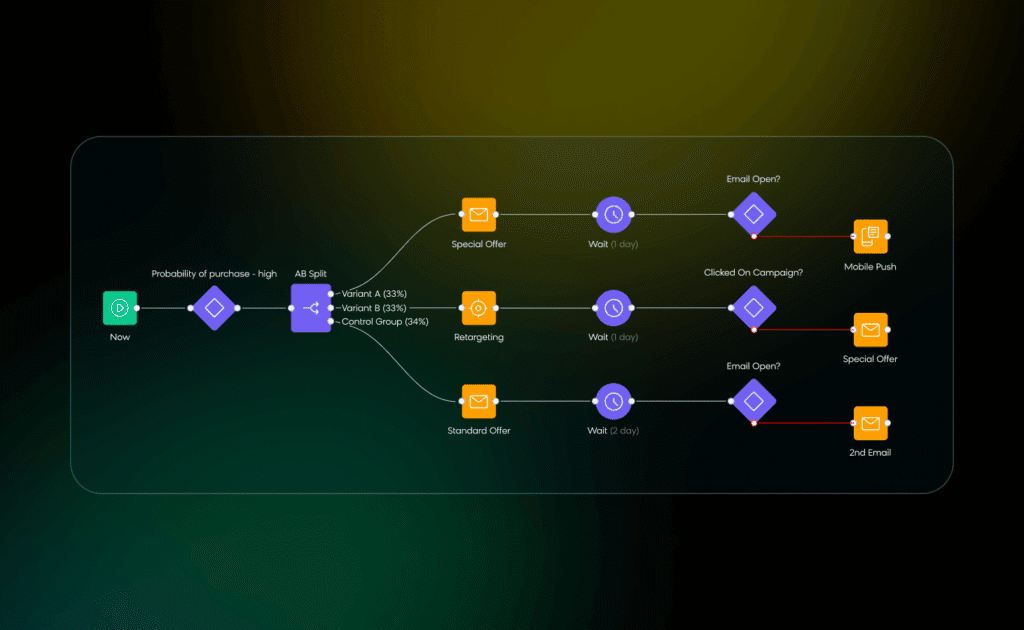
AI marketing workflows are structured systems that combine AI, automation, and human review to execute marketing tasks from start to finish. Unlike using AI tools for isolated activities such as writing blog posts or generating ad copy, an AI workflow connects data, decision-making, execution, and measurement into a repeatable process that directly supports business outcomes.
A mature workflow typically includes six core components:
- Trigger: The event or condition that starts the workflow.
- Input: Data collected from CRM systems, analytics platforms, or other business applications.
- AI job: The task AI performs, such as lead scoring, content generation, summarization, or customer segmentation.
- Output: The result produced by the AI, such as a report, recommendation, or marketing asset.
- Human approval gate: A review step where marketers verify quality, accuracy, and brand alignment before execution.
- Performance measurement: KPIs and analytics used to evaluate workflow effectiveness and identify opportunities for improvement.
By 2026, around 85% of marketers use AI for content creation, while organizations with well-integrated AI workflows report reducing production time by 40-60%, allowing teams to focus more on strategy and customer experience.
The 5-Layer Architecture of an AI-Native Marketing System
Successful AI marketing workflows rely on more than a collection of AI tools. They require an architecture where data flows through intelligence, execution, automation, and business measurement. Each layer builds on the previous one, creating a system that improves marketing efficiency while maintaining quality and governance.
Layer 1: Data – Build on Clean, Connected Data
Every AI workflow begins with data. Customer records, CRM activity, website analytics, advertising performance, and buying signals provide the context AI needs to make useful recommendations. If the data is outdated, duplicated, or incomplete, AI simply produces faster versions of bad decisions.
Before introducing AI into any workflow, businesses should clean customer databases, standardize naming conventions, and organize audiences into meaningful segments. High-quality data remains the most valuable asset in any AI-native marketing organization.
Layer 2: Intelligence – Turn Data into Decisions
Once reliable data is available, AI transforms it into actionable insights. Modern AI models can identify high-value leads, predict purchase intent, recommend audience segments, summarize customer conversations, and detect patterns that are difficult for humans to find manually. Instead of replacing marketers, AI helps teams prioritize opportunities based on evidence rather than assumptions.
This intelligence layer also enables predictive lead scoring, personalized recommendations, and campaign forecasting that continuously improve as more customer data becomes available.
Layer 3: Execution – Coordinate Every Marketing Channel
Execution is where AI begins creating customer-facing work. Content calendars, email campaigns, paid advertising, social media posts, landing pages, and SEO briefs can all be generated from centralized workflows instead of separate manual processes.
Rather than asking AI to create isolated pieces of content, marketing teams can coordinate messaging across multiple channels while maintaining consistent brand voice. The result is faster campaign delivery without sacrificing strategic alignment.
Layer 4: Automation – Eliminate Repetitive Work
Automation connects AI with everyday marketing operations. Instead of manually moving information between CRM systems, analytics dashboards, project management tools, and content platforms, AI workflows automatically trigger actions based on predefined conditions.
New leads can be enriched, emails personalized, reports summarized, and campaign performance monitored with minimal human intervention. Reducing repetitive work allows marketers to spend more time on creative strategy, experimentation, and customer relationships.
Layer 5: Revenue – Connect AI to Business Growth
The final layer focuses on measurable business outcomes rather than AI activity. Effective AI marketing workflows improve sales pipeline visibility, increase conversion rates, optimize marketing spend, and strengthen revenue forecasting.
Instead of measuring how many prompts AI generated, organizations should evaluate whether AI contributes to higher ROAS, faster sales cycles, improved customer retention, or greater marketing efficiency. When every workflow connects back to revenue, AI becomes a business capability rather than simply another productivity tool.
Top AI Marketing Workflows You Can Implement Today
1. Automated Lead Scoring and CRM Enrichment
Lead qualification is one of the most practical places to introduce AI because it directly affects sales productivity.
Using platforms such as HubSpot, Salesforce, Zapier, or MindStudio, AI can automatically analyze every new lead as it enters the CRM. Instead of assigning equal priority to every contact, the system evaluates company size, job title, website activity, buying intent, previous interactions, and firmographic data before assigning a lead score from 1 to 10.
A typical workflow includes:
- A new lead enters the CRM.
- AI enriches the record with publicly available business information.
- The system calculates a lead score and explains why the lead received that score.
- Qualified opportunities are automatically routed to the appropriate sales representative.
Organizations implementing AI-assisted lead scoring have reported increasing conversion rates from approximately 12% to 31%, largely because sales teams spend less time chasing unqualified prospects and more time engaging buyers who show stronger purchase intent.
2. SEO Content Generation Using the G-E-V Framework
Publishing AI-generated content at scale without quality control often creates what many SEO professionals call content debt. Low-quality articles may increase publishing volume, but they rarely improve search performance or user trust.
A more sustainable approach is the G-E-V Framework, which combines AI efficiency with human expertise.
Generate
Use AI to research search intent, organize content clusters, identify semantic keywords, and produce a structured outline instead of asking it to write an entire article from scratch.
Enrich
This is where marketers create differentiation. Add first-hand experience, original examples, expert opinions, proprietary data, customer stories, internal links, and product insights that AI cannot generate independently.
Verify
Before publishing, every article should pass a human review that verifies statistics, pricing, product claims, citations, and factual accuracy. This final approval gate protects brand credibility while improving E-E-A-T signals for both search engines and AI-powered search platforms.
Following the G-E-V process allows teams to publish content faster while avoiding the long-term SEO risks associated with mass-produced AI articles.
3. Social Media Batch Creation System
Creating content for multiple social platforms every day is one of the biggest time drains for marketing teams. An AI-powered batch creation workflow solves this by producing two weeks of content in a single session while keeping messaging consistent across channels.
The process typically follows four stages:
- Build a brand configuration: Define brand guidelines, tone of voice, target audience, messaging pillars, product information, and approved reference materials.
- Generate platform-specific content: Create separate prompts for LinkedIn, Instagram, X, and other channels instead of publishing identical posts everywhere.
- Review and refine: Add personal stories, strengthen calls to action, and verify factual accuracy through human editing.
- Schedule content: Export approved posts to tools such as Buffer or Hootsuite for publishing.
This structured workflow allows small marketing teams to produce more content while maintaining authenticity and brand consistency.
4. Campaign Analytics and Insight Extraction
Reporting often consumes hours every week, especially when marketers need to combine data from Google Ads, Meta Ads, Google Analytics, CRM platforms, and dashboards.
An AI marketing workflow can automate this entire process. Instead of manually downloading reports and creating presentations, AI collects campaign data, summarizes key performance metrics, identifies unusual changes, and recommends optimization opportunities.
For example, an automated workflow can:
- Detect campaigns with declining ROAS.
- Identify audiences with the highest conversion rates.
- Recommend pausing underperforming ads.
- Suggest reallocating budget toward higher-performing campaigns.
- Generate executive summaries for stakeholders every morning.
Rather than presenting raw numbers, AI highlights the insights that matter most, allowing marketers to make faster decisions. Organizations using AI-assisted campaign optimization have reported significant improvements in advertising efficiency, with some case studies showing ROAS increasing by up to 180% within three months after implementing continuous AI-driven optimization.
Step-by-Step Guide to Building an AI Marketing Workflow

Building effective AI marketing workflows doesn’t require automating every marketing activity from day one. In fact, trying to automate everything at once is one of the main reasons AI projects fail. Industry research suggests that 60-80% of automation initiatives struggle because they become overly complex before delivering measurable value.
A better approach is to start small, validate results, and gradually expand successful workflows.
Step 1: Identify the Bottleneck and Clean Your Data
Start with the marketing process that has the greatest impact on business outcomes. For example, if sales teams take two days to follow up with new leads, automating lead qualification will deliver more value than generating AI-powered social posts. Likewise, if reporting consumes hours every week, campaign analytics may be the better place to begin.
Before implementing AI, ensure your CRM, analytics platforms, and customer data are clean, standardized, and properly segmented. Reliable AI recommendations depend on high-quality data.
Step 2: Connect Your Marketing Stack with MCP and Integration Tools
The next step is eliminating manual work between systems. Model Context Protocol (MCP) and integration platforms allow AI models like ChatGPT or Claude to connect directly with HubSpot, Google Analytics, Salesforce, ActiveCampaign, and other business applications.
Instead of copying data between tools, AI can update CRM records, generate reports, and trigger workflows automatically. Connected AI systems have helped organizations reduce campaign management time by 50 -70% while improving data consistency.
Step 3: Add Human-in-the-Loop Quality Assurance
Every successful AI marketing workflow includes a Human-in-the-Loop (HITL) approval stage before content is published, campaigns launch, or budgets are allocated.
In most organizations, AI handles roughly 70% of repetitive work,including research, drafting, analysis, and reporting, while marketers focus on the remaining 30%, refining messaging, validating facts, protecting brand voice, and making strategic decisions. This final review stage minimizes errors without sacrificing the speed benefits of AI.
Measuring Success: Holistic KPIs for AI Workflows
The success of AI marketing workflows shouldn’t be measured by how much content AI produces. Instead, organizations should evaluate whether AI improves business outcomes while maintaining quality and customer trust.
A practical approach is to build an AI workflow scorecard that combines operational, customer, financial, and governance metrics.
Operational Efficiency
The first goal of AI is to eliminate repetitive work.
Track metrics such as:
- Time saved per campaign
- Reduction in manual tasks
- Automation rate
- Error reduction
- Content production speed
If AI only shifts work from content creation to extensive editing, the workflow may need further optimization.
Customer Engagement
Efficiency means little if customer experience declines.
Monitor indicators such as:
- Conversion rate
- Click-through rate (CTR)
- Customer Satisfaction (CSAT)
- Email engagement
- Lead quality
AI should improve personalization and relevance without making interactions feel robotic or generic.
Revenue Growth
Ultimately, marketing workflows should contribute to business performance.
Key financial metrics include:
- Return on Ad Spend (ROAS)
- Marketing-attributed revenue
- Pipeline growth
- Customer acquisition cost (CAC)
- Sales cycle length
Connecting AI workflows to revenue demonstrates whether automation creates measurable business value rather than simply increasing activity.
Responsible AI
Responsible AI deserves its own performance category.
Organizations should monitor:
- AI policy compliance
- Human approval rate
- Bias detection
- Hallucination rate
- Data privacy incidents
Tracking these indicators helps ensure AI remains trustworthy as adoption expands across the marketing organization.
FAQs
How much do AI marketing tools cost for an agency or SME?
Costs vary depending on team size and workflow complexity. Small businesses or agencies with one to three marketers can often build effective AI marketing workflows for $50-80 per month using tools like ChatGPT Plus or Claude Pro alongside automation platforms. Larger organizations using enterprise AI solutions may spend $1,000-3,000 per month for advanced integrations, governance, and collaboration features.
Can AI replace my marketing team?
No. AI is designed to augment marketers rather than replace them. It automates repetitive tasks such as research, reporting, content drafting, and data analysis, allowing marketers to focus on strategy, creativity, and customer relationships. Many organizations report that AI enables teams to handle 30-40% more work without increasing headcount.
Do I need programming skills to build AI marketing workflows?
Not necessarily. Modern no-code and low-code platforms such as Zapier, Make.com, and MindStudio allow users to connect AI with CRM systems, marketing tools, and analytics platforms through visual interfaces. Many common workflows can be built in less than an hour without writing code.
What is the biggest mistake when automating marketing content?
The most common mistake is removing the quality assurance step. Automatically publishing AI-generated content without human review increases the risk of factual errors, inconsistent messaging, outdated information, and poor search performance. Every workflow should include a final approval stage before content is published or campaigns go live.
The Bottom Line
As AI marketing workflows continue to evolve, organizations that combine automation with strong governance and human expertise will gain a lasting competitive advantage. If you’re ready to design secure, scalable AI workflows that deliver measurable business results, contact Varmeta to discover how our AI solutions can support your marketing transformation.