The first half of 2026 has marked a pivotal moment in the evolution of artificial intelligence, with several AI trends reshaping the future of business. What was once dominated by conversations around increasingly powerful language models has shifted toward a broader discussion about real-world adoption, business value, and long-term sustainability. Organizations are no longer asking whether they should adopt AI, they are focusing on how to integrate it effectively, scale it across operations, and generate measurable returns.
This report examines the five most significant AI trends that shaped the first half of 2026 and explores what they mean for businesses across industries. Rather than simply recapping major headlines, it analyzes the broader shifts behind them, providing insights into how organizations can prepare for the next stage of AI adoption and innovation.
1. AI Agents Become the Next Enterprise Workforce

One of the most significant AI trends during the first half of 2026 is the evolution of AI from a conversational assistant into an autonomous digital worker. Instead of simply answering questions or generating content on demand, modern AI agents are increasingly capable of planning, reasoning, using external tools, and completing multi-step tasks with minimal human intervention. For businesses, this marks a transition from using AI as a productivity enhancer to treating it as an active participant in day-to-day operations.
This shift is becoming increasingly evident across the enterprise landscape. According to Microsoft’s 2026 Work Trend Index, the number of active AI agents across the Microsoft 365 ecosystem has grown 15 times year over year, while adoption among large enterprises has increased 18-fold. These figures suggest that organizations are moving beyond pilot programs and beginning to deploy AI agents at operational scale.
The way employees interact with AI is also changing. Rather than relying on AI primarily as a search engine or writing assistant, users are assigning it more cognitively demanding work. Microsoft found that 49% of AI conversations now support knowledge-intensive tasks, such as analyzing information, solving problems, and generating ideas, compared with only 15% focused on simple information retrieval. This indicates that AI is becoming a collaborative thinking partner rather than merely an information provider.
Among advanced users, referred to by Microsoft as Frontier Professionals, the transformation is even more pronounced. These professionals are increasingly building multi-step workflows in which AI agents can coordinate multiple actions, interact with business applications, and even collaborate with other AI agents to complete complex processes. Instead of prompting AI one task at a time, they are orchestrating entire workflows that require little ongoing supervision.
The impact extends beyond productivity gains. Microsoft reports that 58% of users say AI enables them to create work they couldn’t have accomplished a year ago, while this figure rises to 80% among Frontier Professionals. Additionally, 66% of respondents say AI allows them to spend more time on their highest-value responsibilities by reducing repetitive execution tasks.
Together, these findings suggest that the enterprise AI conversation is no longer centered on whether AI can assist employees. Instead, the focus has shifted toward how organizations can effectively integrate AI agents into business processes, establish governance frameworks, and redesign workflows where humans and AI collaborate as part of the same operational system. As AI agents become more autonomous, competitive advantage will increasingly depend not only on adopting AI, but on deploying it strategically across the organization.
2. The AI Race Shifts from Models to Infrastructure
As AI models become increasingly capable, the competition is no longer defined solely by algorithmic breakthroughs. Now the focus of AI trends has expanded to the infrastructure that powers AI, from GPUs and data centers to electricity, networking, cooling systems, and regional computing capacity. Infrastructure is no longer just an engineering concern; it has become a strategic asset that determines how quickly and effectively organizations can scale AI.
According to Deloitte’s State of Generative AI in the Enterprise report, 83% of organizations consider local data storage and compute capabilities important or very important to their strategic planning, while 77% say the geographic location where AI is developed and deployed has become a key factor when selecting new technologies. These findings suggest that AI infrastructure is no longer viewed purely through the lens of performance or cost, it is increasingly linked to resilience, compliance, and digital sovereignty.
As AI infrastructure becomes increasingly strategic, AI trends now is the growing emphasis on reducing dependence on external AI technologies and computing resources. Organizations are placing greater importance on strengthening local infrastructure, improving digital sovereignty, and ensuring long-term resilience. Rather than competing solely to develop more advanced AI models, businesses and governments are increasingly focused on securing the infrastructure needed to deploy AI reliably, efficiently, and at scale.
Organizations are modernizing toward cloud-native, modular, and hybrid architectures that can manage data securely across cloud, on-premises, and edge environments. Meanwhile, the rapid expansion of AI data centers has brought new challenges beyond computing power itself. Energy consumption, cooling capacity, and power grid reliability are emerging as critical constraints, making infrastructure planning just as important as model development.
3. Enterprise AI Moves from Experimentation to Deployment
The first half of 2026 marks a turning point in enterprise AI adoption and represents one of the most significant AI trends shaping the business landscape. After years of experimentation, pilot programs, and proof-of-concept initiatives, organizations are increasingly shifting their focus toward deploying AI at scale. Rather than asking whether AI can deliver value, businesses are now investing in how to operationalize AI across departments, integrate it into existing workflows, and generate measurable business outcomes.
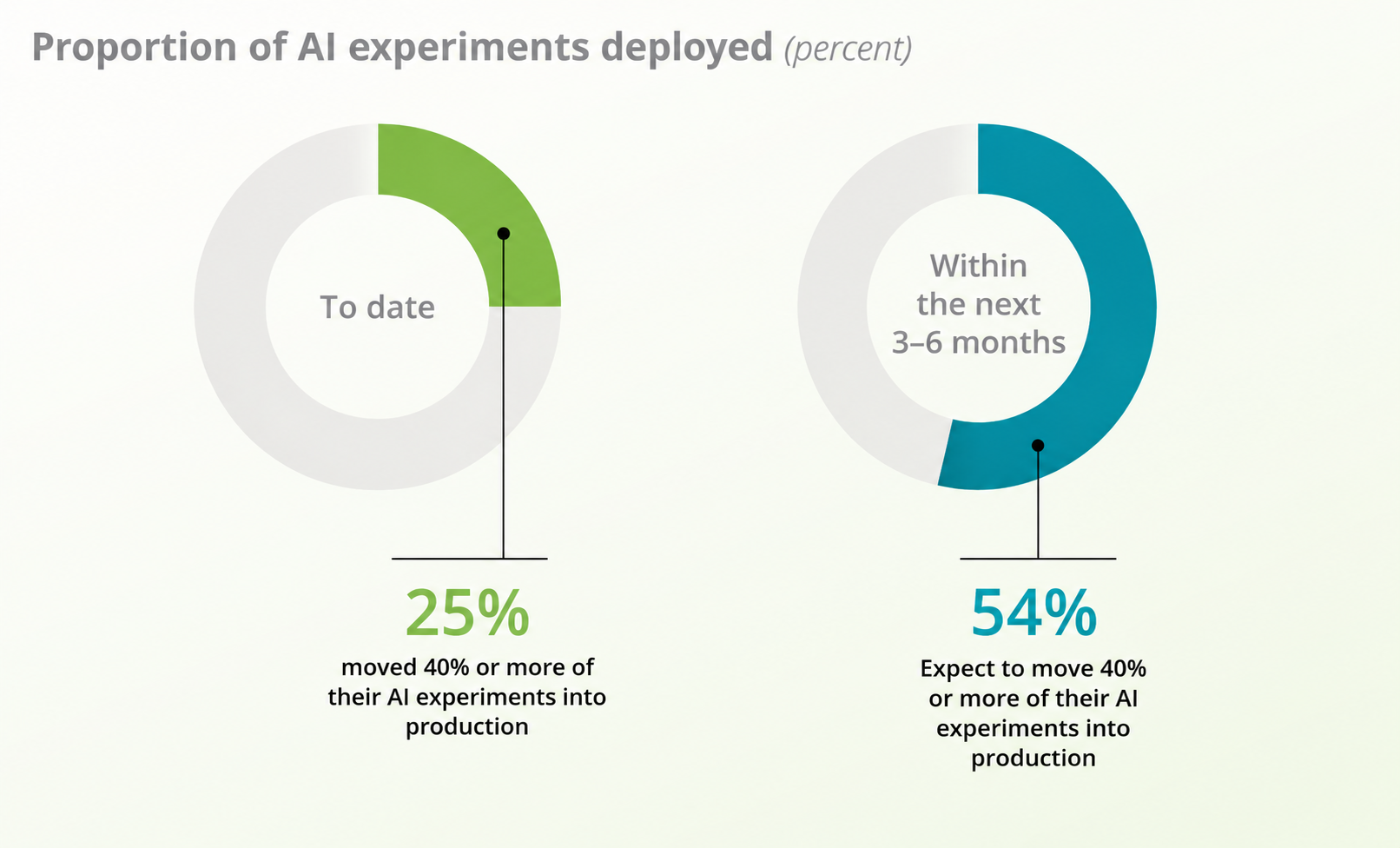
This transition is clearly reflected in Deloitte’s State of Generative AI in the Enterprise report. Currently, 25% of organizations report that at least 40% of their AI experiments have already been deployed into production. More importantly, this momentum is expected to accelerate rapidly, with 54% of organizations expecting to have at least 40% of their AI initiatives in production within the next three to six months. The findings suggest that enterprise AI is moving beyond isolated pilots and entering a phase of large-scale implementation, one of the defining AI trends of 2026.
This shift also reflects a broader change in how organizations evaluate AI investments. Early adoption focused primarily on testing capabilities and exploring use cases. Today, enterprises are increasingly measuring AI through business metrics such as productivity, operational efficiency, customer experience, and return on investment. As AI becomes embedded into core business processes, success is no longer determined by the number of experiments an organization launches, but by how effectively those initiatives can be scaled into reliable, production-ready systems.
For business leaders, this represents a fundamental change in AI trends and strategy. Competitive advantage will increasingly come from execution rather than experimentation. Organizations that can successfully integrate AI into everyday operations, establish governance frameworks, and scale successful use cases will be better positioned to capture long-term value as enterprise AI continues to mature.
4. Open-Weight Models Narrow the Gap with Proprietary AI
The first half of 2026 has demonstrated one of the reshaped AI trends that competition in AI is no longer dominated exclusively by proprietary models. Open-weight models have advanced at an unprecedented pace, significantly reducing the performance gap with leading commercial systems while offering greater flexibility, transparency, and lower deployment costs. As a result, enterprises now have far more options when selecting AI models, intensifying competition across the entire AI ecosystem.
One of the most significant milestones came from DeepSeek-R1, which, by early 2025, achieved performance comparable to some of the leading U.S. reasoning models on several widely recognized benchmarks. Its rapid progress challenged the long-held assumption that only closed-source developers could produce frontier-level AI systems.
The competitive landscape continued to tighten throughout H1 2026. According to the Stanford AI Index 2026, the performance gap between the highest-performing proprietary model and its closest competitor had narrowed to just 2.7% by March 2026. This remarkable convergence illustrates how quickly innovation is spreading across the AI industry, with leading open-weight models rapidly approaching the capabilities of their closed counterparts.
Beyond performance, open-weight models are changing how enterprises approach AI adoption. Organizations can deploy models within private environments, customize them for domain-specific applications, and reduce dependence on a single commercial provider. This flexibility is particularly valuable for industries with strict regulatory, security, or data sovereignty requirements.
The rise of models such as DeepSeek, Qwen, Llama, and Mistral has therefore shifted the conversation from “Which model is the most powerful?” to “Which model best fits a business’s technical, financial, and regulatory needs?” Rather than competing solely on raw benchmark scores, AI providers are increasingly differentiating themselves through deployment flexibility, ecosystem support, inference cost, and enterprise readiness.
| Model | Strengths | Weaknesses | Best For |
| DeepSeek-R1 | Excellent reasoning, strong coding & math performance, cost-effective | Smaller ecosystem, fewer enterprise integrations | Complex reasoning, coding assistants, research, technical tasks |
| Qwen | Strong multilingual support (especially Chinese & English), versatile model family, good coding capabilities | Less widely adopted outside Asia | Global applications, multilingual chatbots, enterprise AI in Asian markets |
| Llama | Large ecosystem, extensive community support, highly customizable | Performance may trail top frontier models in some benchmarks | Fine-tuning, private deployment, enterprise applications, AI research |
| Mistral | Efficient, lightweight, fast inference, strong open-weight ecosystem | Smaller model portfolio than larger competitors | On-premises deployment, edge AI, latency-sensitive applications |
For businesses, this evolving landscape represents more than just greater model choice. It signals a more competitive AI market where innovation is accelerating, costs are gradually declining, and organizations have increasing freedom to build AI solutions without being locked into a single vendor. As open-weight models continue to mature, this AI trend is expected to play an increasingly important role in enterprise AI strategies throughout the remainder of 2026.
5. AI Governance and ROI Become Top Priorities
The year of 2026 marks a clear shift in enterprise AI priorities and highlights one of the most important AI trends shaping business transformation. While the early wave of AI adoption was largely driven by experimentation and excitement around emerging technologies, organizations are now placing greater emphasis on measurable business outcomes, governance, and responsible deployment. The conversation has moved beyond “What can AI do?” to “How can AI deliver value safely, reliably, and at scale?”
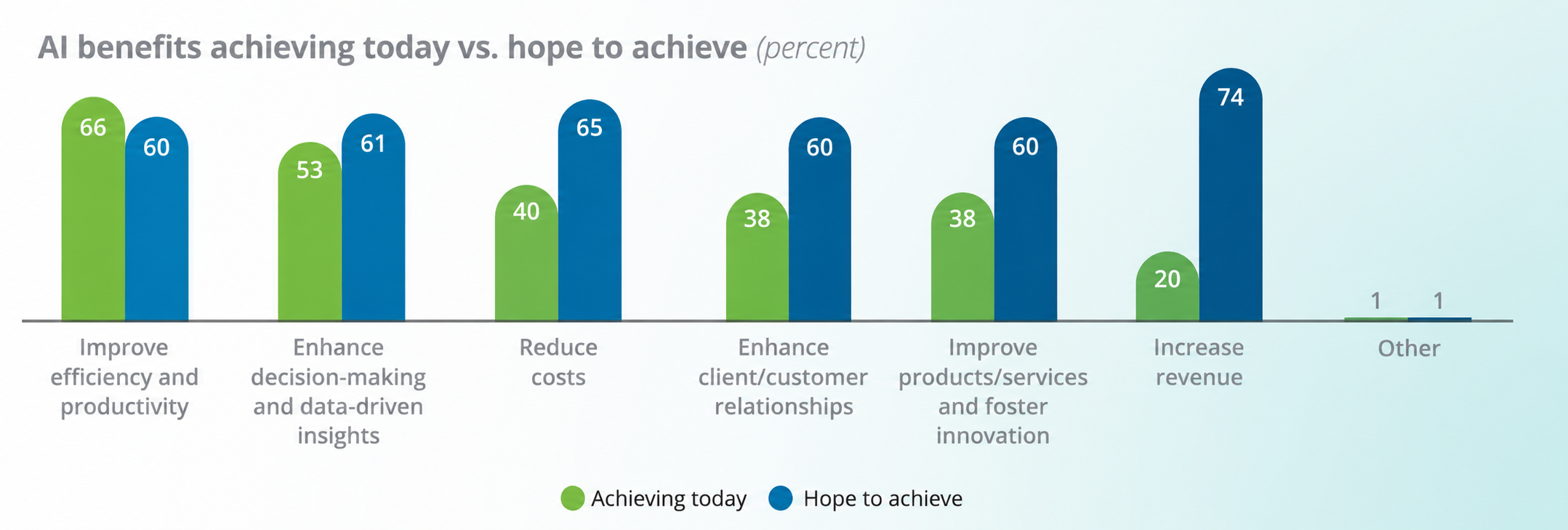
This evolution is reflected in how enterprises are assessing the success of their AI initiatives. According to Deloitte, 66% of organizations report improvements in productivity and operational efficiency through AI, while 53% have enhanced data-driven decision-making and 40% have achieved measurable cost reductions. These results indicate that AI is no longer viewed as a standalone innovation project but as a strategic investment expected to generate tangible business value.
As AI becomes more deeply embedded in business operations, governance has emerged as an equally important priority. Around 30% of executives now consider their organizations to be highly prepared in terms of AI risk management and governance, representing a notable improvement over the previous year. At the same time, 84% of organizations plan to increase AI investment, and 78% of business leaders express greater confidence in AI. However, increased confidence has not reduced concerns. Instead, organizations are placing greater emphasis on transparency, accountability, and responsible AI practices, with 46% identifying explainability as a key risk requiring active management.
Taken together, these findings highlight an important milestone in the evolution of enterprise AI. Success is no longer determined by how many AI tools an organization adopts, but by how effectively those tools generate measurable returns while remaining secure, transparent, and well governed. As AI becomes a core component of business strategy, organizations that combine strong governance with a clear focus on ROI will be better positioned to sustain long-term competitive advantage. These AI trends demonstrate that responsible AI governance and measurable business value are becoming essential pillars of enterprise AI success.
Conclusion
The first half of 2026 has shown that artificial intelligence is entering a new stage of maturity. The conversation is no longer centered solely on building larger or more powerful models. Instead, the most important AI trends are shifting toward real-world implementation, where autonomous AI agents, scalable infrastructure, enterprise-wide deployment, increasingly capable open-weight models, and responsible governance are becoming the key drivers of long-term success.
For businesses, this means the competitive advantage of AI will no longer come from simply adopting the latest technology. Organizations that can integrate AI into their core operations, build the right infrastructure, establish effective governance frameworks, and continuously measure business outcomes will be better positioned to create sustainable value.
As the second half of 2026 unfolds, these AI trends will continue to evolve rapidly. However, the companies that succeed won’t necessarily be those with access to the most advanced models, they will be the ones that can transform AI capabilities into practical, scalable, and measurable business impact.
At Varmeta, we help organizations move beyond AI experimentation by designing and implementing enterprise AI solutions that deliver measurable business value. Whether you’re exploring AI agents, automating business processes, integrating AI into existing systems, or developing a long-term AI strategy, our team can help you navigate emerging AI trends, identify the right opportunities, and build solutions tailored to your business goals.
Contact Varmeta today to discover how enterprise AI can accelerate your digital transformation.
FAQs
1. What are the most important AI trends in 2026?
The most significant AI trends in 2026 include the rise of autonomous AI agents, AI infrastructure becoming a strategic priority, enterprise AI deployment at scale, rapid advancements in open-weight models, and a stronger focus on AI governance and ROI.
2. Why are AI agents becoming important for businesses?
AI agents can perform multi-step tasks, use external tools, and automate business workflows with minimal human intervention. This enables organizations to improve productivity, streamline operations, and support more complex business processes.
3. What are open-weight AI models, and why are they gaining popularity?
Open-weight AI models provide greater flexibility, customization, and deployment options than many proprietary models. They help organizations reduce vendor lock-in while meeting security, compliance, and data sovereignty requirements.
4. Why is AI infrastructure considered one of the top AI trends?
As AI workloads become more demanding, organizations need scalable computing resources, reliable data centers, and modern cloud infrastructure. Strong AI infrastructure enables businesses to deploy AI efficiently, securely, and at scale.
5. How can businesses prepare for emerging AI trends?
Businesses should focus on integrating AI into core operations, investing in scalable infrastructure, establishing AI governance frameworks, measuring ROI, and adopting AI solutions that align with long-term business objectives.