Building a Minimum Viable Product (MVP) is one of the most critical steps in launching any Blockchain or Generative AI (GenAI) project. In today’s fast-moving tech landscape, where innovation is constant and user expectations are high, starting with a focused, functional MVP can make or break your product’s future.
Some of the world’s most successful tech companies began with nothing more than a simple prototype. Take Dropbox, for example before writing a single line of code, the founders validated their idea with just a short explainer video. That clarity of vision and ability to solve a specific problem helped them attract early users and investor interest before the full product even existed.
The potential for Blockchain and GenAI products is massive. The blockchain market, valued at over $92 billion in 2021, is projected to skyrocket to $1.4 trillion by 2030, growing at a steady pace of 9% annually. As adoption accelerates across industries, launching a focused MVP, especially in Blockchain or GenAI, is your chance to stand out, test real world use cases, and attract early believers.
In this guide, we’ll break down what an Minimum Viable Product really means in the context of Blockchain and GenAI, why it matters, and how you can build one that captures your vision while setting the stage for long term success.
What is a minimum viable product (MVP)?
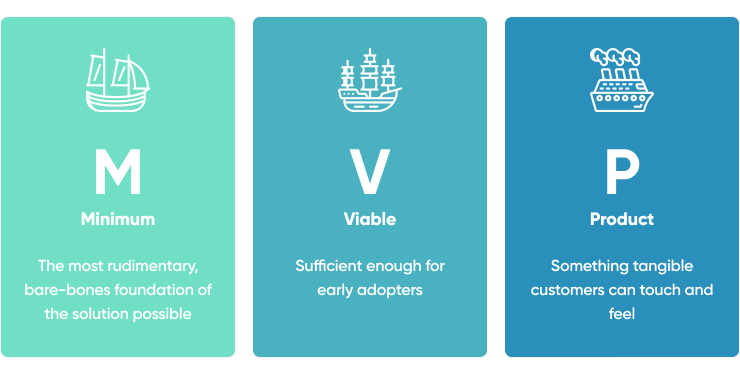
At its core, a Minimum Viable Product (MVP), is the simplest version of a product you can build to test your idea in the real world. It’s a key concept from the lean startup methodology, made popular by Eric Ries in The Lean Startup. The goal is to launch quickly with minimal resources, gather feedback from real users, and learn what works without spending months or years building a full product upfront.
The key is finding the right balance. Your Minimum Viable Product should clearly show the value of your idea, but stay focused enough to avoid wasting time or money on unnecessary features. It’s not about being perfect, it’s about being smart. A well-designed Minimum Viable Product attracts early users, validates your core concept, and gives you the insights you need to improve. It’s the first step toward building something people actually want.
What does an minimum viable product look like in blockchain and generative AI?
In both Blockchain and Generative AI development, a Minimum Viable Product (MVP) is the leanest version of your product that solves a real problem with just the essential features. It’s not about building something perfect, it’s about getting your idea into the hands of real users, fast, so you can learn, adapt, and grow without overinvesting too early.
An AI Minimum Viable Product is a streamlined version of your generative product whether it’s a chatbot, text generator, or image creator that focuses only on its core value proposition. It allows you to test assumptions, gather early feedback, and avoid wasting resources on unnecessary features.
A Blockchain Minimum Viable Product , on the other hand, centers around validating decentralized functionality such as smart contracts, token systems, wallets, or dApps. It’s the quickest way to prove that your blockchain use case works before committing to full-scale development.
Here’s a quick comparison of what MVPs look like in each context:
| Parameters | Minimum Viable Product in blockchain development | Minimum Viable Product in generative AI development |
| Definition | A working prototype with essential blockchain functionality | A lightweight AI model that demonstrates the core idea |
| Core focus | Smart contracts, tokenomics, wallets, or dApp interaction | Text generation, image creation, or conversational AI |
| Purpose | Validate the decentralized use case before scaling | Test AI output quality and relevance to user needs |
| Key benefit | Saves cost while proving blockchain feasibility | Reduces risk by validating performance with minimal features |
| Outcome | A foundation for a scalable, secure blockchain product | A clear path to optimize models for market-ready deployment |
Essential features of a blockchain and generative AI MVP
When developing a Minimum Viable Product (MVP) using Blockchain or Generative AI, it’s important to focus on the features that truly showcase your product’s core value. Whether you’re demonstrating decentralized functionality or testing intelligent content generation, the goal is the same: build a lean, purposeful version that solves a clear problem and validates your idea.
Below is a breakdown of the key features you should include in a Blockchain or GenAI MVP:
| Blockchain MVP features | Generative AI MVP features |
| Smart contracts: Demonstrates how key processes can be automated directly on-chain. | Core AI functionality: Showcases a focused capability like text generation, image creation, or chat assistance. |
| Wallet integration: Allows users to send, receive, and interact with tokens on the blockchain. | User-friendly interface: Ensures ease of use with clean UI/UX, even for non-technical users. |
| Simple UI: Offers a clear, minimal interface to guide users through the MVP experience. | Customizability & fine-tuning: Enables basic user control over AI output or personalization with custom data. |
| Basic security: Implements essential protections to secure transactions and user data. | Scalability & API integration: Built to scale and connect easily with other tools or platforms via APIs. |
| Consensus mechanism: Integrates a lightweight validation protocol to maintain data integrity. | Ethical & safe usage: Includes moderation filters, bias controls, and responsible AI practices. |
By focusing on just these core components, you give users a clear picture of your product’s value while keeping development agile. Whether you’re proving out token logic or testing AI-generated content, a well-designed MVP sets the stage for smarter iterations and stronger market fit.
Real-world examples of MVPs using blockchain or generative AI
Many groundbreaking companies began with nothing more than a simple Minimum Viable Product , just enough functionality to validate their idea, attract early users, and refine their product based on real feedback. Whether powered by Blockchain or Generative AI, these early versions helped founders learn fast and scale smarter.
1. Spotify
Before it became the music giant we know today, Spotify launched as a basic prototype built to test three core ideas:
- Could users stream music instantly without buffering?
- Would people actually want to stream instead of download?
- Could legal streaming be done at scale?
The first version had very limited features, it played only a few hard-coded tracks with a barebones interface. But that MVP proved what mattered most: users loved the seamless, on-demand experience. That insight laid the foundation for what became one of the most successful digital platforms of all time.
2. OpenAI’s GPT playground
When OpenAI introduced its GPT-3 model, they launched a simple demo called the Playground. It wasn’t a full product, but it allowed developers and curious users to interact with the model, experiment with prompts, and imagine real use cases from creative writing to coding assistance.
This lightweight Minimum Viable Product helped OpenAI quickly gather feedback, understand demand, and inspire a wave of applications built on top of the API. It showed how Generative AI could be practical, powerful, and incredibly versatile.
3. Uniswap
Uniswap, one of the most successful blockchain-based platforms, launched as a minimal decentralized exchange (DEX) with a single smart contract. Its early MVP allowed users to swap tokens using an automated liquidity protocol, no flashy UI, no complex features.
What made it successful was the clarity of its value: decentralized, permissionless token trading. With just the core mechanics working, it attracted early users, developers, and liquidity providers who helped shape its evolution into a leading DeFi platform.
Key takeaways from these MVPs
- Simplicity wins when you’re solving a clear problem. Don’t overbuild and focus on one powerful value proposition.
- Real user feedback is more valuable than assumptions. MVPs help validate or challenge your direction early.
- Technical feasibility matters whether it’s stable streaming, reliable smart contracts, or coherent AI output, the MVP should prove that your idea can work.
Whether you’re building in crypto markets, AI tools, or beyond, a well-executed MVP is often the smartest first move.
How to build and test a blockchain minimum viable product

Now that we understand the value of a Minimum Viable Product (MVP) in Blockchain development, let’s break down the key steps to building one that’s lean, impactful, and ready for the real world.
1. Identify the core features that matter
The first step in building a Blockchain MVP is to define what really matters. What pain points does your product solve? Who is your audience, and what do they care about most?
Your MVP should include only the essential features, the ones that demonstrate your value proposition and solve a specific problem. This focused approach not only saves time and cost but also increases clarity for users and stakeholders.
Example:
If you’re building a Blockchain MVP for supply chain management, core features might include:
- Real-time product tracking
- Transparent, tamper-proof recordkeeping
- Automated smart contracts for secure, efficient transactions
These directly address common industry challenges like lack of visibility, traceability, and trust among partners.
2. Design the MVP blueprint
Once you’ve identified the core features, it’s time to sketch your vision. This includes creating:
- User flows that show how users interact with the product
- Wireframes and mockups to visualize the interface
- A simple, clean UX design aligned with your brand and audience
Your MVP doesn’t need to be beautiful, but it does need to be clear. During this phase, test your design with real users to gather feedback on the overall experience. Even small improvements in navigation, wording, or button placement can make a big difference.
3. Build and collaborate closely with developers
With the blueprint in hand, development begins. Work with a skilled Blockchain development team to bring your MVP to life using the right tools and frameworks. Focus on building the core functionality first, keeping scalability and future integrations in mind.
Maintain close communication throughout the build, regular check-ins help ensure your MVP stays aligned with your vision and your users’ needs. Don’t aim for perfection, just aim for clarity, utility, and the ability to validate your concept quickly.
An MVP isn’t the end product, it’s the first real step in proving your idea works. A well-built Blockchain MVP gives your project early traction, helps you gather meaningful user feedback, and sets the foundation for long term growth.
How to build a generative AI minimum viable product
Bringing a Generative AI (GenAI) product to life doesn’t require a massive budget or a full-scale launch. What it does require is a focused, well-executed Minimum Viable Product (MVP) that solves a clear problem and delivers real value. Here’s how to do it, step by step.
1. Set clear goals for your genAI MVP
Before writing any code or testing models, define what success looks like. What problem are you solving? Who is your target user? And what’s the one key outcome your MVP must deliver?
A successful GenAI MVP starts with clarity, not complexity. Whether you’re building an AI writing assistant, chatbot, or creative generator, identifying your core use case and audience pain points will guide every decision that follows.
2. Choose the right genAI tools
Tool selection can make or break your timeline and budget. According to Microsoft, using the right GenAI platforms can cut development time by up to 70%.
Consider tools based on:
- Budget and scalability
- Integration with your current stack
- Data needs and privacy requirements
For instance, platforms like OpenAI, Hugging Face, or no-code solutions like Fuzen.io can dramatically reduce build time while keeping costs low.
3. Seamlessly integrate genAI into your workflow
Once your tools are selected, it’s time to plug GenAI into your actual workflow. Look for high-impact areas like:
- Automating repetitive tasks
- Generating content or insights
- Personalizing user experiences in real time
Make sure your data is clean and your team understands how the AI fits into their process. Strong data management and collaboration practices are key to keeping your MVP on track and functional from day one.
4. Test, measure, and iterate often
A great Minimum Viable Product is built on feedback, not assumptions. Use GenAI-powered analytics and A/B testing tools to understand how users interact with your product, and iterate based on that data.
Companies like Microsoft use continuous testing loops to refine their AI tools in real time. You can do the same by tracking user behavior, analyzing what’s working (or not), and tweaking the model, UI, or flow accordingly. The beauty of GenAI is speed, use it to accelerate learning, not just automation.
Building a GenAI MVP is about starting lean, thinking clearly, and iterating fast. With the right tools and a feedback-driven mindset, you can turn an ambitious idea into a working product that resonates with real users without burning time or budget.
Conclusion
In today’s fast-moving innovation landscape, the Minimum Viable Product (MVP) approach offers the smartest path for testing high-potential ideas, especially when working with powerful technologies like Blockchain and Generative AI. By focusing on the core value first, founders can avoid costly missteps, validate their concepts early, and adapt quickly to real user needs.
Building an MVP isn’t about launching a perfect product. It’s about building lean, learning fast, and evolving alongside your users. Whether you’re creating a decentralized application or an AI-driven solution, the Minimum Viable Product framework empowers you to move from vision to reality with clarity and confidence.
Start small, stay focused, and use every iteration to sharpen your edge. That’s how today’s ideas become tomorrow’s industry leaders.