The rapid evolution of technology is driving unprecedented growth in artificial intelligence (AI), making it one of the most transformative forces in modern society. AI agent systems, in particular, are at the forefront of this revolution, playing a critical role in streamlining processes, automating decision-making, and solving complex problems across industries.
The significance of AI in today’s world is reflected in its remarkable market growth. In 2024, the global AI market surpassed $184 billion, a substantial increase of nearly $50 billion compared to 2023. This momentum is set to continue, with projections estimating the market will exceed $826 billion by 2030. This exponential growth highlights the immense opportunities in developing AI agent systems and their central role in shaping the future of industries such as healthcare, finance, transportation, and more.
As the demand for intelligent, adaptable, and efficient systems rises, building AI agent systems has become a focal point for innovation. This guide will walk you through the process of creating these systems, exploring the key components, steps, and opportunities they bring in shaping the future of technology.
Understanding AI agent systems
AI agent systems are central to the development of intelligent technologies, enabling machines to act independently and intelligently in complex environments. To fully appreciate their role, it is essential to explore their definition, core characteristics, and the various types of AI agents. A deeper understanding reveals how these systems drive innovation across diverse applications.
What is an AI agent system?

Artificial Intelligence (AI) agents are intelligent software systems designed to perform tasks independently, using data and predefined rules to make decisions. They range from simple rule-based programs executing repetitive tasks to advanced systems that leverage machine learning algorithms to adapt and improve over time.
AI agents are transforming industries with their versatility and efficiency. In customer service, they power chatbots that handle inquiries and resolve issues autonomously. In healthcare, they streamline patient management by scheduling appointments and sending medication reminders. In finance, AI agents monitor market trends, execute trades, and optimize investment strategies in real time.
In the business world, AI agents have become invaluable tools for improving productivity. AI agents address this inefficiency by automating repetitive processes like data entry, customer support, and routine analysis, allowing human employees to focus on complex, strategic, and creative endeavors.
The success of AI agents lies in their design, the quality and quantity of data they access, and the efficiency of the algorithms they use. By enhancing decision-making and operational efficiency, AI agents have become essential across industries, driving innovation and helping businesses achieve greater agility and scale.
Key characteristics of AI agents:
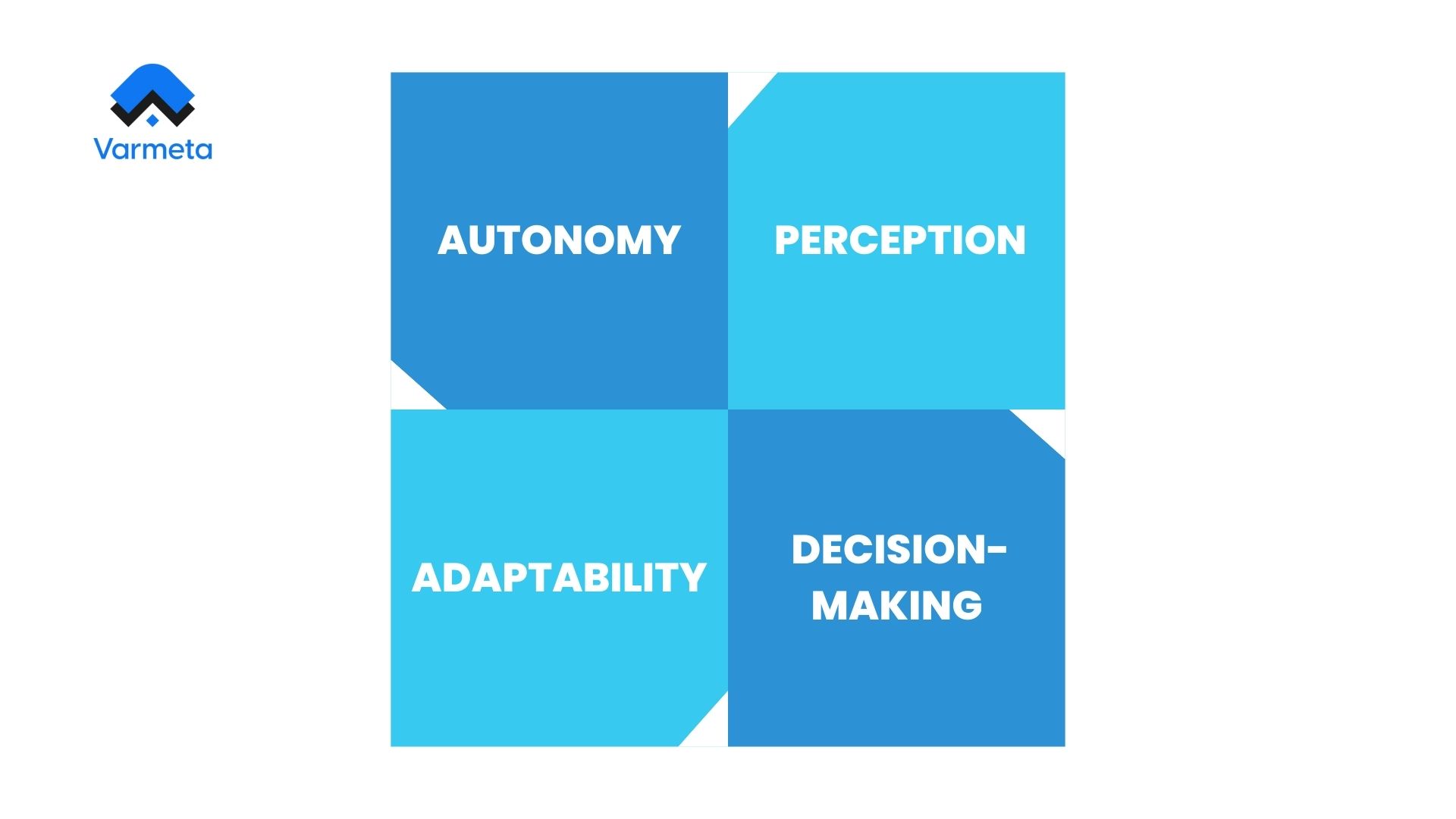
- Autonomy:
- AI agents operate without direct human intervention, making decisions based on their programming and real-time inputs.
- For example, a self-driving car can independently navigate streets, interpreting traffic signals and avoiding obstacles.
- Perception:
- They use sensors, data streams, or external inputs to observe and interpret their environment.
- A good example is a surveillance drone collecting real-time video feeds for monitoring purposes.
- Decision-making:
- AI agents evaluate situations using algorithms, logic, and predictive models to determine the best course of action.
- For instance, stock trading algorithms decide whether to buy or sell assets based on market data.
- Adaptability:
- Advanced AI agents learn from experience and improve over time, making them more effective in dynamic scenarios.
- Personal assistants like Alexa or Siri adapt to user preferences to provide better recommendations.
Types of AI agents
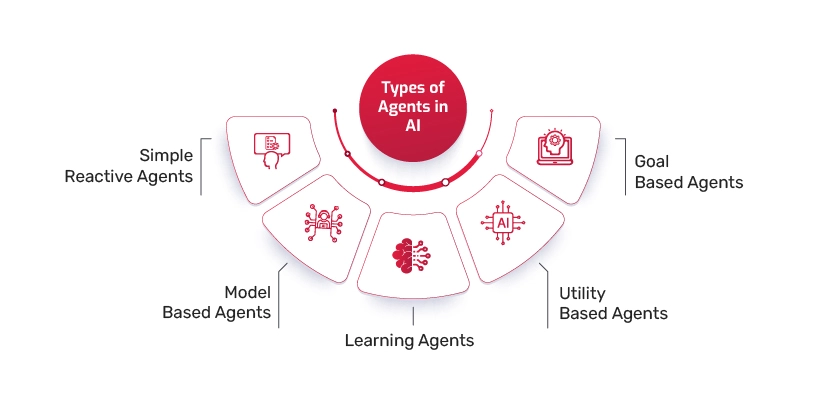
AI agents vary in complexity, ranging from basic systems with predefined rules to advanced agents capable of self-learning and adaptive decision-making. Below is an in-depth look at the main types:
-
Simple reflex agents
These agents respond directly to environmental stimuli using “if-then” rules. They operate purely reactively without storing or analyzing historical data.
Example: A thermostat increases or decreases temperature based on current readings.
Strengths:
- Quick and efficient for straightforward tasks.
- Minimal computational requirements.
Weaknesses:
- Cannot handle complex or dynamic environments.
- Limited by their inability to anticipate future events or consider past experiences.
-
Model-based AI agents
These agents maintain an internal representation of the environment (a model) and use it to predict how their actions will affect future states.
Example: A GPS navigation system that accounts for real-time traffic and suggests alternative routes.
Strengths:
- Can operate in dynamic and partially observable environments.
- Capable of adapting decisions based on predictions.
Weaknesses:
- More complex and computationally demanding than simple reflex agents.
- Accuracy depends on the quality of the internal model.
-
Goal-based AI agents
These agents are designed to take actions that achieve specific goals. Unlike model-based agents, they explicitly consider their objectives and evaluate which actions are most likely to achieve them.
Example: A robotic vacuum cleaner creating a path to clean an entire room while avoiding obstacles.
Strengths:
- Focused on achieving desired outcomes rather than just reacting to inputs.
- Capable of planning and prioritizing actions.
Weaknesses:
- Requires more sophisticated programming to define and evaluate goals.
- Computationally intensive for complex objectives.
-
Utility-based AI agents
These agents assess multiple possible actions and select the one that maximizes a “utility” value, which represents the agent’s measure of success (e.g., efficiency, cost, or safety).
Example: An AI energy management system optimizing power usage in a smart home to balance comfort and cost.
Strengths:
- Can handle trade-offs and optimize outcomes in multi-variable environments.
- Suitable for real-world applications requiring complex decision-making.
Weaknesses:
- Requires carefully defined utility functions, which can be challenging to create.
- Computational overhead increases with the complexity of the decision space.
-
Learning AI agents
These agents improve their performance over time by learning from data, experience, or interactions. Techniques like supervised learning, reinforcement learning, and unsupervised learning enable them to adapt and evolve.
Example: A recommendation system (e.g., Netflix) that improves content suggestions based on user behavior.
Strengths:
- Highly adaptable and capable of handling unknown scenarios.
- Continuously improves, leading to better performance over time.
Weaknesses:
- Requires large amounts of data and computational power for training.
- May exhibit unpredictable behavior in poorly trained or biased systems.
AI agent systems are incredibly diverse, with each type suited to different levels of complexity and problem-solving requirements. From simple reflex agents to learning agents, these systems provide the foundation for a wide range of applications, from industrial automation to personalized recommendations. Understanding their characteristics and capabilities is crucial for designing effective AI-driven solutions that address real-world challenges and opportunities.
How does an AI agent work?
An AI agent operates by interacting with its environment through a structured process of perception, decision-making, action execution, and often learning. This systematic approach enables it to perform tasks intelligently and adaptively.
The process begins with perception, where the agent gathers data from its surroundings using sensors or digital inputs. This data forms the basis for the agent’s understanding of the current state of its environment.
Next comes decision-making, where the agent processes the collected data to determine the best course of action. This step can be simple, relying on predefined rules, or highly complex, utilizing advanced models like machine learning to adapt and predict outcomes in real time.
After deciding, the agent moves to action execution. Here, it implements its decision through output mechanisms, such as generating responses, controlling devices, or performing specific tasks.
Finally, many AI agents include a feedback loop. This mechanism allows them to analyze the results of their actions, learn from their performance, and improve over time. The integration of perception, decision-making, action, and learning makes AI agents capable of functioning autonomously, solving problems efficiently, and optimizing processes in dynamic and complex environments.
Top 9 steps to build an AI agent system
1. Define your goal
Defining the goal is the first and most crucial step when developing an AI agent system. This step lays the foundation for the entire process, from design to deployment. You need to clearly identify the problem the AI agent will solve, its specific objectives, and the desired outcomes. A well-defined goal allows you to design appropriate features and evaluate effectiveness later.
For instance, if your goal is to create a chatbot for customer support, you might set measurable criteria such as responding to queries within 5 seconds or handling 80% of common questions without human intervention. Without clear goals, the project risks veering off course or becoming inefficient, wasting time and resources.
2. Choose suitable tools and libraries
The tools and libraries you select will greatly influence the efficiency and scalability of the system. Frameworks like TensorFlow, PyTorch, or OpenAI Gym offer powerful features, ranging from building machine learning models to simulating environments for testing. Selecting the right tools depends on the specific requirements of your project, such as the type of problem, speed requirements, or budget constraints. It’s also crucial to choose tools with strong community support and clear documentation, as these can help address challenges during development. For example, a reinforcement learning project might use OpenAI Gym for simulating environments, which simplifies testing and training the agent in realistic scenarios.
3. Pick a programming language
The choice of programming language is pivotal to implementing an AI agent system effectively. Python is often the top choice due to its simplicity and a rich ecosystem of libraries, such as NumPy, pandas, and scikit-learn, which streamline the development process. However, if your project requires high performance, such as real-time processing in robotics, C++ might be a better choice because of its speed and memory management capabilities. The language should align with the project’s specific requirements and the development team’s expertise. Making the right choice at this stage can save significant time and effort during later stages of development.
4. Gather and prepare training data
Data is the backbone of any AI system. Gathering the right data and processing it effectively is essential to ensure the system performs as intended. The data must be clean, free of noise, and consistent in format. For example, in a facial recognition project, the dataset should include diverse demographics, such as varying ages, genders, and lighting conditions, to ensure the system functions accurately across all scenarios. Additionally, data should be split into training, validation, and test sets to rigorously evaluate the system. Poor-quality data can lead to inaccurate predictions and render the system ineffective in real-world applications.
5. Develop the core system design
System design is the blueprint that lays the groundwork for the AI agent’s architecture. It should be modular, with clear components such as data collection, processing, and action layers. This modularity not only simplifies maintenance but also ensures scalability as the system evolves. An intelligent AI agent should also include a feedback mechanism to learn from its actions and improve over time. For instance, a smart energy management agent for a home could gather data from IoT sensors, analyze it to optimize energy usage, and adapt its strategy based on historical usage patterns to become increasingly efficient.
6. Train the model
Training is the stage where the AI agent learns to perform its assigned tasks effectively. Depending on the problem, you may use supervised learning, unsupervised learning, or reinforcement learning. This process involves feeding the agent a training dataset and evaluating its performance on unseen data. Key metrics such as accuracy, loss, and convergence rates must be monitored to ensure the model performs well. For instance, a recommendation system may train on user interaction data to suggest more relevant content. Insufficient training can result in errors that compromise the system’s reliability and usability.
7. Deploy the trained model
Deployment involves integrating the trained AI agent into its real-world environment. This step requires careful consideration of the platform, such as a cloud-based solution (AWS, Google Cloud) or on-premises infrastructure, depending on performance and security requirements. Scalability is critical to handle increasing demand, while robust security measures are necessary to protect sensitive data. For instance, deploying a chatbot on a cloud platform must ensure it can manage thousands of simultaneous user requests without downtime. Deployment is not just about “launching” the system but ensuring it operates smoothly and reliably in production.
8. Evaluate and test the agent
Testing is the phase where you verify whether the AI agent performs as intended. Comprehensive testing should cover typical use cases as well as edge cases and unexpected scenarios. For example, a facial recognition system must be tested under various lighting conditions, angles, and even partially obscured faces. Performance testing under heavy loads or with complex inputs is also essential to ensure the system is robust. By rigorously evaluating the agent, you can identify weaknesses and refine its functionality, reducing the risk of failure in real-world applications.
9. Monitor and continuously improve
Post-deployment, monitoring the system is crucial to ensure it remains effective as real-world conditions change. Collecting data from live operations can reveal flaws or inefficiencies that need to be addressed. Additionally, periodic updates to the model with fresh data ensure the system adapts to evolving trends or behaviors. For example, a fraud detection system must be regularly updated to counteract new fraud techniques. Continuous optimization and improvement are vital to the system’s long-term success and reliability, ensuring it stays relevant and effective in its application.
Each of these steps is interconnected and critical for developing a robust AI agent system. From defining clear goals to continuous post-deployment monitoring, every phase contributes to the system’s performance and success. By carefully addressing these steps, you can build an intelligent, adaptable AI agent that delivers measurable benefits and drives innovation in its application.
Conclusion
Building an AI agent system is a multifaceted process that combines clear goal-setting, careful planning, and technical execution. From defining the purpose of the agent to designing its architecture, training it with quality data, and continuously improving its performance, each step plays a critical role in creating a system that is both effective and reliable. These agents, capable of perceiving their environment, making decisions, and adapting to new situations, are reshaping industries by automating tasks, optimizing processes, and enabling innovative solutions.
The transformative potential of AI agents lies in their versatility and adaptability. They are not just tools for efficiency but catalysts for innovation, opening doors to new possibilities in fields like healthcare, finance, customer service, and beyond. By leveraging AI agents, businesses and individuals alike can unlock unprecedented opportunities to solve complex problems and improve everyday life.
For those intrigued by this technology, the journey of building an AI agent offers both challenges and rewards. Experimenting with AI agents whether simple or complex provides valuable insights into the power of artificial intelligence and its potential to create meaningful impact. Start small, learn continuously, and explore the endless possibilities AI agents have to offer. The future of AI is being written today, and your contributions can be part of that story.