Consensus Miami 2026 ran from May 5 to 7 at the Miami Beach Convention Center, drawing over 20,000 attendees across three days of keynotes, policy panels, an institutional summit, and a live hackathon on the show floor. Organized by CoinDesk, the conference has been running since 2015 and has become the broadest gathering the digital asset industry produces, not the most technical, not the most exclusive, but the one where the widest cross-section of the ecosystem actually shows up in the same room. Regulators, exchange founders, asset managers, policy advisors, and developers building their first product all attended the same event this year, and the tensions between those groups shaped the most interesting conversations of the week.
Varmeta’s CEO was in Miami for the full event. This is our recap of what actually happened, what it means, and why the conversations in Florida matter directly to the markets we work in across Vietnam and Southeast Asia.
The scale and structure of the event
Consensus Miami 2026 featured six stages, three summits, six content tracks, over 200 sessions, and more than 500 speakers, covering everything from Bitcoin ETF allocations to zero-knowledge proofs to AI-native payments. The Mainstage handled keynotes and the largest headline moments. The Agentic Commerce track, new this year, reflected the degree to which AI agent infrastructure has entered serious developer and investor conversation. The Institutional Summit ran as a parallel, invitation-only program for bank executives and fund managers working through digital asset strategy.
The theme organizers built the conference around bringing together three forces: crypto at scale, institutional finance, and agentic commerce. That framing was not arbitrary. Each of those three themes represents a different stage of the same underlying transition: assets moving natively on-chain, traditional financial institutions figuring out how to engage with that reality, and autonomous software beginning to transact on behalf of users and organizations without human intervention at each step.
The biggest announcement of the week: Bullish acquires Equiniti for $4.2 Billion
The single largest announcement at Consensus Miami came on Day 1, when Bullish, CoinDesk’s parent company, announced a $4.2 billion agreement to acquire Equiniti, a global transfer agent that serves as the system of record for nearly 3,000 blue-chip public companies and processes approximately $500 billion in annual payments. The deal positions Bullish to bridge traditional equity infrastructure with blockchain rails, enabling tokenized equities with real-time cap table visibility and automated corporate actions.
Clear Street, which maintained a Buy rating and a $50 price target on Bullish following the announcement, wrote that “Equiniti fills the most important gap in Bullish’s tokenization thesis: issuer access and transfer-agent authority.” The acquisition is expected to close in January 2027 and the combined company projects 20% revenue growth from tokenization and blockchain services as part of its 2027 to 2029 outlook. For the broader market, the deal signals that the tokenization of public equities is no longer a theoretical exercise, it is moving into the infrastructure layer that governs how ownership records are kept and transferred at scale.
Regulatory momentum: The GENIUS Act is law, the CLARITY act is next
The policy sessions at Consensus Miami took place against a specific and consequential backdrop. The GENIUS Act, signed into law in July 2025, established a comprehensive federal framework for payment stablecoins, and implementation is now underway through coordinated rulemakings from the OCC, FDIC, Treasury, FinCEN, and OFAC. Stablecoins have graduated from a policy debate to an implementation problem, and the firms that built compliance infrastructure early are the ones benefiting from that shift.
The CLARITY Act passed the U.S. House in July 2025 with strong bipartisan support and is now in front of the Senate, covering token classification, the jurisdictional boundary between the SEC and CFTC, developer protections for decentralized technology, and the framework for tokenized financial instruments. Senator Kirsten Gillibrand appeared on the Mainstage on Day 2 and said there will be no vote on the bill without an ethics provision limiting crypto involvement for senior government officials including the president. Patrick Witt, Executive Director of the White House Crypto Council, also spoke at the event, reflecting the degree to which digital asset policy has moved from a fringe conversation to one the executive branch is actively shaping.
Dave Lavalle, President of CoinDesk Indices, noted on the conference floor that the tone in Washington has shifted dramatically, with crypto regulation increasingly becoming a nonpartisan issue as lawmakers recognize the scale of innovation and investment entering the space. That observation matters for markets outside the United States. When U.S. regulatory frameworks solidify, they function as reference architectures for regulators in Southeast Asia, the Middle East, and Latin America who are building their own frameworks and looking for stable precedent to work from.
Stablecoins as infrastructure, not instruments
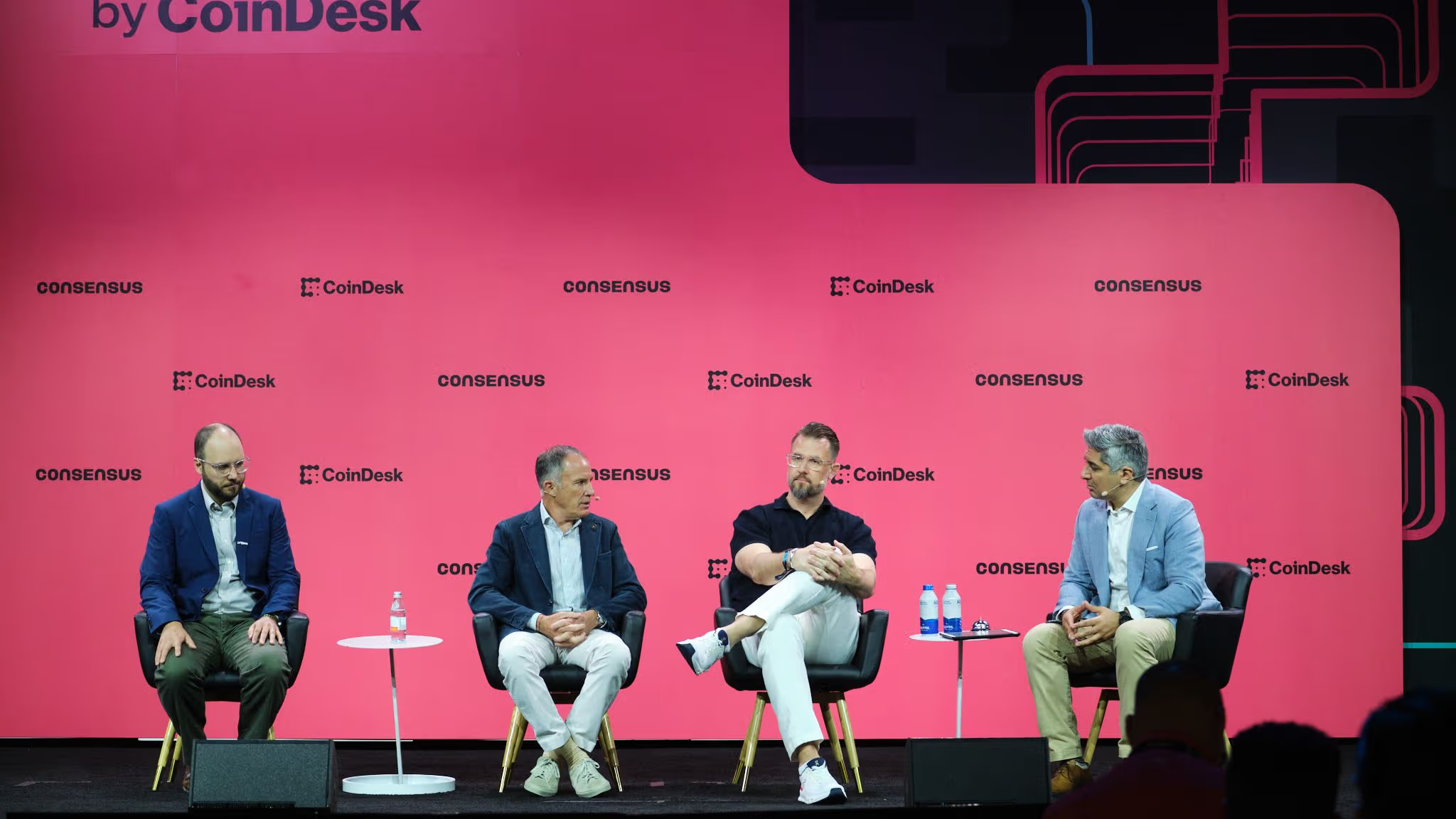
The conversation about stablecoins at Consensus Miami was qualitatively different from previous years. Executives from MoonPay, Ripple, and Paxos explained that clearer regulatory frameworks are reducing uncertainty for institutions exploring stablecoin products and on-chain settlement networks, and the market data supports that tone: stablecoin market capitalization sits at roughly $322 billion, up approximately 50% year-over-year, with JPMorgan’s tokenized deposit work, Citi’s Token Services, HSBC’s tokenized deposit pilots, Mastercard’s acquisition of BVNK, and SoFi’s unified fiat-crypto banking platform all pointing in the same direction.
Bridge executive Lindsey Einhaus said that large corporations are actively exploring stablecoins for treasury and global payments, pointing specifically to multinational firms looking for faster and cheaper settlement systems. AI agents were cited as a likely accelerant, autonomous software that can execute financial tasks would naturally route payments through stablecoin rails rather than correspondent banking networks, because the settlement speed and programmability are incomparably better. This connection between the stablecoin infrastructure buildout and the agentic commerce track was one of the more substantive threads running through the conference.
The agentic economy: Builders are already there
Erik Reppel, founder of the x402 protocol, said on stage that the agentic economy is estimated to reach $3 to $5 trillion by 2030. That number is speculative, but the behavioral evidence at the conference was concrete. The EasyA Hackathon, which ran live on the conference floor throughout the event, had nearly 1,000 developers competing, with engineers from Microsoft and Google alongside crypto-native teams, nearly all of them building around the theme of AI agents.
Coinbase sponsored challenges around x402, an emerging framework for AI-agent payments, while the winning project, Dairy Price API x402, built a pay-per-call commodity pricing service that allows AI agents to access market data without traditional API keys, with payments settled directly in USDC through x402 on Base. The pattern visible in those winning projects was consistent: the most compelling use cases are not about speculating on token prices but about automating tasks that currently require human coordination at each step. Paying for an API call, verifying an identity check, releasing escrowed funds when a condition is met, these are the workflows that on-chain infrastructure makes cheaper and faster to build.
PitchFest, the startup competition held alongside the hackathon, was won by Coinbax, whose programmable escrow system helps banks manage compliance for stablecoin payments using smart contracts to hold funds while third-party services perform identity, sanctions, and transaction-risk checks before releasing payment. The fact that a compliance tool for bank stablecoin payments won the startup competition at the world’s largest crypto conference is its own kind of signal about where the market is heading.
What the institutional presence actually meant
Morgan Stanley, JPMorgan Chase, Charles Schwab, Mastercard, BlackRock, and Goldman Sachs all sent representatives to Consensus Miami 2026. The meaningful question is not whether they attended but what they were working on. Tom Zschach, former chief innovation officer at SWIFT, said on a panel that he expects tokenization as a trend to continue, and that his belief is that all value will eventually be digital and everything that can be tokenized will be tokenized. That framing, coming from someone who spent years at the center of global interbank payments infrastructure, carries different weight than the same claim made by a venture investor.
Consensys CEO Joseph Lubin declared at Consensus that the world’s entire economy will eventually be tokenized, envisioning a complete on-chain rewrite of global finance. Whether that specific claim proves accurate or not, the operational behavior of BlackRock, Fidelity, JPMorgan, and DTCC over the past 18 months suggests the direction is not in serious dispute, only the pace and the infrastructure layer on which it happens.
Reading Consensus Miami from Southeast Asia
For markets like Vietnam, Thailand, and Malaysia, the developments at Consensus Miami are not abstract. The GENIUS Act’s implementation framework for payment stablecoins is being watched closely by central banks across ASEAN as a reference model. The tokenization infrastructure being built by Bullish-Equiniti, Securitize, and DTCC is the same infrastructure that will eventually connect to APAC capital markets as cross-listing and foreign investment flows move toward on-chain settlement.
What Consensus Miami 2026 confirmed, more than anything else, is that the infrastructure layer is being built simultaneously from both ends: the regulatory frameworks are hardening in Washington, and the production deployments are already running in markets like Vietnam. The gap between those two realities is closing faster than most people outside the region realize. Varmeta has been operating at that intersection, as Hedera’s ecosystem partner across Vietnam and APAC and the conversations we had in Miami reinforced that the timing for serious enterprise and government adoption in Southeast Asia is not a future consideration. It is happening now.
The gap between what was discussed on stage at the Miami Beach Convention Center and what is being built on the ground in Vietnam is narrowing. The institutional frameworks are being established in Washington. The technology is already running on mainnet. The question for APAC markets now is which organizations have the local expertise, the regulatory relationships, and the production infrastructure to connect those two realities.
If your organization is exploring DLT deployment, stablecoin settlement, or enterprise blockchain integration in Vietnam or the wider APAC region, Varmeta works directly with financial institutions, enterprises, and government bodies to take these systems from architecture to operation. Reach us at www.var-meta.com/contact.