In the fast-paced world of cryptocurrency trading, arbitrage has emerged as a reliable strategy to capitalize on price differences between exchanges. Imagine Bitcoin trading at $30,000 on one exchange and $30,200 on another. A trader who buys at the lower price and sells at the higher price can lock in a profit almost instantly. While this sounds simple in theory, the reality is far more complex—these opportunities often exist for mere seconds, requiring exceptional speed, precision, and execution. This is where crypto arbitrage bots come into play.
Crypto arbitrage bots are automated software programs that scan multiple exchanges simultaneously, identify price discrepancies, and execute trades faster than any human could. By eliminating manual delays, these bots provide a significant edge in a market where fractions of a second can determine profitability. Research highlights their effectiveness: Automation is used to some extent by more than 65% of individual retail traders and up to 99% of institutional investors’ activities, underscoring the growing importance of these tools in the trading ecosystem.
In this guide, we’ll break down how crypto arbitrage bots work, why they’re essential for traders, and how you can build one of your own. Whether you’re a seasoned trader looking to automate your strategy or a developer exploring the potential of algorithmic trading, this article will provide you with the insights and tools needed to get started.
What is a crypto arbitrage bot?

A crypto arbitrage bot is an automated tool designed to identify and capitalize on price discrepancies for the same cryptocurrency across different platforms or within the same exchange. In the highly dynamic crypto market, prices can vary due to differences in liquidity, trading volume, or regional demand. Arbitrage bots take advantage of these variations faster than any manual trader could, ensuring profits from small but consistent price gaps.
Types of crypto arbitrage
Simple arbitrage
Simple arbitrage involves buying a cryptocurrency on one exchange where the price is lower and immediately selling it on another exchange where the price is higher. For example, if Bitcoin is $30,000 on Exchange A but $30,200 on Exchange B, a trader can buy low on A and sell high on B to earn a quick profit.
Triangular arbitrage
Triangular arbitrage takes place within a single exchange. It involves exploiting price differences between three different trading pairs. For instance, you could trade BTC → ETH → USDT → BTC, taking advantage of slight mismatches in conversion rates to make a profit. This strategy requires precision and speed, as these opportunities can disappear quickly.
Spatial arbitrage
Spatial arbitrage focuses on price differences across geographically distant exchanges. For example, a trader might buy Bitcoin on a U.S. based exchange where it’s cheaper and sell it on an Asian exchange where demand has driven up the price. While profitable, spatial arbitrage often involves higher latency and logistical challenges, such as transfer delays or regional regulations.
The importance of speed and automation in arbitrage
In arbitrage trading, speed is everything. The crypto market operates 24/7, and price discrepancies often last for only a few seconds. This is where automation becomes essential. A crypto arbitrage bot can monitor prices across multiple exchanges simultaneously, calculate profitable opportunities, and execute trades instantly all without human intervention. This eliminates delays and increases the chances of locking in profits.
By leveraging automation, traders can take full advantage of arbitrage opportunities while reducing risks associated with manual execution, such as slow reaction times or calculation errors. Crypto arbitrage bots have become indispensable tools in the fast-moving world of cryptocurrency trading, helping both beginners and experienced traders stay competitive.
How do crypto arbitrage bot work?
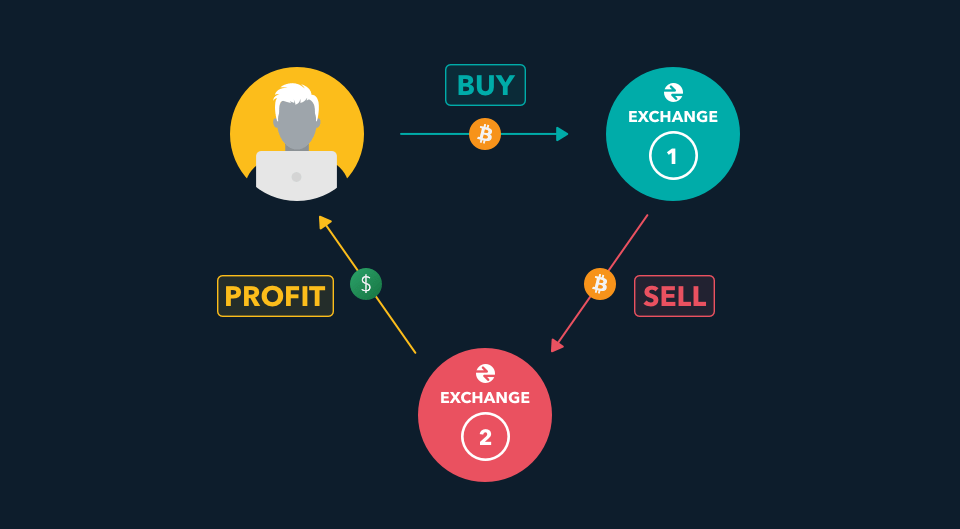
Crypto arbitrage bots are automated trading tools that play a key role in exploiting price differences across cryptocurrency exchanges. These bots streamline the entire arbitrage process, eliminating the delays and errors associated with manual trading. They continuously monitor markets, identify profitable opportunities, and execute trades faster than any human could, making them indispensable in a market where speed and precision are everything.
Key functions of arbitrage bot
Monitoring price differences across multiple exchanges
The bot constantly scans prices for the same cryptocurrency across multiple exchanges in real time. By comparing values simultaneously, it can pinpoint price discrepancies and flag opportunities for arbitrage.
Automating the buy/sell process to exploit opportunities
Once a profitable price difference is identified, the bot automates the buying and selling process. It places orders instantly, ensuring the opportunity is seized before the price gap disappears, something impossible to achieve manually in such a volatile market.
Managing transaction fees, latency, and market risks
Successful arbitrage isn’t just about spotting price gaps; profits can be eroded by fees, delays, or market changes. Bots are programmed to factor in exchange transaction fees, network latency, and slippage risk to ensure trades remain profitable. This strategic approach minimizes risk while maximizing returns.
Components of a crypto arbitrage bot
Data gathering
This module is responsible for fetching real-time price data from multiple exchanges using APIs. It continuously updates prices, volumes, and trading conditions, ensuring the bot has the most current market data to identify opportunities.
Decision-making algorithm
The decision-making algorithm is the brain of the bot. It processes the gathered data, identifies arbitrage opportunities, and calculates profitability by factoring in fees and transfer times. It then determines when and where trades should be executed.
Execution engine
This is the action center of the bot. The execution engine places buy and sell orders on the identified exchanges as quickly and efficiently as possible. Its speed is critical, as even a small delay can result in missed opportunities in a fast-moving market.
Risk management module
To ensure safe and profitable trading, the risk management module monitors fund allocation, sets trade limits, and implements safety measures like stop-loss features. This component ensures the bot operates within pre-defined risk thresholds, protecting users from unexpected losses.
Steps to build a crypto arbitrage bot
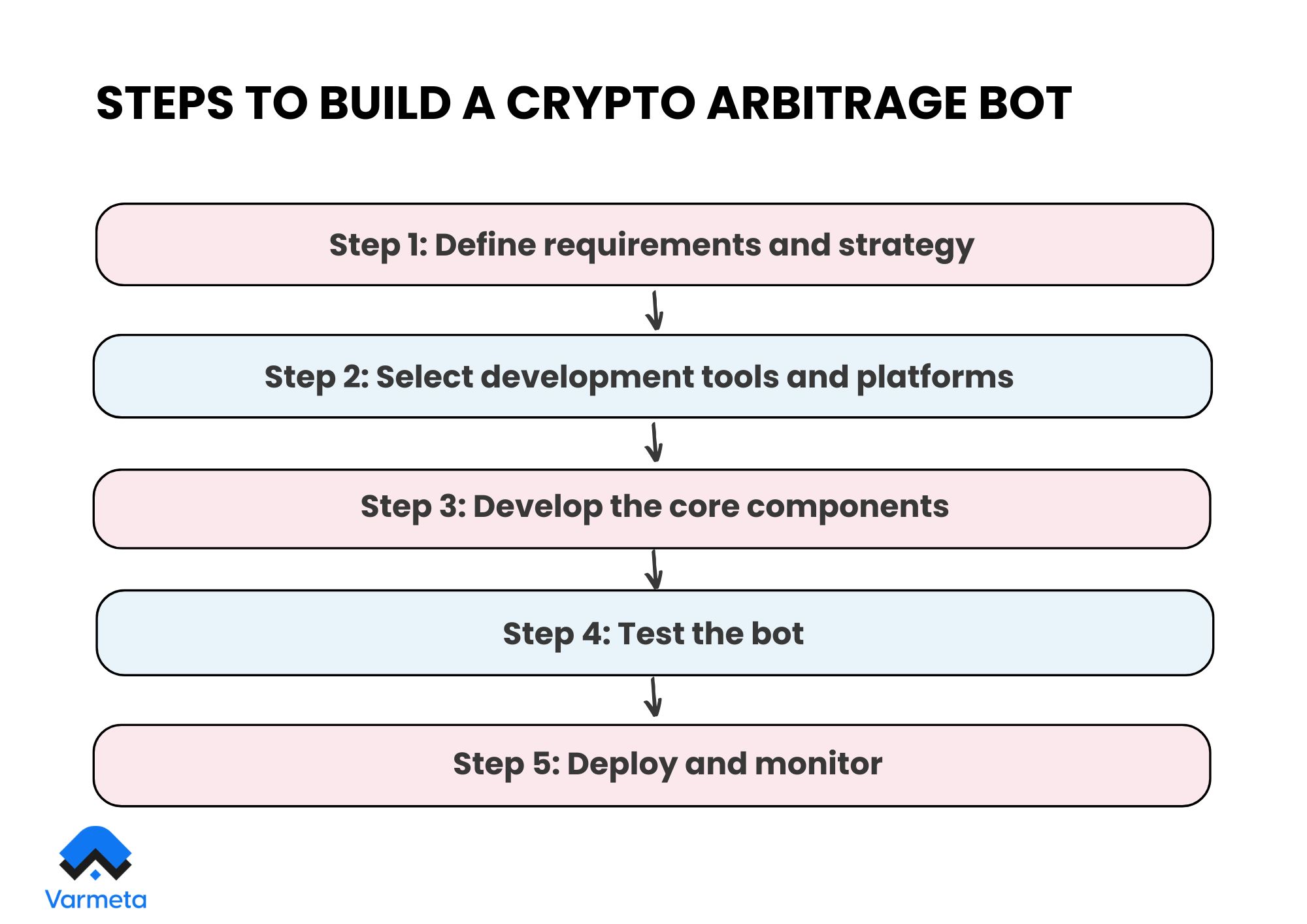
Building a crypto arbitrage bot involves careful planning, the right tools, and thorough testing to ensure smooth operation. Below is a step-by-step guide to help you develop and deploy a functional arbitrage bot.
Step 1: Define requirements and strategy
Before you start coding, you need to establish your strategy and goals.
Choose the type of arbitrage: Decide whether to focus on simple arbitrage (across exchanges), triangular arbitrage (within a single exchange), or spatial arbitrage (across geographically distant platforms).
Select target exchanges and cryptocurrencies: Identify which exchanges you will monitor (e.g., Binance, Kraken, or Coinbase) and which cryptocurrencies you will trade. This decision should align with factors like liquidity, transaction fees, and market activity.
Step 2: Select development tools and platforms
To build the bot, you need the right tools and development environment.
Programming languages: Use popular programming languages like Python or JavaScript for their flexibility and extensive libraries.
APIs: Access real-time exchange data through exchange APIs like those from Binance, Kraken, or Coinbase. These APIs will allow your bot to fetch prices, place trades, and check balances.
Libraries and frameworks:
- Pandas and NumPy: Essential for data handling and analysis in Python.
- ccxt: A widely used library for integrating with multiple exchange APIs. It simplifies communication with exchanges and reduces development time.
Step 3: Develop the core components
Once your tools are ready, start building the bot’s core functionality.
Data collection module : Build a module to fetch real-time price data from multiple exchanges using APIs. This ensures the bot can monitor price movements and identify discrepancies.
Arbitrage algorithm:
- Implement logic to detect price differences across your selected exchanges or pairs.
- Factor in transaction fees, latency, and transfer times to calculate actual profitability and filter out unviable trades.
Trading execution module: Automate the buy/sell orders using exchange APIs to capitalize on arbitrage opportunities quickly. This module ensures trades are executed seamlessly without manual intervention.
Risk management features : Add safety measures like stop-loss limits, capital allocation rules, and error handling to protect against unexpected issues like API failures, network delays, or rapid market changes.
Step 4: Test the bot
Thorough testing is critical to ensure your bot performs as expected in different scenarios.
Backtesting: Run the bot using historical data to evaluate its performance and identify weaknesses in the arbitrage algorithm.
Simulated testing: Use test environments or paper trading to monitor real-time performance without risking actual funds. This allows you to refine the bot’s behavior and execution strategy.
Step 5: Deploy and monitor
After testing, you can deploy the bot on live exchanges, but proceed cautiously.
- Start with limited capital to minimize risks while monitoring the bot’s behavior in a real market environment.
- Continuously monitor performance metrics, including profit margins, latency, and execution success rates.
- Make adjustments as needed to optimize performance and adapt to changing market conditions.
Building a crypto arbitrage bot requires a solid understanding of trading strategies, programming, and risk management. By carefully following these steps, defining your strategy, selecting tools, developing core components, testing thoroughly, and monitoring live performance you can create a powerful, automated tool to capitalize on arbitrage opportunities and maximize profitability in the crypto market.
Benefits of creating a crypto arbitrage bot
Building a crypto arbitrage bot offers traders significant advantages in the fast-moving cryptocurrency market. With price differences across exchanges lasting only moments, a well-designed bot can maximize profits, reduce risks, and save valuable time. Here are the key benefits of creating your own crypto arbitrage bot:
Speed and efficiency
In arbitrage trading, every second counts. A crypto arbitrage bot operates at lightning speed, scanning multiple exchanges simultaneously and executing trades instantly. Unlike manual trading, which is prone to delays and human error, a bot ensures you capitalize on opportunities the moment they arise, giving you a competitive edge.
24/7 trading
The cryptocurrency market never sleeps, and neither does your bot. By automating the arbitrage process, your bot can work round the clock to monitor prices and seize profitable opportunities even when you’re off the clock. This ensures you never miss out on arbitrage trades due to time zone differences or fatigue.
Elimination of emotional trading
Human traders often make decisions influenced by fear, greed, or hesitation. A crypto arbitrage bot eliminates these emotional biases, executing trades based purely on pre-defined logic and strategies. This consistency leads to better, more reliable trading results over time.
Maximizing profit opportunities
Arbitrage opportunities can be small, but they are frequent. A bot enables you to profit from even minor price discrepancies across exchanges, something that would be impractical manually. Over time, these small gains add up to substantial profits, making the bot an efficient revenue-generating tool.
Creating a crypto arbitrage bot is not just about automation, it’s about maximizing efficiency, reducing risk, and consistently capitalizing on opportunities in the market. By leveraging speed, accuracy, and 24/7 availability, a well-built bot gives you a powerful tool to stay ahead of the competition and optimize your trading outcomes.
Conclusion
Creating a crypto arbitrage bot offers a powerful way to navigate the fast-paced and volatile cryptocurrency market. By automating the trading process, you can take advantage of price discrepancies across exchanges with unmatched speed, efficiency, and precision. Beyond saving time, a bot eliminates emotional decision-making, ensures 24/7 trading, and allows you to customize strategies to suit your goals. Whether you’re looking to maximize profits, scale your operations, or maintain consistency, a well-designed arbitrage bot provides the tools to stay competitive and profitable in an ever-evolving market.