The rise of generative AI is revolutionizing customer service, fundamentally changing how businesses interact with and support their customers. No longer confined to scripted responses and rigid workflows, AI-powered systems now enable dynamic, intelligent, and highly personalized interactions at scale. This shift is not just about automation, it’s about enhancing customer experiences, making engagements more human-like, responsive, and intuitive.
Since the release of advanced AI tools like ChatGPT, businesses have rapidly adopted generative AI to streamline support, reduce wait times, and improve service quality. According to a recent BCG study, 95% of service leaders predict that AI-driven chatbots will become a standard in customer support by 2025, with potential productivity gains of 30% to 50%. This surge in AI adoption is reshaping customer expectations, driving businesses to rethink their service strategies to stay competitive.
In this article, we explore how generative AI is transforming customer service, from real-world use cases to strategic implementation methods and the challenges that lie ahead. Whether you’re a business leader, customer service manager, or tech enthusiast, understanding this evolution is key to leveraging AI for a smarter, more efficient, and customer-centric future.
What is generative AI in customer service?

Generative AI is revolutionizing customer service by enabling intelligent, context-aware, and human-like interactions. Unlike traditional automation, it analyzes intent, understands sentiment, and adapts responses in real time, creating more personalized and engaging customer experiences.
AI-powered tools like chatbots and virtual assistants can answer inquiries, resolve issues, and provide relevant information independently, reducing response times while improving accuracy. Rather than replacing human agents, generative AI enhances support teams by automating routine tasks, allowing them to focus on complex issues that require human expertise.
By boosting efficiency and scaling personalized experiences, generative AI is setting a new standard for customer interactions, making them smarter, faster, and more intuitive than ever before.
Key technologies powering generative AI in customer service
Generative AI in customer service isn’t just about automation, it’s about creating meaningful, human-like interactions that enhance the customer experience. Behind the scenes, several advanced technologies work together to make this possible. Let’s break down the core innovations driving this transformation:
1. Natural Language Processing (NLP): Making AI conversations more human
At the heart of generative AI is Natural Language Processing (NLP), which allows AI to understand, interpret, and respond to human language in a natural and conversational way.
- NLP enables chatbots and virtual assistants to grasp context, detect sentiment, and adjust tone based on the conversation.
- Unlike traditional customer support bots that rely on rigid scripts, NLP-powered AI can handle complex queries, recognize intent, and even detect emotions to deliver more personalized responses.
- With advancements in context awareness and multi-turn conversations, AI-powered customer service is moving closer to replicating real human interactions, offering smoother and more engaging experiences.
Example: A customer reaching out about a delayed order might express frustration. NLP allows the AI to recognize the emotion and respond with empathy, rather than just providing a standard tracking update.
2. Machine learning: Making AI smarter over time
Unlike static rule-based systems, machine learning (ML) enables AI to continuously improve by learning from past interactions. The more data it processes, the better it gets at understanding customer needs and refining its responses.
- ML algorithms analyze past conversations, identify patterns in customer behavior, and adjust responses dynamically to enhance accuracy.
- AI can predict customer preferences based on previous interactions, helping businesses deliver more proactive support.
- Over time, machine learning allows AI to become more efficient, reducing response errors and improving problem resolution rates.
Example: If a customer frequently asks about a specific product, ML helps the AI anticipate their needs, providing relevant recommendations before they even ask.
3. Deep learning: Unlocking advanced customer insights
Deep learning takes AI to the next level by allowing it to process large amounts of unstructured data, recognize patterns, and predict customer behavior with incredible accuracy.
- It enables AI to detect subtle cues in customer inquiries, helping businesses understand why customers are reaching out, not just what they are asking.
- Deep learning powers sentiment analysis, allowing AI to recognize frustration, urgency, or satisfaction and adjust its responses accordingly.
- Businesses can leverage deep learning to forecast trends in customer behavior, helping them proactively improve services and reduce common pain points.
Example: A deep learning-powered AI system might recognize that customers tend to reach out for support when a product is nearing the end of its lifecycle, allowing businesses to proactively offer maintenance tips or renewal discounts before the issue arises.
Generative AI is not just about automation, it’s about enhancing the quality of customer interactions through NLP-powered conversations, machine learning-driven improvements, and deep learning-based predictions. As these technologies continue to evolve, AI-driven customer service will become smarter, more intuitive, and increasingly capable of providing real-time, human-like support at scale. Businesses that embrace these advancements are not just improving efficiency, they’re redefining what great customer service looks like.
How generative AI is transforming customer service: Real-world use cases
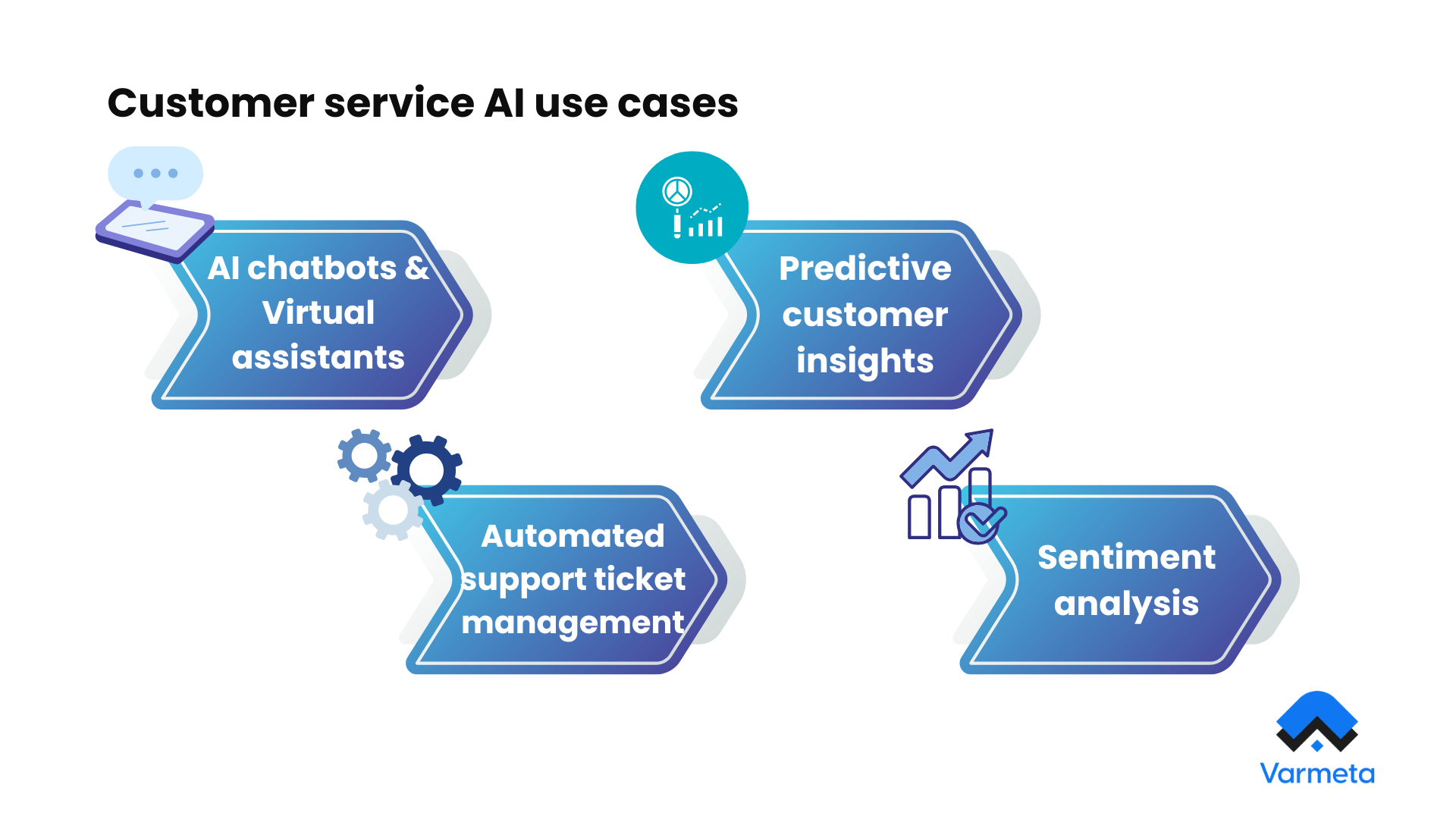
Source: Varmeta
Generative AI is redefining customer service, enabling businesses to offer faster, smarter, and more personalized support at scale. No longer limited to simple chatbots or static FAQ systems, AI is now capable of understanding context, predicting customer needs, and even recognizing emotions. Here’s how businesses are leveraging generative AI to revolutionize customer interactions:
1. AI chatbots & Virtual assistants
AI-powered chatbots and virtual assistants have moved beyond basic scripted responses. With advanced natural language processing (NLP) and deep learning, they can:
- Engage in natural conversations, understanding context and tone
- Handle a wide range of customer queries, from order tracking to troubleshooting
- Operate 24/7, providing real-time assistance without human intervention
- Reduce wait times, allowing human agents to focus on more complex cases
2. Automated support ticket management
Managing customer support tickets manually can be slow and inefficient, leading to delayed responses and frustrated customers. Generative AI can automate ticket classification, routing, and resolution, ensuring a smoother experience for both customers and support teams.
- Categorizes tickets automatically based on urgency and issue type
- Routes requests to the right department or agent, reducing response time
- Provides suggested responses for agents, improving efficiency
- Learns from past cases, continuously improving issue resolution
3. Predictive customer insights
Instead of waiting for customers to reach out with problems, AI can anticipate their needs and offer proactive solutions. By analyzing customer behavior, purchase history, and past interactions, AI can:
- Predict when a customer might need assistance before they even ask
- Offer relevant solutions or promotions tailored to individual needs
- Identify at-risk customers and suggest retention strategies
- Reduce churn rates by addressing customer concerns early
4. Sentiment analysis
Generative AI doesn’t just process words, it understands emotions. Sentiment analysis allows businesses to:
- Detect frustration, satisfaction, or urgency in customer messages
- Prioritize high-risk interactions, ensuring immediate human intervention when needed
- Analyze trends in customer feedback to improve services
- Refine chatbot responses to sound more empathetic and human-like
By enabling real-time support, predictive insights, and emotionally aware interactions, businesses can provide seamless, proactive, and deeply personalized service experiences. As AI continues to evolve, companies that embrace these advancements will set new standards in customer satisfaction, loyalty, and operational excellence.
Benefits of generative AI in customer service

Generative AI is reshaping customer service, not just by making it faster, but by making it smarter, more efficient, and truly customer-centric. Whether it’s handling thousands of inquiries at once, providing instant, personalized responses, or cutting operational costs, AI-driven customer support is setting a new standard for how businesses engage with their customers.
Improved customer experience
Customers today expect instant responses and tailored solutions, and generative AI delivers both. AI-powered chatbots and virtual assistants can provide personalized assistance, recognizing customer history, preferences, and context. Unlike traditional support systems, these AI models continuously learn and refine their responses, ensuring interactions feel more natural and intuitive.
With 24/7 availability, AI eliminates long wait times, allowing customers to get help at any time, in multiple languages, and across various communication channels. By handling inquiries efficiently and proactively, AI enhances customer satisfaction and loyalty.
Cost efficiency
Maintaining a large customer service team can be costly, especially as businesses scale. AI reduces operational expenses by automating routine tasks, minimizing the need for extensive human intervention. Chatbots and AI-driven ticketing systems can handle a high volume of requests, freeing up human agents to focus on complex issues that require critical thinking and emotional intelligence.
AI also reduces errors and inconsistencies, decreasing the need for follow-up interactions and improving first-contact resolution rates. This leads to significant savings while maintaining high-quality customer service.
Scalability
Businesses often struggle with fluctuating customer service demands, especially during peak seasons or product launches. AI provides seamless scalability by handling thousands even millions of interactions simultaneously without any drop in efficiency.
Whether responding to customer queries in real-time, assisting with troubleshooting, or managing appointment bookings, AI ensures that no customer is left waiting. It can also integrate across multiple platforms, including chat, email, social media, and voice support, creating a unified service experience regardless of the communication channel.
Consistency across all touchpoints
One of the biggest challenges in customer service is maintaining uniform quality across different support channels. AI ensures that every response is accurate, aligned with company policies, and adapted to the customer’s tone and sentiment. Unlike human agents, who may vary in approach or experience, AI delivers a standardized level of service every time.
AI also plays a crucial role in knowledge management, ensuring that all responses reflect the latest product information, company guidelines, and customer service protocols. This reduces miscommunication and improves overall brand reliability.
Challenges of implementing generative AI in customer service
While generative AI offers transformative benefits, integrating it into customer service comes with critical challenges that businesses must navigate.
- Data privacy & security: AI systems handle vast amounts of sensitive customer data, making privacy protection and cybersecurity essential. Ensuring compliance with regulations like GDPR and deploying robust encryption and authentication protocols are crucial to maintaining trust.
- Integration with existing systems: Many companies rely on legacy infrastructure that isn’t designed for AI-driven automation. Seamless integration requires upgrading outdated systems, ensuring compatibility, and retraining teams to work alongside AI solutions.
- Balancing AI & human interaction: While AI enhances efficiency, it lacks human empathy and complex problem-solving skills. Striking the right balance between automation and human support is key to delivering efficient yet empathetic customer experiences.
Successfully adopting generative AI requires a strategic approach, ensuring security, optimizing system integration, and maintaining a human-centric service model.
The future of generative AI in customer service: A new era of intelligent support
Generative AI is not just transforming customer service today, it’s shaping the future of how businesses and customers interact. As AI technology evolves, customer service will become more proactive, intuitive, and seamlessly integrated into everyday experiences. The key to this transformation lies in continuous advancements, human-AI collaboration, and the strategic adoption of AI-driven solutions.
Advancements in AI technology
AI is rapidly evolving, with new breakthroughs in natural language processing (NLP), contextual understanding, and emotional intelligence. Future AI-driven customer support will go beyond answering basic queries, it will be capable of understanding intent, predicting customer needs, and offering highly personalized solutions before customers even ask.
We’re already seeing AI models that can hold multi-turn conversations, detect sentiment in real-time, and adjust their tone to match the customer’s emotions. As these capabilities improve, AI will move from being just a support tool to a strategic partner in customer engagement.
AI and human collaboration
The future of customer service isn’t about replacing human agents with AI, it’s about creating a seamless collaboration between humans and AI-driven systems. While AI can handle routine inquiries, transactional requests, and data-driven insights, human agents will focus on complex problem-solving, emotional engagement, and high-value interactions.
AI will act as an intelligent assistant, providing agents with real-time insights, suggested responses, and predictive analytics, enabling them to deliver faster and more informed support. This hybrid model ensures that efficiency doesn’t come at the expense of human connection, which remains a crucial element in customer service.
Industry predictions
By 2030, AI-powered customer service will no longer be a competitive advantage, it will be an industry standard. Businesses that fail to adopt AI-driven solutions risk falling behind as customer expectations shift toward real-time, AI-assisted interactions.
- AI-driven voice assistants will handle complex conversations just as well as human agents.
- Hyper-personalized customer experiences will be the norm, with AI anticipating and solving customer issues before they arise.
- Omnichannel AI support will provide a consistent experience across chat, email, voice, and social media, ensuring seamless interactions regardless of the platform.
- AI-powered emotional intelligence will allow businesses to gauge customer satisfaction in real time, automatically escalating cases that require human empathy.
Conclusion
Generative AI is redefining customer service, making interactions faster, more intelligent, and highly personalized. By automating routine inquiries, enhancing human-AI collaboration, and delivering 24/7 support, businesses can boost efficiency, reduce costs, and improve customer satisfaction.
With AI adoption accelerating, companies that embrace this transformation now will gain a competitive edge. The key is a strategic approach, integrating AI into existing systems, training teams to work alongside it, and continuously refining AI models for better performance.