If you are looking to scale your AI game in 2026, it has probably become clear that just “having data” isn’t enough anymore. There is a need to control it, manage it, and have a solid plan for it. But honestly, what’s the actual difference between a data governance framework, a management one, or a strategy?
This guide will clear the fog so a tech stack can be built that doesn’t just store data but actually wins. Stick around, because by the end of this, the specific “rules” to set and “tools” to buy will be clear.
1. The Foundation of Modern Data Architecture
In the old days, data was just thrown into a warehouse for structured reporting. But in 2026, AI-powered analytics have flipped the script. Modern enterprises are architecting intelligent platforms that handle unstructured, streaming, and multimodal data to support real-time decision-making.
The problem? Most companies have “platform sprawl” and integration complexity. There are tools for everything, but no glue holding them together. An integrated architecture is no longer a luxury; it’s a mechanical necessity to avoid getting burned by surprise bills or biased AI models. Organizations that effectively leverage these integrated platforms outperform peers by up to 20% in operational efficiency.
2. What is a Data Governance Framework?
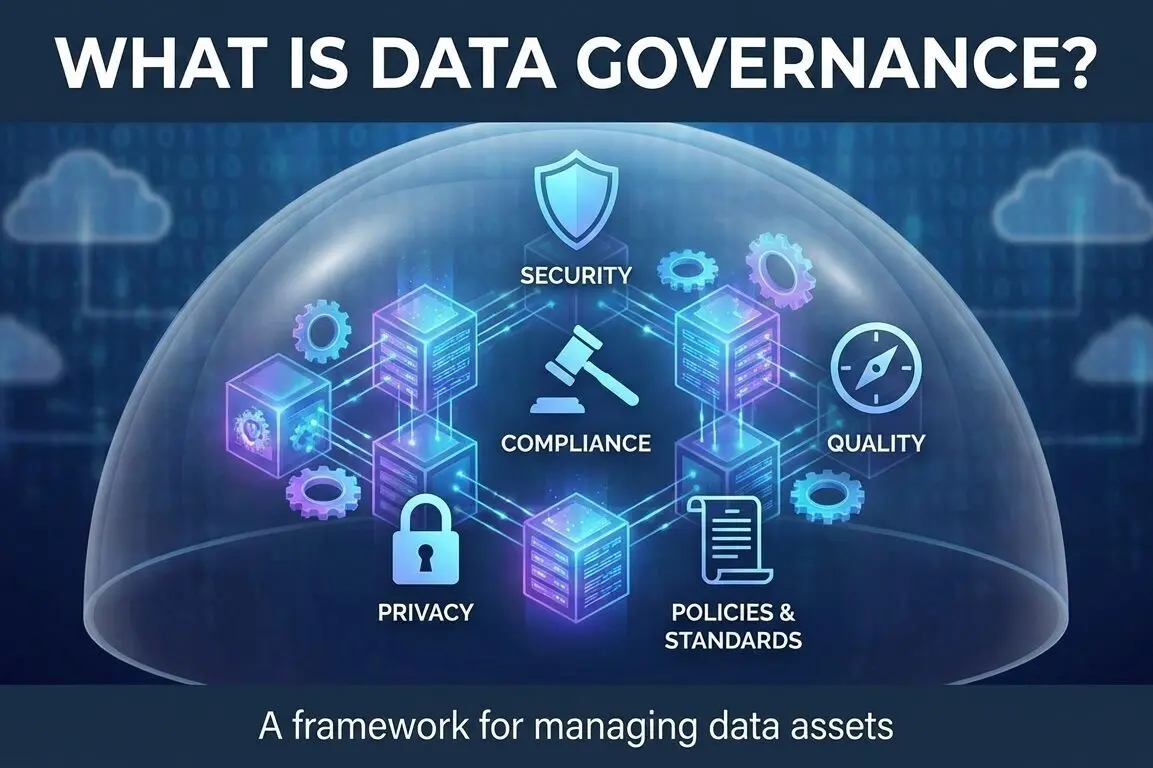
Let’s talk about the big one. A data governance framework is the collection of “rules of engagement” for data. It’s not the software itself; it’s the blueprint that tells who is allowed to touch what, how accurate the data needs to be, ensuring strict data compliance, and how to stay out of legal trouble.
2.1 Accountability and Roles
A solid framework starts with people. There is a need to define exactly who is responsible for data quality and AI ethics. This often involves setting up interdisciplinary AI ethics boards to assess models before deployment. Without these roles, AI systems may perpetuate biases, resulting in reputational damage and legal consequences.
2.2 Ethics, Fairness, and Bias Mitigation
In 2026, “algorithmic bias” cannot be ignored as it reinforces societal inequalities. A governance framework mandates bias detection methods, fairness-aware machine learning models, and continuous audits. This ensures that decision-making algorithms are transparent and justifiable to stakeholders.
2.3 Regulatory Compliance (GDPR, CCPA, and Beyond)
The framework is a shield against lawsuits and a cornerstone for data compliance. Regulations like the GDPR and CCPA require stringent practices to protect consumer rights. The EU AI Act and the US AI Bill of Rights now mandate informed consent and the “right to explanation” for AI decisions. Failing to align with these legal frameworks leads to legal penalties and a loss of consumer trust.
3. What is a Data Management Framework?
If governance is the “law,” then a data management framework is the “infrastructure”. It’s the technical execution of the data lifecycle. While Data Governance Framework says “only authorized people can see this,” management is the code that actually locks the door.
3.1 Data Engineering and Pipelines
This is the “doing” layer. It involves data ingestion, transformation, cleansing, and building the pipelines that move data from point A to point B. In 2026, this often means moving toward “Lakehouse” architectures that unify data lakes and warehouses into a single cohesive ecosystem.
3.2 Metadata-First Architecture
A huge trend right now is the “metadata-first” approach. Instead of sending raw, sensitive values to a Large Language Model (LLM), only the metadata, like schema definitions, column names, and computed metrics, is sent. This allows the AI to generate precise analytical queries and insights without ever seeing the actual raw underlying data, ensuring privacy and accuracy simultaneously.
3.3 Master Data Management (MDM) and Data Quality
Management ensures there is a “single source of truth” through data cleansing and cataloging. It focuses on the actual data crunching using deterministic algorithms. This prevents the nightmare scenario where different teams are looking at conflicting data sets, which would otherwise undermine the principles of governed analytics.
4. Key Differences: Data Governance vs. Management vs. Strategy
These terms are often used interchangeably, but they shouldn’t be. Think of it like building a house: Strategy is deciding to build; Governance is the building code; Management is the actual construction.
| Feature | Data strategy | Data governance framework | Data management |
| Primary focus | The “Why” and “What” | The “Who” and “Rules” | The “How” and “Tools” |
| Objective | Aligning data with business goals and ROI | Ensuring trust, security, and compliance | Technical execution and maintenance |
| Typical output | Roadmap and Investment plans | Ethics boards and audit trails | Scalable pipelines and data lakes |
| Example task | Deciding to shift from siloed systems | Setting data minimization rules | Engineering a real-time data pipeline |
5. Examples of Modern AI-Ready Platforms
When ready to implement a data governance framework, a platform is needed that can handle both the “rules” and the “tools”. In 2026, a few names dominate the enterprise space.
5.1 Microsoft Fabric (Unified SaaS)
Fabric is the “all-in-one” solution that eliminates the need for multiple fragmented tools. It combines data engineering, warehousing, and real-time analytics into a single SaaS environment. It uses Microsoft Purview for strong, simplified governance across all workloads.
5.2 Databricks (The Lakehouse Leader)
If a team is heavy on data science and machine learning, Databricks is a top choice. It pioneered the “Lakehouse” architecture, enabling unified storage for both structured and unstructured data. It stands out for its advanced ML lifecycle management (MLflow) and support for large-scale AI training.
5.3 IBM watsonx.data (Governance-First)
IBM has doubled down on “responsible AI” and enterprise trust. Their platform is built specifically for industries prioritizing AI accountability, like finance or healthcare. It focuses heavily on model explainability, bias detection, and regulatory compliance tools.
6. Best Practices for Implementing an AI Governance Framework
Setting up a data governance framework isn’t a “set it and forget it” task. It needs to evolve as AI models do.
6.1 Human-in-the-Loop (HITL)
Automation is great, but for critical scenarios, like medical diagnoses or financial risk assessments, a human should review the automated decisions. Future AI policies will likely mandate HITL approaches to mitigate risks while maintaining efficiency.
6.2 Explainable AI (XAI)
If an AI rejects a customer’s credit application, “because the computer said so” isn’t a legal answer anymore. XAI techniques allow for seeing why a model made a specific choice, making AI-driven decisions interpretable and allowing individuals to challenge them.
7. Scale with Confidence at Varmeta

At the end of the day, a data governance framework is what turns a risky AI experiment into a sustainable business asset. Governance gives the oversight, management gives the infrastructure, and strategy gives the direction. If any of these are skipped, the foundation is weak and risks delay critical projects because the infrastructure can’t scale.
Ready to stop the platform sprawl and start building for the future? At Varmeta, specialization lies in helping businesses bridge the gap between complex data theory and actual, scalable AI implementation. Whether the need is to audit current governance policies, modernise legacy systems into AI-ready platforms, or build a metadata-first pipeline from scratch, the support is here.
Contact Var-meta today to book a strategy session and make data AI-ready for 2026.
FAQs
1. Is data governance the same as data security?
Not exactly. Security is about preventing unauthorized access and breaches. Governance is broader, it establishes the accountability, ethics, and quality standards for how that data is used to drive decisions.
2. Why is a “metadata-first” approach safer for AI?
Because raw personal info isn’t exposed to the LLM. The AI works with the labels and relationships of the data (metadata), which is often sufficient to generate meaningful insights without risking privacy breaches.
3. What happens if the EU AI Act is ignored?
Just like GDPR, companies that violate these regulations face massive legal penalties, reputational damage, and a loss of consumer trust. Regulatory compliance is now a business imperative for long-term sustainability.
4. Can Microsoft Fabric be used without other Microsoft tools?
It can, but the biggest “pro” of Fabric is its deep integration with the Microsoft ecosystem, like Power BI. For Google or AWS shops, more flexibility might be found in platforms like Databricks or Snowflake that support strong multi-cloud strategies.
5. How long does implementation take?
For a large enterprise, it typically takes between 3 to 12 months to fully roll out a unified platform and a comprehensive data governance framework. It’s a marathon, not a sprint!