A few years ago, the headline breach scenarios were largely external: ransomware gangs, nation-state actors, sophisticated phishing campaigns. Organizations responded by hardening their perimeters, rolling out MFA, deploying EDR. Most of that investment was well-placed.
What it did not solve was the quieter problem: data walking out the door through channels that security teams either could not see or chose not to watch too closely. A misdirected email. A cloud sync running in the background. An employee downloading a customer list to a personal device on their last day. According to the Verizon 2024 Data Breach Investigations Report, 68% of breaches involved a non-malicious human element, meaning they stemmed from errors, misconfiguration, or people falling for social engineering, not malicious external intrusion. And in the 2025 edition, the human element still contributed to 60% of breaches.
This is the problem data leakage protection is built to address. This guide covers what it actually means, how it works, where most implementations fall short, and how to choose the right approach for your organization.
What data leakage protection means
Data leakage protection, often discussed under the broader umbrella of data loss prevention (DLP), refers to the set of technologies, policies, and processes an organization uses to detect and prevent sensitive information from leaving its controlled environment without authorization.
The term covers three states of data that each require different controls:
| Data state | Where it lives | Leakage risk | Primary control |
| Data at rest | Databases, file servers, cloud storage, endpoints | Unauthorized access, misconfigured permissions | Access control, encryption, discovery scanning |
| Data in motion | Email, web uploads, API calls, file transfers | Exfiltration via email, USB, cloud sync, messaging | Network DLP, email filtering, web proxy |
| Data in use | Open in applications, being edited or copied | Screen capture, clipboard transfer, printing | Endpoint DLP, application controls |
A complete data leakage protection strategy addresses all three. Most organizations start with data in motion because it is the most visible, then discover that data at rest and data in use present equal or greater risk.
A clarification worth making: data leakage and data breach are related but not the same thing. A breach typically involves unauthorized external access. A leak can happen without any external actor at all, through accidental misconfiguration, an overly permissive file share, or an employee who genuinely did not know the policy. Both carry compliance and reputational consequences. Data leakage protection programs need to account for both the malicious and the careless.
Why data leakage is getting harder to control
The scale of the problem has changed. The DLP market was valued at $4.29 billion in 2024 and is expected to reach $19.08 billion by 2032, a compound annual growth rate of 20.74%, according to Stratview Research’s 2025 DLP market analysis. That growth reflects organizational urgency, not vendor hype.
Several forces are pushing the risk curve upward simultaneously.
Cloud adoption has fragmented data across environments
Customer records, financial data, and intellectual property no longer sit in two or three on-premises databases. They live across email platforms, CRM systems, collaboration tools, cloud storage, and third-party SaaS applications. Each of these represents a potential exit point for data, and traditional network perimeter controls cannot see most of them.
Remote and hybrid work has dissolved endpoint control
When employees work from personal networks, on personal devices, and across unmanaged applications, the attack surface for accidental or intentional data leakage grows substantially. In 2024, Fortinet found that 77% of organizations encountered insider incidents, and nearly half considered their existing DLP tools ineffective against these scenarios.
Generative AI has introduced a new leakage vector
The 2025 Verizon DBIR flagged that 15% of employees were regularly accessing generative AI tools on corporate devices, with the majority doing so through non-corporate accounts and without integrated authentication. Employees routinely feed contract terms, customer data, and internal strategy documents into AI tools to complete tasks faster, with little awareness of where that data goes.
Third-party risk has escalated sharply
The same 2025 DBIR found that third-party involvement in breaches doubled year-over-year, rising from 15% to 30% of incidents. Data shared with vendors, contractors, and software supply chain partners represents significant leakage exposure that most DLP programs fail to address adequately.
The four root causes most programs miss
When data leakage protection programs underperform, it is rarely because the technology itself is lacking. More often, the issue starts with how the problem is framed. Many organizations approach DLP as a tool to deploy, rather than a system that needs to reflect how data actually moves across teams, platforms, and day-to-day workflows.
1. Treating DLP as a technology deployment rather than a data governance problem
A common misconception is that DLP can be “implemented” in the same way as other security tools. In reality, the effectiveness of any DLP solution depends almost entirely on the quality of the policies behind it, and those policies depend on how well the organization understands its own data.
If sensitive data has not been clearly identified or classified, the system has very little context to work with. It may still generate alerts, but those alerts often lack meaning because the definitions are too vague or incomplete.
In practice, this usually leads to one of two outcomes:
- Policies become too broad, flagging large volumes of normal activity and overwhelming security teams
- Or they are too narrow, leaving important gaps where sensitive data can move without restriction
The underlying issue is not technical. It is about clarity and ownership. Until organizations have a clear view of what data matters, where it resides, and how it should be used, DLP remains reactive rather than effective.
2. Focusing only on intentional exfiltration
Security discussions often focus on the idea of a malicious insider deliberately extracting data. While that risk is real, it is not the most common source of leakage.
Most incidents happen in the course of normal work. People share files, move data between tools, or try to complete tasks more efficiently without fully understanding the implications. These actions are rarely intentional, but they still create exposure.
DLP programs that are designed primarily to catch deliberate misuse tend to struggle in these scenarios. They either generate too many alerts for legitimate behavior or fail to detect subtle but meaningful risks.
The key difference lies in context. The same action can be acceptable or problematic depending on where the data is going and why. A well-designed program looks beyond the data itself and considers how it fits into real workflows, rather than treating every movement as equally risky.
3. Deploying in monitor-only mode indefinitely
Starting with monitoring is a sensible first step. It allows organizations to observe how data flows before introducing restrictions. The challenge is that many programs never move beyond this stage.
Over time, monitoring becomes the default. Alerts are generated and reviewed, but no action is taken to prevent actual leakage. The system provides visibility, but it does not influence outcomes.
As this continues, teams often become less responsive to alerts, especially when many of them turn out to be false positives. The signal becomes harder to distinguish from the noise, and the perceived value of the system begins to decline.
At that point, DLP is no longer functioning as a control mechanism. It becomes a passive layer that reports risk without reducing it. Moving into enforcement requires more effort and coordination, but without that transition, the program never fully delivers on its purpose.
4. Ignoring the cloud and collaboration layer
Many DLP strategies are still built around traditional channels such as email and network traffic. While these remain relevant, they no longer represent the majority of data movement.
Today, a significant portion of data is shared through cloud platforms and collaboration tools. Files are accessed via links, edited across teams, and transferred between systems without ever passing through conventional control points. This shift has created new blind spots.
For example, data exposure in modern environments often happens through:
- overly permissive sharing settings in cloud storage
- data being copied between SaaS tools or external platforms
These actions can bypass traditional DLP controls entirely, not because the controls are ineffective, but because they are not positioned where the activity occurs.
Programs that do not extend into these environments are working with an incomplete picture. They may cover the most visible channels, but miss a large portion of real-world data movement. As a result, the organization ends up protecting the perimeter, while the actual risk sits inside the systems people use every day.
Core capabilities of effective data leakage protection
Understanding what to look for in a DLP solution requires knowing which capabilities actually determine program effectiveness.
Sensitive data discovery and classification
Before you can protect data, you need to know where it is. Discovery scanning identifies sensitive content across file servers, databases, cloud storage, and endpoints. Classification assigns sensitivity labels based on content inspection, whether the file contains PII, financial records, health information, or intellectual property. Without accurate classification, every subsequent control is working from an incomplete picture.
Content inspection at depth
Effective DLP reads inside files, not just their metadata. This includes structural pattern matching for formats like credit card numbers and national ID formats, fingerprinting of specific documents so copies and modified versions are detected, optical character recognition for sensitive content in images and scanned documents, and natural language processing to identify context that patterns alone cannot catch.
Policy enforcement across channels
Data leakage protection needs to operate where data actually moves: email, web uploads, cloud sync applications, USB and removable media, print and screenshot functions, and API data transfers to third parties. Single-channel coverage leaves obvious gaps that motivated or careless users will find quickly.
User and entity behavior analytics
Modern DLP integrates behavioral signals. A user who has historically accessed ten records a day and suddenly queries fifty thousand is displaying a pattern worth investigating regardless of whether any individual query violates a static rule. Behavioral baselining reduces both false positives and false negatives compared to pure rule-based approaches.
Contextual enforcement
Blocking all data movement is not a viable security policy because it blocks work. Effective DLP enforces based on context: the same file can be shared freely within a team, requires approval to go to a partner, and should never reach a personal account. Context awareness reduces the friction that causes employees to route around controls entirely.
Leading data leakage protection solutions: How they compare
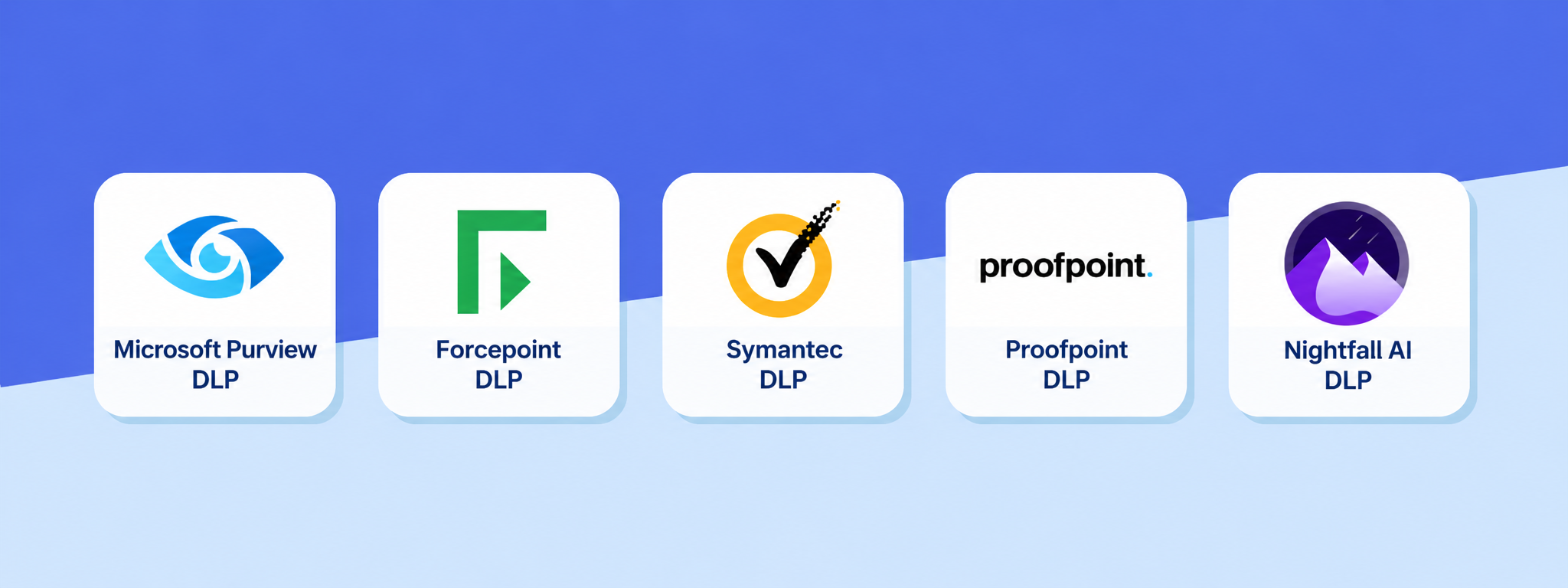
The DLP market includes both purpose-built standalone solutions and capabilities embedded within broader security platforms. No single tool is the right answer for every environment.
| Solution | Best fit | Coverage | Key strength | Key limitation |
| Microsoft Purview DLP | M365-centric organizations | Endpoint, email, cloud (Microsoft) | Native integration, no deployment overhead | Limited outside Microsoft ecosystem |
| Forcepoint DLP | Regulated industries, global enterprises | Endpoint, network, cloud, email | 1,700+ classifiers, risk-adaptive protection | Complex setup, steep learning curve |
| Symantec DLP (Broadcom) | Large enterprises, dedicated security teams | Endpoint, network, cloud, storage | Deep content inspection, data lineage tracking | Resource-intensive, high operational cost |
| Proofpoint DLP | Email-heavy environments, human risk focus | Email, cloud, endpoint | Strong email heritage, user behavior risk scoring | Narrower coverage than pure-play DLP suites |
| Nightfall AI | Cloud-native, SaaS-first organizations | Cloud apps, APIs, collaboration tools | Developer-friendly, API-first, fast deployment | Less mature endpoint coverage |
A few observations from practitioner experience that vendor comparison pages rarely surface. Microsoft Purview DLP has a compelling value proposition for organizations already holding M365 E5 licenses, but the gap between a working deployment and a well-tuned one that does not generate overwhelming false positives is significant. Forcepoint’s Risk-Adaptive Protection feature, which dynamically adjusts enforcement based on individual user risk scores, represents a genuine architectural advance over static rule-based systems, but realizing that value requires investment in policy configuration. Symantec DLP under Broadcom remains the most comprehensive option for large enterprises with dedicated DLP teams, but organizations without that internal capacity often find the operational overhead unsustainable.
Gartner predicts that by 2027, 70% of CISOs in larger enterprises will adopt a consolidated approach addressing both insider risk and data exfiltration use cases in a single platform, reflecting a market shift away from point solutions toward integrated data security programs.
Building a data leakage protection program that works
Tools are a subset of the problem. Organizations that deploy DLP technology without addressing the surrounding program factors consistently underperform against organizations with simpler tools and better governance.
Start with data discovery before writing a single policy. Run a discovery scan across your environment to understand where sensitive data actually lives versus where you think it lives. The gap is almost always larger than expected. Customer data in a development environment. Employee records in an unstructured file share. Old contract drafts in a shared drive that nobody has reviewed in years. You cannot protect what you have not found.
Define realistic data handling policies in collaboration with business units. Security teams writing DLP policies without input from the people who handle the data produce policies that block legitimate work and generate resentment. Finance, legal, HR, and product teams each have distinct data handling patterns. Policies built around those actual workflows enforce more accurately and require less intervention.
Move from monitoring to enforcement in stages. Start with your highest-risk channels and most sensitive data classifications. Implement policies in block mode for clear violations, in alert mode for ambiguous cases, and in user-justification mode for activities that might be legitimate but warrant awareness. Build confidence in the program incrementally before extending enforcement broadly.
Measure program effectiveness through outcomes, not coverage. The number of policies deployed and the number of alerts generated are activity metrics, not outcome metrics. Track the rate of actual policy violations, the volume of sensitive data exposure incidents, the time to detect potential leakage events, and the rate of false positives that security teams are dismissing. If false positive rates are high, the program is training analysts to ignore real alerts.
For organizations building or rebuilding their data security architecture, Varmeta’s AI and data services offer implementation support that bridges the gap between DLP tooling and the data governance foundation that makes those tools effective.
Conclusion
Data leakage protection is one of the more difficult security problems to get right because it requires both technical implementation and organizational change. The technology has matured considerably, and the tools available in 2025 are substantially more capable than what existed five years ago. The harder challenge remains governance: classifying data accurately, writing policies that reflect how the business actually operates, and building a culture where employees understand why the controls exist rather than treating them as obstacles.
The organizations that get this right treat DLP not as a product they purchased but as a program they run, with clear ownership, regular review cycles, and outcomes they measure. The ones that struggle bought a tool, ran it in monitor mode, and wondered why nothing changed.
Frequently Asked Questions
1. What is data leakage protection?
A set of technologies and policies designed to detect and prevent sensitive data from leaving an organization’s controlled environment without authorization, covering data at rest in storage systems, data in motion across networks and email, and data in use on endpoints.
2. What is the difference between data leakage and a data breach?
A breach typically involves unauthorized external access to systems. A leak can occur without any external actor, through accidental misconfiguration, misdirected email, or an employee exfiltrating data intentionally. Both carry compliance and reputational consequences.
3. Which industries need data leakage protection most urgently?
Financial services, healthcare, and the government have the strongest regulatory drivers. Finance faces PCI-DSS and SOX requirements; healthcare must address HIPAA audit controls; and the government handles classified and personally identifiable information at scale. That said, any organization handling customer data, intellectual property, or employee records has meaningful leakage exposure.
4. How do I choose between endpoint DLP, network DLP, and cloud DLP?
Start where your data actually moves. If most leakage risk is email and web, network DLP is the priority. If employees work primarily on managed endpoints, endpoint DLP provides the deepest visibility. If your data lives across SaaS applications, cloud DLP is essential. Most mature programs eventually need all three, but sequencing investment around your highest-risk channels produces faster results.
5. Why do DLP programs fail?
The most common causes are deploying tools before classifying data, writing policies without input from business units, staying in monitor-only mode too long, and not measuring whether the program is actually preventing leakage or just generating alerts that nobody acts on.