Author: Dung Pham
Head of AI and Data Science at Varmeta
In the rapidly evolving field of artificial intelligence (AI), small startups often face significant challenges when trying to compete with tech giants. Limited access to high-quality AI models, computational resources, and scalable infrastructure often puts them at a disadvantage. However, a new player is changing the game – DeepSeek.
DeepSeek is emerging as a transformative force for AI startups, providing cutting-edge AI models, open-source solutions, and scalable tools that were once only accessible to large corporations with deep pockets. By democratizing advanced AI capabilities, DeepSeek is enabling smaller AI companies to innovate, scale, and compete in the global market without the need for massive financial investment.
In this article, we will explore DeepSeek’s impact on the AI industry, the potential opportunities it presents for smaller startups, and the challenges that come with its adoption. We will also discuss the broader implications for AI development, particularly in terms of cost-effectiveness, disruptive innovation, and open-source contributions.
What is DeepSeek and how does it work?

Founded by Liang Wenfeng in May 2023, DeepSeek has quickly gained industry recognition, particularly with its powerful language models, DeepSeek V3 and DeepSeek R1, which made headlines in early 2025. The training of these models required an impressive 2.788 million H800 hours, yet DeepSeek managed to optimize resource usage, making them more efficient than their rivals.
What truly sets DeepSeek apart is its cost-effective approach to AI training and deployment. In early 2025, the company introduced an advanced AI model comparable to those from U.S. firms like OpenAI’s ChatGPT, but with significantly reduced reliance on expensive Nvidia chips. By optimizing training efficiency and computational resources, DeepSeek has not only lowered entry barriers for smaller AI companies but also set a new industry standard for cost-effective AI innovation.
How it works
DeepSeek is committed to advancing AI capabilities, with a strong focus on enhancing reasoning skills, a crucial step in the evolution of artificial intelligence. The company employs cutting-edge techniques to optimize learning efficiency and improve AI’s ability to process complex tasks.
- Reinforcement learning: DeepSeek leverages large-scale reinforcement learning to enhance AI’s reasoning abilities, enabling it to tackle complex decision-making tasks with greater accuracy.
- Reward engineering: Researchers developed a rule-based reward system that outperforms traditional reward models, leading to more effective learning and decision-making.
- Distillation: Using knowledge transfer strategies, DeepSeek condenses AI skills into highly efficient models, requiring as few as 1.5 million elements while maintaining strong performance.
- Emergent activity network: Through reinforcement learning, DeepSeek’s AI can develop sophisticated reasoning patterns naturally, without the need for explicit programming.
By integrating these advanced methodologies, DeepSeek is setting new benchmarks in AI reasoning, efficiency, and scalability, making high-performance AI more accessible to a broader range of developers and businesses.
The cost-effectiveness of DeepSeek’s AI models
One of the most compelling aspects of DeepSeek’s success is its ability to build high-performing AI models with significantly lower costs compared to industry leaders such as OpenAI and Google DeepMind. Traditional AI model training requires enormous computational power, often involving thousands of GPUs or TPUs, leading to costs in the millions or even billions of dollars.
DeepSeek, however, has managed to reduce these costs through innovative optimization techniques, efficient model architectures, and possibly more targeted training methodologies. This cost reduction is a major breakthrough for small startups, as it lowers the entry barrier to AI development. Instead of requiring a massive budget, startups can now leverage more affordable AI models and computing infrastructure to develop competitive products and services.
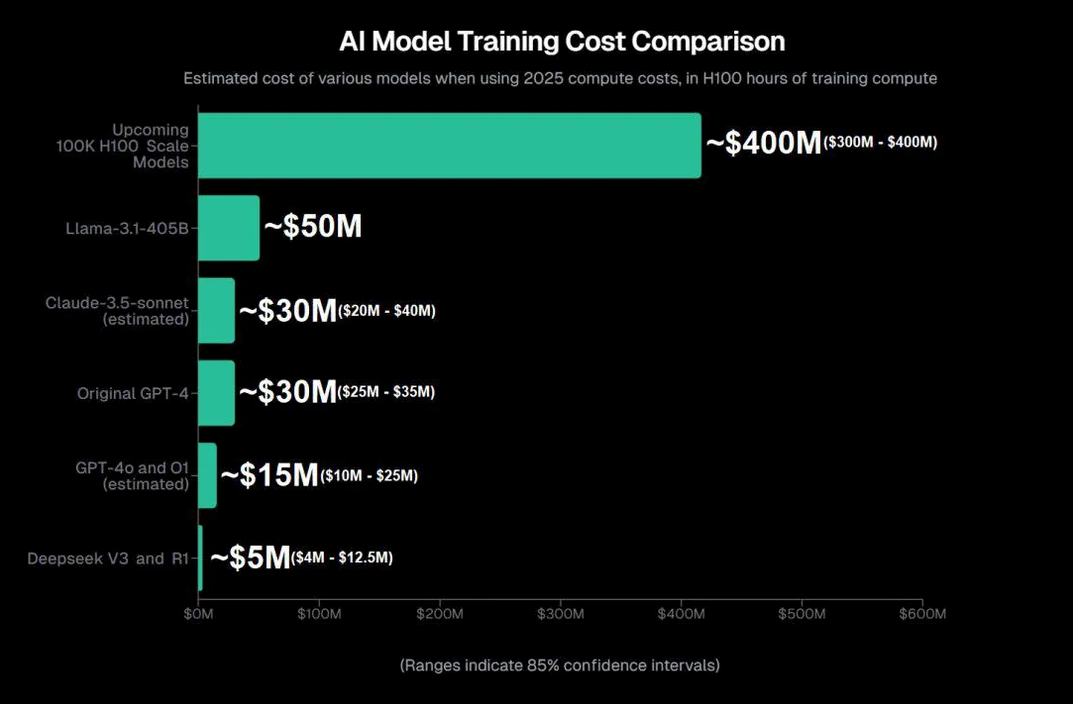
AI model training cost comparison (January 2025)
Implications for small startups
For small startups with limited resources, DeepSeek’s approach provides several advantages:
- Lower initial investment: Reduced training costs mean startups can experiment with AI without requiring massive venture capital funding.
- Faster time-to-market: Instead of spending years developing foundational AI models, startups can use DeepSeek’s technology to build on existing innovations.
- Access to advanced AI: Previously, only companies with vast computational resources could develop high-performance AI. DeepSeek’s model makes AI development more accessible to a broader range of businesses.
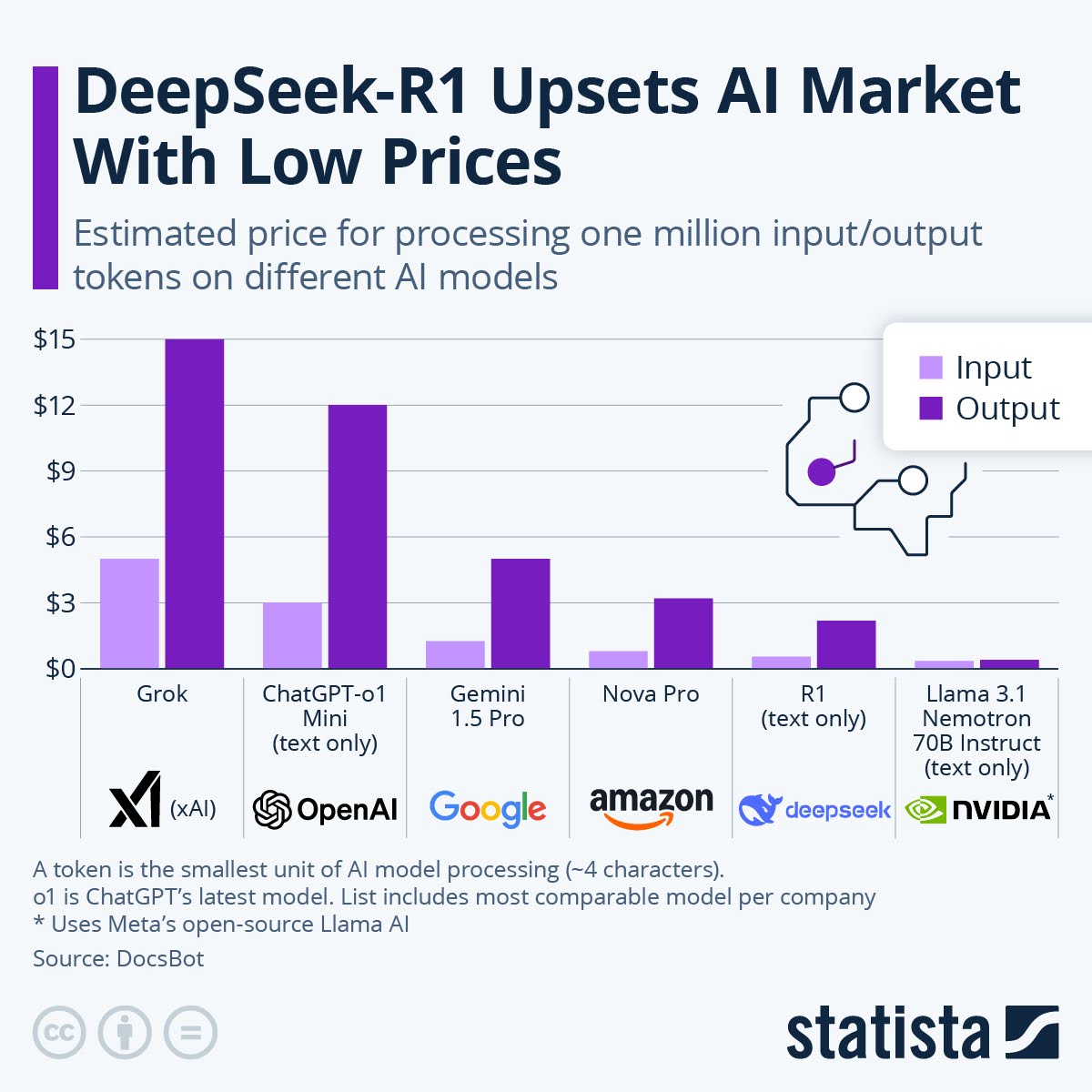
Price comparison between popular AI models
Disruptive innovation in AI development
DeepSeek’s emergence can be considered a disruptive innovation in the AI space. Historically, AI development has been dominated by a few major players who could afford the massive costs of training large-scale models. DeepSeek’s ability to develop highly competitive AI models without these massive resources challenges the conventional wisdom that AI development is only feasible for large corporations.
This democratization of AI development aligns with the broader trend in technology where smaller, more agile companies disrupt industries traditionally controlled by incumbents. Similar to how cloud computing enabled smaller companies to compete with established IT firms, DeepSeek’s approach could empower startups to challenge major AI players by leveraging cost-efficient AI models.
Open-source contributions and collaboration potential
While DeepSeek is not entirely open-source, it has released aspects of its AI model that allow other companies and researchers to build upon its foundation. This partial openness provides an opportunity for smaller AI companies to:
- Leverage pre-trained models: Instead of training AI from scratch, startups can fine-tune DeepSeek models to fit their specific needs.
- Enhance AI research and development: Open-source components enable further experimentation and innovation in AI applications.
- Reduce costs further: Startups can allocate resources to developing applications rather than expensive training phases by using preexisting models.
Although DeepSeek’s open-source contributions are limited compared to projects like Meta’s LLaMA or Hugging Face’s open models, they still offer a valuable foundation for AI development. Future iterations may expand openness, leading to broader industry adoption and collaboration.
Challenges and considerations for startups using DeepSeek
While DeepSeek presents exciting opportunities, there are several challenges that startups must consider before adopting its models:
1. Data access and quality
One of the biggest concerns with DeepSeek’s AI models is the quality and source of its training data. Since AI performance heavily depends on the data used for training, questions arise about the following:
- The bias present in DeepSeek’s dataset
- The accuracy and diversity of data sources
- The relevance of the training data for different industries and markets
Startups that rely on DeepSeek’s AI models must conduct thorough evaluations to ensure the model aligns with their specific use cases and does not introduce unintended biases.
2. Geopolitical and censorship considerations
Being a Chinese company, DeepSeek faces potential regulatory challenges in certain regions, particularly in the West. There are concerns about:
- Data privacy laws: Regulations like the GDPR in Europe and data sovereignty laws in various countries could impact the use of AI models developed by Chinese firms.
- Censorship risks: Some analysts worry about potential limitations or biases in AI models originating from China, especially in politically sensitive areas.
- Export restrictions: The ongoing technological competition between the U.S. and China could restrict DeepSeek’s AI models in certain markets.
Startups operating in international markets must be aware of these geopolitical considerations before integrating DeepSeek’s AI into their products.
3. Market competition and response from AI giants
Although DeepSeek’s approach disrupts the AI industry, it is unlikely that established AI leaders like OpenAI, Google DeepMind, or Meta will remain passive. These companies may:
- Adapt their AI strategies: By optimizing their models to compete on cost-efficiency, making it harder for smaller players to differentiate.
- Increase proprietary advantages: Leveraging proprietary data and computational advantages to maintain market dominance.
- Acquire or invest in competing startups: Big tech companies may acquire emerging AI startups that demonstrate innovative approaches similar to DeepSeek.
For small startups, this means navigating a competitive landscape where major players may adjust their strategies to counter DeepSeek-like approaches.
The future of AI startups with DeepSeek’s model
Despite the challenges, DeepSeek has demonstrated that AI development is no longer exclusive to tech giants. Startups now have a viable path to developing sophisticated AI systems without requiring billion-dollar budgets. This shift could lead to:
- Increased innovation: With lower entry barriers, more startups can experiment with AI, leading to new applications and breakthroughs.
- Greater diversity in AI applications: Smaller companies can develop AI models tailored to niche markets and industry-specific needs.
- More competition in the AI space: The rise of cost-efficient AI models may lead to a more balanced competitive environment.
To maximize these opportunities, startups should:
- Evaluate data quality: Ensure that DeepSeek’s AI models align with their data requirements and business objectives.
- Stay informed on regulations: Keep track of international regulations that may affect AI model adoption.
- Differentiate their AI offerings: Find unique ways to apply AI that provide a competitive advantage beyond just using DeepSeek’s models.
Conclusion
DeepSeek’s emergence as a cost-efficient AI powerhouse signals a transformative shift in the industry. By proving that cutting-edge AI models can be built without massive infrastructure, DeepSeek paves the way for small startups to compete in AI development. However, while the opportunities are immense, startups must also consider challenges related to data access, geopolitical constraints, and competition from AI incumbents.
For small startups, the key takeaway is clear: AI development is more accessible than ever before. By strategically leveraging DeepSeek’s advancements, innovative startups can carve out their place in the AI industry and drive the next wave of technological disruption.