For decades, digital transformation focused on helping employees work faster. Organizations invested heavily in software platforms, cloud infrastructure, automation tools, and enterprise applications with the goal of improving productivity. Yet despite these investments, many organizations continue to struggle with operational bottlenecks, talent shortages, and rising labor costs.
Today, a new paradigm is emerging. Businesses are no longer simply deploying tools that assist employees. Instead, they are introducing an entirely new category of workforce: the digital worker.
Powered by advances in Artificial Intelligence (AI), Machine Learning (ML), Robotic Process Automation (RPA), and Generative AI, digital labors are transforming from passive software systems into autonomous operational entities capable of understanding, reasoning, making decisions, and executing complex business processes independently.
This shift has given rise to what many industry analysts describe as The Digital Worker Mandate, a strategic imperative for organizations seeking to remain competitive in an increasingly automated economy.
For enterprises operating at the intersection of Blockchain, AI, FinTech, and Digital Transformation, understanding the rise of digital labors is no longer optional. It is becoming a fundamental requirement for future growth.
What Is a Digital Worker?

The term digital worker has evolved significantly over the past decade.
Traditionally, organizations viewed software as a tool designed to support human workers. A virtual worker changes that equation. Instead of acting as a passive application, a digital worker performs actual work responsibilities similar to those traditionally assigned to human employees.
A virtual worker can process documents, analyze data, communicate with customers, monitor compliance activities, generate reports, execute workflows, and coordinate actions across multiple systems without requiring constant human supervision.
Unlike conventional software, digital labors are designed around business roles rather than isolated tasks. This distinction is critical.
For example, a traditional automation tool might simply extract invoice information. A digital worker assigned to Accounts Payable can receive invoices, validate information, cross-reference purchase orders, route approvals, process payments, and generate audit records as part of a complete end-to-end workflow.
In essence, a virtual worker behaves more like a virtual employee than a software application.
What Is an AI Digital Worker?
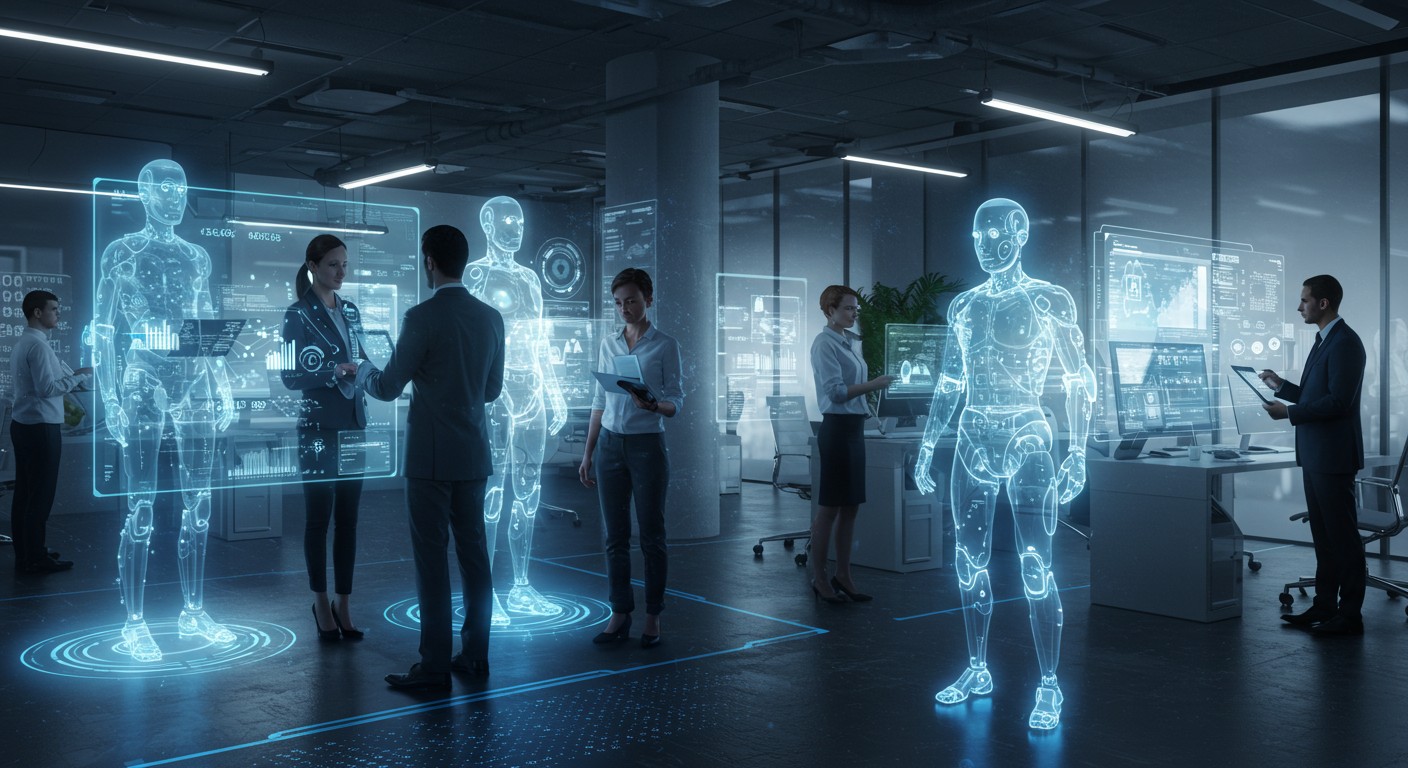
One of the most searched questions today is: What is an AI digital worker?
An AI worker combines automation technologies with advanced artificial intelligence capabilities to perform cognitive tasks traditionally requiring human judgment.
Unlike earlier automation systems that relied exclusively on predefined rules, AI workers can:
- Understand natural language
- Analyze unstructured documents
- Learn from historical data
- Generate recommendations
- Adapt to changing situations
- Collaborate with human teams
Generative AI has accelerated this transformation dramatically.
Large Language Models (LLMs) now enable digital labors to interpret emails, summarize reports, draft responses, conduct research, and interact with enterprise systems using conversational interfaces.
This evolution represents a major leap from automation toward autonomous digital labor.
As organizations face increasing complexity, AI digital workers provide a scalable way to augment human expertise without proportionally increasing headcount.
What Is a Digital Worker in Automation?
To understand the value of digital labors, it is important to distinguish them from traditional automation technologies.
Traditional RPA
Robotic Process Automation excels at repetitive, rule-based tasks. However, RPA lacks contextual understanding and struggles with exceptions.
AI Agents
AI agents can reason, plan, and pursue goals. They operate dynamically but may lack governance controls required in enterprise environments.
Digital Workers
Digital workers combine the reliability of automation with the intelligence of AI and the structure of enterprise workflows.
| Capability | Traditional RPA | AI Agent | Digital Worker |
| Rule Execution | High | Moderate | High |
| Context Understanding | Low | High | High |
| Enterprise Governance | High | Moderate | High |
| End-to-End Process Ownership | Low | Moderate | High |
| Learning Capability | Low | High | High |
This convergence makes digital labors particularly valuable for large organizations operating in highly regulated environments.
The Digital Worker Mandate
The rise of digital workers is not simply a technology trend. It is a response to structural economic challenges.
Organizations face growing pressure from:
- Labor shortages
- Rising operational costs
- Increasing compliance requirements
- Expanding data volumes
- Demand for 24/7 customer experiences
These challenges create a compelling case for digital labor.
Digital labors operate continuously, maintain consistent quality, and scale rapidly during periods of high demand. Unlike traditional workforce expansion, deploying additional digital workers does not require lengthy recruitment cycles, onboarding programs, or geographical limitations.
The Digital Worker Mandate reflects a broader realization among executives: future competitiveness will depend on an organization’s ability to effectively orchestrate human and digital labor together.
How Productive Is the Average Office Worker?
A frequently searched question is: How productive is the average office worker?
Research across multiple productivity studies consistently suggests that knowledge labors spend a surprisingly small percentage of their workday on high-value activities.
Meetings, administrative tasks, email management, reporting, data entry, and process coordination often consume substantial portions of employee time.
The result is a significant productivity gap.
Highly skilled professionals frequently spend hours performing tasks that do not fully utilize their expertise.
Digital labors address this challenge by absorbing routine operational activities.
Studies show that the average office worker is truly productive for only about 2 hours and 53 minutes per day. Furthermore, research from the McKinsey Global Institute reveals that approximately 28% of a knowledge worker’s week—amounting to 11.2 hours—is consumed by email and communication management.
Digital workers function as a strategic imperative, designed to absorb these routine operational activities and mitigate administrative overhead.
Instead of manually processing information, human employees can focus on strategic planning, relationship building, innovation, problem-solving, and decision-making.
This transition has profound implications for organizational productivity. Rather than replacing labors, digital workers amplify the effectiveness of existing teams.
How Many Knowledge Workers in the US?
Another important workforce statistic concerns knowledge workers.
According to Gartner and the U.S. Bureau of Labor Statistics (BLS), there are approximately 100 million knowledge workers in the United States, representing roughly 38% to 42% of the total workforce. Participate in knowledge-based occupations involving information processing, analysis, communication, and decision-making.
These professionals represent the backbone of modern enterprises.
However, knowledge workers face growing cognitive overload as information volumes continue to expand.
Organizations increasingly recognize that scaling human productivity alone is insufficient.
Digital workers provide an effective mechanism for managing repetitive information-intensive tasks while allowing knowledge workers to concentrate on higher-value contributions.
This shift is expected to become a defining feature of enterprise operating models throughout the remainder of the decade.
How Many Digital Nomads and Why It Matters
The global workforce is also becoming increasingly decentralized.
The boom in remote work has pushed the number of digital nomads to a record high, estimated at approximately 18.5 million in the U.S. alone by 2025, according to MBO Partners.
As this workforce is constantly moving and working across borders, the handover and maintenance of business process continuity are easily disrupted by time zone differences.
Operating as an “invisible infrastructure,” AI Digital Workers function 24/7/365 to maintain persistent operational workflows. By providing continuous service across all time zones, these entities effectively bridge the availability gaps inherent in human-only teams.
Recent industry estimates indicate that tens of millions of professionals now identify as digital nomads, working remotely across geographical boundaries.
According to McKinsey Digital, companies deploying digital workers report an ROI of 30% to 200% within the first year, with potential long-term returns reaching up to 300%.
Similarly, a Forrester Total Economic Impact study found that intelligent automation investments can achieve a payback period of less than six months.
How to Create a Digital Worker
Many organizations ask: How to create a digital worker?
Successful implementation requires a structured approach.
Step 1: Identify High-Impact Opportunities
Organizations should begin by analyzing workflows with high volumes, repetitive tasks, frequent errors, or significant operational costs.
Common candidates include:
- Customer onboarding
- Compliance reviews
- Invoice processing
- Claims management
- IT service desk operations
Step 2: Build the Intelligence Layer
Digital workers require multiple technology components:
- AI models
- Machine learning systems
- Natural language processing
- Intelligent document processing
- Process orchestration engines
Together, these technologies enable digital workers to perceive, understand, and act.
Step 3: Establish Governance and Security
Governance is often overlooked but remains critical.
Organizations must implement:
- Identity management
- Role-based access controls
- Audit trails
- Human-in-the-loop mechanisms
- Ethical AI frameworks
Without governance, autonomous systems can introduce operational and compliance risks.
The Role of Blockchain in the Digital Workforce Era
Blockchain technology introduces an important layer of trust and transparency into digital workforce ecosystems.
As digital workers gain greater autonomy, organizations require verifiable records of decisions, transactions, and actions.
Blockchain can provide:
- Immutable audit trails
- Transparent process histories
- Decentralized identity management
- Smart contract automation
- Trusted cross-organizational collaboration
The convergence of Blockchain and AI creates opportunities for secure, accountable digital labor ecosystems where every action can be verified and traced.
This capability will become increasingly important as regulators demand greater transparency from autonomous systems.
Digital Workers Across Industries
The adoption of digital workers is accelerating across multiple sectors.
In financial services, digital workers streamline compliance monitoring, fraud detection, and customer onboarding.
In healthcare, they reduce administrative burdens while supporting patient services and clinical operations.
Manufacturing organizations leverage digital workers to optimize supply chains, inventory management, and production workflows.
Retail businesses use digital workers to improve workforce planning, customer support, and demand forecasting.
The common theme across industries is clear: digital workers enable organizations to achieve greater operational efficiency while improving customer experiences.
The Human + Digital Worker Hybrid Workforce
Despite widespread concerns about automation, the future is unlikely to be fully autonomous.
Instead, organizations are moving toward hybrid workforce models where humans and digital workers collaborate.
In this environment:
Digital workers handle repetitive tasks.
Humans provide judgment and creativity.
AI generates recommendations.
People make critical decisions.
This partnership model delivers the best of both worlds.
Organizations gain efficiency and scalability while preserving the uniquely human qualities essential for leadership, innovation, empathy, and ethical reasoning.
The most successful enterprises will not be those that replace people with AI. They will be those that create effective collaboration between human intelligence and machine intelligence.
Future Outlook: The Next Five Years of Digital Labor
Between now and 2030, digital workers are expected to evolve rapidly.
Advancements in generative AI, multi-agent systems, and autonomous orchestration will enable increasingly sophisticated digital workforce ecosystems.
Future digital workers will likely:
- Collaborate with other AI agents
- Learn continuously from experience
- Operate across organizational boundaries
- Maintain digital credentials and skill profiles
- Participate in complex decision workflows
At the same time, organizations must address challenges involving governance, ethics, energy consumption, transparency, and regulatory compliance.
The future belongs not simply to organizations that adopt AI, but to those that build trusted frameworks for managing autonomous digital labor responsibly.
Conclusion
The emergence of the digital worker represents one of the most significant shifts in enterprise operations since the advent of the internet itself.
Organizations are moving beyond simple automation toward intelligent digital labor capable of executing complex business responsibilities. As AI technologies continue to mature, digital workers will become foundational components of enterprise infrastructure.
For business leaders, the question is no longer whether digital workers will become part of the workforce. The real question is how quickly organizations can adapt their operating models, governance structures, and talent strategies to capitalize on this transformation.
The enterprises that embrace the Digital Worker Mandate today will be the ones shaping the future of work tomorrow.
Ready to build an AI-powered digital workforce?
Varmeta helps enterprises design and deploy intelligent digital worker solutions that automate complex workflows, improve operational efficiency, and accelerate digital transformation. Contact our team to discover how AI can reshape your business.
FAQs
1. How do digital workers differ from traditional software?
Unlike traditional software, which acts as a tool for human use, digital workers operate as independent entities that execute end-to-end business processes, learn from historical data, and make autonomous decisions aligned with enterprise goals.
2. Can digital workers replace human employees entirely?
No, the goal is not total replacement but augmentation. Digital workers handle routine, repetitive, and data-intensive tasks, allowing human employees to shift their focus toward high-value activities like strategic innovation, complex problem-solving, and relationship management.
3. What are the biggest risks when deploying digital workers?
The primary risks involve governance, data security, and operational compliance. Successful deployment requires establishing robust frameworks, including role-based access controls, continuous monitoring, and clear human-in-the-loop decision protocols.
4. How can businesses ensure ROI from their digital workforce?
ROI is achieved by identifying high-volume, error-prone processes that provide immediate efficiency gains. Organizations should measure performance through clear KPIs such as task completion speed, error reduction rates, and the number of hours returned to human workers.
5. How will the role of the knowledge worker evolve in the next five years?
Knowledge workers will transition into “orchestrators” who manage, govern, and collaborate with digital workers. Success will depend on the ability to translate business goals into digital workflows and leverage machine intelligence to drive competitive advantage.