Fintech AI has moved beyond the stage of being treated as a promising layer of innovation inside financial services. It is now becoming part of the operating logic of the industry itself. Banks, payment firms, insurers, wealth platforms, and financial infrastructure providers are using artificial intelligence to process larger volumes of data, improve decision quality, strengthen risk controls, and respond to customers in real time. Institutions such as the IMF, BIS, and World Economic Forum have all pointed to the growing impact of AI on financial markets, financial institutions, and financial stability.
At a macro level, this matters because finance sits at the center of resource allocation in the economy. When AI improves underwriting, fraud detection, compliance monitoring, liquidity analysis, or advisory processes, the effect is not limited to one application screen or one bank workflow. It changes how capital is assessed, how trust is priced, and how quickly institutions can react to uncertainty. That is why fintech AI should be understood as an infrastructure shift rather than a temporary product trend.
What is Fintech AI?

Fintech AI refers to the use of artificial intelligence and machine learning systems in financial technology products and financial institutions. In practical terms, it means using models that can detect patterns, classify behaviors, generate predictions, or automate decisions across financial workflows such as onboarding, fraud screening, loan assessment, customer support, portfolio analysis, and compliance operations. The value of fintech AI comes from its ability to convert high-frequency, high-volume, and often fragmented financial data into decisions that are faster and more adaptive than rule-based systems alone.
A narrow definition of fintech AI would reduce it to chatbot interfaces or recommendation engines. That misses the larger picture. The stronger definition is this: fintech AI is the application of intelligence systems to the full decision chain of finance, from data capture to model inference to operational response. In that sense, fintech AI affects both customer-facing products and the internal control architecture of financial firms.
Why fintech AI is becoming indispensable to modern finance
The rise of fintech AI is driven by a set of structural changes in how financial systems operate.
First, financial services now generate data at a scale that exceeds the capacity of manual review and conventional analytics. Every transaction, interaction, document, device signal, and behavioral trace produces a continuous stream of information. Traditional systems are limited in how much of this data they can process and interpret. AI becomes relevant in this environment because it can extract patterns, detect anomalies, and generate insights directly from that scale, without requiring predefined rules for every scenario.
Second, financial systems are under pressure to operate faster while maintaining tighter control. Customers expect instant payments, near-real-time onboarding, and responsive support. At the same time, institutions must meet increasing expectations around auditability, compliance, and risk management. These two requirements often move in opposite directions. Fintech AI helps bridge this gap by enabling faster decision-making while still maintaining visibility and control over those decisions when properly implemented.
Third, AI is beginning to influence how financial markets function. Its role in trading, market monitoring, and investment analysis continues to expand. As adoption increases, AI systems are shaping how signals are interpreted, how strategies are executed, and how information flows through markets. This shifts the impact of fintech AI beyond individual institutions, as it starts to affect pricing behavior, liquidity dynamics, and overall market stability.
Fintech AI use cases across the financial value chain
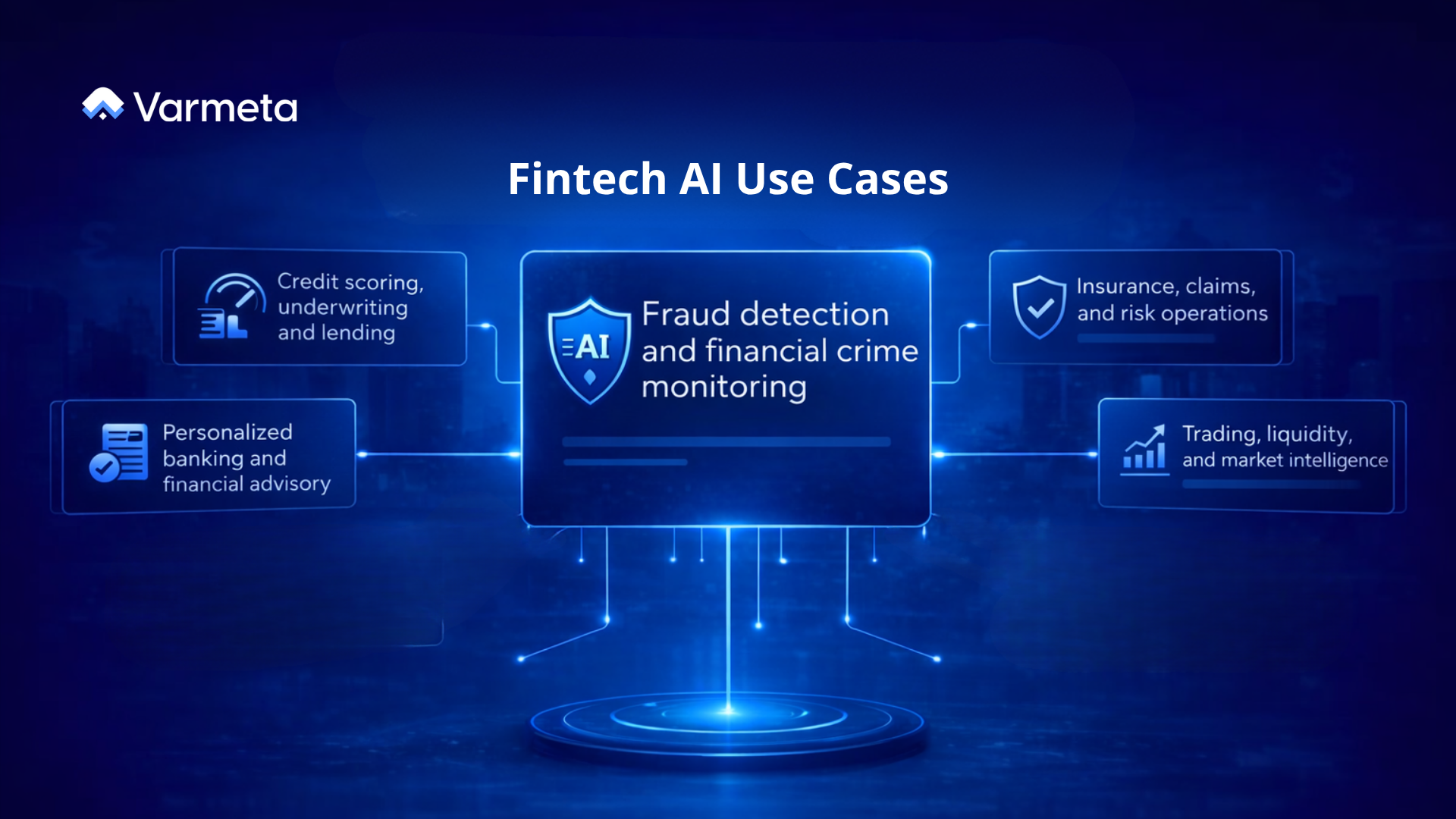
Fraud detection and financial crime monitoring
Fraud detection remains one of the clearest use cases for fintech AI because the problem itself is pattern-based and adversarial. Fraud does not stay still. Attackers adapt to thresholds, learn customer behavior, and exploit operational lag. A static rule engine can catch known patterns, but it struggles when fraud changes shape. AI systems improve this by evaluating multiple variables at once, including device behavior, transaction context, timing, geolocation anomalies, network relationships, and deviation from customer history.
Payments volume is growing, cross-border movement is becoming more digital, and embedded finance has widened the number of touchpoints where malicious behavior can occur. When fraud models improve, the gain is not only lower loss rates. It also includes lower false positives, better customer trust, and more efficient operations in compliance and investigations teams. In competitive markets, the firms that reduce friction without weakening controls create a structural advantage.
Credit scoring, underwriting and lending
Fintech AI has become influential in lending because credit decisions are fundamentally exercises in uncertainty. Traditional scoring systems rely heavily on fixed attributes and limited historical files. AI expands the analytical field. It can examine transaction flows, employment patterns, behavioral signals, repayment histories, document quality, and nontraditional indicators to produce a more granular view of risk.
This matters most in markets where thin-file customers, SMEs, gig workers, and underbanked populations remain difficult to serve under rigid underwriting frameworks. Fintech AI can widen inclusion when it is used responsibly, but this is also where governance becomes critical. If the training data reflects historical exclusion or biased lending outcomes, the model can scale those distortions more efficiently.
This paradox of inclusion versus bias is a global concern. Kristalina Georgieva, Managing Director of the IMF, has warned that while AI offers immense opportunities, it also risks “deepening the digital divide and escalating inequality” if not governed by strong ethical frameworks. In the context of lending, the IMF suggests that without proactive “de-biasing” of algorithms, AI might simply automate and accelerate past discriminatory practices under the guise of data-driven decisions.
The commercial opportunity and the governance risk grow together. Therefore, the next generation of fintech lending will not just be judged by its approval rates, but by its ability to provide Explainable AI (XAI), ensuring that every credit decision can be audited and justified to regulators and customers alike.
Personalized banking and financial advisory
Personalization in finance is often presented as a user experience upgrade, but the deeper shift is economic. When an institution understands customer behavior well enough to anticipate savings needs, detect churn risk, recommend more suitable products, or trigger timely guidance, it moves from transactional service to higher-lifetime-value relationships. AI makes this possible by connecting fragmented customer signals into a continuously updated profile.
Personalization also changes how financial intermediation works. Advisory logic that once depended on human relationship managers can now be extended to broader segments through models, copilots, and intelligent workflows. That does not eliminate the role of people. It changes where human expertise is concentrated: less time on repetitive triage, more time on exception handling, complex cases, and trust-building decisions.
Insurance, claims, and risk operations
In insurance and adjacent financial protection products, fintech AI helps classify risk, detect fraud in claims, automate document review, and improve response speed. These functions are economically important because the profitability of insurers and protection products depends heavily on accurate risk segmentation and efficient claims handling. AI changes both. It can improve assessment precision and shorten operational cycles that otherwise consume significant labor and time.
The larger implication is that AI strengthens the information-processing layer of finance. Insurance, lending, compliance, and payments all depend on turning uncertainty into priced, governed action. Fintech AI improves that conversion layer. This is why the same foundational capabilities: data quality, model governance, explainability, monitoring, show up across different subsectors.
Trading, liquidity, and market intelligence
In capital markets, AI is increasingly relevant for signal extraction, execution support, market surveillance, and portfolio analytics. The IMF has highlighted the likelihood of growing AI adoption in capital markets and the possibility that AI could alter market structure through more advanced algorithmic trading and new investment strategies. This is important because market microstructure, liquidity formation, and pricing behavior can all change when firms deploy increasingly powerful models into decision loops.
The same AI systems that improve market efficiency can also create correlated behaviors if many firms depend on similar models, datasets, vendors, or signals. This phenomenon, often referred to as herding behavior, is a primary concern for top regulators.
SEC Chair Gary Gensler has explicitly warned that AI could be the catalyst for a future financial crisis. He argues that when multiple market participants rely on the same underlying data sets or base models, it creates a systemic fragility. In his words, “AI may heighten financial fragility as it could promote herding… with individual actors making similar decisions because they are getting the same signal from a base model or data aggregator.”
That is one reason why regulators and global institutions have focused on concentration risk, model risk, and systemic transmission channels. As AI becomes the “dominant logic” of trading, the risk shifts from individual firm errors to a collective, synchronized failure that could compromise overall market stability.
Fintech AI capabilities and business impact
| Fintech AI capability | Primary financial use case | Business impact | Main governance concern |
| Pattern recognition | Fraud detection, AML alerts, anomaly monitoring | Faster detection, fewer manual reviews, better control precision | False positives, drift, explainability |
| Predictive modeling | Credit scoring, delinquency forecasting, churn prediction | Better risk pricing, improved approval quality, portfolio resilience | Bias, data quality, adverse outcomes |
| Natural language processing | Customer support, document extraction, compliance review | Lower service cost, faster onboarding, operational scale | Hallucination, privacy, record accuracy |
| Recommendation systems | Product offers, budgeting guidance, wealth suggestions | Higher engagement, cross-sell efficiency, personalized journeys | Suitability, transparency, conduct risk |
| Generative and agentic workflows | Internal copilots, research, workflow automation | Productivity gains, reduced turnaround time, better decision support | Human oversight, autonomy boundaries, auditability |
Each capability is usually applied in more than one area. Pattern recognition is used to detect fraud, but the same logic can also flag unusual transactions or compliance risks. Predictive models are used for credit scoring, and can also help forecast customer churn or repayment behavior. Natural language processing supports customer service, while also helping process documents and compliance data.
Because of this, fintech AI often scales quickly once it is implemented. A system built for one use case can be reused in other workflows without starting from zero.
However, as these systems are used more widely, the risks also increase. If the data is biased, the outcomes can be inaccurate. If the model is hard to explain, it becomes difficult to audit. This is why fintech AI needs both strong performance and clear control over how decisions are made.
The architecture behind fintech AI
A mature fintech AI system is usually built as an operational stack rather than a standalone model. At the base is data infrastructure: transaction records, CRM events, identity data, behavioral telemetry, market feeds, documents, and external risk signals. Above that sits a processing and feature layer that cleans, normalizes, and prepares inputs for training and inference. Then comes the model layer, where machine learning or generative systems produce classifications, scores, summaries, or recommendations. Above that is the decision layer, where outputs are routed into workflows such as approve, escalate, block, review, recommend, or monitor. Finally, there is the feedback layer, where outcomes are logged, audited, and used to retrain or recalibrate the system.
This architecture matters because many firms fail by focusing on the model while underinvesting in the surrounding system. In finance, performance depends on data lineage, latency, access control, exception handling, and monitoring as much as it depends on model quality. A fraud model that scores well in testing but cannot be deployed with reliable feedback loops will underperform in production. A lending model with limited explainability may generate value in pilots but become difficult to scale under governance and audit requirements.
For enterprise implementation, this is where architecture discipline becomes decisive. Fintech AI works best when designed as modular infrastructure that can integrate with existing banking systems, payment rails, compliance platforms, and data governance policies. That is also where technology partners with strong data, AI, and financial systems experience add the most value. For companies like Varmeta operating across AI, data, and blockchain-oriented systems, the practical opportunity often lies in designing architectures that are interoperable, auditable, and fit for regulated environments rather than chasing isolated AI demos.
Risks and challenges in fintech AI

AI in finance brings clear benefits, but it also introduces new risks that directly affect how financial systems operate.
One of the most common concerns is bias. AI models learn from historical data. If that data contains bias, the model can repeat or even amplify it. In lending, this can lead to unfair credit decisions. In customer-facing systems, it can affect how users are treated or evaluated. This is why data quality and model validation are critical from the beginning.
Another challenge is transparency. Financial institutions often need to explain why a decision was made, especially in areas like credit approval, fraud detection, or compliance. If a model produces accurate results but cannot explain how it reached them, it becomes difficult to use in regulated environments. Performance alone is not enough, decisions must also be understandable.
There is also a growing concern around dependency on shared infrastructure. Many institutions rely on similar AI models, cloud providers, or third-party systems. This creates efficiency, but it also introduces concentration risk. If multiple systems depend on the same underlying technology, failures or weaknesses can have wider impact across the industry.
In addition, AI systems require continuous monitoring. Model performance can change over time as data patterns shift. Without proper tracking, systems that once worked well may gradually become less accurate or produce unexpected results.
These challenges show that adopting fintech AI is not only a technical decision. It requires strong governance, clear processes, and ongoing oversight to ensure that systems remain reliable, fair, and aligned with regulatory expectations.
Regulation, governance, and the next phase of adoption
The future of fintech AI will depend as much on governance maturity as on model capability. The World Economic Forum has emphasized responsible AI and regulatory challenges in financial services, while the BIS and IMF have both highlighted the importance of oversight, controls, and operational discipline. This signals the direction of travel clearly: AI adoption in finance is likely to expand, but expectations around governance will expand with it.
For firms, this means the next competitive gap may not be who experiments with AI first. It may be who industrializes AI with the strongest governance foundation. The winners will likely be organizations that can connect model performance with auditability, privacy protection, policy controls, human review design, and measurable business outcomes. In finance, scale without governance is fragile. Governance without usable systems is too slow. Fintech AI strategy must hold both.
Fintech AI and the shift toward agentic finance
A newer frontier in fintech AI is the rise of agentic systems. The World Economic Forum has described agentic AI in financial services as a development that could increase decision accuracy, personalize interactions, and bring finance closer to process autonomy. This does not mean fully autonomous finance everywhere. It means more workflows will be orchestrated by systems that can interpret context, choose actions, and collaborate with human operators across multistep tasks.
The strategic importance of this trend is substantial. Earlier phases of fintech AI were mainly analytical: score this, classify that, predict this probability. Agentic systems move closer to operational intelligence: gather inputs, reason across them, propose a course of action, trigger workflows, and learn from outcomes. In banking, payments, insurance, or wealth operations, that could compress cycle times dramatically. It could also raise the stakes for supervision, boundary-setting, and accountability.
How to approach fintech AI implementation in practice
A sound implementation approach usually begins with use cases where value and control are both measurable. Fraud detection, document intelligence, onboarding support, collections prioritization, and service automation are often practical starting points because they have clear operational baselines. From there, firms should build repeatable foundations around data governance, model monitoring, human-in-the-loop workflows, and deployment standards.
The mistake many organizations make is scaling outward too fast before the underlying operating model is ready. In finance, isolated pilots can produce impressive demos, but enterprise value usually comes from consistent integration into business processes. That requires architecture, policy, measurement, and change management. The macro lesson is simple: fintech AI creates compounding value when it becomes part of institutional capability, not when it remains trapped inside a set of disconnected experiments.
Conclusion
Fintech AI is becoming part of how financial systems operate. It helps institutions process large amounts of data, make faster decisions, and respond more effectively to risk and customer needs.
Its impact goes beyond improving efficiency. It changes how credit decisions are made, how fraud is detected, how services are delivered, and how institutions react to market changes. As AI is used more widely, it starts to shape the way financial services function overall.
Because of this, the challenge is not simply adopting AI tools. What matters is how well these systems are integrated into real workflows and how reliably they operate over time.
Organizations that treat fintech AI as a core capability will be able to build more flexible and responsive systems. Those that use it only at the surface level may see short-term improvements, but will struggle to keep up as financial systems continue to evolve.
FAQ
1. What is Fintech AI?
Fintech AI refers to the use of artificial intelligence in financial services such as banking, payments, lending, insurance, and investment. It helps automate processes, analyze data, and support decision-making in real time.
2. How is Fintech AI used in Real Life?
Fintech AI is used in many areas, including fraud detection, credit scoring, customer support, and personalized financial recommendations. For example, banks use AI to detect suspicious transactions, while fintech apps use it to suggest saving or spending habits.
3. Is Fintech AI Safe?
Fintech AI can be safe when properly designed and monitored. However, it requires strong data protection, clear governance, and regular evaluation to avoid risks such as bias, errors, or misuse of sensitive information.
4. What are the main benefits of Fintech AI?
The main benefits include faster decision-making, improved accuracy, reduced operational costs, and better customer experience. It also allows financial institutions to scale services more efficiently.
5. What are the challenges of Fintech AI?
Key challenges include data quality, model bias, lack of transparency, regulatory compliance, and integration with existing systems. Managing these challenges is essential for long-term success.
6. Can small companies use Fintech AI?
Yes. With cloud services and modern AI tools, smaller companies can adopt fintech AI without building everything from scratch. Many startups use AI to compete with larger financial institutions.