Organizations today are tapping into generative AI as a powerful tool to transform the way they utilize data and shape smarter decisions. Rather than merely processing existing data, generative AI actively creates original insights and fresh content allowing businesses to spot emerging market trends, deeply understand consumer preferences, and predict shifts in demand with impressive accuracy. This isn’t just about improving efficiency, it’s about unlocking new pathways for strategic growth in a rapidly evolving market. Gartner predicts that by 2026, over 80% of businesses will leverage generative AI, ushering in a new era where innovation is driven by unprecedented creativity and speed.
Traditional market research techniques frequently fall behind, overwhelmed by the sheer scale of data generated daily. Generative AI addresses this challenge head-on by automating complex processes from data collection to detailed analysis and actionable interpretation. This empowers teams to swiftly uncover meaningful insights, significantly cutting down the time spent sifting through mountains of data and freeing them to focus instead on higher-value, strategic tasks.
Moreover, generative AI excels at synthesizing diverse data sets, seamlessly blending social media chatter, customer reviews, and behavioral patterns into a cohesive market narrative. By harnessing this unified view, organizations are equipped to make precise, data-driven decisions, sharpening their competitive edge and staying attuned to shifting consumer needs.
In this article, we explore the exciting possibilities of generative AI in market research and intelligence, examining how leading organizations are integrating this technology into their daily workflows. We’ll also highlight practical, tangible benefits businesses of any size can gain from adopting generative AI platforms. Get ready to uncover the transformative potential of generative AI and discover how it can position your organization at the forefront of innovation.
Generative AI in market research and intelligence: Unlocking a competitive edge

Historically, researchers faced a constant struggle collecting, analyzing, and interpreting vast amounts of data, causing significant delays before actionable insights reached decision-makers. Generative AI changes this entirely. It swiftly analyzes massive and diverse data sets, from customer surveys and social media conversations to online reviews and feedback, empowering businesses to spot emerging trends, grasp consumer behavior in real time, and seize market opportunities faster than ever before. In fact, recent studies show that 76% of market researchers recognize Generative AI as essential for gaining a competitive edge.
But the power of Generative AI extends well beyond speed. It automates complex tasks such as report creation, data visualization, and summarization, freeing teams from tedious manual work. With advanced natural language processing capabilities, Generative AI transforms complicated datasets into clear, easily digestible insights, helping everyone make smarter decisions effortlessly. Additionally, it facilitates realistic market simulations and scenario planning, enabling companies to proactively prepare for market shifts rather than merely react.
Organizations embracing Generative AI are better positioned to achieve agility, deeper market understanding, and superior responsiveness in a fast-moving business environment.
Why generative AI is a game-changer for market research
Market research has always played a vital role in helping businesses understand their customers and spot emerging trends. However, traditional approaches, manual surveys, interviews, and slow, labor-intensive analysis often struggle to keep up with today’s rapidly evolving markets. These methods, while valuable, are time-consuming, expensive, and limited in scope, making timely insights difficult to achieve.
Enter Generative AI, a transformative technology redefining what’s possible. By integrating Generative AI into market research, companies unlock faster results, deeper insights, and unmatched scalability. Rather than merely summarizing past trends, Generative AI proactively identifies emerging consumer behaviors, pinpoints new market opportunities, and uncovers hidden patterns across vast datasets in real-time.
Consider these scenarios:
- A global retailer leverages Generative AI to analyze social media conversations and quickly identifies a rising demand for sustainable products, allowing it to adjust product strategies months ahead of competitors.
- An innovative startup automates competitor analysis using Generative AI, delivering instant insights into market gaps and competitive positioning, significantly accelerating its go-to-market strategy.
- A consumer-goods company uses AI-powered simulations to predict consumer reactions to new product launches, reducing risk and informing smarter decisions before significant investments are made.
Generative AI isn’t just enhancing market research, it’s reshaping how companies approach intelligence altogether, empowering decision-makers with unprecedented agility, accuracy, and strategic foresight.
Core applications of generative AI in market research
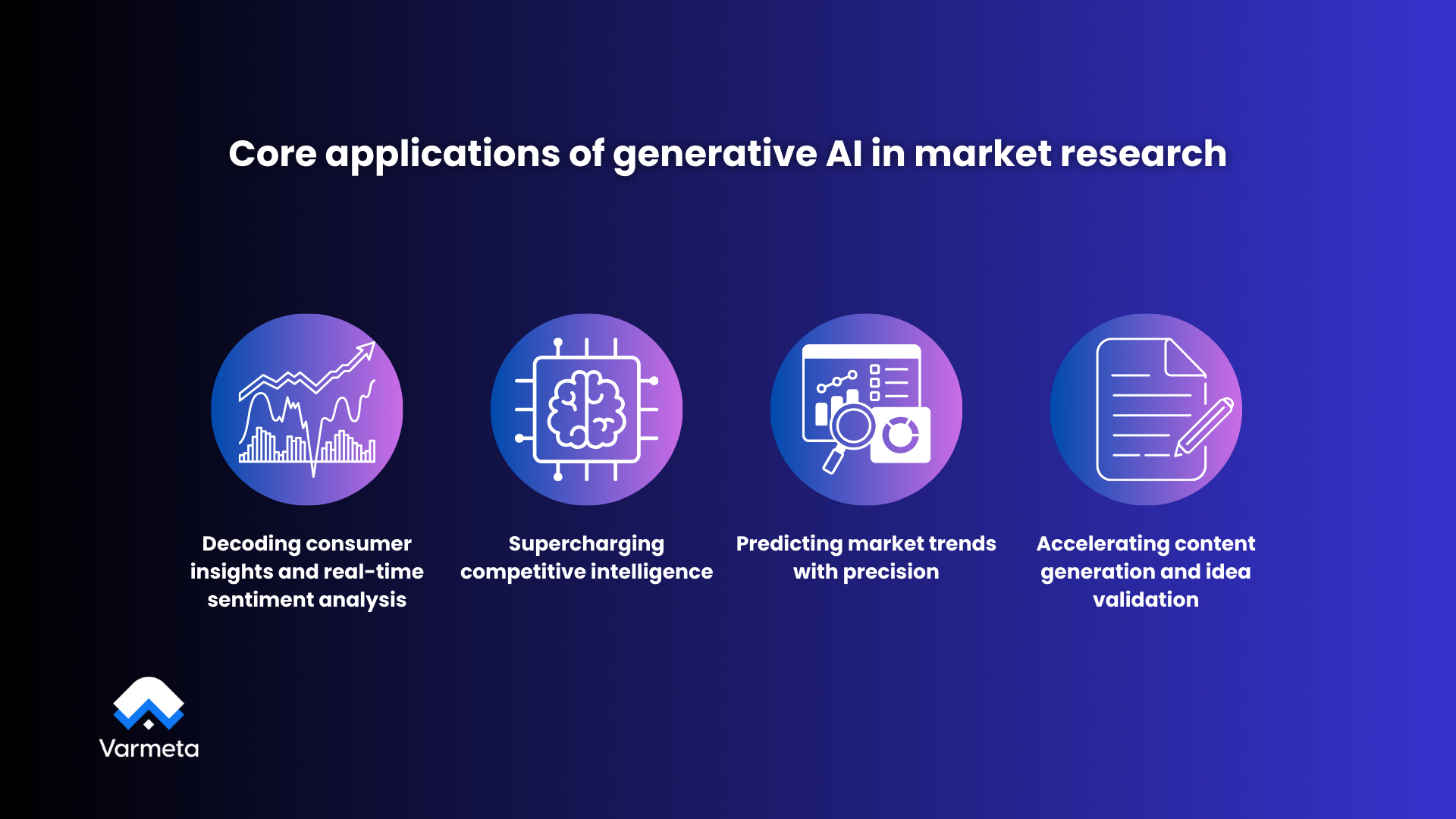
Market research has entered a new era, where the power of Generative AI unlocks capabilities previously unimaginable. Let’s explore four critical areas where Generative AI is dramatically enhancing market intelligence and delivering tangible results for businesses.
1. Decoding consumer insights and real-time sentiment analysis
Consumers today continuously share their opinions online through social media posts, product reviews, and digital interactions. Generative AI taps directly into these digital conversations, swiftly uncovering patterns in consumer sentiment and revealing insights traditional methods often miss. Brands now have the unprecedented ability to track real-time shifts in consumer preferences, emotions, and purchasing behaviors.
Imagine a global cosmetics brand using Generative AI to quickly detect a shift toward eco-friendly beauty products, immediately adjusting its marketing campaigns and product lines. Similarly, a fast-food chain leveraging AI sentiment analysis instantly recognizes dissatisfaction with packaging sustainability, prompting rapid and effective changes in response. This real-time insight not only boosts responsiveness but solidifies consumer loyalty.
2. Supercharging competitive intelligence
Staying ahead of your competition demands continuous and precise insights into their strategies, strengths, and weaknesses. Generative AI revolutionizes this process by rapidly analyzing competitor movements, market positioning, and product offerings with unprecedented accuracy and depth.
Companies can leverage AI-driven competitive analysis platforms to quickly identify market opportunities overlooked by traditional competitive research, enabling smarter, data-backed strategic decisions that strengthen their market position.
3. Predicting market trends with precision
Anticipating market trends before they fully emerge can be a game-changer. Generative AI provides powerful predictive analytics, combing through vast datasets to identify subtle signals that human analysts might overlook.
Picture an automotive manufacturer employing AI-driven predictive analysis to foresee shifts toward electric vehicles years before mainstream adoption. Acting proactively, the company successfully captures market share by preparing strategic partnerships, product development, and branding campaigns ahead of its competitors. Through Generative AI, businesses are empowered to lead rather than follow market trends.
4. Accelerating content generation and idea validation
Market researchers often face tight deadlines, needing quick, effective ways to generate insightful reports, surveys, and marketing content. Generative AI simplifies this process dramatically, rapidly producing high-quality, targeted content and enabling researchers to test hypotheses efficiently.
By harnessing these core capabilities, Generative AI not only amplifies the efficiency of market research but also transforms how organizations anticipate trends, engage consumers, outpace competitors, and validate ideas, positioning them to thrive in a highly competitive market landscape.
Best tools and platforms to leverage generative AI for market research

With the explosion of AI-driven tools, market researchers now have access to platforms that can streamline workflows, uncover insights faster, and generate smarter strategies. But not all Generative AI tools are created equal. The right choice depends on your goals whether it’s analyzing consumer sentiment, generating reports, or simulating market scenarios.
Here’s a breakdown of some of the leading Generative AI platforms, and how to choose the one that best fits your market research needs.
1. ChatGPT (OpenAI): Best for versatility and natural language understanding
ChatGPT is one of the most widely adopted AI platforms, known for its conversational intelligence and ability to process and generate human-like content. It’s excellent for drafting research summaries, simulating consumer personas, generating survey questions, and synthesizing findings into digestible insights.
Pros:
- Intuitive and easy to use
- Strong language generation and summarization capabilities
- Can be integrated into workflows via API
Cons:
- May require manual fact-checking
- Not purpose-built for market data analysis
Best for: Researchers who need a flexible assistant to support various content and ideation tasks.
2. Claude (Anthropic): Best for in-depth dialogue
Claude is designed with a strong emphasis on safe, aligned responses, making it ideal for teams that prioritize responsible AI use. It’s capable of handling complex documents, long-form analysis, and deep question-and-answer tasks.
Pros:
- Handles longer content and detailed context well
- Focus on ethical, transparent AI use
- Smooth integration with workflows
Cons:
- Less widely adopted, fewer third-party tools
- Still evolving compared to larger ecosystems like OpenAI
Best for: Organizations with strict ethical guidelines and deep-document analysis needs.
3. Gemini (Google): Best for real-time search-integrated insights
Gemini integrates Google’s vast search capabilities with a conversational AI model. It’s useful for gathering up-to-date insights, trend tracking, and validating information across sources, making it a strong complement to traditional market intelligence.
Pros:
- Access to real-time search data
- Familiar Google interface
- Strong multilingual support
Cons:
- Still in active development
- Not specialized for business-focused outputs
Best for: Teams needing fresh, real-time data alongside AI-generated insights.
4. Jasper AI: Best for marketing-focused research and content creation
Jasper AI specializes in marketing content generation, but it’s also a powerful tool for market research teams that need to turn insights into compelling reports, presentations, and messaging fast. It offers templates tailored for audience analysis, campaign testing, and brand voice consistency.
Pros:
- Great for brand-aligned content
- Built-in templates for research and marketing
- Collaborative team features
Cons:
- Less flexible for analytical tasks
- Requires a paid plan for most features
Best for: Marketing teams and content creators working alongside market research departments.
Generative AI is a strategic advantage for market research. By choosing the right tool, you can accelerate insights, reduce manual workload, and stay agile in a fast-changing market. The future of research is not just data-driven, it’s AI-powered.
How to successfully integrate generative AI into your market research workflow
Adopting Generative AI for market research isn’t just about choosing the right tools, it’s about building a strategy that aligns people, processes, and technology. While the benefits are game-changing faster insights, smarter decisions, greater agility, successful integration requires more than flipping a switch. It calls for intentional planning, cross-functional collaboration, and a mindset ready to embrace the future of research.
Here’s how to do it right.
Step 1: Define your use cases and objectives
Start by asking: What problems are we trying to solve with Generative AI?
Is it speeding up customer insight analysis? Automating reports? Tracking competitors in real time? Clearly identifying your goals will guide your tool selection and integration strategy, ensuring AI delivers measurable business impact.
Step 2: Choose the right tools for the job
With countless AI platforms on the market, it’s critical to pick the ones that match your specific research needs. Use versatile tools like ChatGPT or Claude for content generation and synthesis. Opt for Gemini for real-time, search-informed insights. Consider Jasper if your focus leans toward marketing-related content.
Tip: Start small pilot one or two tools with a focused team before scaling across departments.
Step 3: Prepare your data ecosystem
Generative AI thrives on quality input. Audit your data sources to ensure you’re feeding the AI accurate, diverse, and up-to-date information. Integrate feedback loops from surveys, social channels, CRM platforms, and reviews for a 360° view of your market landscape.
Step 4: Upskill your market research team
Successful adoption depends on people as much as tech. Equip your researchers with foundational skills in:
- Prompt engineering (how to communicate effectively with AI)
- Data interpretation and validation
- AI ethics and bias awareness
Workshops, online courses, and internal training programs can fast-track your team’s AI fluency.
Step 5: Build AI into your workflow (Not around it)
Generative AI should enhance, not replace, your existing research process. Think of it as a smart co-pilot automating repetitive tasks like survey writing or competitor analysis, while freeing up human researchers to focus on strategic thinking, creative problem-solving, and interpretation.
Embed AI into stages like:
- Survey design & testing
- Market trend analysis
- Report drafting & summarization
- Consumer persona creation
Step 6: Monitor, optimize, and iterate
AI integration is not a one-time project, it’s an ongoing process. Regularly review AI-generated insights for accuracy and usefulness. Gather team feedback, refine prompts, adjust workflows, and measure performance based on KPIs like speed to insight, accuracy, and engagement.
Pro tips for getting the most out of AI in market research
- Treat AI as a partner, not a replacement. Human expertise still drives interpretation, judgment, and context.
- Focus on quality inputs. Better prompts and cleaner data lead to better outputs.
- Stay curious and adaptable. AI is evolving fast keep learning and exploring new features.
By following these steps and fostering a culture that embraces experimentation, your organization can unlock the full potential of Generative AI. From deeper insights to faster turnaround times, AI isn’t just a research tool, it’s a strategic advantage in an increasingly data-driven world.
Conclusion
The landscape of market research is undergoing a radical shift and Generative AI is at the center of it. No longer limited to static surveys and time-consuming manual analysis, research teams now have the power to tap into real-time sentiment, uncover nuanced insights, and predict emerging trends faster and more accurately than ever before.
For researchers, marketers, analysts, and business leaders, the message is clear: adapting to this AI-driven evolution is essential to staying relevant and competitive. Those who embrace it now will lead the conversation tomorrow.
Explore today’s top Generative AI platforms, test new use cases, and start integrating AI into your research workflow. The earlier you begin, the greater your advantage.