GitHub contributions point to sustained technical investment in enterprise-grade use cases
Santiment, a blockchain analytics platform, has ranked Hedera first among networks building for the real-world asset (RWA) sector, based on recent code-contribution activity on GitHub. Chainlink and Avalanche took the second and third spots respectively, pointing to sustained investment in the infrastructure needed to tokenize and manage both financial and physical assets.
The finding points to accelerating momentum among blockchain projects focused on RWA, as the industry works to link decentralized infrastructure with the traditional financial system. Developer activity is widely used as a proxy for the health of an ecosystem, since it captures the pace of software improvements, protocol upgrades, and new applications aimed at institutional users.
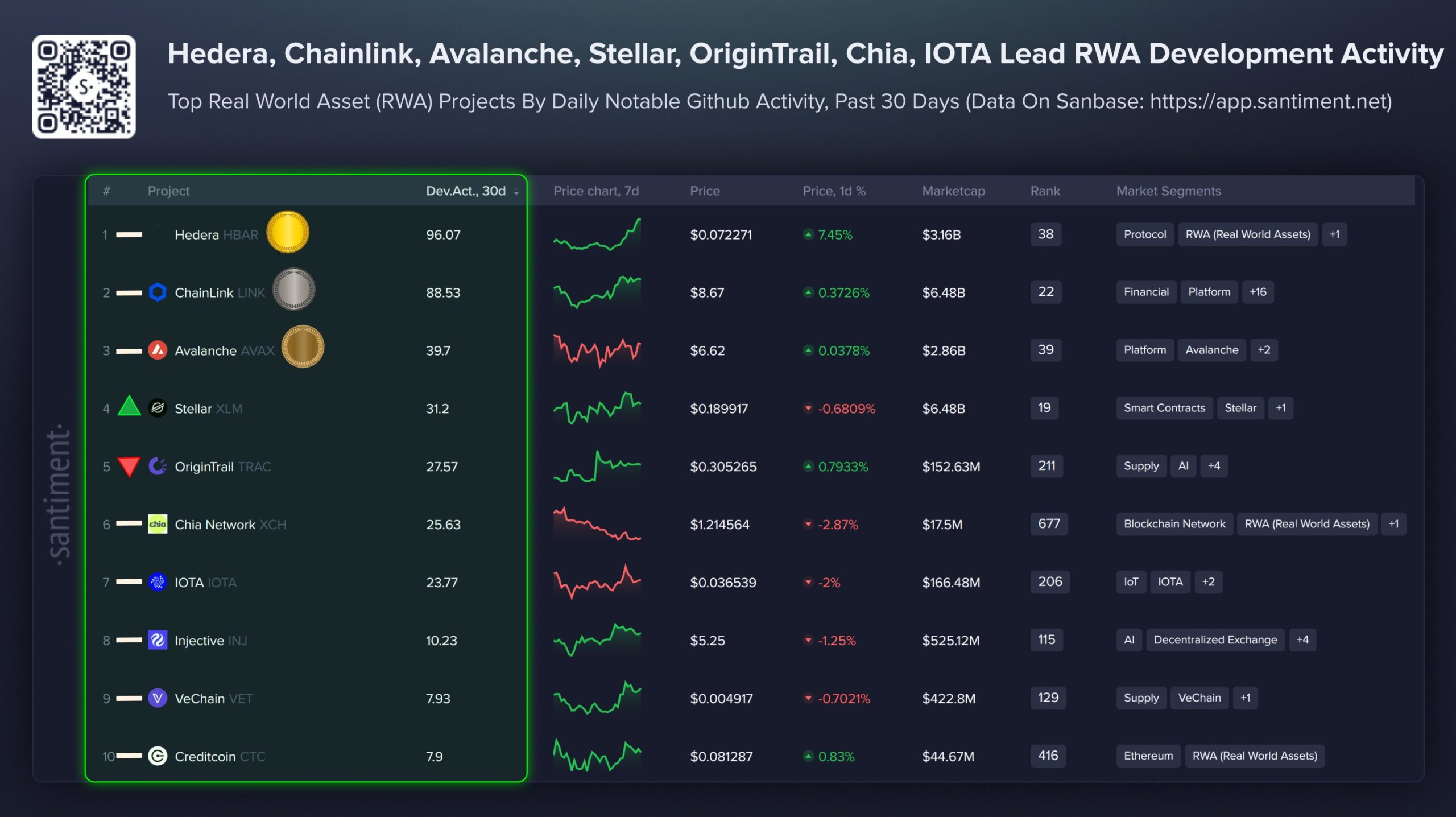
Santiment placed Hedera at the top of its RWA development rankings based on recent GitHub activity, with Chainlink and Avalanche rounding out the top three.
| Rank | Network | Token | Key Strength |
| 1 | Hedera | HBAR | Leading GitHub development activity in the RWA category |
| 2 | Chainlink | LINK | Decentralized oracle infrastructure connecting on-chain and off-chain data |
| 3 | Avalanche | AVAX | Scalable infrastructure built for financial institutions and developers |
The ranking suggests that blockchain developers are continuing to prioritize infrastructure built around institutional needs: asset tokenization, digital identity, payments, and enterprise-grade financial services. As more organizations look to blockchain to modernize how they manage and settle assets, development activity has become one of the metrics analysts track to gauge a project’s staying power.
Hedera’s position at the top is consistent with the network’s continued push into enterprise partnerships. The network has announced collaborations with organizations spanning several industries, including a well-known partnership with McLaren Racing. Deals like this reflect blockchain platforms’ broader search for commercial use cases beyond crypto trading, embedding distributed ledger technology directly into corporate operations and digital transformation efforts.
Enterprise demand is driving RWA growth
RWA has become one of the fastest-growing segments of the blockchain industry. RWA projects aim to represent tangible and financial assets, securities, real estate, commodities, invoices, and other instruments, as digital tokens that can be managed and transferred on-chain.
By enabling tokenization, blockchain platforms are working to make traditional financial markets more efficient, transparent, and accessible. Many in the industry argue the technology could shorten settlement cycles, cut administrative overhead, and open up investment opportunities by making assets easier to trade.
Chainlink and Avalanche also held strong positions in Santiment’s rankings, reflecting continued build-out across multiple blockchain ecosystems. Chainlink remains a leading provider of decentralized oracle infrastructure, letting blockchain networks securely pull in the external data that tokenized-asset applications depend on. Avalanche, meanwhile, keeps expanding its ecosystem with enterprise-oriented tools and scalable infrastructure built for financial institutions and developers alike.
The level of development activity across Hedera, Chainlink, and Avalanche reflects a faster pace of innovation aimed at enterprise adoption and the tokenization of traditional assets.
Analysts commonly use GitHub metrics to gauge the technical progress of blockchain projects. Sustained contributions from a development team typically signal active maintenance, regular feature improvements, and a longer-term commitment to the ecosystem, though development activity on its own doesn’t guarantee commercial success or future market performance.
Institutional interest in tokenized assets keeps growing 
The growing focus on RWA infrastructure fits into a broader shift across finance, as banks, asset managers, and technology firms explore blockchain-based approaches to issuing, settling, and custodying assets. Industry observers see tokenization as one of blockchain’s most promising applications, given its potential to modernize traditional financial infrastructure while improving operational efficiency.
Hedera’s enterprise-first strategy has helped position the network as a prominent player in this space. Its partnerships with established organizations point to growing interest in bringing blockchain technology into mainstream business operations, backed by infrastructure designed to be secure and scalable.
The way Hedera is governed also helps explain why large organizations have been willing to join the network. Rather than relying on anonymous miners or validators, Hedera is run by a Governing Council made up of global organizations, each operating a network node and holding equal voting rights. The Council currently includes technology firms such as Google, IBM, and Boeing; telecom groups including Deutsche Telekom and LG; and, on the financial side, institutions such as Nomura Holdings, Standard Bank, DBS Bank, and Shinhan Bank. Accenture joined the Council in early 2026, stating publicly that its focus would include delivering trusted infrastructure for both financial-services clients and government agencies.
The expanding RWA ecosystem points to deeper integration between blockchain technology and traditional financial markets, creating room for further institutional adoption and long-term industry growth.
As blockchain platforms keep investing in infrastructure and enterprise partnerships, competition within the RWA space is expected to intensify. Market observers expect that continued software development, strategic partnerships, and successful real-world deployments will determine which networks come out ahead in the next phase of blockchain adoption.
Santiment’s latest rankings reflect the industry’s broader shift toward practical enterprise applications, with development activity serving as one of the clearer signals of innovation as blockchain moves beyond digital assets and further into mainstream financial and commercial ecosystems.
As a Hedera ecosystem partner in Asia-Pacific, this is a ranking we watch closely. Varmeta builds products on the network and has worked with Hedera on a consortium piloting on-chain cross-border payments. A single ranking won’t change what we’re building, but it’s a good sign: the network we rely on is under active, measurable development, and it’s headed the same direction we are, toward enterprise and RWA use cases.