On May 4, 2026, the Hedera ecosystem gathered at Faena Forum in Miami Beach for HederaCon 2026, the second annual conference following the inaugural edition in Denver. The event was deliberately positioned between two of the busiest weeks in the blockchain calendar: Formula 1 Miami Grand Prix and Consensus 2026. That placement was intentional, and it signaled something about how Hedera sees itself, not as a fringe crypto conference competing for attention, but as a venue for a different kind of conversation, one involving institutions, regulators, and the infrastructure teams actually building production systems.
Varmeta’s CEO – Nha Tran was in the room. As Hedera’s ecosystem partner across Vietnam and the Asia Pacific region, we have been building on this network, through developer communities, enterprise workshops, university programs, and production deployments on mainnet. Being at HederaCon was less about discovery and more about seeing firsthand how the global conversation aligns with what we are already executing on the ground. What was announced and debated in Miami has direct consequences for financial institutions, government bodies, and enterprises across APAC and that is what this piece is about.
The shift that defined HederaCon 2026
The most honest summary of HederaCon 2026 is this: the conversation moved from “can distributed ledger technology do this?” to “how do we scale what is already working?” That shift is not rhetorical. It showed up in which organizations sent representatives, which sessions drew the most attention, and what Hashgraph chose to announce on stage.
Hashgraph CEO Eric Piscini declared the “End of the War of the Chains” during his keynote, a phrase that captures a real dynamic. The competitive framing of blockchain networks as adversaries has given way to a more pragmatic question: what combination of infrastructure serves institutional needs most reliably? Hedera’s answer is a layered architecture, public network for transparency and finality, private permissioned network for compliance and privacy, with interoperability between both.
Hashgraph’s three announcements
Hashgraph used HederaCon as the stage for three significant announcements that together outline where enterprise DLT is heading.
HashSphere reached general availability
HashSphere is a private, permissioned network built on Hedera technology, designed for financial institutions that need transaction privacy alongside access to broader digital asset markets. What makes HashSphere distinct is that it is not a subnet of the public network. It operates as a standalone architecture with customer-controlled validators, zero-knowledge proofs for settlement transactions, and mathematically guaranteed transaction ordering. Critically, it is built to interoperate with other HashSphere instances, the Hedera public network, and other blockchain networks via a new protocol called CLPR. As Piscini put it, financial institutions should not have to choose between regulatory compliance and access to liquidity. For markets like Vietnam, where the State Bank is actively developing a regulatory framework for digital assets, the architecture of HashSphere is directly relevant to how banks here will eventually connect to on-chain financial infrastructure.
CLPR, a cross-ledger protocol, was introduced
The CLPR protocol is designed to solve one of the persistent problems in institutional DLT adoption: the fragmented liquidity that results from siloed networks. The direction this points toward is a financial system where assets can move across ledgers with the same fluency that funds move between correspondent banks today, but with on-chain auditability and near-instant settlement.
Hashgraph invested in ioBuilders
The investment in ioBuilders, a Madrid-based firm whose Asseto platform enables compliant multi-chain asset issuance, reflects a broader strategy of meeting institutions where they are rather than demanding they commit to a single protocol. HashSphere will be integrated into Asseto starting in June 2026, giving institutions a path to issue and manage tokenized assets across networks without lock-in.
The substance of the sessions
Beyond the announcements, the agenda at HederaCon 2026 was notable for who participated and what they were willing to discuss on the record.
The session “The New Global Rails: Rewiring Payments, Settlement, and Trust” brought together representatives from Citi, Euroclear, DTCC, and Moody’s to examine how stablecoins and tokenized cash are changing the mechanics of cross-border settlement. This is not exploratory conversation at this point, Euroclear and DTCC are actively running or piloting tokenized settlement systems, and the discussion focused on what the regulatory and interoperability conditions need to look like for these to become standard infrastructure.
The “Trust on Chain: The Tokenization Era Takes Hold” session featured speakers from Archax, Aberdeen, ERC-3643 Foundation, and Red Swan, covering tokenization of real estate, investment funds, and foreign exchange instruments. Aberdeen managing assets on a tokenized basis is a different category of development from a startup minting NFTs. It means the compliance and audit requirements that govern traditional asset management are being mapped onto DLT infrastructure.
On the policy side, the sessions “Policy at a Pivot: Rules for a Tokenized Economy” and “Digital Assets as Financial Infrastructure: The Policy Debate” brought in voices from the White House, Blockchain Association, Digital Chamber, and Institute of International Finance. The event closed with a fireside chat with Patrick Witt, Executive Director of the White House Crypto Council. The signal here is that digital asset regulation in the United States is no longer being written around retail crypto; it is being written around institutional tokenization, stablecoin infrastructure, and cross-border payment rails. That framing matters enormously for how regulatory conversations develop in Southeast Asian markets that tend to follow U.S. and EU frameworks as reference points.
Hedera co-founder Mance Harmon’s concept of “invisible ubiquity”, articulated earlier at Davos, was central to the leadership keynote. The argument is that DLT, like the internet protocols before it, will be most successful when it becomes background infrastructure: always running, rarely visible, underpinning systems that people use without thinking about the ledger underneath. That framing has concrete implications for product strategy. It means the most important Hedera deployments are not the ones with the most visible on-chain activity, they are the ones embedded deepest into financial and government operations.
Why APAC, and why Vietnam specifically
Everything discussed in Miami has a parallel conversation happening in Southeast Asia, and the conditions in this region make that conversation unusually consequential.
Vietnam has over one million software engineers, a crypto adoption rate of 29% that ranks among the highest globally, a gaming industry generating $1.2 billion in annual revenue, and a government that passed a National Blockchain Strategy and is actively building the regulatory sandbox infrastructure to test digital payment systems. Vietnam is not waiting to see what happens in the West and then deciding whether to adopt, it is running its own pilots, forming its own policy, and looking for technology partners who understand both the technical requirements and the local regulatory context.
The Danang International Finance Centre is operating a sandbox program specifically designed to test compliant cross-border payment systems. The State Bank of Vietnam is engaged in sandbox discussions that touch directly on the payment rails, stablecoin, and tokenized asset conversations that dominated HederaCon 2026. When Citi and Euroclear discuss settlement finality at a conference in Miami, the questions they are asking are the same ones that Vietnamese banks and government bodies are working through, just at an earlier stage of institutional commitment.
The SEA blockchain market is projected to reach $10 billion by 2028. The window for establishing which infrastructure becomes foundational is open now, and it will close as standards solidify and switching costs accumulate.
Varmeta on Hedera: Deployments in production
Varmeta has been working as Hedera’s on-the-ground ecosystem partner in Vietnam and APAC. We are not describing a strategy, we are describing what is already deployed and operational.
The Unity SDK for Hedera gives mobile game studios the ability to handle account creation, transaction management, and token actions: minting, transferring, and managing HTS tokens including NFTs, directly within a Unity application on iOS or Android, without requiring users to connect an external wallet. With Vietnam’s gaming industry at $1.2 billion and growing, the distribution surface for Hedera through game developers is significant, and the SDK removes the primary technical barrier to entry.
The Accounting and Billing Module is deployed on Hedera mainnet. It is the first enterprise-grade accounting tool built specifically for Hedera in Southeast Asia, and it handles Vietnam’s VAT requirements, electronic invoicing, and triple-entry accounting natively. Any Vietnam-based business moving toward on-chain financial operations can use it directly, as it was designed to be compliant from the start rather than retrofitted.
The Danang IFC Sandbox Pilot is the most operationally significant of the three. A seven-company consortium: Varmeta, Hedera, Animoca Brands, Basalpay, HashPack, Open Campus, and Sunrise Events, is deploying a fully compliant cross-border payment system using Ironman Vietnam 70.3 as a live test environment. Sponsors contribute funds in USDT, USDC, or HBAR. Basalpay converts to VND and settles directly into the organizer’s bank account with a complete KYC/AML forensics trail. Varmeta’s Accounting Module then automatically issues a compliant VAT invoice. The full transaction cycle, from international crypto contribution to local fiat settlement to tax-compliant invoicing, runs on Hedera infrastructure. This is the first blockchain payment sandbox pilot of its kind in Vietnam.
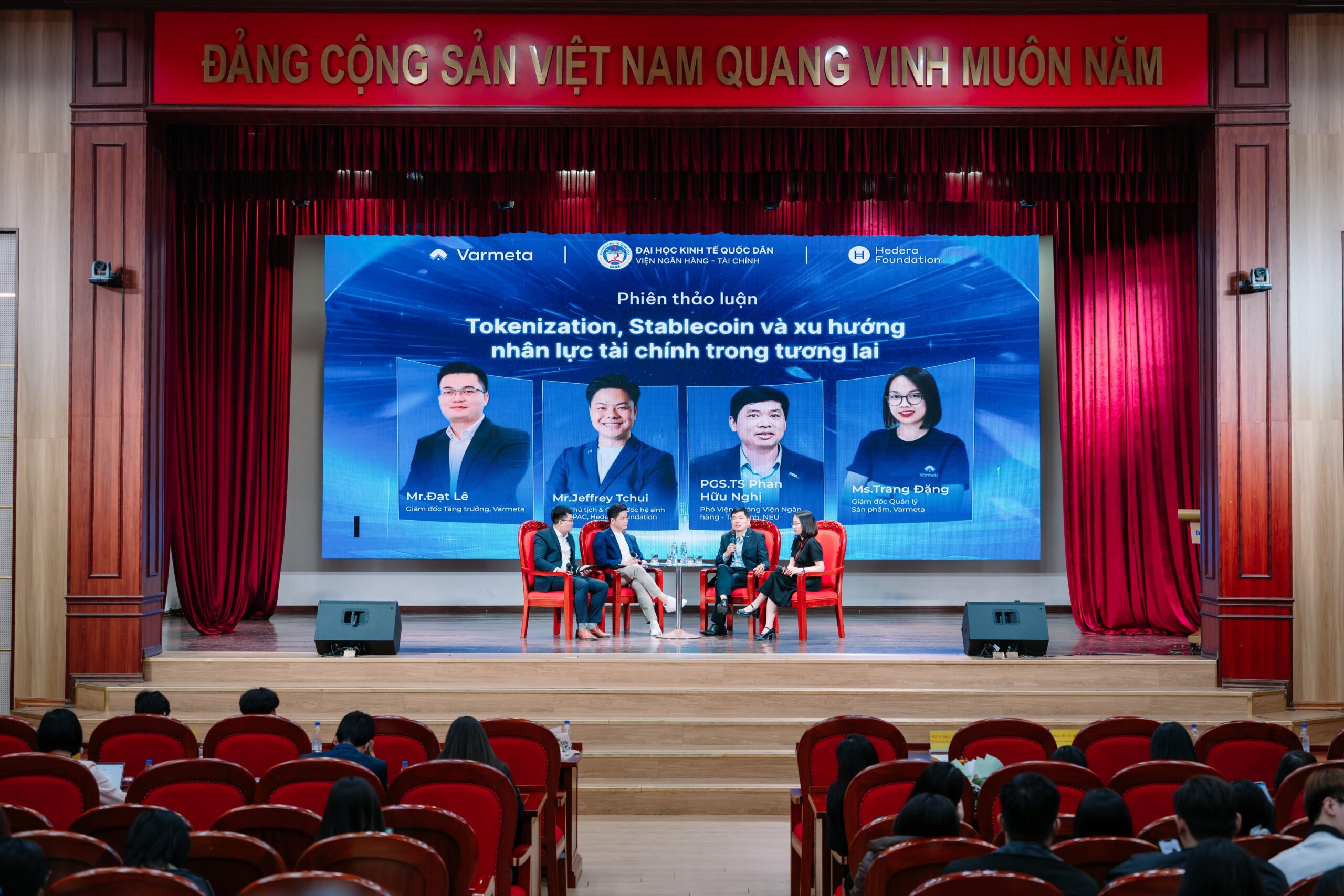
Beyond the engineering deliverables, Varmeta has run five Builders Meetups with over 700 total attendees, engaged more than ten universities including HUST, FTU, NEU, and RMIT, and connected Hedera with eight major Vietnamese banks at a BFSI roundtable. These are not awareness campaigns, they are pipeline development for the enterprise and government deployments that follow.
Looking ahead
HederaCon 2026 confirmed that the institutional-grade DLT market is consolidating around interoperability and compliance as the two defining requirements. HashSphere’s architecture, CLPR’s cross-ledger ambitions, and the policy sessions all point in the same direction: the networks that win in financial infrastructure will be the ones that can connect to existing systems rather than demanding that existing systems rebuild around them.
In APAC, that means the next phase of work is about integration: connecting Hedera’s infrastructure to Vietnam’s national payment sandbox projects, extending the Danang IFC model to HCMC and eventually to Thailand and Malaysia, and building the interbank data-sharing capabilities that Vietnamese banks discussed at the BFSI roundtable. Varmeta’s AI team, with PhD-level expertise in machine learning and applied AI, is also beginning formal contributions to Hedera AI Studio, focused on multi-agent frameworks and on-chain verifiable inference.
The broader opportunity is for Hedera to become the trust infrastructure for Southeast Asian financial systems in the same way that the conference in Miami described it becoming foundational in Western markets. The question is whether the right partnerships and deployments are in place to make that happen before other networks establish the same relationships. From our position on the ground in Vietnam, the conditions are favorable, the institutional interest is real, and the technical foundation is already built.
If you represent an enterprise, financial institution, or government body exploring DLT deployment in Vietnam or the wider APAC region, Varmeta operates as a full-stack implementation partner with existing relationships across the Hedera ecosystem and direct experience navigating Vietnam’s regulatory environment.
Contact us at https://www.var-meta.com/contact