Imagine a game where characters don’t just follow scripts they observe, learn, and evolve just like real people. Welcome to the age of AI agents: intelligent systems that are reshaping how video games are played, experienced, and remembered.
These advanced AI agents are powering non-player characters (NPCs) that behave more like teammates than code, adapting to your decisions and play style. They generate dynamic worlds that shift with every playthrough, ensuring that no two players share the exact same journey.
Game developers are increasingly tapping into the power of AI agents, not just to improve graphics or speed up development, but to enhance immersion, storytelling, and gameplay itself. And the momentum is only growing. According to recent forecasts, the generative AI in gaming market is expected to surge from $992 million in 2022 to $7.1 billion by 2032, growing at a CAGR of 23.3%.
In this article, we’ll explore how AI agents are revolutionizing modern gaming from smarter NPCs and personalized worlds to real-time decision-making and beyond. Let’s dive into the future of gaming, where intelligence plays the lead role.
Understanding AI agents in gaming

AI in gaming isn’t a new concept, it has deep roots going all the way back to the early 1950s. The first known AI-powered game, Nim, was created in 1951. Just a year later, IBM developed an AI system for checkers that could learn from its moves and gradually improve over time. These early experiments laid the groundwork for what would become a revolution in interactive entertainment.
Fast forward to today, and AI agents are no longer limited to strategy games like Go or Atari simulations used in research labs. Modern machine learning models are now being trained and tested in complex game environments not just to win, but to reason, adapt, and evolve. Video games have become a proving ground for some of the most advanced AI systems in the world.
But perhaps the most exciting application of AI isn’t just behind the scenes, it’s in the gameplay itself.
Generative AI agents are now capable of transforming traditional gaming experiences by:
- Controlling NPCs with dynamic, lifelike behavior
- Simulating physics and world interactions in real time
- Generating procedural content that changes with each playthrough
- Adapting gameplay difficulty based on player behavior
- Reacting intelligently to in-game environments and instructions
What sets these AI agents apart from conventional scripted systems is their ability to act with autonomy. Rather than following rigid, pre-programmed patterns, they can understand goals, interpret context, and respond organically to changes in the game world.
This leap means NPCs no longer feel robotic or predictable. Instead, they can exhibit human-like decision-making, learn from past encounters, and even surprise players with their actions, bringing a new level of immersion, unpredictability, and realism to modern gaming.
As AI agents continue to evolve, the line between player and system blurs and the result is a more intelligent, engaging, and responsive game world than ever before.
How AI agents are powering the next generation of gaming

Artificial intelligence is no longer a futuristic concept in gaming, it’s happening right now. From the way NPCs react to your choices, to how entire worlds are generated on the fly, AI agents are reshaping how games are developed, played, and evolved over time.
Let’s explore some of the most exciting and impactful applications of AI agents in today’s video game experiences.
1. Smarter, more human NPC behavior
Gone are the days of lifeless, repetitive non-player characters. AI agents now give NPCs the ability to think, react, and remember resulting in more immersive worlds and meaningful interactions.
AI-powered NPCs can:
- Adjust behavior based on your in-game choices
- Express believable emotions and reactions
- Learn from conversations and past encounters
For instance, NPCs in open-world games such as Red Dead Redemption 2 recall previous interactions with the player and respond appropriately, making the world more realistic and lively.
2. Procedural content generation at scale
AI agents are incredibly good at building things, big things. From terrain and environments to quests, loot, and even character archetypes, they can generate dynamic content that keeps games fresh with every playthrough.
Used in titles like No Man’s Sky, AI generates:
- Vast, explorable planets
- Unique ecosystems and creatures
- Randomized quests and item placement
The result? A virtually infinite universe that feels handcrafted, yet different every time.
3. Adaptive difficulty that feels just right
No one likes a game that’s too easy or frustratingly hard. AI agents solve this by analyzing your performance in real time and adjusting difficulty dynamically to match your skill level.
Examples of adaptive mechanics include:
- Enemies scaling in strength as you improve
- Offering hints or power-ups if you’re struggling
- Adjusting loot drops or enemy patterns based on past behavior
Games like Resident Evil 4 use adaptive difficulty to tweak item availability and enemy AI silently in the background, keeping the experience balanced and engaging.
4. Intelligent pathfinding and navigation
Behind every smooth enemy ambush or flanking maneuver is an AI agent calculating the best route. In both NPC and player-controlled units, AI-powered pathfinding ensures characters move with purpose and realism.
In genres like RTS, RPGs, and open-world adventures, this leads to:
- More tactical enemy behaviors
- Realistic movement patterns in complex environments
- Fewer “glitchy” AI navigation hiccups
5. Next-level visual enhancements
AI isn’t just about logic, it’s helping power the visual fidelity of modern games. Using deep learning and neural networks, AI agents can improve graphical quality in real time.
Key applications include:
- Texture and resolution upscaling (e.g., NVIDIA DLSS)
- Generating more expressive facial animations
- Optimizing rendering for smoother performance on varied hardware
This technology allows developers to deliver visually stunning games without pushing hardware to its limits.
6. Player sentiment and experience analysis
Understanding player behavior goes beyond what happens on-screen. AI agents are now being used to analyze how players feel, based on both direct feedback and in-game behavior patterns.
This data helps studios:
- Improve game balance and UX
- Personalize player experiences
- Roll out smarter updates based on community sentiment
From tracking engagement to predicting churn, sentiment analysis helps developers fine-tune their games for long-term success.
As AI models become faster, smarter, and more creative, the possibilities for their use in gaming will only continue to expand. We’re already seeing early prototypes of:
- NPCs that remember past players and evolve over time
- In-game conversations powered by LLMs like ChatGPT
- Autonomous agents that shape the story based on your choices in real time
The future of gaming lies in intelligence, immersion, and personalization and AI agents are at the heart of this transformation.
Key benefits of AI agents in gaming
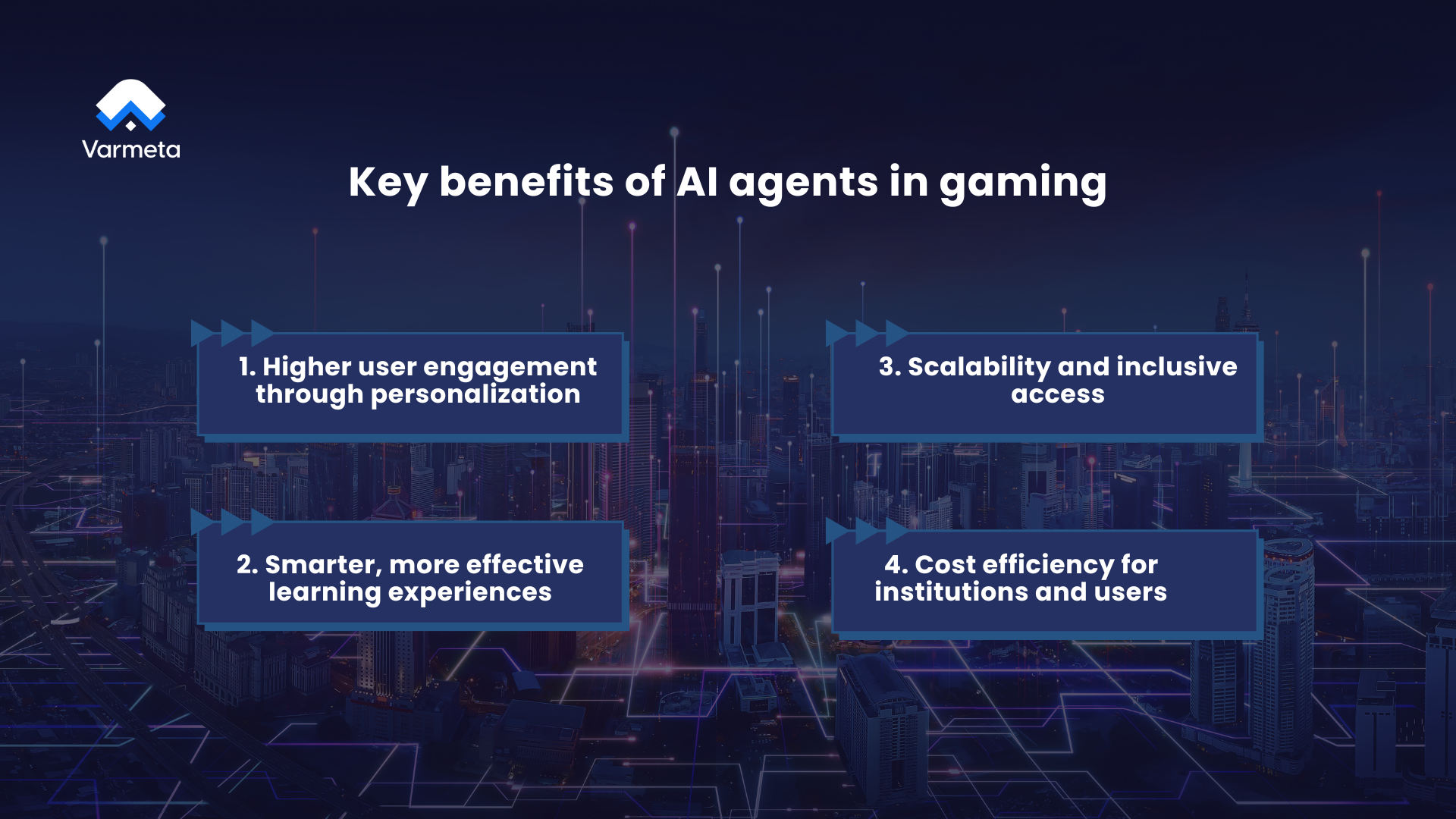
AI agents are more than just a cool add-on in modern video games, they’re driving real improvements in how users play, learn, and engage. Whether in the world of gaming or e-learning, intelligent agents bring personalization, adaptability, and scalability to the next level.
Let’s break down some of the biggest benefits of AI agents in action:
1. Higher user engagement through personalization
AI agents are masters of adaptation and that’s exactly what keeps players and learners coming back. In gaming, they can tweak difficulty levels on the fly, respond to player decisions, and create dynamic scenarios that make every session feel new.
- Personalized challenges keep gameplay balanced and rewarding.
- Gamified rewards and AI-generated quests enhance motivation.
- In social games, AI agents can simulate lifelike community interactions, building a sense of belonging.
In e-learning, these same principles apply:
- Quizzes adapt to how well you’re doing.
- Simulations respond to your choices.
- The result? Deeper immersion and longer engagement.
2. Smarter, more effective learning experiences
AI-driven systems don’t just deliver content, they learn how you learn. Whether you’re mastering radiology or game design, intelligent agents help make education more efficient, personalized, and impactful.
Here’s how:
- Real-time feedback pinpoints strengths and weaknesses.
- Customized learning paths match your pace and style.
- Collaborative AI environments foster peer-to-peer learning and discussion.
And because AI tools analyze huge volumes of performance data, educators can refine their content based on real insights improving outcomes for future learners.
- Scalability and inclusive access
With AI agents at the core, digital platforms can grow fast. Whether it’s a game server hosting thousands of users or an online classroom reaching rural students, AI makes high-quality interaction possible at scale.
Benefits include:
- 24/7 availability across time zones and schedules.
- Support for different learning styles via videos, quizzes, and interactive content.
- Accessibility features for students with disabilities (e.g., text-to-speech, visual aids).
- Cost-effective expansion without the need for massive physical infrastructure.
In short, AI makes meaningful interaction possible for more people, in more places, without sacrificing quality.
4. Cost efficiency for institutions and users
AI agents help cut costs not by lowering quality, but by streamlining operations and reducing overhead.
For educational institutions:
- Fewer physical resources = lower facility costs.
- Automated content delivery = reduced teaching strain.
- Scalable systems = more students without more spending.
For learners:
- More affordable courses thanks to automation.
- No travel or campus expenses.
- Free or low-cost learning tools powered by AI.
The long-term benefit? A more efficient, democratized model of both gaming and learning, where quality doesn’t rely on deep pockets.
AI agents are changing the rules of engagement not just in video games, but in how we approach interaction, education, and scalability as a whole.
Whether it’s creating lifelike NPCs in an open-world RPG or delivering a personalized lesson plan to a remote student, AI agents bring intelligence, flexibility, and humanity into digital environments.
As the technology matures, expect even deeper levels of personalization, smarter systems, and experiences that feel truly tailored to the individual whether you’re holding a controller or sitting in a virtual classroom.
Conclusion
We’ve entered a new era of gaming, one where intelligence doesn’t just sit in the hands of the player, but lives within the world itself. AI agents are no longer silent processes behind the curtain. They are storytellers, teammates, world-builders, and strategists, elevating the player experience from passive interaction to dynamic co-creation.
Gone are the days of rigid scripts and static outcomes. Today’s AI agents observe, adapt, and grow. They challenge you, surprise you, and respond to your choices in ways that feel genuinely human. From lifelike NPCs that remember your actions, to worlds that evolve with every step, AI is creating games that are not only more immersive but more alive.
And this transformation isn’t slowing down. With massive growth projected in generative AI for gaming, we’re just scratching the surface of what’s possible. Imagine characters that evolve across playthroughs, stories that shape themselves around your personality, and virtual worlds that feel as responsive and unpredictable as real life.
Whether you’re a developer, a gamer, or a curious observer of where technology is headed, one thing is clear:
The future of games isn’t just about playing. It’s about connecting with worlds, with stories, with intelligence.
At the heart of it all?
AI agents.
And they’re only getting smarter.