The rise of DePIN: Transforming infrastructure with web3 technology
The market for Decentralized Physical Infrastructure Networks (DePIN) is experiencing unprecedented growth, showcasing its potential to reshape industries. By August 2024, DePIN’s market cap defied trends, rising by 22.7% while other sectors faced stagnation.
Taking a broader view, the growth trajectory of DePIN is even more impressive. The market cap has soared by 400%, surpassing $20 billion, and fundraising activity has surged by an incredible 296% year-over-year. These milestones underscore the increasing trust and enthusiasm from developers and investors, who see DePIN as a game-changing solution for modern infrastructure challenges.
In a world driven by rapid technological evolution, the reliance on physical infrastructure like energy grids and wireless networks remains fundamental. However, traditional centralized systems often grapple with inefficiencies, vulnerabilities, and limited reach. DePIN introduces a transformative alternative by leveraging blockchain technology to decentralize infrastructure, creating more robust and accessible systems.
This blog explores the revolutionary potential of Web3-powered DePIN across various industries, examining how it addresses existing limitations and sets the stage for a decentralized, efficient, and future-ready infrastructure landscape. From transparent supply chains to peer-driven energy solutions, DePIN is not just an idea—it’s a movement redefining how we interact with the physical world.
A new perspective on web3 DePIN

Web3 has introduced Decentralized Physical Infrastructure Networks (DePINs) as a revolutionary approach to owning and managing infrastructure. By harnessing the power of blockchain, tokenization, and decentralized governance, DePINs pave the way for community-driven networks that challenge traditional centralized models. This innovative concept brings inclusivity, transparency, and collaboration to the forefront of infrastructure management.
At its core, DePIN in Web3 shifts control from centralized authorities to the community. Unlike conventional systems managed by corporations or governments, DePINs empower individuals and organizations to collectively own, operate, and make decisions about the infrastructure. This decentralized governance model ensures that network participants have a direct say in development, allocation, and maintenance processes, fostering transparency and accountability while democratizing infrastructure management.
Tokenization plays a central role in the DePIN ecosystem, enabling contributors to actively participate in both ownership and governance. Tokens represent a share in the network, granting voting rights and access to revenue. This creates a powerful incentive for community members to contribute resources, skills, and ideas to the infrastructure’s growth and sustainability. By aligning incentives with the network’s success, tokenization transforms contributors into stakeholders, driving collaboration and long-term commitment.
One of DePIN’s most transformative features is its ability to leverage resources contributed by individuals and organizations. These resources can range from digital assets like storage, bandwidth, or processing power to physical assets such as renewable energy. Contributors are rewarded with tokens that reflect their input and entitle them to a share of the network’s earnings. This model not only incentivizes participation but also ensures the infrastructure remains scalable, resilient, and cost-effective.
DePIN’s impact extends across industries, offering innovative solutions for long-standing challenges:
- Telecommunications: DePINs enable decentralized internet networks, providing affordable and reliable access to underserved communities while reducing dependence on large telecom providers.
- Energy: Peer-to-peer trading platforms powered by DePINs allow individuals and businesses to exchange renewable energy directly, fostering sustainable energy consumption and reducing costs.
- Supply Chain: Transparent, blockchain-backed systems ensure accountability and efficiency in tracking goods from production to delivery.
By reimagining how infrastructure is owned and operated, Web3 DePINs are not just reshaping industries—they are empowering communities to take an active role in building and maintaining the systems they rely on, creating a more equitable and sustainable future.
Unveiling the advantages of web3 DePIN
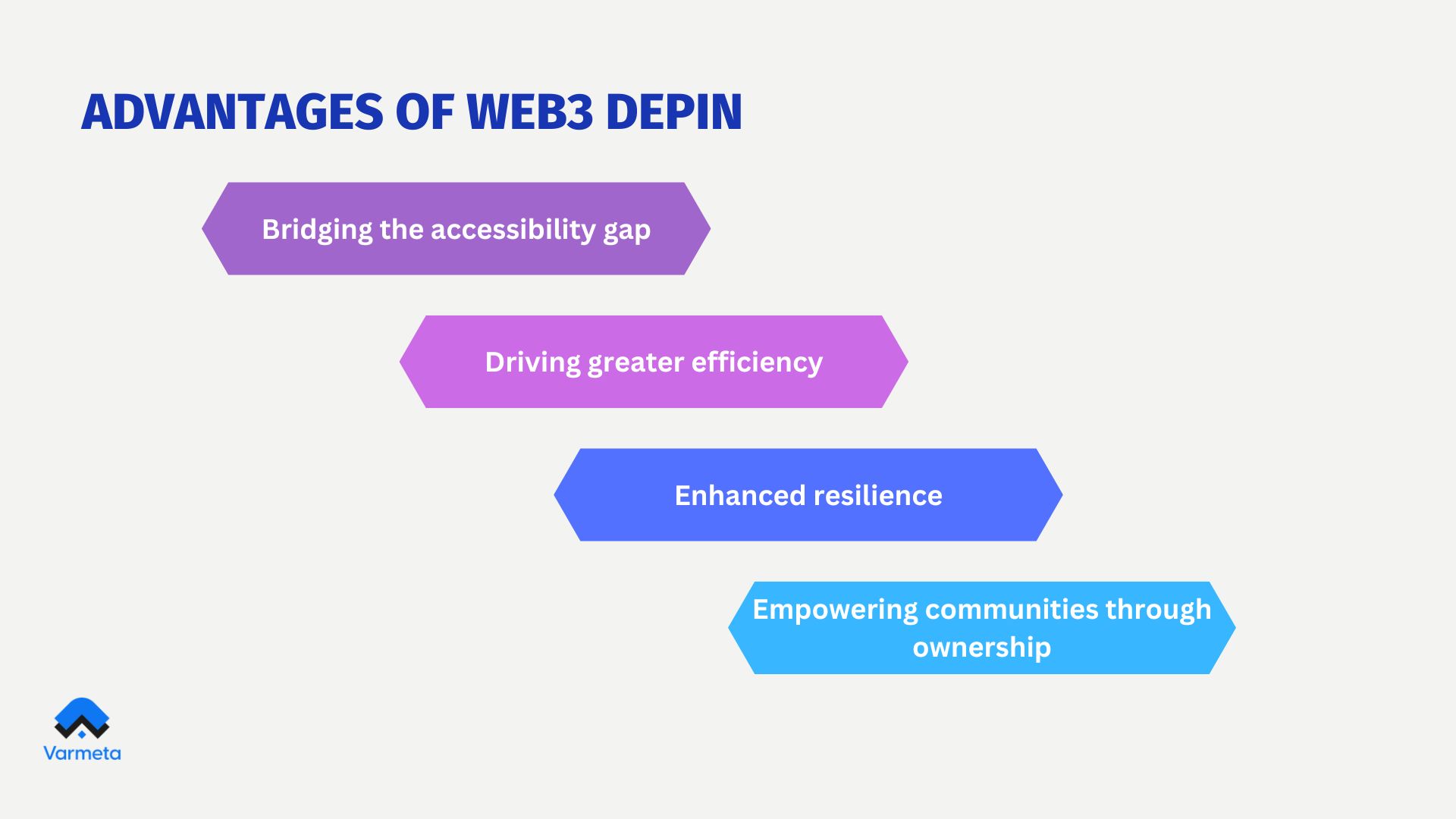
Web3 DePIN (Decentralized Physical Infrastructure Networks) represents a breakthrough in how physical infrastructure is managed and accessed. By leveraging blockchain technology, DePIN is set to revolutionize industries, providing innovative solutions to long-standing challenges. Here’s a fresh look at the key advantages of Web3 DePIN:
Bridging the accessibility gap
DePIN breaks down barriers to essential services for underserved communities.
- Why it matters: By sidestepping centralized providers, DePIN enables even the most remote and economically disadvantaged communities to access the internet, renewable energy, and other critical resources.
- Real-world impact: In remote regions without traditional infrastructure, DePIN creates lifelines for education, healthcare, and economic opportunities. For instance, a decentralized energy grid can power homes in areas where conventional systems don’t reach, empowering communities to thrive in the digital economy.
Driving greater efficiency
By leveraging blockchain, DePIN eliminates inefficiencies caused by intermediaries and outdated processes.
- How it works: Transparent and auditable systems ensure resources are allocated efficiently, reducing costs for consumers and businesses.
- Impact example: Peer-to-peer energy trading, enabled by DePIN, allows individuals to directly buy and sell electricity without the need for costly middlemen. This not only lowers energy prices but also boosts competition, benefiting both users and providers.
Enhanced resilience
Decentralized networks like DePIN are naturally more robust than traditional centralized systems because they eliminate single points of failure. This makes them highly reliable during events such as natural disasters or cyberattacks, where centralized infrastructure might collapse. With DePIN, critical services can remain operational even in the most challenging circumstances, ensuring uninterrupted support for affected communities.
For example, after a hurricane, DePIN-powered communication networks can serve as lifelines for emergency responders and residents. These decentralized systems enable reliable coordination of relief efforts, quick dissemination of critical information, and faster restoration of essential services. This resilience is particularly crucial for remote or disaster-prone areas, providing them with stability and security when they need it most.
Empowering communities through ownership
DePIN shifts the control of infrastructure to the communities that rely on it, promoting shared ownership and decision-making.
- Why it matters: Local governance allows communities to prioritize their needs and take pride in managing their resources.
- Impact example: In water management, DePIN can help residents collaboratively monitor and distribute water resources, ensuring fairness and sustainability. This approach fosters stronger community bonds and better resource stewardship.
Notable examples of web3 DePIN projects
Web3 DePIN is already making significant strides across industries, showcasing the real-world applications of decentralized infrastructure. Here are four standout examples that highlight the transformative potential of DePIN:
Helium
Purpose: Decentralized Wireless Connectivity
Helium is reshaping internet access with a global network of decentralized hotspots. These small, low-power devices, installed in homes and businesses, provide wireless coverage for IoT devices. In return, hotspot operators earn HNT, Helium’s native token, for their contributions to the network.
Key features:
- Affordable and reliable internet access.
- Blockchain-based infrastructure ensures security, transparency, and decentralization.
- Empowers individuals to participate in a community-driven network.
Helium’s mission to democratize wireless connectivity makes it a game-changer, particularly for underserved regions, where affordable and accessible internet can unlock educational and economic opportunities.
Render network
Purpose: Decentralized 3D Rendering
Render Network connects artists and studios with affordable rendering power through a decentralized system. By utilizing blockchain technology, it offers a scalable and cost-effective alternative to traditional rendering farms.
Key features:
- Decentralized platform for rendering 3D graphics.
- Transparent and auditable blockchain framework.
- Rewards contributors with RNDR tokens for providing rendering capacity.
Render Network is particularly beneficial for creators and studios looking to streamline production costs while maintaining high-quality outputs in gaming, film, and design industries.
Filecoin
Purpose: Decentralized Storage Solutions
Filecoin revolutionizes data storage by allowing users to rent out unused hard drive space. As a peer-to-peer network, it eliminates centralized control, relying on a distributed system of nodes to store and retrieve data securely.
Key features:
- Cost-effective and scalable alternative to traditional cloud storage.
- Blockchain ensures data security, transparency, and auditability.
- Rewards participants with FIL tokens for contributing storage capacity.
Filecoin is especially valuable for businesses and individuals seeking secure, decentralized solutions to store sensitive data, avoiding the vulnerabilities of centralized systems.
Why choose DePIN for web3 gaming?

The integration of DePIN (Decentralized Physical Infrastructure Networks) into Web3 gaming offers transformative benefits that redefine both the gaming experience and game development processes. Here’s how DePIN enhances Web3 gaming:
Empowering players as stakeholders
DePIN shifts players from being mere consumers to active participants in the game’s ecosystem.
- Player governance: Players can join decentralized autonomous organizations (DAOs) to vote on game decisions, such as development updates or rule changes, giving them a direct voice in the game’s direction.
- Node participation: Players can contribute to the game’s infrastructure by running nodes to validate transactions, ensuring secure and transparent in-game economies.
- Rewards: Contributors are incentivized with tokens or assets, fostering a deeper sense of ownership and connection to the game.
This player-first approach creates a dynamic gaming environment where players feel valued and emotionally invested.
Unlocking new economic opportunities
DePIN revolutionizes the Web3 gaming economy with decentralized, player-focused systems.
- Reduced costs for developers: DePIN eliminates the need for costly centralized servers and infrastructure, freeing developers to focus on creativity rather than overheads.
- Asset monetization: Players can buy, sell, and trade in-game items through decentralized marketplaces, creating sustainable economies that benefit both players and developers.
- True ownership: Digital assets become valuable, tradable resources, offering players tangible economic rewards for their time and effort.
By decentralizing the financial model, DePIN ensures a fairer and more equitable gaming economy.
Enhancing gameplay with superior infrastructure
DePIN’s decentralized architecture ensures smoother and more responsive gameplay.
- Ultra-low latency: Faster communication between players and servers leads to seamless interactions, crucial for competitive games like MOBAs or first-person shooters.
- Global accessibility: Players can access games from anywhere with an internet connection, removing the dependency on expensive hardware or consoles.
These improvements elevate the gaming experience, making Web3 gaming more inclusive and enjoyable for a broader audience.
Driving innovation in game development
DePIN empowers developers to push the boundaries of what’s possible in gaming.
- New game models: Games can be fully player-owned and player-governed, with communities shaping the game’s future.
- Interoperable gaming: DePIN supports assets and progress that can be transferred across different games, creating a connected ecosystem of experiences.
- Creative freedom: The decentralized infrastructure allows developers to experiment with new mechanics and genres, fostering groundbreaking innovations.
This opens the door to entirely new ways of engaging with and experiencing games.
Building stronger communities
DePIN encourages collaboration between players and developers, creating vibrant gaming communities.
- Decentralized decision-making: Developers can involve players in shaping the game through feedback and voting systems, ensuring alignment with player expectations.
- Social interaction: DePIN fosters platforms for players to connect, socialize, and collaborate, enhancing the sense of community within games.
- Retention and loyalty: By aligning with player needs, developers build games that are more engaging, resulting in higher satisfaction and long-term player retention.
These community-driven approaches make Web3 games more than just entertainment—they become shared spaces for collaboration and growth.
By integrating DePIN, Web3 gaming achieves unprecedented levels of accessibility, innovation, and community engagement. Whether through player empowerment, economic opportunities, or enhanced infrastructure, DePIN is reshaping the future of gaming, making it more inclusive, dynamic, and rewarding for everyone involved.
Conclusion
DePIN is shaping the future of decentralized applications by revolutionizing industries with its innovative infrastructure. From enhancing Web3 gaming experiences to streamlining business operations, DePIN introduces a transformative approach to decentralization. By leveraging blockchain technology, it aligns seamlessly with the growing demands of decentralized finance and other emerging Web3 sectors.
As industries continue to adopt decentralized models, DePIN Blockchain as a Service is poised to drive significant advancements, fostering efficiency, accessibility, and sustainability across various domains. Looking ahead, DePIN is set to become a cornerstone of the decentralized ecosystem, paving the way for more inclusive and forward-thinking applications.