Web3 is redefining the landscape of decentralized applications by placing ownership, transparency, and security directly in the hands of users. Unlike Web2’s reliance on centralized servers, Web3 leverages blockchain protocols to build trustless systems where data and value flow freely without intermediaries.
However, launching Web3 apps requires more than just an innovative idea. Developers must navigate blockchain selection, smart contract deployment, user interface design, and tokenomics strategies. Popular tools like Solidity, Rust, and Web3.js streamline development, but long-term success depends on scalability, community growth, and regulatory compliance.
With the global Web3 market projected to surge from $3.17 billion in 2024 to nearly $100 billion by 2034, now is the time to capitalize on this momentum. This guide will walk you through every step from development to marketing to help you successfully launch and sustain your Web3 app.
What is a Web3 app & how does it work?
A Web3 app, or decentralized application (dApp), runs on blockchain networks instead of centralized servers, empowering users with ownership, transparency, and security. At its core, a Web3 app connects a user-friendly front end to a decentralized backend powered by smart contracts. No single entity controls the data, everything is distributed across the network.
Common examples include:
- Supply chain dApps: Tracking goods transparently.
- DeFi platforms: Enabling peer-to-peer lending, borrowing, or trading without banks.
- Decentralized social networks: Giving users full control over content and data.
- NFT marketplaces: Facilitating the exchange of unique digital assets.
In essence, Web3 apps eliminate intermediaries, creating open, trustless ecosystems where users are in control.
Exploring the most popular types of web3 apps
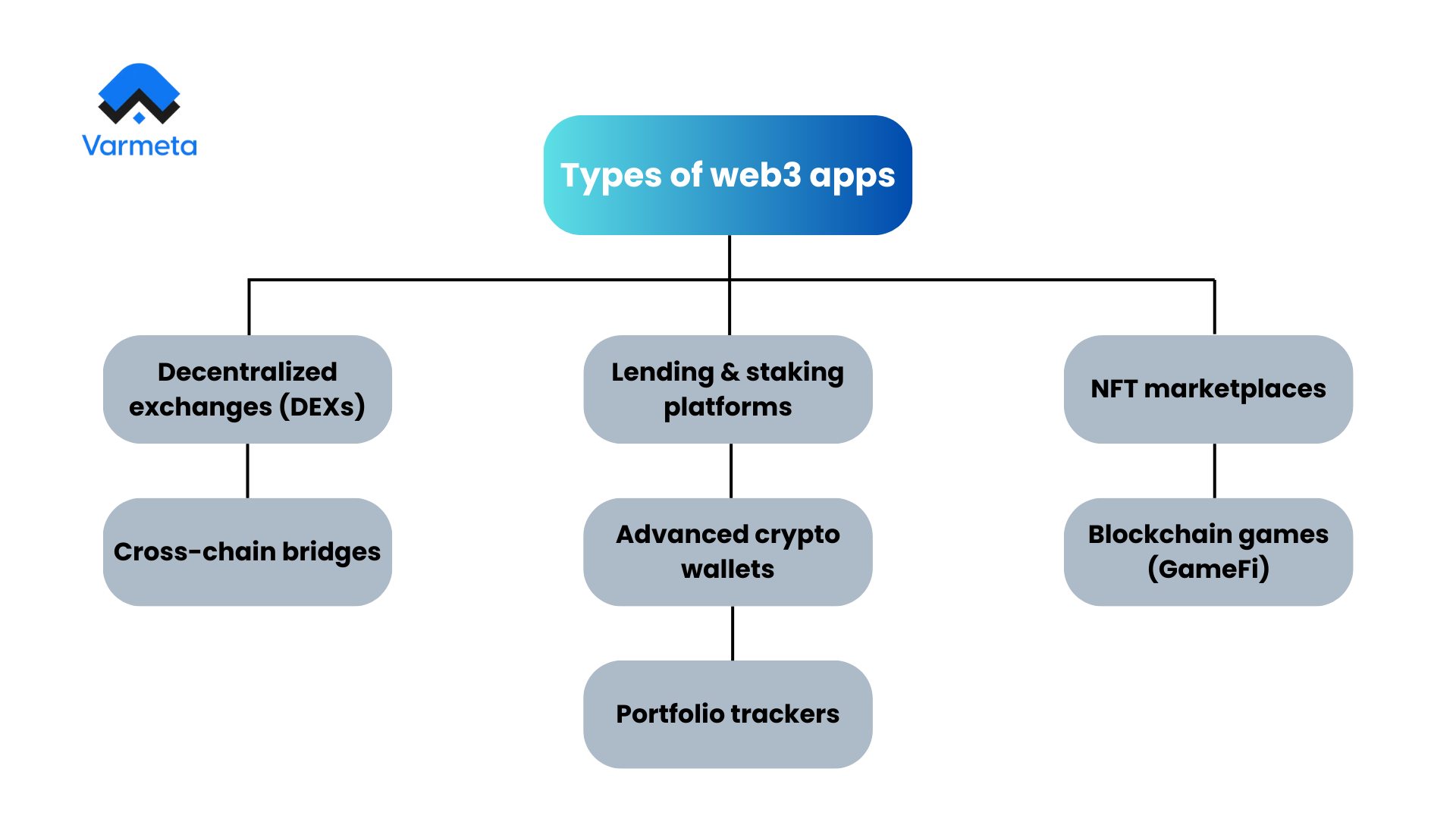
Source: Varmeta
Web3 apps come in various forms, each transforming how we interact with digital assets and online ecosystems. Despite spanning different industries, all Web3 applications share one goal: delivering open, secure, and decentralized experiences powered by blockchain technology. Let’s take a closer look at the standout categories:
- Decentralized exchanges (DEXs): Facilitate peer-to-peer crypto trading without intermediaries.
- Lending & staking platforms: Automate borrowing, lending, and staking through smart contracts.
- NFT marketplaces: Enable trading of unique digital assets representing ownership or authenticity.
- Cross-chain bridges: Enhance interoperability by allowing asset transfers across blockchains.
- Advanced crypto wallets: Offer features like token swapping, DeFi access, and DApp integration.
- Blockchain games (GameFi): Reward players with crypto and NFT-based in-game assets.
- Portfolio trackers: Help users monitor their crypto investments across multiple platforms.
Each category demonstrates how Web3 is reshaping industries, fostering transparency, and giving users greater control over their digital interactions.
How to develop a successful web3 application
Building a Web3 app is not just about coding, it’s about strategically blending blockchain technology, user experience, and sustainable growth. Here’s a refined roadmap to guide you:
1. Clarify vision & market fit
Before writing a single line of code, define why your Web3 app should exist. Is it solving a real inefficiency in DeFi, gaming, social media, or supply chains? Research market gaps, identify your target user persona, and validate your app idea through community engagement or early surveys. A clear, validated purpose not only keeps development focused but also builds a loyal user base early.
Tip: Competitive analysis of existing dApps in your niche can reveal features users want but aren’t getting.
2. Select the optimal blockchain & infrastructure
Choosing a blockchain network isn’t just technical, it’s a business decision. Consider:
- Transaction speed & costs: Ethereum offers security but higher fees; Polygon or Solana offer lower costs and scalability.
- Consensus mechanism: PoS (Proof of Stake) chains are environmentally friendly and often faster.
- Ecosystem maturity: Assess developer tools, existing dApps, liquidity, and community support.
Additionally, decide whether you’ll integrate Layer 2 solutions, off-chain storage (IPFS, Arweave), or oracle services (Chainlink, Band Protocol).
3. Build the right team
Web3 development requires expertise beyond traditional software:
- Smart contract developers proficient in Solidity, Rust, or Vyper.
- Blockchain architects who design scalable, secure protocols.
- Front-end engineers familiar with Web3.js, Ethers.js, React, or Vue.
- UX/UI designers who understand wallet flows and crypto user behaviors.
If you lack in-house expertise, collaborating with specialized blockchain development firms accelerates your launch and minimizes security risks.
4. Craft a comprehensive technical specification
Avoid future rework by writing a precise tech spec document:
- Define core features: wallet integration, smart contract logic, token management, governance mechanisms.
- Map data flow: how on-chain and off-chain data interact.
- Detail APIs, dependencies, and scalability strategies (e.g., sharding, sidechains).
Clear documentation ensures alignment between stakeholders and smoothens onboarding of new developers later.
5. Design robust tokenomics & whitepaper
Tokenomics isn’t just about issuing tokens, it’s about incentivizing behavior.
- Define token utility: governance rights, staking, access to premium features.
- Set clear supply cap, distribution strategy, vesting schedules, and inflation mechanisms.
- Ensure economic sustainability (prevent pump & dump scenarios).
The whitepaper is your credibility document, providing transparency to investors, partners, and users. It should clearly articulate:
- The problem your app solves.
- How blockchain improves the solution.
- Roadmap, revenue model, and security strategies.
6. Prioritize seamless UX/UI
Many Web3 apps fail because they are technically sound but unintuitive. Your users shouldn’t have to understand private keys, gas fees, or liquidity pools to interact.
Focus on:
- Easy onboarding: Wallet connection (MetaMask, WalletConnect) should be smooth.
- Transparent transaction flows: Minimize steps, display clear fee breakdowns.
- Mobile-first design: With Web3 adoption growing in emerging markets, mobile responsiveness is critical.
7. Implement smart contract & app development
Your app’s architecture should consist of:
- Smart contracts: Handle core functionality (DeFi lending, NFT minting, DAO governance). Write secure, gas-efficient contracts. Test them rigorously using frameworks like Truffle or Hardhat.
- Backend systems: Manage off-chain processes such as user profiles, large file storage, and external API calls. Use decentralized storage (IPFS, Filecoin) where feasible.
- Frontend interface: Built with modern frameworks, ensuring it connects seamlessly to blockchain networks and smart contracts using libraries like Web3.js or Ethers.js.
8. Audit & security testing
Given the irreversibility of blockchain transactions, security must be non-negotiable:
- Conduct internal code reviews.
- Hire independent auditing firms to stress-test your smart contracts.
- Simulate attack scenarios (reentrancy attacks, flash loan exploits, oracle manipulation).
Additionally, incentivize ethical hackers with bug bounty programs post-launch.
9. Deploy & launch
Deploy smart contracts to the mainnet only after thorough testing. Provide clear documentation, including how users can interact with wallets, governance mechanisms, or token staking.
Ensure:
- Backend servers can handle sudden spikes in activity.
- Monitoring tools are in place for real-time tracking of blockchain and off-chain operations.
10. Community building & marketing
In Web3, your community is your product. Foster trust and engagement through:
- Active presence on Discord, Telegram, X (Twitter), Reddit.
- Transparent updates and AMAs (Ask Me Anything) sessions.
- Reward systems (airdrops, loyalty tokens, governance participation) that incentivize contributions.
Strategic partnerships with other dApps, influencers, or DeFi protocols can amplify visibility.
11. Continuous iteration & governance
Post-launch, Web3 apps thrive on continuous improvement:
- Roll out regular updates based on community feedback.
- Gradually decentralize control through DAO structures.
- Monitor KPIs (TVL, active wallets, transaction volume) and refine tokenomics if needed.
Essential tech stack for building a web3 application
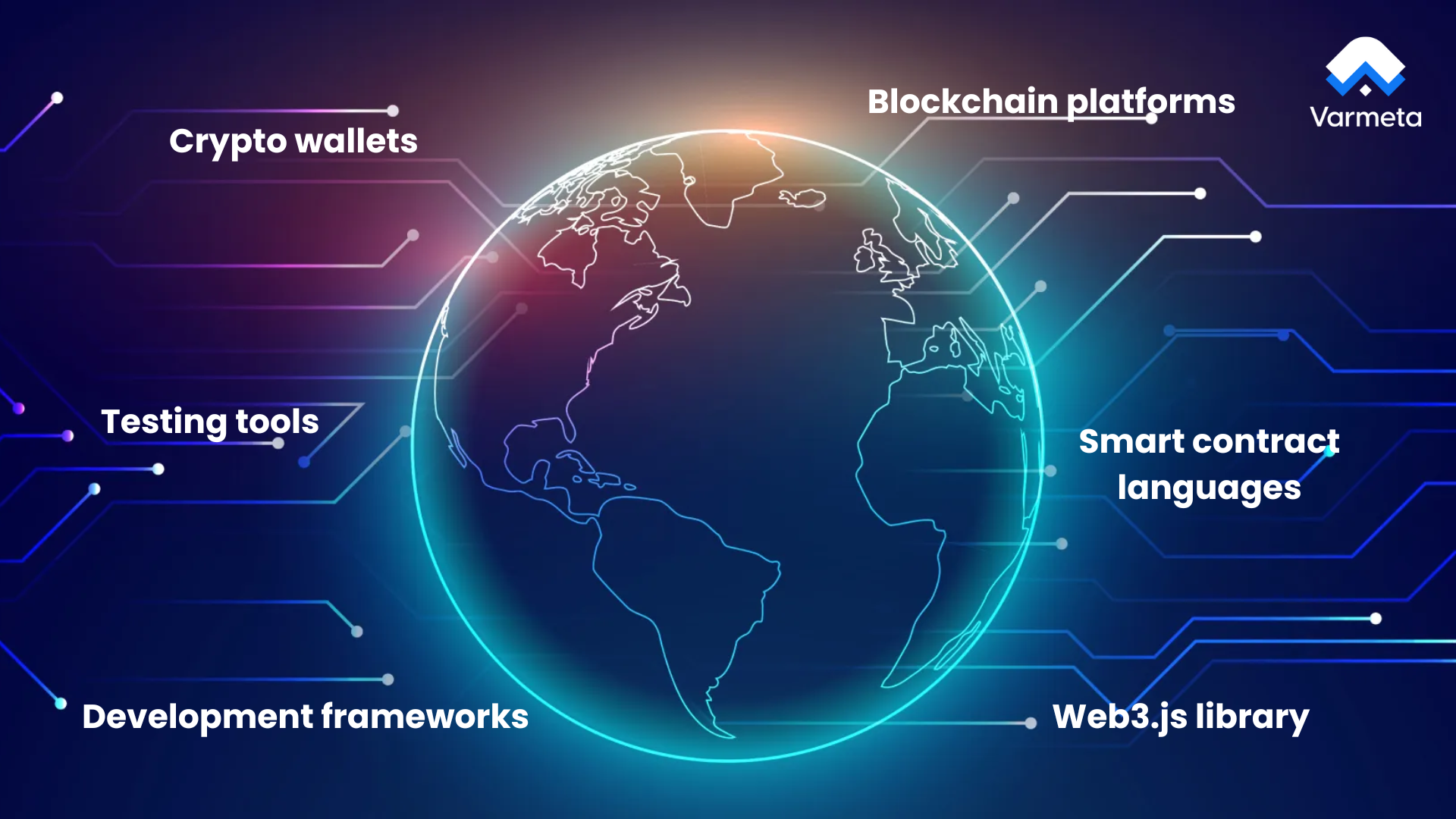
Crafting a robust Web3 application requires more than just blockchain expertise, it involves assembling a toolkit of cutting-edge technologies. Here’s a breakdown of the key components powering modern Web3 app development:
- Blockchain platforms
At the heart of every Web3 app lies the blockchain. Ethereum remains the most widely used platform, valued for its security, decentralization, and smart contract capabilities.
- Smart contract languages
Smart contracts are self-executing code on the blockchain. Solidity leads the pack as the go-to language for Ethereum-based contracts, though languages like Rust (for Solana) and Vyper are also gaining traction.
- Web3.js library
Web3.js is a vital JavaScript library that connects your frontend with the Ethereum network. It handles transaction signing, wallet interactions, and real-time data queries between the blockchain and your app.
- Crypto wallets
No Web3 app is complete without seamless wallet integration. MetaMask remains the standard for Ethereum apps, enabling users to store assets, sign transactions, and interact securely with dApps.
- Testing tools
Security and reliability hinge on rigorous testing. Tools like Truffle and Ganache offer development environments where smart contracts can be deployed, debugged, and stress-tested before going live.
- Development frameworks
Frameworks such as Embark and DappHub simplify the dApp development lifecycle, offering streamlined workflows for deploying smart contracts, integrating decentralized storage, and handling frontend/backend communication.
Together, these technologies form the backbone of any successful Web3 project, ensuring both functionality and scalability in an ever-evolving decentralized ecosystem.
Key features you need to build a web3 application
Web3 applications, also known as decentralized apps (dApps), bring a fresh approach compared to traditional centralized apps. If you’re planning to develop a Web3 app, here are the core features that make them stand out:
- Decentralization
At the heart of every Web3 app is decentralization. Instead of being controlled by a single entity or organization, Web3 apps run on a distributed network of nodes. This structure makes them highly resistant to censorship, single points of failure, or external attacks.
- Transparency
One of the major appeals of Web3 is its transparency. Every transaction is recorded on the blockchain, allowing anyone to verify its accuracy and integrity. No hidden processes, everything is out in the open, building trust among users.
- Trustless environment
Web3 apps are designed to operate without needing users to place trust in a central authority. Smart contracts, which are self-executing agreements coded into the blockchain, ensure that the terms of any transaction are enforced automatically and fairly, without third-party intervention.
- Tokenization
Tokens are a fundamental part of Web3. These can represent anything of value—whether it’s cryptocurrency, shares, in-game assets, or rewards. Through tokenization, developers can introduce new economic models, incentivizing user engagement and participation.
- Open source
Most Web3 apps are built as open-source projects. This means the source code is publicly available, encouraging community collaboration and innovation. Developers from around the world can contribute to improving and evolving the application.
- User ownership & control
Unlike traditional apps where companies control user data, Web3 apps empower users. Individuals have full control over their digital identities, privacy settings, and assets, ensuring more security and autonomy over their personal information.
Conclusion
Building and launching a successful Web3 application requires more than technical know-how, it demands a well-rounded strategy blending blockchain innovation, seamless user experience, and a loyal community. From choosing the right blockchain and crafting airtight smart contracts to designing intuitive interfaces and sustainable tokenomics, every step plays a crucial role in your app’s long-term viability.
As Web3 technology continues to evolve and its market potential skyrockets, developers and entrepreneurs who act decisively today will be the ones leading tomorrow’s decentralized digital frontier. By following the roadmap laid out in this guide, you’ll be well-equipped not just to launch, but to thrive in the competitive world of Web3 apps.