Author : James Nguyen
Co-Founder & CTO of Varmeta
Vietnam is entering a new era of digital governance and public policy enforcement, particularly with the introduction of Decree 168/2024, which takes effect on January 1, 2025. This decree introduces strict administrative sanctions for traffic violations, including point deductions and driving license restoration procedures. However, a significant portion of the public has raised concerns regarding the perceived harshness of fines, especially when compared to average income levels.
While official reports suggest broad public support, conflicting opinions persist on social media and other informal platforms, exposing gaps in current survey methodologies. The lack of transparency, anonymity, and security in traditional public opinion surveys makes it challenging to accurately gauge the true sentiment of Vietnamese citizens.
This is where Decentralized Identifiers (DIDs) come into play. DIDs offer a privacy-preserving and tamper-proof method for conducting public opinion surveys, ensuring that results are authentic, anonymous, and resistant to manipulation. In the context of controversial regulations like Decree 168, DIDs could revolutionize data collection and citizen engagement, paving the way for more inclusive and trustworthy governance.
The role of DIDs in public opinion surveys
Decentralized Identifiers (DIDs) are digital identity solutions that allow individuals to control their own identities and data without relying on a centralized authority. Unlike traditional survey systems that require personal information (name, ID number, email), DIDs allow participants to remain anonymous while still verifying the authenticity of their responses.
Why DIDs are essential for public opinion surveys in Vietnam
- Enhanced anonymity & privacy protection
- Many citizens fear retaliation or social pressure when participating in politically sensitive or controversial surveys. DIDs eliminate the need for personally identifiable information, ensuring that respondents can express their true opinions without concern.
- Verifiable & tamper-proof responses
- Unlike traditional surveys, where results can be manipulated or biased by data collectors, DIDs ensure that each response is uniquely tied to a verifiable identity while maintaining anonymity.
- Blockchain-based survey systems prevent tampering, ensuring that the final results accurately reflect public sentiment.
- Bridging the gap between official narratives and public sentiment
- Governments and policymakers rely on surveys to measure public support, but discrepancies between official reports and public perception can lead to distrust.
- DIDs provide an independent, decentralized mechanism for measuring real public opinion, ensuring that citizen voices are accurately represented in policy discussions.
Case study: Decree 168 and public sentiment

One of the most debated policies in Vietnam’s recent governance landscape is Decree 168/2024. This law aims to improve traffic safety through stricter penalties for violations. While government reports claim widespread support, social media discussions, independent polls, and anecdotal evidence suggest otherwise. Many citizens believe that the financial penalties are disproportionately high, creating economic strain on lower-income groups.
The discrepancy between official survey data and actual public sentiment raises concerns about the effectiveness and reliability of the current data collection methods. Traditional surveys often conducted through government-linked organizations lack credibility due to:
- Biased sampling: Surveys may not reach a truly diverse or representative portion of the population.
- Lack of anonymity: Participants may hesitate to share their true opinions for fear of retaliation.
- Data manipulation risks: Centralized control over survey results makes it possible to alter or selectively publish findings.
How DIDs can solve these challenges and restore public trust
Decentralized Identifiers (DIDs) offer a revolutionary solution to the inherent flaws in traditional surveys. By integrating DIDs into Vietnam’s public opinion data collection systems, the country could eliminate bias, manipulation, and privacy concerns, establishing a transparent, secure, and verifiable method for measuring real public sentiment.
Here’s how DIDs can reshape public opinion surveys:
- Eliminating biased sampling through decentralization
With DIDs, survey respondents do not need to be pre-selected or screened by centralized institutions. Instead:
- Any citizen can voluntarily participate in verified surveys, ensuring a more diverse and representative sample.
- DID-based surveys can be automatically randomized, preventing demographic bias and ensuring that all population groups are proportionally included.
- Government agencies cannot selectively control participation, making the data genuinely reflective of public sentiment.
- Guaranteeing anonymity & privacy protection
DIDs allow citizens to participate in surveys without revealing their personal identities, addressing the fear of retaliation or social pressure. This means:
- Each respondent receives a unique decentralized identifier, but their real identity remains fully private.
- Responses are recorded on a blockchain, ensuring that each opinion is counted fairly and securely.
- Citizens can express their honest opinions without fear, leading to more reliable and meaningful survey data.
- Preventing data manipulation & ensuring verifiability
Since DID-based surveys operate on blockchain technology, the data is:
- Immutable: Survey results cannot be altered, deleted, or selectively published.
- Fully auditable: Citizens and independent observers can verify the survey’s integrity in real time.
- Automated and tamper-proof: Smart contracts ensure that responses are counted exactly as they are submitted, eliminating human interference.
By implementing a DID-powered survey system, Vietnam can restore public confidence in government statistics and provide policymakers with accurate, unbiased data that truly reflects the concerns and preferences of the people.
Potential use cases and benefits of DIDs in surveys
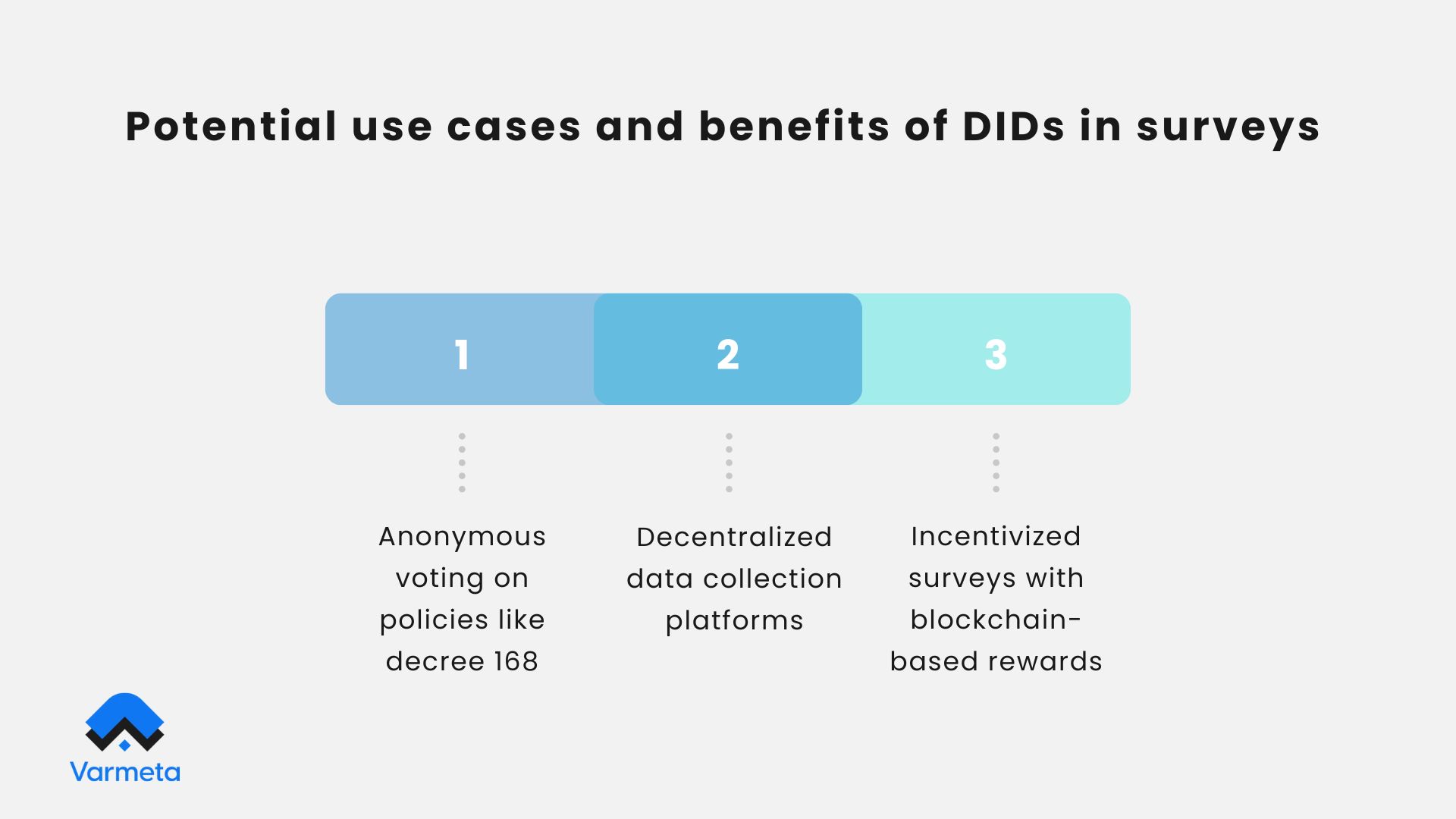
1. Anonymous voting on policies like decree 168
One of the primary applications of DIDs in public opinion surveys is anonymous, verifiable voting on government policies. Citizens could express their support or opposition to new laws without revealing their identities, ensuring a fair and bias-free decision-making process.
How it works:
- Each participant is assigned a unique DID, ensuring one person, one vote, without linking to personal identity.
- Survey responses are recorded on a blockchain, preventing data tampering.
- Smart contracts automatically verify that each DID casts only one vote, eliminating duplicate responses.
2. Decentralized data collection platforms
Unlike traditional survey platforms, which centralize data storage, a decentralized model using DIDs distributes data across a secure network, reducing the risks of data breaches, unauthorized access, or manipulation.
How it works:
- Survey responses are distributed across multiple nodes, preventing a single point of failure.
- Respondents use DIDs to control their own data, deciding what information to share and with whom.
- Blockchain technology ensures that survey results cannot be altered or selectively edited.
3. Incentivized surveys with blockchain-based rewards
Public participation in surveys is often low due to lack of motivation or mistrust. However, blockchain-based incentives such as token rewards or digital assets can encourage engagement while maintaining privacy through DIDs.
How it works:
- Participants receive token-based rewards for completing surveys.
- Smart contracts automatically distribute rewards only to verified DIDs, ensuring fairness.
- DIDs maintain anonymity, preventing any personal data exposure.
This model not only increases survey participation rates but also creates a self-sustaining ecosystem where citizens are incentivized to contribute to important public discussions.
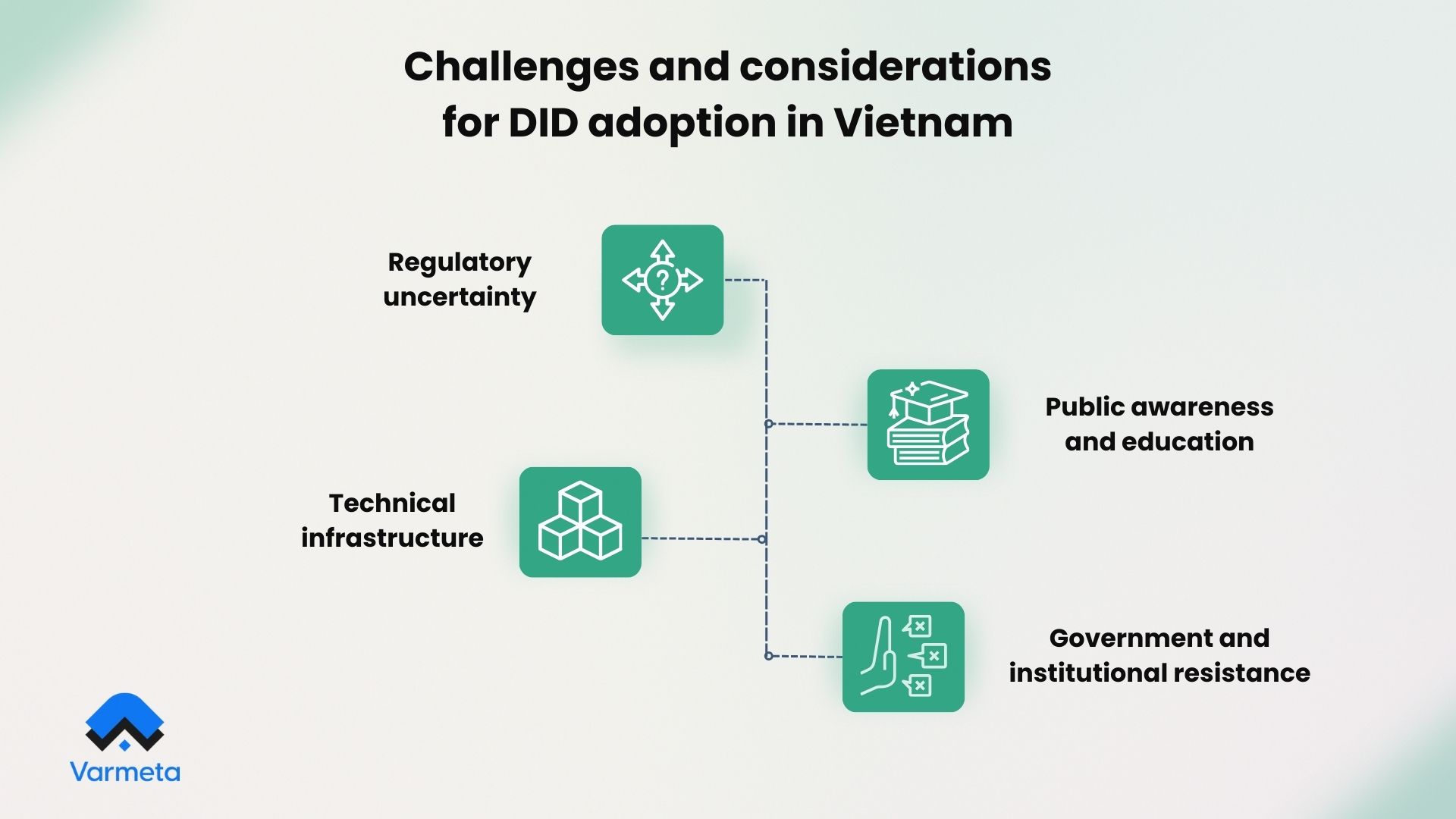
While Decentralized Identifiers (DIDs) offer a promising solution to the issues of survey transparency, anonymity, and data integrity, their adoption in Vietnam is not without obstacles. The country’s regulatory landscape, technological readiness, and institutional mindset all play a role in determining the feasibility of integrating DIDs into public opinion surveys. Below are some of the key challenges and considerations that must be addressed before DIDs can be widely implemented in Vietnam.
- Regulatory uncertainty: Vietnam’s legal framework for blockchain and decentralized technologies remains underdeveloped. Clearer policies are needed to govern the implementation of DIDs.
- Technical infrastructure: While blockchain adoption is growing, the country still lacks widespread DID integration platforms. Investments in infrastructure and interoperability will be required.
- Public awareness and education: Many citizens are unfamiliar with DIDs and their benefits. Public education campaigns will be crucial to drive adoption and trust in decentralized identity systems.
- Government and institutional resistance: Since DIDs remove centralized control over survey data, there may be hesitation from authorities in adopting a system that limits their influence over public opinion narratives.
Overcoming barriers for a decentralized future
The adoption of DIDs in Vietnam’s public opinion surveys holds enormous potential, but it is not without challenges. To successfully integrate DIDs, Vietnam must address regulatory gaps, invest in technical infrastructure, educate the public, and engage with institutions to foster trust and collaboration.
If these challenges are met with proactive solutions, Vietnam has the opportunity to lead the way in digital democracy, decentralized governance, and transparent policy-making. The future of public trust in governance begins with decentralization and DIDs may be the key to unlocking it.
A forward-looking perspective
As Vietnam accelerates its digital transformation, embracing DIDs in public opinion surveys represents a groundbreaking opportunity to enhance transparency, privacy, and trust in data collection. By leveraging decentralized identity solutions, Vietnam can ensure that public sentiment is accurately represented, ultimately fostering a more democratic and participatory governance system.
To successfully implement DIDs for surveys, Vietnam must:
- Establish regulatory clarity on decentralized identity adoption.
- Invest in technical infrastructure and blockchain development.
- Conduct public education initiatives to raise awareness about DIDs.
- Encourage collaboration between government, tech startups, and blockchain communities.
The potential of DIDs in public surveys extends beyond Decree 168, they could reshape citizen engagement, influence policymaking, and set a global example for digital democracy. By addressing technical and regulatory challenges, Vietnam has the chance to lead the way in secure, decentralized, and verifiable public opinion collection.
The future of public trust in governance starts with decentralization. Will Vietnam take the leap?