Asset tokenization is transforming the way we think about ownership and investment in the digital age. By converting real-world assets, such as real estate, art, or even intellectual property, into digital tokens on a blockchain, this innovative approach unlocks new opportunities for fractional ownership, enhanced liquidity, and global accessibility. As blockchain technology continues to evolve, asset tokenization is becoming a critical tool for reshaping traditional markets and democratizing access to investment opportunities.
The potential of this market is staggering. According to estimates from Citigroup and Boston Consulting Group, tokenized assets could represent up to 10% of global GDP by 2030. This translates to a market size projected to reach between $5 trillion and $16 trillion, fueled by growing demand for tokenization across financial assets, real estate, and unique assets like intellectual property and carbon credits.
However, not all tokenization processes are the same. A key distinction lies between on-chain and off-chain tokenization. For investors, developers, and businesses, understanding these two approaches is crucial for navigating the complex landscape of digital assets. Choosing the right method can impact everything from security and transparency to regulatory compliance and cost efficiency. In this article, we’ll break down the differences between on-chain and off-chain asset tokenization and help you determine which approach best fits your needs.
What is asset tokenization?

Asset tokenization is the process of converting real-world assets into digital tokens that are stored and managed on a blockchain. These tokens represent ownership or rights to an underlying asset, such as real estate, stocks, art, intellectual property, or even commodities like gold and carbon credits. By leveraging blockchain technology, tokenization provides a secure, transparent, and efficient way to trade, invest in, or manage assets.
At its core, tokenization breaks down traditional barriers to asset ownership. In the traditional world, owning high-value assets like real estate or fine art often requires significant upfront capital and involves cumbersome legal processes. Tokenization disrupts this by allowing assets to be divided into smaller, digital units called tokens. Each token can represent a fraction of the asset’s value, making it possible for multiple investors to own portions of a single property, painting, or stock portfolio. This fractional ownership model democratizes access to assets, enabling a wider audience to participate in markets previously limited to high-net-worth individuals or institutional players.
The key to tokenization lies in the blockchain. Blockchain technology ensures that every token is securely recorded, tamper-proof, and traceable. Smart contracts self-executing agreements written in code further automate processes like ownership transfer, dividend distribution, or compliance checks. This eliminates the need for intermediaries, such as brokers or banks, reducing costs and increasing transaction efficiency.
For example, imagine tokenizing a $1 million property into 1,000 tokens, with each token worth $1,000. Instead of one person purchasing the entire property, 1,000 investors could buy a token each, gaining proportional ownership and benefits, such as rental income or future sale profits. These tokens can then be traded on blockchain-based marketplaces, adding liquidity to traditionally illiquid assets.
Beyond accessibility and efficiency, tokenization introduces new levels of transparency and security. Every transaction involving a tokenized asset is recorded on the blockchain, creating a clear, immutable history of ownership. This reduces the risk of fraud and enhances trust among participants.
Asset tokenization isn’t limited to physical assets, it can also apply to digital or intangible assets like intellectual property, copyrights, patents, or even debt instruments. As industries increasingly adopt blockchain solutions, tokenization is expected to become a cornerstone of how assets are created, traded, and managed in the future.
On-Chain asset tokenization
On-chain asset tokenization refers to a process where assets are entirely digital and exist natively on the blockchain. In this model, the asset itself is created, stored, and managed within the blockchain ecosystem, making it inherently digital and decentralized. These tokenized assets leverage blockchain’s core capabilities, including transparency, immutability, and automation through smart contracts.
Key features of On-Chain asset tokenization
- Full transparency
On-chain assets tokenization are recorded and managed directly on the blockchain, where every transaction is publicly visible and verifiable. This ensures a high level of transparency, as anyone can audit the token’s history, ownership, and movement in real time. Transparency fosters trust among participants and reduces the likelihood of disputes or fraud.
- Decentralized verification
Blockchain networks use decentralized mechanisms, such as consensus algorithms, to verify transactions. This removes the need for intermediaries like banks or brokers and ensures that the system operates without a single point of control or failure. Decentralization enhances security and creates a trustless environment where parties can transact directly.
- Automated through smart contracts
Smart contracts self-executing agreements coded into the blockchain automate processes such as transferring ownership, distributing dividends, or enforcing compliance rules. This reduces administrative overhead, minimizes human error, and ensures that actions are carried out as programmed without delays or intermediaries.
Advantages of On-Chain asset tokenization
- High security
Blockchain technology is built to be secure and tamper-proof. Transactions are cryptographically protected, and data stored on the blockchain is immutable, meaning it cannot be altered or deleted. This ensures the integrity and safety of on-chain tokenized assets, making them highly resistant to fraud or cyberattacks.
- Instant settlement
On-chain transactions are executed in near real-time. This means ownership transfers, payments, or other processes occur almost instantly, as opposed to traditional systems that require days to clear and settle transactions. Instant settlement reduces delays and enhances the efficiency of asset trading.
- Cost efficiency
By eliminating intermediaries and automating processes, on-chain tokenization significantly reduces transaction costs. Fees associated with brokers, escrow agents, or legal paperwork are replaced by blockchain network fees, which are generally much lower.
Use cases and examples of On-Chain asset tokenization
On-chain asset tokenization is revolutionizing various industries by enabling seamless, secure, and transparent digital ownership. Below is a deeper analysis of key use cases and examples:
1. Cryptocurrencies
Cryptocurrencies like Bitcoin and Ethereum are the earliest and most prominent examples of on-chain assets. They exist natively on the blockchain and enable decentralized value transfer without intermediaries like banks or payment processors.
Use case:
- Decentralized payments: Bitcoin enables peer-to-peer transactions globally, with no reliance on centralized banking systems.
- Smart contract functionality: Ethereum introduced programmable blockchain capabilities, allowing developers to create decentralized applications (dApps) and tokens directly on-chain.
- Hedge against inflation: Cryptocurrencies like Bitcoin are increasingly used as a hedge against fiat currency devaluation due to their limited supply.
2. Digital art and NFTs
Non-Fungible Tokens (NFTs) are unique digital assets that exist entirely on the blockchain. They represent ownership of digital or physical items like art, collectibles, and in-game assets. Each NFT is distinct, making it ideal for certifying authenticity and provenance.
Use case:
- Art and collectibles: Platforms like OpenSea and Rarible allow artists to tokenize and sell their creations directly to collectors. Smart contracts can automate royalty payments, ensuring artists receive a percentage of secondary sales.
- Gaming and virtual assets: In blockchain-based games such as Axie Infinity, NFTs represent characters, weapons, or land that players can own, trade, or monetize.
- Music and media: Musicians are using NFTs to sell limited-edition tracks or albums, granting fans exclusive ownership and access.
Example: Beeple’s digital artwork, “Everydays: The First 5000 Days,” sold as an NFT for $69 million, showcasing the potential of blockchain for digital art markets.
3. DeFi tokens
Decentralized Finance (DeFi) platforms use on-chain tokens to facilitate financial services such as lending, borrowing, trading, and earning interest, all without traditional intermediaries.
Use case:
- Lending and borrowing: Platforms like Aave and Compound allow users to deposit crypto assets and earn interest or borrow against their holdings using on-chain tokens to represent their positions.
- Liquidity pools: Tokens in decentralized exchanges like Uniswap represent shares in liquidity pools, enabling token holders to earn fees from trading activities.
- Yield farming: DeFi participants earn rewards in the form of native tokens (e.g., UNI or SUSHI) by providing liquidity or staking assets.
Example: Aave’s AAVE token not only represents governance rights but also provides holders with benefits like fee discounts and staking rewards.
4. Stablecoins
Stablecoins are cryptocurrencies pegged to a stable asset, such as fiat currency or a basket of assets. Algorithmically managed stablecoins exist entirely on-chain and maintain their value stability without relying on off-chain reserves.
Use case:
- Cross-border payments: Stablecoins like DAI enable fast, low-cost international transfers, bypassing traditional financial networks.
- Risk mitigation: Traders use stablecoins to protect against crypto market volatility by converting volatile assets into stable ones during market downturns.
- Decentralized Banking: Algorithmic stablecoins, such as TerraUSD before its collapse, demonstrated the potential for entirely on-chain monetary systems.
Example: DAI, an on-chain stablecoin backed by over-collateralized crypto reserves, offers transparency and decentralization in maintaining its peg to the US dollar.
5. Blockchain-native assets
These are assets created and traded entirely within the blockchain ecosystem, often representing digital real estate, virtual goods, or platform-specific tokens.
Use case:
- Virtual real estate: Platforms like Decentraland and The Sandbox allow users to purchase, develop, and monetize virtual land parcels as on-chain tokens. These virtual spaces can be used for gaming, advertising, or virtual events.
- Digital economies: Blockchain-native assets power virtual economies by enabling users to buy, sell, and trade in a completely decentralized manner.
- Creative monetization: Content creators and brands use virtual real estate to host experiences, sell NFTs, or engage audiences directly.
Example: A virtual plot of land in Decentraland sold for over $2.4 million, demonstrating the growing demand for on-chain assets in the metaverse.
Off-Chain asset tokenization
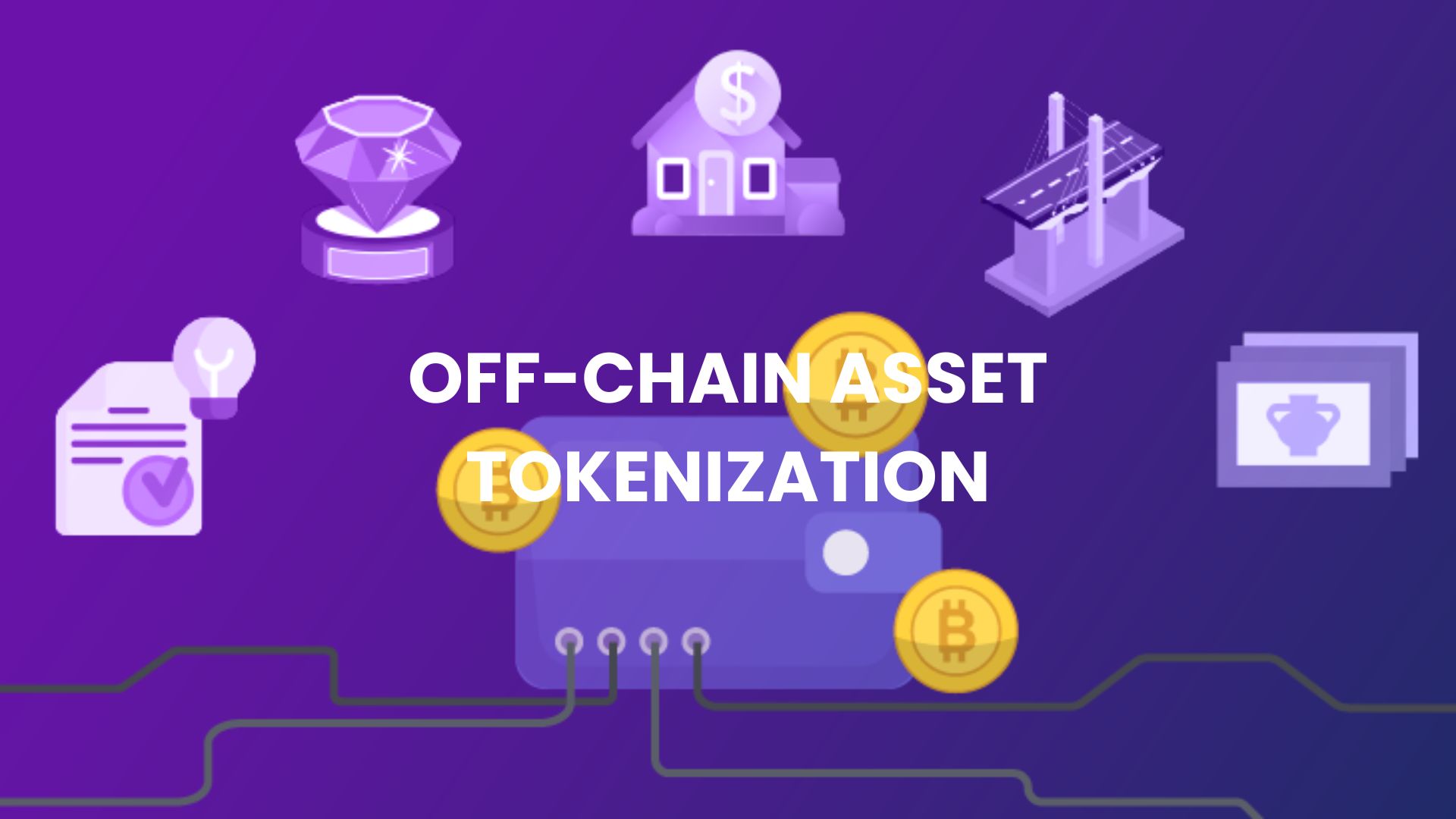
Off-chain asset tokenization bridges the gap between the digital blockchain world and tangible, real-world assets. In this approach, the tokenized asset is not inherently digital or natively stored on the blockchain. Instead, it represents ownership, rights, or claims to a physical or legal asset that exists outside the blockchain, such as real estate, art, or gold. This process leverages blockchain technology to improve efficiency, transparency, and accessibility, while still relying on trusted third parties to link the digital token to the real-world asset.
Key features of Off-Chain asset tokenization
- Reliance on trusted third parties
Off-chain asset tokenization requires an intermediary, such as a custodian, legal entity, or institution, to maintain and verify the connection between the blockchain-based token and the physical or legal asset it represents. For instance, a real estate token would need a custodian to manage property ownership records or legal agreements.
- Representation of physical or legal assets
Tokens in this model are essentially digital proxies. They represent rights to real-world assets, such as shares of property, gold reserves, or legal contracts. The actual asset remains in the physical world, while the token serves as a tradable digital representation.
- Compliance with legal frameworks
Off-chain tokenization must adhere to legal and regulatory requirements, ensuring that ownership rights, asset valuation, and transaction processes are legally binding.
Advantages of Off-Chain asset tokenization
- Broader asset coverage
Unlike on-chain tokenization, off-chain tokenization allows for the digitization of physical assets like real estate, commodities, fine art, and intellectual property. This expands the scope of tokenizable assets, enabling traditional asset classes to participate in blockchain ecosystems.
- Integration with traditional finance
Off-chain asset tokenization provides a natural integration point between blockchain technology and existing financial and legal systems. This hybrid approach allows institutional investors and traditional players to participate without fully migrating to blockchain-native systems.
- Fractional ownership
Similar to on-chain asset tokenization, off-chain tokenization enables fractional ownership of high-value assets. For example, a $10 million building can be divided into 10,000 tokens, allowing smaller investors to buy and trade portions of the asset.
- Regulatory flexibility
Since off-chain tokenization works within existing legal and financial structures, it offers more flexibility in addressing regulatory requirements compared to purely on-chain solutions.
Use cases and examples of Off-Chain asset tokenization
Off-chain tokenization leverages blockchain technology to enhance efficiency and transparency while maintaining traditional oversight for physical or legal assets. Below are some of the most prominent use cases:
1. Real estate
Real estate is a leading industry for off-chain asset tokenization. High-value properties can be divided into fractional ownership represented by digital tokens on the blockchain, allowing global investors to participate. While blockchain facilitates trading and tracking ownership, the physical asset remains governed by traditional legal systems and custodians. This ensures compliance with property laws while offering the benefits of increased accessibility and liquidity.
2. Securities and equities
Off-chain tokenization is widely used in the securities and equities markets. Financial instruments like stocks and bonds can be tokenized and traded on blockchain platforms for greater efficiency and security. However, the actual ownership rights, dividends, and compliance with financial regulations are managed off-chain. This integration ensures that tokenized securities remain within the boundaries of traditional legal frameworks.
3. Commodities
Physical commodities like gold, silver, and agricultural products are often tokenized to enable fractional ownership and easier trading. Blockchain tokens represent portions of these commodities, providing transparency and traceability. Meanwhile, the actual assets are stored and managed by trusted custodians off-chain, ensuring their security and compliance with existing commodity management practices.
4. Supply chain management
Off-chain tokenization enhances transparency and tracking in supply chains by digitizing ownership or status of goods. Blockchain records tokenized representations of shipments, while the physical movement and management of goods occur off-chain. This approach improves visibility and traceability without disrupting traditional logistics systems, ensuring a seamless integration of blockchain technology into supply chain operations.
5. Art and collectibles
High-value artwork and collectibles are another area where off-chain asset tokenization thrives. By tokenizing these assets, multiple investors can own fractional shares, enabling greater accessibility to expensive items. The tokens are traded on blockchain platforms, ensuring transparency, while the physical assets remain securely managed by custodians or galleries, preserving their condition and value.
Comparing On-Chain and Off-Chain asset tokenization
Below is a detailed comparison of on-chain and off-chain tokenization, highlighting differences in their implementation, costs, compliance, and best-use scenarios across various industries like real estate and financial assets.
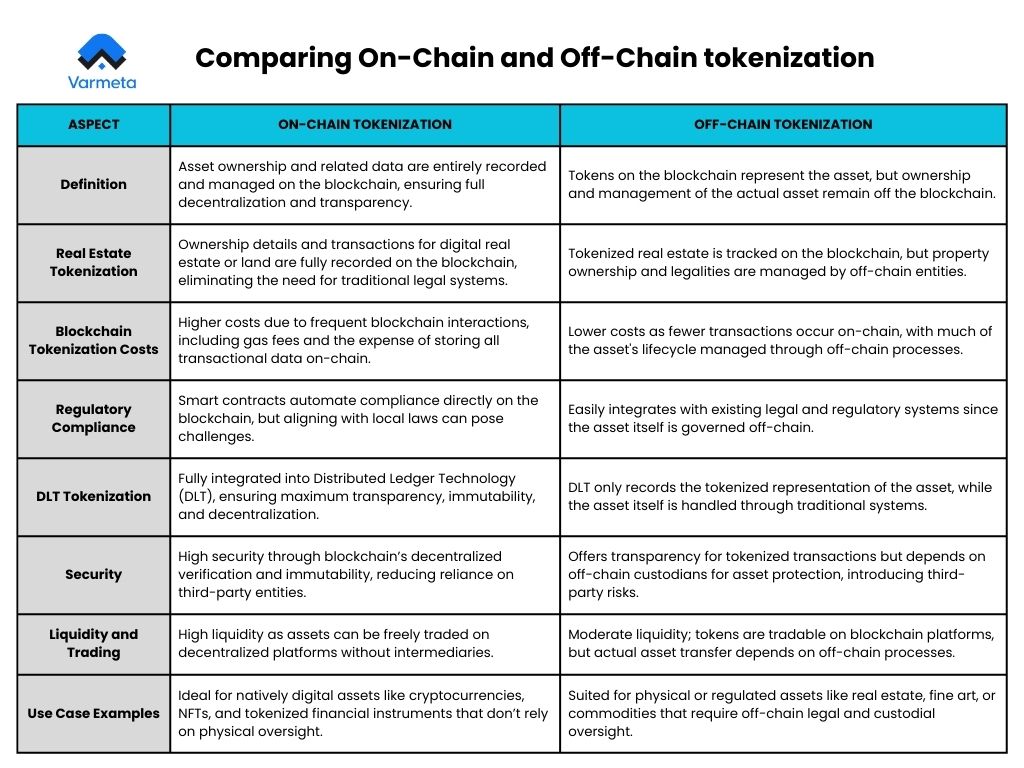
Source : Varmeta
On-chain asset tokenization is best for fully digital assets that require decentralized management, whereas off-chain asset tokenization is more suitable for physical or legal assets that demand integration with traditional systems. Understanding these differences helps businesses and investors choose the right approach based on their asset type, scalability needs, and regulatory considerations.
Challenges in both On-Chain and Off-Chain asset tokenization
While both on-chain and off-chain tokenization offer significant advantages, they are not without challenges. Each approach comes with its own set of limitations that must be addressed to fully realize the potential of tokenized assets.
Challenges in On-Chain asset tokenization
Scalability:
On-chain tokenization requires that all data and transactions be recorded directly on the blockchain, which can lead to network congestion and high transaction costs. Current blockchain networks, especially public ones, often struggle to handle large volumes of transactions efficiently, limiting scalability for high-demand applications.
Regulatory hurdles:
The decentralized nature of on-chain tokenization can make it difficult to comply with existing legal and regulatory frameworks, which were designed for centralized systems. Ensuring compliance with local and international laws, such as those related to securities or property ownership, can be complex and time-consuming.
Public adoption:
Despite growing interest, blockchain technology remains a niche field for many users. Public understanding of tokenization and blockchain is still limited, leading to hesitation and slower adoption rates. Issues such as user education, accessibility, and trust in decentralized systems further complicate widespread acceptance.
Challenges in Off-Chain asset tokenization
Trust issues:
Off-chain tokenization relies heavily on trusted third parties, such as custodians, legal entities, or intermediaries, to manage the link between digital tokens and real-world assets. This dependence introduces risks, as the integrity of the system depends on the reliability and honesty of these intermediaries.
Reliance on intermediaries:
Unlike on-chain tokenization, which eliminates middlemen, off-chain tokenization depends on external parties to enforce contracts, manage assets, and ensure compliance. This reliance can increase costs, reduce efficiency, and expose the system to potential bottlenecks or failures.
Enforcement risks:
In off-chain tokenization, the enforcement of ownership rights or legal agreements depends on traditional legal systems, which can vary significantly across jurisdictions. This can create complications if disputes arise, as token holders must rely on off-chain enforcement mechanisms to resolve issues.
Both on-chain and off-chain tokenization present unique challenges that must be addressed to maximize their potential. On-chain systems need to overcome scalability and regulatory hurdles, while off-chain systems must mitigate trust issues and reliance on intermediaries. By understanding and addressing these challenges, businesses and developers can better implement tokenization solutions that align with their specific needs and goals.
Conclusion
Understanding the differences between on-chain and off-chain asset tokenization is crucial for navigating the evolving landscape of blockchain and digital assets. On-chain asset tokenization offers unparalleled transparency, security, and decentralization, making it ideal for digital assets and applications that prioritize full blockchain integration. On the other hand, off-chain asset tokenization bridges the gap between blockchain technology and traditional systems, enabling the digitization of physical and regulated assets while maintaining compliance and real-world oversight.
For individuals, businesses, and organizations, the key lies in choosing a tokenization strategy that aligns with their specific goals, asset types, and operational needs. Whether the priority is decentralization, regulatory compliance, or scalability, understanding the strengths and limitations of each approach will help unlock the full potential of tokenized assets. As the technology and regulatory environment continue to evolve, hybrid models combining the best of both worlds may also become a viable option.
FAQs
- What are the main differences between on-chain and off-chain asset tokenization?
On-chain tokenization fully integrates assets into the blockchain, providing transparency and decentralization. Off-chain tokenization, however, represents physical or legal assets on the blockchain but manages the actual asset through traditional systems, relying on custodians and legal agreements. - Can physical assets be fully tokenized on-chain?
Physical assets cannot be fully tokenized on-chain because they exist in the real world. While their ownership can be represented digitally on the blockchain, the physical management and legal enforcement of these assets still require off-chain oversight. - Are hybrid tokenization models possible?
Yes, hybrid tokenization models combine elements of both on-chain and off-chain approaches. For instance, ownership might be represented on-chain for transparency, while the physical asset remains managed by off-chain custodians, providing a balance between decentralization and regulatory compliance. - How does regulation affect on-chain and off-chain asset tokenization?
Regulation plays a significant role in both approaches. On-chain tokenization faces challenges in aligning decentralized systems with existing laws. Off-chain tokenization, on the other hand, integrates more easily with regulatory frameworks but requires trusted intermediaries to enforce compliance. Both approaches need to navigate jurisdictional differences and evolving laws in the blockchain space.