Data has become one of the most valuable resources of the modern enterprise. Businesses collect vast streams of customer interactions, operational metrics, and market signals every second, but more data does not automatically mean better decisions. Without the ability to interpret patterns and project forward, businesses remain stuck in hindsight.
This is where Predictive AI unfolds its power to transform data from a historical record into a strategic asset. It uses advanced machine learning to uncover patterns, forecast outcomes, and guide proactive decision-making.
Overview tables
1. Predictive AI vs. Predictive Analytics
| Criteria | Predictive AI | Predictive Analytics |
| Definition | A branch of artificial intelligence that uses advanced machine learning models to predict future outcomes from large datasets | A broader analytical discipline that uses statistical methods and historical data to forecast future trends or behaviors |
| Core Approach | Leverages AI-driven models such as deep learning, neural networks, and advanced machine learning algorithms | Uses statistical modeling, regression analysis, and simpler machine learning techniques |
| Model Complexity | Typically involves complex models capable of learning nonlinear patterns from large-scale datasets | Often relies on traditional statistical techniques and simpler predictive models |
| Data Processing Capability | Can process large, complex, and unstructured datasets such as text, images, and behavioral data | Primarily works with structured historical datasets |
| Accuracy in Complex Scenarios | Higher predictive power when dealing with complex patterns or high-dimensional data | Effective for structured data forecasting but may struggle with highly complex relationships |
| Typical Business Applications | Customer behavior prediction, predictive maintenance, fraud detection, dynamic pricing, and recommendation systems | Sales forecasting, demand prediction, financial forecasting, and operational trend analysis |
| Technology Stack | AI frameworks, deep learning models, neural networks, large-scale data processing infrastructure | Statistical software, BI tools, and traditional analytics platforms |
2. Predictive AI vs. Generative AI
| Criteria | Predictive AI | Generative AI |
| Primary Purpose | Analyze historical and real-time data to forecast future outcomes | Generate new content based on patterns learned from training data |
| Core Function | Identifies patterns, correlations, and trends to estimate probabilities or future events | Produces original outputs such as text, images, audio, code, or video |
| Underlying Techniques | Statistical modeling, regression analysis, classification models, and machine learning algorithms | Deep learning architectures such as large language models (LLMs), diffusion models, and transformer-based systems |
| Typical Output | Forecasts, probability scores, risk assessments, demand predictions, or churn predictions | Generated text, AI images, code snippets, audio, video, and creative digital content |
| Primary Data Usage | Uses structured or historical datasets to identify predictive patterns | Uses large training datasets to learn patterns for generating new content |
| Business Applications | Customer churn prediction, fraud detection, demand forecasting, predictive maintenance, financial risk modeling | Content generation, marketing automation, conversational AI, software development assistance, design generation |
| Business Value | Helps organizations anticipate future events and make proactive decisions | Enables automation of content creation, communication, and creative workflows |
What is Predictive AI?
Predictive AI is a subset of artificial intelligence and predictive analytics. It utilizes statistical algorithms and machine learning techniques to analyze historical and current data to identify patterns and relationships within this data, thereby making predictions about future events, trends, or behaviors.
Contrary to reactive approaches, predictive AI enables organizations to act before an event occurs, thus mitigating risks and seizing opportunities. It transforms raw data into forward-looking insights that go beyond simple descriptions of what happened to estimations of what will happen.
To develop a thorough understanding of Predictive AI, we will need to explore the foundational concepts behind it and the larger technological systems it belongs to.
The relationship of Predictive AI, Machine Learning, and Artificial Intelligence
Artificial Intelligence (AI) is the broad field of creating systems that can perform tasks that typically require human intelligence. Machine Learning (ML) is a subfield of AI that focuses on enabling systems to learn from data without being explicitly programmed.
Predictive AI relies heavily on ML. Specifically, machine learning models and machine learning algorithms are the engines that power predictive AI. These algorithms are trained on vast datasets to recognize complex patterns, enabling them to generate predictions when presented with new, unseen data. Therefore, predictive AI is an application of ML within the broader scope of AI, focused specifically on forecasting.
Predictive AI vs. Predictive Analytics
While often used interchangeably, there is a subtle yet important distinction between predictive AI and predictive analytics.
Predictive analytics is a broader field that contains statistical techniques and modeling to analyze historical data and make predictions. It can involve traditional statistical methods or simpler machine learning approaches.
Predictive AI, however, specifically refers to the use of advanced AI and complex ML models with techniques such as deep learning and sophisticated neural networks, to achieve these predictions.
In short, Predictive AI can often uncover more intricate patterns and achieve higher accuracy in complex scenarios than traditional predictive analytics.
Predictive AI vs. Generative AI
Other than Predictive Analytics, Generative AI is also often brought up alongside Predictive AI as they are built on machine learning models trained on vast datasets. However, they serve very different purposes.
Predictive AI focuses on analyzing existing data to make forecasts or predictions about future outcomes. For instance, it might predict which customers are likely to churn or when equipment is likely to fail.
Generative AI, on the other hand, is focused on creating new content like text, images, music, code, etc., often based on patterns learned from existing data.
Nevertheless, most businesses gain the most value by adopting both of them. Predictive models can inform decisions with forward-looking insights, while generative systems can communicate those insights, automate workflows, or create content at scale. The key is how their specialized capabilities complement one another when strategically combined.
How does Predictive AI work?
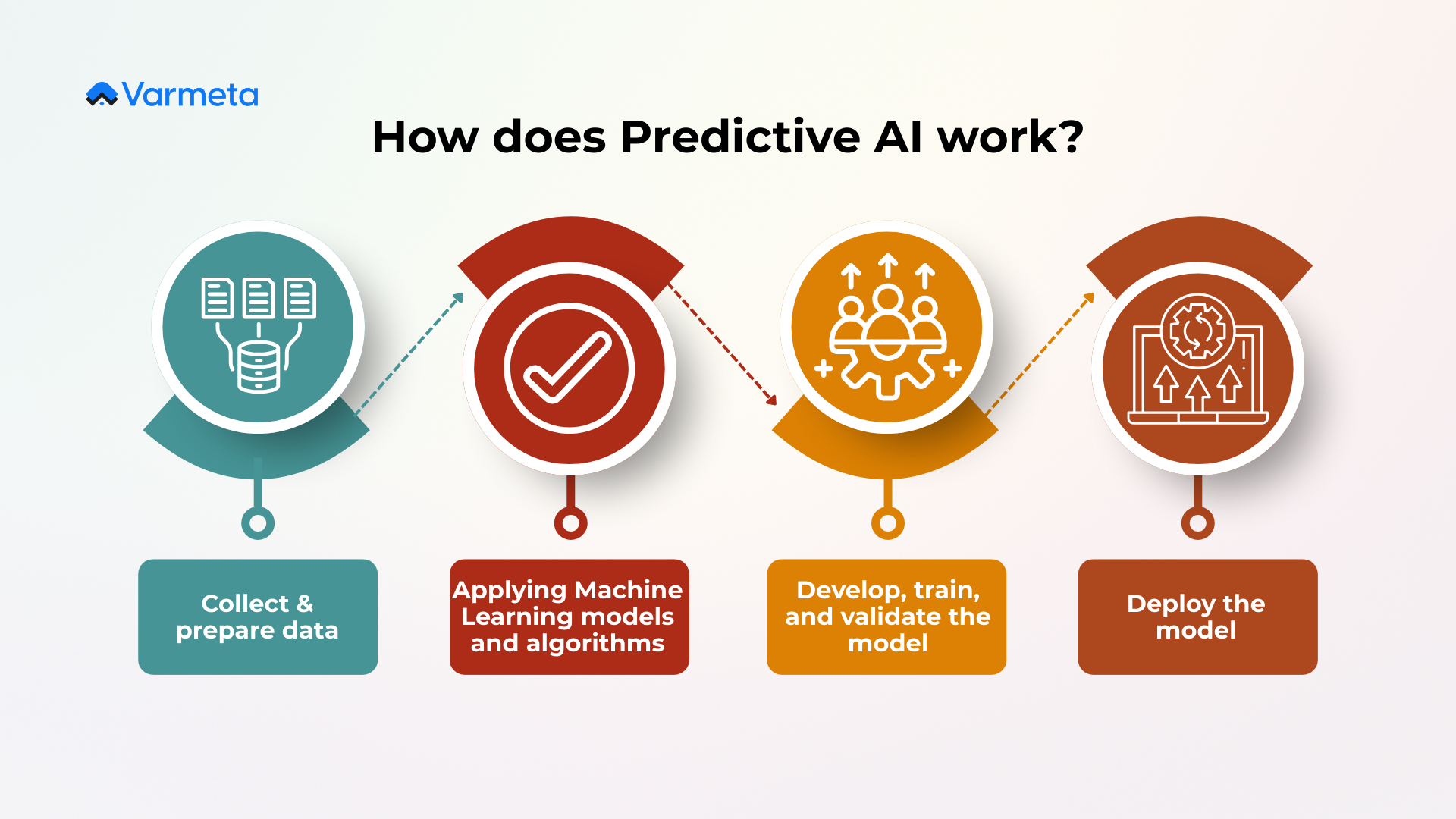
The creation of predictive insights is a systematic process that transforms raw information into actionable foresight. This journey goes from meticulous data handling to sophisticated algorithmic processing and ends with continuous refinement.
Stage 1: Collect & prepare data
The foundation of any effective predictive AI system is data. This step involves gathering relevant historical and real-time data from various sources: databases, sensors, customer interactions, market feeds, etc.
Crucially, this data must undergo strict preparation. This includes:
- Cleaning: Identify and correct errors
- Transforming: Standardize formats and values
- Feature engineering: Create new variables that might enhance predictive power
Poor quality data or significant bias at this stage can lead to inaccurate predictive models, a phenomenon often summarized as “garbage in, garbage out”.
Once prepared, the data becomes the canvas for uncovering patterns. This is where the intelligence of predictive AI truly shines. Machine learning algorithms are designed to sift through massive datasets, identifying subtle correlations, trends, and anomalies that are imperceptible to human analysts. These patterns are the building blocks for forecasting.
Stage 2: Applying Machine Learning models and algorithms
This stage will select and apply the right machine learning models and machine learning algorithms to the prepared data. The choice depends on the specific problem being addressed.
For instance, regression algorithms are used for predicting continuous values (like sales figures), while classification algorithms are employed for predicting categorical outcomes (like whether a customer will churn or not).
More complex tasks might use neural networks, which are inspired by the structure of the human brain, to process complex patterns in large datasets. Each predictive model is a mathematical representation derived from these algorithms and data.
Stage 3: Develop, train, and validate the model
The selected machine learning algorithms are used to build predictive models. In this process, the algorithm learns from the historical data by adjusting its internal parameters to minimize prediction errors.
After training, the predictive model undergoes validation using a separate set of data that is not used during training to assess its accuracy and generalization capability. Techniques like cross-validation are employed to make sure the model performs well on unseen data and avoids overfitting, where the model performs exceptionally well on training data but poorly on new data.
Stage 4: Deploy the model
Once a predictive model is trained, validated, and deemed reliable, it is deployed into a production environment. This is where the model actively makes predictions, a process known as AI inference.
When new data is fed into the deployed model, it applies the learned patterns to generate a prediction or forecasting. This output can then be used to inform decision-making, trigger actions, or offer insights to users and stakeholders.
The deployed system constantly monitors performance, and models may need to be retrained periodically as new data becomes available or market conditions change.
How is Predictive AI driving value across industries?

The applications of Predictive AI have a profound impact on how businesses operate, innovate, and engage with customers. Its ability to forecast and guide decision-making has always been a significant competitive edge across industries.
- Customer Experience & Marketing: By anticipating customer behavior such as purchase intent or churn risk, businesses can deliver personalized recommendations, targeted campaigns, and timely offers that strengthen loyalty and increase conversion rates.
- Financial Services: In a sector built on managing uncertainty, predictive AI acts as a risk radar that detects fraud in real time and assesses creditworthiness, thus informing smarter investment and trading strategies.
- Operations & Supply Chain: Efficiency improves dramatically when companies can forecast equipment failures, predict demand fluctuations, and proactively adjust inventory or logistics before disruptions occur.
- Healthcare & Life Sciences: From identifying high-risk patients to accelerating drug development, predictive models help clinicians and researchers make earlier, more precise interventions that improve outcomes.
- Strategic decision-making (Cross-Industry): At an executive level, predictive AI shifts organizations from reactive to proactive. It transforms raw data into forward-looking insights that guide resource allocation, risk mitigation, and long-term planning.
Insights for business: The essential infrastructure for Predictive AI
Without the right infrastructure in place, predictive AI cannot perform at its full potential. Hence, it is a must for businesses to have a scalable system where data, models, and deployment pipelines work together seamlessly.
Robust data pipelines
Input data, which is more important than ever, is a factor that defines the effectiveness of predictive AI. Therefore, establishing robust data pipelines is equally important. These pipelines are responsible for collecting, cleaning, transforming, and integrating data from disparate sources into a format suitable for machine learning models.
Businesses must invest in tools that handle data flow end-to-end, from collection to storage, transformation, and governance. If these pipelines are poorly structured, models will not receive high-quality information to generate accurate predictions.
Scalable deployment
Once predictive models are developed, they need to be deployed where they can generate AI inference and drive value. This requires scalable infrastructure. Historically, this might have been on-premise servers, but the advent of cloud computing has revolutionized deployment.
Cloud platforms offer flexibility, scalability, and cost-effectiveness that allow organizations to deploy predictive AI solutions that can handle changing workloads. Whatever you choose as an approach, the deployment strategy must ensure the predictive models are accessible and can deliver timely predictions to decision-makers and users.
Wrap up
As we discussed before, gathering more data does not move the needle, but translating it into foresight does. Predictive AI facilitates this by providing businesses with smarter decisions, stronger risk management, operational efficiency, and deeply personalized customer engagement.
Yet realizing this value requires more than deploying a model. It demands a solid data foundation, thoughtful algorithm selection, continuous validation, and a responsible approach to governance.
Looking ahead, its convergence with complementary technologies such as Generative AI will further expand what organizations can automate, optimize, and innovate. The path forward begins with defined objectives, trusted data pipelines, and a cohesive plan that bridges innovation with measurable business value. For those willing to take that step, predictive AI offers something powerful: the ability not just to respond to the future, but to anticipate and shape it.
Ready to deploy your own Predictive AI? Book a Free Consultation with Varmeta Today and let’s build a smarter, more autonomous future together.