In recent years, technology has evolved at an astonishing pace, reshaping industries, economies, and our daily lives. From artificial intelligence to blockchain, each innovation has pushed the boundaries of what we thought was possible. Now, a new revolution is on the horizon – quantum computing.
Unlike traditional computers, which process information in binary (0s and 1s), quantum computers leverage the mind-bending principles of quantum physics. This enables them to tackle problems that would take classical computers thousands of years to solve. From breakthroughs in medicine to advancements in artificial intelligence and cryptography, quantum computing holds the promise of transforming the way we approach some of the world’s most complex challenges.
This guide is designed for beginners who want to understand what quantum computing is, how it works, and why it’s poised to change the future. Together, we’ll explore the fundamentals, applications, and the road ahead for this exciting field. Whether you’re curious about the science behind it or its potential impact on your industry, this is your gateway to the next technological revolution.
What is quantum computing?
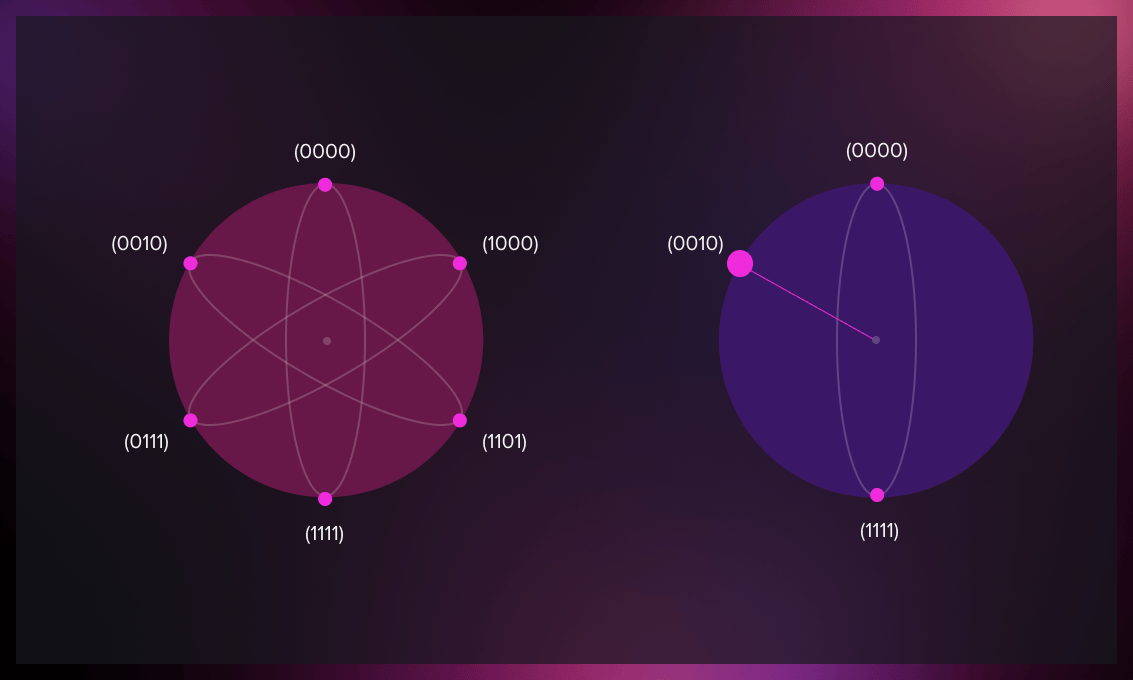
At its core, quantum computing is a revolutionary approach to processing information that takes advantage of the principles of quantum mechanics, the fundamental theory that governs the behavior of particles at the smallest scales. While classical computers rely on bits, which represent information as either 0 or 1, quantum computers use qubits, which can represent 0, 1, or both. This opens up entirely new possibilities for solving problems that classical computers struggle to tackle efficiently.
Basic principles of quantum physics
To understand quantum computing, it helps to grasp a few fundamental principles of quantum physics:
- Superposition
Superposition is what allows qubits to exist in multiple states at once. While a classical bit can be either 0 or 1, a qubit can be 0, 1, or any combination of both at the same time.
Imagine flipping a coin. In the classical world, the coin must land on either heads or tails. In the quantum world, it can exist in a state that is a mix of both heads and tails until measured. This property enables quantum computers to perform many calculations in parallel, dramatically increasing their computational power for certain tasks.
- Entanglement
Entanglement is a phenomenon where two or more qubits become interconnected, so the state of one qubit directly influences the state of the others, even if they are physically separated by large distances. This interconnectedness allows quantum computers to process information in ways that classical systems cannot, enabling them to tackle highly complex problems more efficiently.
- Quantum interference
Quantum interference leverages the wave-like behavior of quantum systems to amplify the probabilities of correct solutions while reducing the probabilities of incorrect ones. This is a critical mechanism that allows quantum computers to solve problems with remarkable accuracy.
How do quantum computers work?

Quantum computers operate on principles entirely distinct from classical computing, fundamentally changing how information is processed. While classical computers rely on bits, values of either 0 or 1 to store and manipulate data, quantum computers use qubits (quantum bits). This key difference enables quantum computers to handle exponentially larger amounts of information by leveraging the unique properties of quantum mechanics.
What are qubits?
Qubits are the foundational units of quantum computing, derived from quantum particles such as photons, electrons, trapped ions, or even engineered systems like superconducting circuits. Unlike classical bits, which can only exist in a state of 0 or 1, qubits can exist in a superposition of both states simultaneously, providing a powerful advantage for solving complex problems.
To function properly, qubits require extreme precision. They must be isolated from environmental noise and kept at extremely low temperatures to prevent decoherence, a phenomenon where quantum information is lost due to unintended interactions with the surroundings. These strict requirements make maintaining qubits challenging but essential for accurate quantum computation.
Types of qubits
Quantum computers utilize different types of qubits, each with strengths tailored to specific tasks:
Superconducting qubits
- Built using superconducting materials operating at near-absolute-zero temperatures.
- Known for their speed and precise control, making them a favorite for computational tasks.
Trapped ion qubits
- Qubits are created by trapping ions with electromagnetic fields.
- Recognized for their long coherence times and high-fidelity operations.
Quantum dots
- Semiconductor structures that trap single electrons.
- Promising for their scalability and compatibility with existing semiconductor technologies.
Photon qubits
- Individual light particles used for transmitting quantum information across long distances.
- Commonly applied in quantum communication and cryptography.
Neutral atoms
- Neutral atoms manipulated by lasers to perform quantum operations.
- Favored for scalability in large quantum systems.
How qubits solve problems differently
When faced with a complex problem, such as factoring large numbers or optimizing supply chains, classical computers rely on sequential calculations, often requiring immense time and resources to explore every possible solution. In contrast, qubits use their quantum properties to explore solutions in a fundamentally different way.
Qubits leverage superposition to represent multiple possibilities simultaneously, and entanglement ensures that changes to one qubit affect others in predictable ways. But quantum computing isn’t about brute-force testing all solutions at once. Instead, quantum computers use quantum interference, a phenomenon where wave-like probability amplitudes overlap and interact to amplify correct solutions and cancel out incorrect ones.
An analogy for understanding quantum computing
Imagine you’re at the center of a complex maze. A classical computer would solve the problem by trying every possible path, step by step, marking dead ends along the way. This approach, while effective, can be time-consuming for very large mazes.
A quantum computer, on the other hand, approaches the maze differently. Instead of exploring paths one at a time, it effectively analyzes the entire maze simultaneously, using interference patterns to highlight the correct path while eliminating the dead ends. It’s not that the quantum computer “walks” every path at once; rather, it measures probabilities and uses quantum mechanics to converge on the optimal solution.
By enabling qubits to process information in fundamentally new ways, quantum computers offer unprecedented potential to solve problems in cryptography, optimization, drug discovery, and more. While the technology is still in its infancy, the principles that power quantum computing are already paving the way for transformative advances in science and technology.
Classical computing vs. quantum computing
Quantum computing represents a fundamental shift in how we approach computation, leveraging the strange and fascinating principles of quantum mechanics, the rules governing the behavior of particles at the atomic and subatomic levels. While classical computers are also based on physical systems, they operate within the predictable laws of macroscopic physics, missing the opportunity to harness the full power of quantum mechanics. Quantum computers, on the other hand, capitalize on these quantum phenomena to solve problems that are virtually impossible for even the most powerful classical supercomputers.
What is a classical computer?
Classical computers, from the simplest calculators to the most advanced supercomputers, operate on a foundation of binary logic. They store and process information using bits, each representing a state of either 0 or 1. These bits are combined and manipulated using logical operations to perform calculations sequentially.
For example, a supercomputer can process massive datasets and solve intricate equations by working through each calculation step by step, albeit at incredible speeds. Despite their advancements, classical computers are limited by their reliance on sequential operations and binary data storage, making certain types of problems such as modeling molecular interactions or optimizing complex systems difficult to solve efficiently.
What is a quantum computer?
Quantum computers build on classical computing principles but operate using qubits, which are fundamentally different from bits. Qubits can exist in a state of superposition, meaning they can represent both 0 and 1 simultaneously. This allows quantum computers to process multiple possibilities at once. Additionally, through quantum entanglement, qubits can be interconnected in ways that enable them to work together on complex computations, even when separated by large distances.
Instead of processing data in a step-by-step manner like classical computers, quantum computers use quantum logic circuits to perform calculations on enormous datasets simultaneously. These capabilities allow quantum systems to solve specific types of problems like optimizing logistics, cracking encryption, or simulating quantum systems much faster than traditional methods.
Key differences between classical and quantum computing
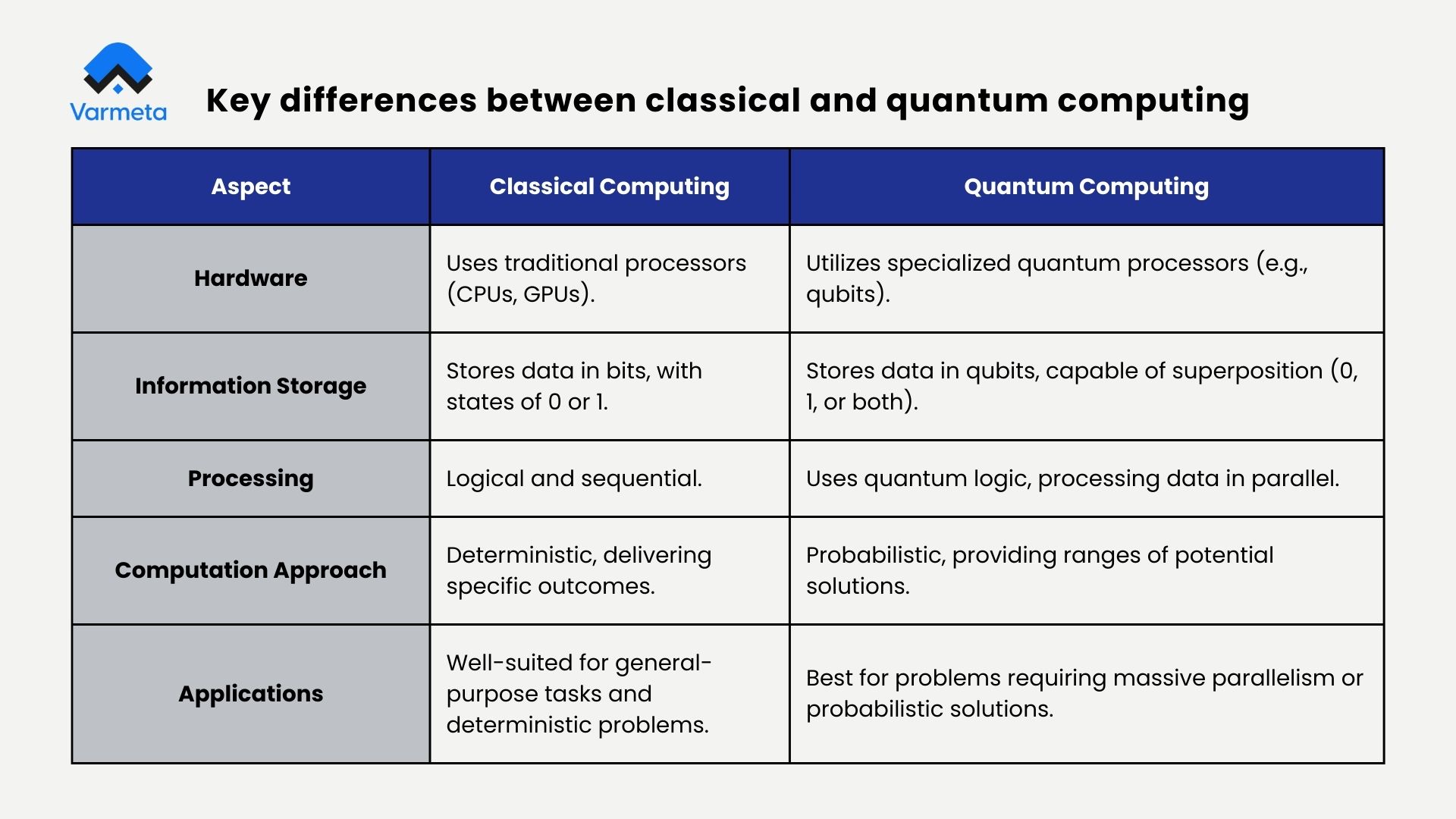
Although quantum computers hold immense promise, they are not universally superior. For most applications running software, browsing the internet, or managing databases—classical computers will continue to dominate. Quantum computing is best suited for specific challenges like optimization, cryptography, and complex simulations.
The future lies in hybrid computing systems, where quantum and classical systems work together. Cloud-connected quantum computers are already being used to solve specialized problems, complementing classical systems. As quantum technology matures, it is expected to impact industries like pharmaceuticals, energy, and finance while potentially creating entirely new sectors.
Quantum computing is still in its infancy, but its potential to transform computation and unlock previously unattainable possibilities is undeniable. By understanding the strengths and limitations of both classical and quantum systems, we can better appreciate the unique role each will play in shaping the future of technology.
Applications of quantum computing
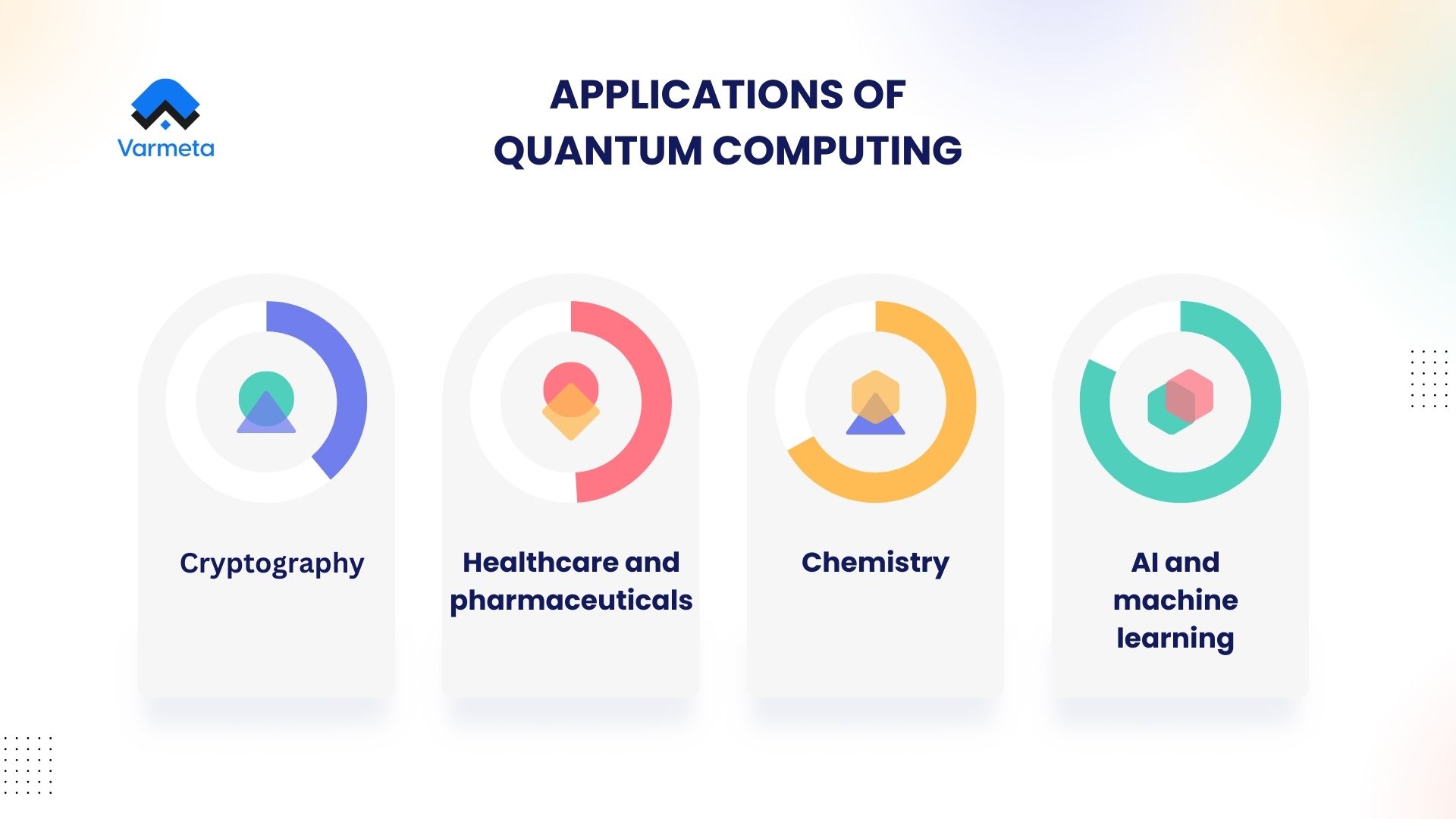
Quantum computing, with its unparalleled ability to process complex calculations and massive datasets, is poised to revolutionize a variety of industries. First theorized in the 1980s and brought into sharper focus by Peter Shor’s groundbreaking algorithm in 1994, the technology offers transformative potential in cryptography, healthcare, finance, and artificial intelligence. Here are some of the most exciting and impactful applications of quantum computing:
Cryptography: Securing the future of data
In 1994, Peter Shor demonstrated how quantum computers could factor large numbers exponentially faster than classical computers, effectively breaking widely used encryption systems like RSA. This revelation sent shockwaves through the field of cybersecurity, as it highlighted the vulnerability of current cryptographic methods.
- Breaking classical encryption: Quantum computers can quickly solve problems that classical systems rely on for security, such as integer factorization and discrete logarithms. This capability threatens encryption standards like RSA and AES, which underpin secure communication today.
- Quantum-safe cryptography: On the flip side, quantum computing has spurred the development of post-quantum cryptography, creating algorithms designed to withstand quantum attacks. These systems are crucial for ensuring secure communications in the quantum era.
Healthcare and pharmaceuticals: Accelerating drug discovery
Quantum computers can simulate molecular structures and chemical reactions at a level of precision unattainable by classical computers. This capability has enormous implications for healthcare and pharmaceuticals:
- Drug discovery: By modeling complex molecules and their interactions, quantum computers can speed up the discovery of new drugs and treatments, potentially reducing the time and cost of research and development.
- Protein folding: Simulating how proteins fold, an essential factor in understanding diseases like Alzheimer’s becomes significantly more efficient with quantum computing, paving the way for breakthroughs in personalized medicine.
Chemistry: Revolutionizing material and process design
Quantum computing’s ability to simulate quantum interactions at the molecular level extends beyond healthcare to the field of chemistry:
- Cleaner processes: It could help design better catalysts to reduce harmful byproducts in industrial processes, paving the way for greener energy solutions.
- Climate change solutions: Simulating chemical reactions could lead to innovative ways to capture and reduce carbon emissions, aiding in the fight against climate change.
Artificial Intelligence and machine learning: A new frontier
As the demand for advanced AI models grows, traditional computing is reaching its limits in terms of processing power and energy consumption. Quantum computing offers a way to overcome these barriers:
- Enhanced machine learning: Quantum algorithms can analyze data in entirely new ways, providing potential speedups for certain machine learning tasks. For example, they can optimize neural networks or solve clustering and classification problems more efficiently.
- AI energy efficiency: Quantum systems may offer more energy-efficient ways to train AI models, addressing the growing environmental concerns associated with AI development.
The future of quantum computing
Quantum computing is no longer confined to theoretical physics labs, it’s steadily moving toward practical applications with the potential to redefine industries. While the field is still in its early stages, the next decade promises significant advancements and opportunities as the technology matures. Here’s what the future might hold for quantum computing.
Predictions for the next decade
Advancements in hardware and software
Quantum computing hardware has come a long way, but challenges such as error correction, scalability, and stability remain significant hurdles. In the coming years:
- Hardware innovations: Expect breakthroughs in qubit stability, error rates, and quantum coherence times. Efforts like developing more efficient superconducting qubits, improving trapped ion systems, and exploring photonic qubits are likely to gain momentum.
- Software evolution: Quantum programming frameworks will become more robust and user-friendly, enabling developers to build more complex and efficient quantum algorithms. Tools like Qiskit, Cirq, and Quantum Development Kit are likely to evolve into more versatile platforms, making quantum programming accessible to a wider audience.
Mainstream adoption across industries
As quantum computing continues to advance, industries will begin integrating it into their workflows for specific, high-value tasks:
- Finance: Optimizing investment strategies, risk modeling, and fraud detection.
- Healthcare: Accelerating drug discovery, simulating protein folding, and enhancing diagnostic tools.
- Logistics: Optimizing supply chains, transportation networks, and delivery routes.
- Energy and environment: Modeling chemical reactions for cleaner energy and improving carbon capture technologies.
While quantum computing won’t replace classical systems entirely, we’ll likely see hybrid systems combining the strengths of both technologies to tackle complex problems.
Opportunities for beginners
The growing momentum around quantum computing is creating an exciting environment for newcomers to enter the field.
Career prospects and skills in demand
- Quantum programming: Developers proficient in quantum programming languages like Qiskit, Cirq, or PyQuil are in high demand. Building expertise in these tools can position you for roles in quantum software development.
- Physics and engineering: Professionals with backgrounds in quantum mechanics, material science, and electrical engineering are essential for advancing hardware technologies.
- Research and academia: With many fundamental problems yet to be solved, researchers will continue to play a pivotal role in pushing the boundaries of the field.
- Hybrid expertise: Knowledge of both classical computing and quantum systems is increasingly valuable, particularly as industries explore hybrid solutions.
Learning opportunities
- Free and accessible resources are growing, from online courses to open-source quantum programming platforms. Companies like IBM and Google offer cloud-based access to quantum computers, enabling beginners to experiment and learn in real-world environments.
- Universities and training programs are also expanding their quantum computing curricula, reflecting the field’s growing importance.
A transformative decade ahead
Over the next decade, quantum computing will likely evolve from an experimental technology to a transformative force in industries worldwide. While its adoption will be gradual, its impact on solving previously unsolvable problems will be profound. For those with a passion for cutting-edge technology, this is the perfect time to dive in, whether through building quantum algorithms, advancing hardware, or exploring the scientific possibilities that quantum computing offers. As this field grows, so too will the opportunities to shape its future.
Conclusion
Quantum computing represents a monumental leap forward in the way we process information, holding the potential to solve problems that were once considered insurmountable. Throughout this guide, we’ve explored the fundamentals of quantum computing, its unique principles like superposition and entanglement, its applications across industries, and the exciting possibilities it brings for the future.
As we move deeper into the quantum age, the opportunities to engage with this transformative technology are abundant. Whether you’re a beginner curious about its basic concepts or a professional seeking to develop expertise in this field, there has never been a better time to start exploring quantum computing. With accessible tools, online resources, and growing industry adoption, anyone can take the first step toward understanding this revolutionary technology.
Staying informed about quantum computing is more than just a career move, it’s an investment in the future. As the field evolves, its impact on industries like healthcare, finance, and AI will only grow, opening doors to innovations we can barely imagine today. Embracing this knowledge now positions you to be part of the journey, whether as a contributor or an informed observer.
The quantum revolution is here so dive in, stay curious, and be part of shaping the future of technology.