Held from September 22 to 28, 2025, Korea Blockchain Week (KBW) once again turned Seoul into the beating heart of the global Web3 industry. Its flagship conference, IMPACT (September 23–24 at the Walkerhill Hotel), attracted thousands of developers, policymakers, institutional investors, and innovators from every continent, all drawn by a shared conviction: the blockchain industry is maturing, and Asia is leading this transformation.
Far from being another hype-driven crypto gathering, KBW 2025 marked a decisive shift in tone and purpose. The week’s discussions centered on how blockchain is evolving into real infrastructure: compliant, interoperable, and institutionally ready. It was a clear signal that Web3 is no longer just a technological experiment, but a strategic foundation for the digital economy.

1. Institutional integration and the compliance mandate
One of the most striking aspects of KBW 2025 was how deeply the theme of institutional integration resonated across sessions. The presence of Caroline D. Pham (Acting Chair, U.S. CFTC), U.S. policy advisors for Tether, and delegates connected to the White House demonstrated how far blockchain has entered mainstream policy discussion.
No longer framed as a speculative asset class, digital assets are now being discussed as a legitimate financial instrument, one that requires robust regulation, transparency, and standardized frameworks. The spotlight was on Stablecoins and Real-World Assets (RWA), the two pillars driving institutional adoption.
Stablecoins were portrayed as the essential bridge between decentralized and traditional finance, enabling instant, programmable settlements without the friction of legacy systems. Meanwhile, RWAs representing tokenized versions of bonds, commodities, and real estate were described as the trillion-dollar frontier connecting traditional capital markets to DeFi infrastructure.
The message was unmistakable: institutional trust will determine blockchain’s next decade. Regulatory clarity, rather than being an obstacle, is now the most powerful catalyst for mainstream acceptance.
2. The technological shift: Modular systems and AI-native infrastructure
Beyond the financial narrative, KBW 2025 offered a glimpse into blockchain’s technological future. The dominant technical conversation revolved around modular blockchain design: separating execution, consensus, and data layers to achieve scalability and flexibility.
Speakers from 0G Labs, Sui, Lambda256, and other infrastructure pioneers made a unified argument: the monolithic blockchain model that served early adopters can no longer handle enterprise-scale applications or data-intensive workloads. Modular architectures, supported by advanced Data Availability (DA) layers, are emerging as the key to high throughput, cost efficiency, and interoperability across chains.
This technical evolution aligns closely with the growing integration of Artificial Intelligence (AI) into blockchain ecosystems. From predictive risk modeling in DeFi to automated smart contract auditing, AI is redefining how decentralized networks operate. KBW showcased multiple projects using AI-driven analytics and language models to enhance security, transaction monitoring, and developer tooling suggesting that the future of Web3 will be not only decentralized, but also intelligent.
Crucially, the emphasis on security and auditability marked a new maturity. Workshops such as the CertiK Espresso Workshop reinforced that blockchain products targeting institutional or regulated adoption must treat security as a first-class feature, encompassing not just code safety, but compliance-grade transparency and recoverability.
3. The cultural equation: From financial systems to global movements
What truly distinguishes KBW from other global blockchain summits is its ability to merge culture and technology into a unified narrative. This year, the organizers skillfully leveraged Korea’s cultural soft power the influence of music, entertainment, and digital art to illustrate how blockchain is becoming embedded in everyday life.
The week featured collaborations between K-pop brands, entertainment agencies, and blockchain platforms, positioning Web3 not just as a financial or technical movement but as a cultural transformation. This cultural integration reflects a broader truth about Asia’s Web3 trajectory: adoption will not be driven by abstract protocols, but by relatable, human-centered experiences that resonate across communities.
Panels also emphasized that the next phase of global growth will depend on localization, building ecosystems that understand regional user behavior, regulatory nuance, and cultural identity. In this sense, Asia’s diversity is its greatest strength, allowing innovation to adapt fluidly across markets like Japan, Korea, Vietnam, and Singapore.
Varmeta at KBW 2025: Building on Doma, empowering developers
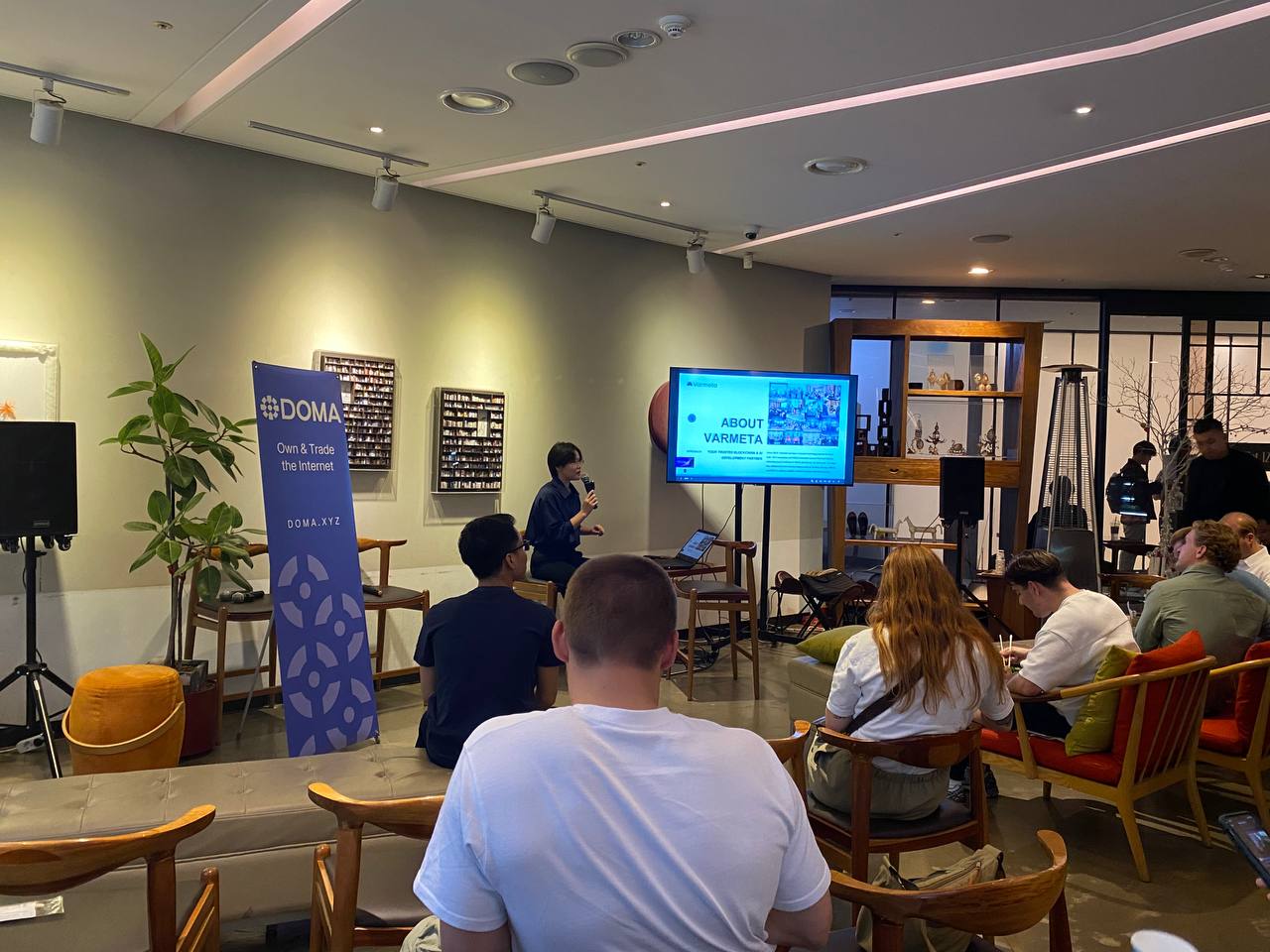
Among the highlights of the week, Varmeta was proud to contribute to the developer conversation at the DeFi Builder Café, hosted by Doma Protocol in collaboration with Superteam Korea, Maelstrom, D3, and DoraHacks.
In a featured session titled “Building on Doma: A Developer’s Perspective,” Julie Pham (Partnerships Manager) and Hung Dang (Blockchain Technologist) from Varmeta shared insights drawn from the company’s hands-on experience as one of the first recipients of the Doma Forge $1M USDC grant program.
Their discussion provided an inside look at building real-world applications on Doma, exploring the challenges of designing scalable DeFi systems, achieving interoperability between modular components, and delivering a user experience that simplifies the complexity of blockchain.
For the audience, the session offered practical knowledge on what it takes to move from prototype to production in today’s evolving Web3 landscape, reaffirming Varmeta’s commitment to advancing technical excellence and collaboration across the developer ecosystem.
Conclusion: Asia’s blueprint for the next phase of Web3
Korea Blockchain Week 2025 will be remembered as the moment when Asia’s blockchain narrative matured, shifting from speculation to structure, from experimentation to execution. Across regulation, technology, and culture, the event underscored one overarching truth: the future of blockchain will be built through collaboration between institutions, innovators, and communities.
For Varmeta, KBW 2025 was not just a stage to share ideas but a reaffirmation of purpose to build intelligent, secure, and human-centered blockchain solutions that empower both enterprises and everyday users. As we move toward the next chapter of Web3, Varmeta remains committed to bridging innovation with practicality, ensuring that blockchain continues to drive meaningful change across industries and borders.
Varmeta – Excellent in every block
Website: var-meta.com
Linkedln: https://www.linkedin.com/company/var-meta/