Stablecoin has become an indispensable part of the decentralized finance (DeFi) ecosystem, acting as a bridge between the stability of traditional financial assets and the innovative potential of blockchain technology. These unique digital assets offer price stability, making them a popular choice for traders, investors, and DeFi enthusiasts alike.
In November, the stablecoin sector demonstrated its growing importance with impressive milestones. The total market capitalization of stablecoins surged by 9.94%, reaching a remarkable $190 billion. This marked the fourteenth consecutive increase in the end-of-month market cap and surpassed the previous all-time high recorded in April 2022. Additionally, the monthly trading volume for stablecoin trading pairs on centralized exchanges saw a significant rise of 77.5%, hitting $1.81 trillion as of the 25th.
This rapid growth highlights the central role stablecoin plays in the cryptocurrency market and DeFi space, offering a secure and liquid alternative amidst market volatility. In this guide, we’ll explore the world of stablecoins in DeFi, covering their types, benefits, challenges, and why they are essential for the future of decentralized finance. Whether you’re a beginner or looking to deepen your understanding, this guide is your gateway to navigating stablecoins effectively.
What is stablecoin?

A stablecoin is a type of cryptocurrency designed to maintain a stable value, typically pegged to a reserve asset like fiat currency (e.g., the US Dollar), a commodity (e.g., gold), or even another cryptocurrency. Unlike traditional cryptocurrencies such as Bitcoin or Ethereum, which experience significant price volatility, stablecoins aim to provide a reliable store of value and medium of exchange in the digital economy.
Stablecoins serve a critical purpose in the cryptocurrency ecosystem by offering users a way to transact and hold digital assets without being exposed to the extreme price fluctuations common in other cryptocurrencies. This stability makes them ideal for activities like trading, lending, and remittances, bridging the gap between traditional finance and the fast-evolving world of blockchain.
Overview of Decentralized Finance (DeFi)
Decentralized Finance, or DeFi, refers to a new financial system built on blockchain technology that eliminates intermediaries like banks and brokers. DeFi applications enable users to access a wide range of financial services, such as lending, borrowing, trading, and earning interest, directly through decentralized platforms powered by smart contracts.
In the context of DeFi, stablecoins play a pivotal role by providing a stable and reliable asset that can be used across various protocols. They serve as a key liquidity source, making transactions seamless and reducing exposure to the market’s inherent volatility. From collateralizing loans to facilitating automated market-making, stablecoins are the backbone of many DeFi applications, ensuring the system’s efficiency and accessibility for users worldwide.
Types of stablecoins
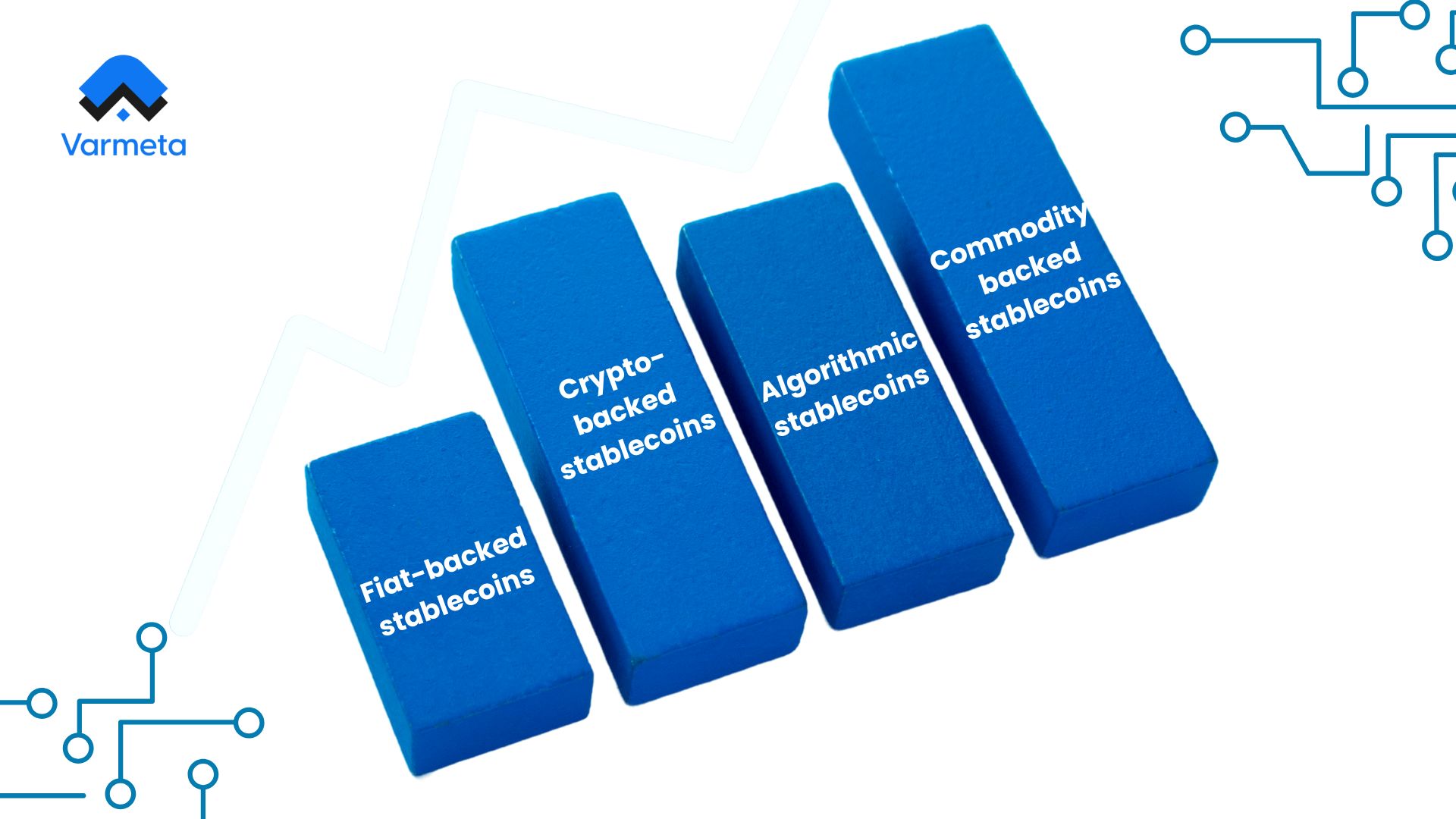
Stablecoins come in various forms, each with a unique mechanism for maintaining price stability. Let’s explore the main types of stablecoins and how they function:
Fiat-backed stablecoins
Fiat-backed stablecoins are the most common type, pegged to a traditional currency like the US Dollar, Euro, or Yen. Each stablecoin is backed by reserves of the corresponding fiat currency held in a bank or financial institution. This ensures that for every stablecoin issued, there is an equivalent amount of fiat currency in reserve.
Examples: USDT (Tether), USDC (USD Coin).
- How they maintain value:
The issuer guarantees a 1:1 ratio with the fiat currency, making these stablecoins redeemable for their equivalent value in cash. Regular audits and transparency reports are often used to assure users of the reserves’ legitimacy.
Crypto-backed stablecoins
Crypto-backed stablecoins are pegged to other cryptocurrencies, using them as collateral. Unlike fiat-backed stablecoins, these rely on smart contracts to manage collateralization and ensure stability. Since cryptocurrencies are volatile, these stablecoins are typically overcollateralized to absorb market fluctuations.
Example: DAI (issued by MakerDAO).
- Mechanism:
To create DAI, users lock up a larger value of a cryptocurrency like Ethereum in a smart contract. This collateral acts as security, ensuring the stablecoin maintains its peg even if the underlying cryptocurrency’s value drops. Smart contracts continuously monitor the system and may liquidate collateral if its value falls too low.
Algorithmic stablecoins
Algorithmic stablecoins rely on complex algorithms and smart contracts to maintain their value, rather than collateral. The system adjusts the supply of the stablecoin dynamically to match market demand, aiming to keep the price stable.
Examples: UST (TerraUSD), AMPL (Ampleforth).
- How they achieve stability:
When demand increases and the price rises above the peg, the system creates new tokens to lower the price. Conversely, when demand decreases and the price drops, tokens are removed from circulation. While innovative, this type of stablecoin is more prone to instability and has faced notable failures, such as the collapse of UST.
Commodity-backed stablecoins
Commodity-backed stablecoins are tied to the value of physical assets, such as gold, silver, or oil. These tokens are backed by reserves of the respective commodity, making them an appealing choice for investors seeking exposure to traditional assets in digital form.
Example: PAXG (Paxos Gold)
- How they maintain value:
For every PAXG token, there is a corresponding amount of physical gold held in secure vaults. This one-to-one backing ensures that the token’s value moves in tandem with the price of the commodity, offering stability and tangible asset support.
Each type of stablecoin serves a distinct purpose and caters to different needs in the cryptocurrency ecosystem. Understanding their differences can help users choose the most suitable stablecoin for their specific requirements, whether it’s for trading, investing, or participating in DeFi applications.
Why stablecoins are essential in DeFi ?

Stablecoins are a cornerstone of the decentralized finance (DeFi) ecosystem, enabling seamless and efficient financial operations. Their unique ability to combine the stability of traditional financial assets with the flexibility of blockchain technology makes them indispensable. Here’s why stablecoins are so critical in DeFi:
Facilitating liquidity and transactions
One of the biggest challenges in the cryptocurrency market is price volatility. Stablecoins address this by maintaining a consistent value, providing a reliable medium of exchange. This stability ensures that users can transact without worrying about sudden value fluctuations, which is especially crucial in DeFi, where rapid and precise operations often require a stable asset.
Use cases in DeFi
Stablecoins are versatile assets that fuel a variety of DeFi applications, such as:
- Lending and borrowing platforms:
Stablecoins are the preferred choice for lending and borrowing because they eliminate the risks associated with volatile collateral. Borrowers can lock up assets as collateral and receive stablecoins as a loan, while lenders earn interest in a predictable, stable currency. - Yield farming and staking:
In yield farming and staking, users provide liquidity or lock up assets in exchange for rewards. Stablecoins reduce risk in these activities, offering a safer way to earn returns compared to more volatile tokens. - Cross-border payments and remittances:
Stablecoins streamline international transactions by enabling fast and low-cost transfers without relying on traditional banking systems. Since their value is stable, recipients can confidently use or hold the funds without worrying about currency fluctuations.
Enhancing stability in DeFi ecosystems
The DeFi ecosystem thrives on efficiency, reliability, and predictability—all of which are supported by stablecoins. These assets act as a stabilizing force, reducing market volatility’s impact on DeFi protocols. They provide a foundation for pricing assets, collateralizing loans, and settling transactions in a consistent and secure manner.
In summary, stablecoins are essential in DeFi because they ensure smoother transactions, support a wide range of use cases, and enhance overall stability. As DeFi continues to evolve, the role of stablecoins will only grow, solidifying their place as the backbone of decentralized finance.
Key benefits of stablecoins
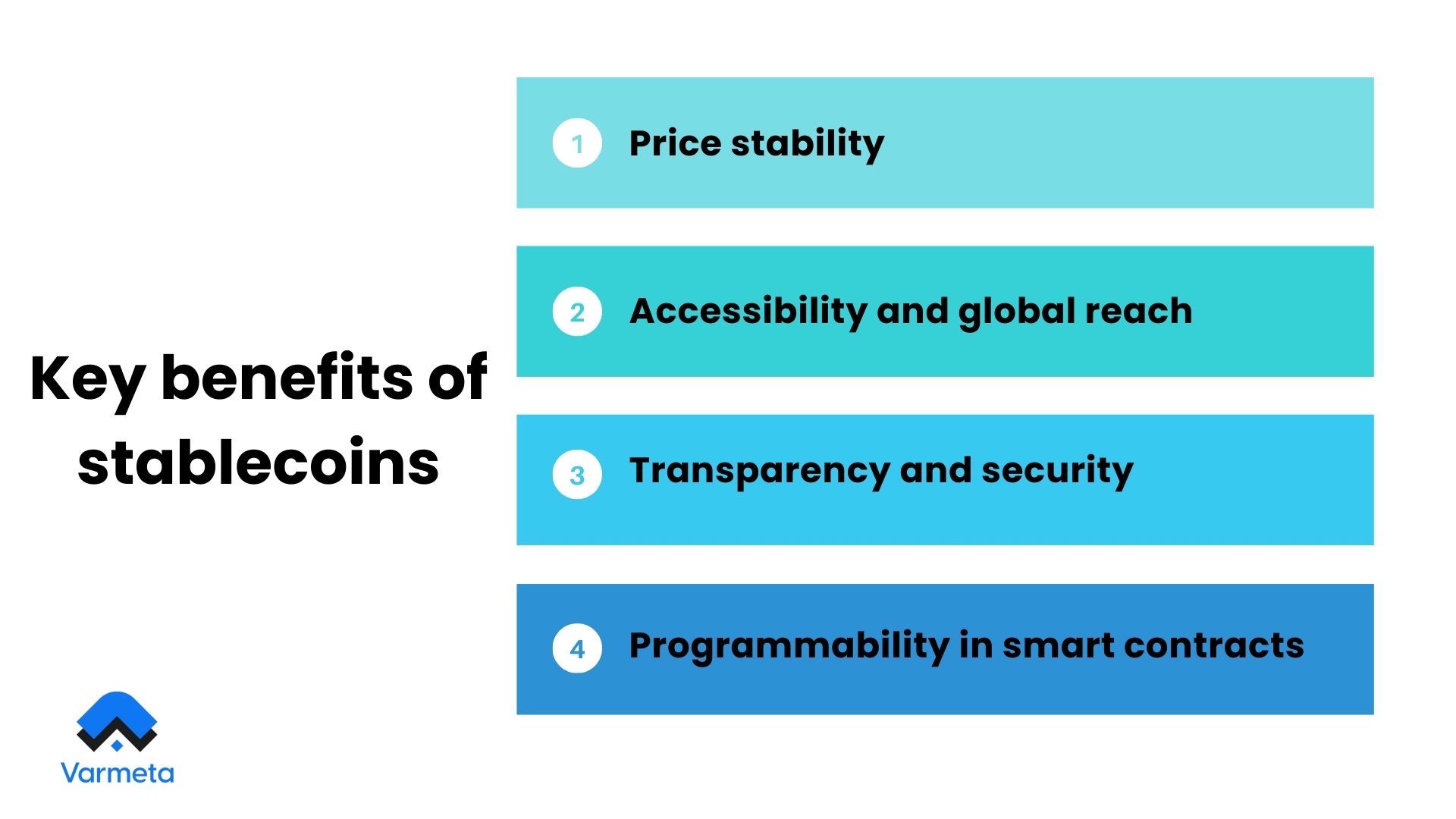
Stablecoins have become a fundamental asset in the cryptocurrency world, offering a range of benefits that make them highly attractive for individuals, businesses, and the broader blockchain ecosystem. Here are the key advantages that set stablecoins apart:
Price stability
The defining feature of stablecoins is their ability to maintain a consistent value, typically pegged to a fiat currency like the US Dollar or a tangible asset such as gold. This stability eliminates the volatility associated with traditional cryptocurrencies, making stablecoins an ideal medium of exchange, store of value, and unit of account. Whether for trading, investing, or everyday transactions, users can rely on stablecoins to preserve their purchasing power.
Accessibility and global reach
Stablecoins are accessible to anyone with an internet connection, removing barriers created by traditional financial systems. They enable people in underserved or unbanked regions to participate in the global economy, offering a simple and cost-effective way to send and receive money across borders. Their 24/7 availability and compatibility with blockchain networks further enhance their usability, ensuring that transactions are fast and seamless, no matter the time or location.
Transparency and security
Unlike traditional fiat systems that often lack visibility, most stablecoins operate on public blockchains, where transactions and reserves can be transparently audited. This level of openness builds trust among users, especially when issuers regularly publish reports verifying the backing of their stablecoins. Additionally, blockchain technology ensures that stablecoin transactions are secure, tamper-proof, and resistant to fraud, offering peace of mind to users.
Programmability in smart contracts
Stablecoins are more than just digital money; they are programmable assets that can be integrated into smart contracts. This functionality unlocks endless possibilities for innovation in decentralized applications (dApps). From automated payments and decentralized lending to complex financial instruments, the programmability of stablecoins allows developers to create efficient, self-executing systems that eliminate the need for intermediaries.
The combination of price stability, accessibility, transparency, and programmability makes stablecoins a powerful tool for reshaping the financial landscape. Whether you’re an individual looking for a reliable digital currency or a developer building the future of decentralized finance, stablecoins offer unparalleled advantages that drive adoption and innovation in the blockchain ecosystem.
Risks and challenges of stablecoins

While stablecoins have revolutionized the way we use digital currencies, they are not without their own set of risks and challenges. Understanding these potential issues is essential for both users and developers to make informed decisions and ensure the long-term viability of stablecoin ecosystems.
Centralization concerns (for Fiat-backed stablecoins)
Fiat-backed stablecoins, such as USDT or USDC, rely on centralized entities to maintain their fiat reserves. This dependence creates a single point of failure, exposing users to risks like mismanagement of funds, lack of transparency, or potential insolvency of the issuing institution. Additionally, centralized control can conflict with the decentralized ethos of blockchain technology, raising concerns about censorship or freezing of funds at the discretion of the issuer.
Algorithmic failures (e.g., UST collapse)
Algorithmic stablecoins aim to maintain their peg through supply-and-demand adjustments rather than collateral backing. While innovative, this model has proven fragile, as seen in the collapse of TerraUSD (UST). When confidence in the system erodes, a “death spiral” can occur, leading to a catastrophic loss of value. These failures highlight the difficulty of relying solely on algorithms to maintain stability, especially during periods of market stress.
Regulatory uncertainty
As stablecoins gain popularity, they have come under increasing scrutiny from regulators worldwide. Concerns about consumer protection, money laundering, and systemic risks have led to calls for stricter regulations. This regulatory uncertainty creates challenges for issuers, users, and developers, who must navigate a complex and evolving landscape. Overly restrictive regulations could stifle innovation, while inconsistent global policies could limit stablecoins’ cross-border utility.
Collateralization risks
Stablecoins that rely on collateral, whether fiat or cryptocurrency, are only as secure as the reserves backing them. For fiat-backed stablecoins, there is a risk that reserves may not be fully audited or adequately maintained. Crypto-backed stablecoins face additional risks due to the volatility of their collateral. In extreme market conditions, the value of the collateral could plummet, leading to insufficient backing and potential destabilization.
Despite their benefits, stablecoins are not immune to challenges. Centralization, algorithmic vulnerabilities, regulatory pressures, and collateral risks all pose significant hurdles to their widespread adoption and reliability. Addressing these risks through transparency, innovation, and regulatory compliance will be crucial for the continued success and trustworthiness of stablecoins in the evolving world of decentralized finance.
How to choose a stablecoin?

Selecting the right stablecoin is an important decision for anyone engaging with cryptocurrencies or decentralized finance (DeFi). Not all stablecoins are created equal, and understanding the factors that differentiate them can help ensure you choose one that aligns with your needs. Here are key considerations and best practices to guide your decision:
Factors to consider
Stability mechanism
Start by understanding how the stablecoin maintains its value. Is it fiat-backed, crypto-backed, algorithmic, or commodity-backed? Each mechanism has its strengths and weaknesses.
- Fiat-backed stablecoins offer reliable stability but may involve centralization.
- Crypto-backed stablecoins are decentralized but may be more volatile due to the underlying collateral.
- Algorithmic stablecoins are innovative but can be risky in unstable markets.
- Commodity-backed stablecoins provide tangible backing but may have limited use cases in DeFi.
Transparency and auditability
Transparency is critical when selecting a stablecoin. Look for issuers that regularly publish audits or reserve attestations to verify the backing of the stablecoin. A lack of transparency could indicate risks related to reserve management or misrepresentation.
Adoption and liquidity
The level of adoption and liquidity of a stablecoin determines its utility. A widely adopted stablecoin, such as USDT or USDC, ensures you’ll find it on most platforms and exchanges, making it easier to use in DeFi applications. High liquidity also reduces the risk of slippage during transactions.
Best practices for using stablecoins in DeFi
Diversify your stablecoin holdings
Just as diversification is a key principle in investing, spreading your stablecoin holdings across different types can mitigate risks. For instance, holding both fiat-backed and crypto-backed stablecoins can balance centralization and decentralization risks.
Verify smart contract security
When using stablecoins in DeFi platforms, ensure that the protocols are reputable and their smart contracts have been audited. This minimizes the risk of losing funds to bugs or exploits.
Stay updated on regulatory developments
Regulatory changes can impact the usability of stablecoins, especially those issued by centralized entities. Stay informed about legal developments in your jurisdiction to avoid potential disruptions.
Monitor market conditions
For crypto-backed and algorithmic stablecoins, keep an eye on market volatility and system health. Be aware of factors like collateral ratios and governance updates that could affect stability.
Choosing the right stablecoin involves balancing stability, transparency, adoption, and liquidity. By understanding the mechanisms behind each stablecoin and following best practices in their use, you can maximize their benefits while minimizing risks. Stablecoins are powerful tools in DeFi, and making informed choices ensures a safer and more rewarding experience.
The future of stablecoins in DeFi
Stablecoins have already proven to be a cornerstone of decentralized finance (DeFi), but their journey is far from over. As the blockchain ecosystem evolves, stablecoins are poised for further innovation, regulatory clarity, and integration with traditional financial systems. Here’s a look at what the future may hold for stablecoins in DeFi:
Innovations and advancements
The stablecoin sector is witnessing continuous innovation, driven by the need for better security, scalability, and decentralization. Emerging stablecoin models are addressing existing challenges while pushing the boundaries of what stablecoins can achieve.
- Hybrid models: Combining elements of fiat-backing, crypto-collateralization, and algorithmic adjustments, hybrid stablecoins aim to provide the best of all worlds: decentralization, stability, and resilience.
- Decentralized stablecoins: With increasing demand for trustless solutions, decentralized stablecoins like DAI are evolving to become more scalable and robust, leveraging multi-collateral systems and decentralized governance.
- Programmable stablecoins: Future stablecoins may integrate more advanced programmability, enabling seamless interoperability with smart contracts, decentralized applications (dApps), and payment systems.
These innovations will likely expand the use cases for stablecoins, making them even more integral to DeFi ecosystems.
Regulatory outlook
Regulation is one of the most significant factors shaping the future of stablecoins. Governments and regulatory bodies around the world are working to establish clear frameworks for stablecoin issuance and usage.
- Enhanced oversight: Regulations could enforce stricter reserve requirements, transparency, and regular audits, boosting user confidence in fiat-backed stablecoins.
- Global standards: Efforts to create standardized rules across jurisdictions could make stablecoins more accessible for international trade and cross-border payments.
- Impact on innovation: While clear regulations can promote trust and adoption, overly restrictive rules could stifle innovation, particularly for decentralized and algorithmic stablecoins.
Striking the right balance between regulation and innovation will be key to fostering the growth of stablecoins in DeFi.
Integration with traditional finance
The line between traditional finance (TradFi) and decentralized finance is becoming increasingly blurred, and stablecoins are at the heart of this convergence.
- Banking and payments: Major financial institutions are exploring partnerships with stablecoin issuers to streamline cross-border payments, remittances, and settlement systems.
- Central bank digital currencies (CBDCs): While CBDCs are not the same as stablecoins, their development could coexist with or even complement stablecoin ecosystems by providing additional fiat on-ramps and enhancing trust in blockchain-based solutions.
- Institutional adoption: As more traditional players enter the DeFi space, stablecoins will likely serve as the bridge, enabling institutions to participate without direct exposure to volatile cryptocurrencies.
The future of stablecoins in DeFi is bright, driven by innovations, regulatory clarity, and deeper integration with traditional finance. As stablecoins evolve, they will continue to expand their role in enabling a more inclusive, efficient, and decentralized global financial system. With these advancements, stablecoins are set to remain a pivotal force shaping the next chapter of DeFi and blockchain technology.
Conclusion
Stablecoins have emerged as a vital component of the decentralized finance (DeFi) ecosystem, bridging the gap between the stability of traditional financial systems and the innovation of blockchain technology. By offering price stability, global accessibility, transparency, and programmability, stablecoins have revolutionized how we transact, invest, and interact within the crypto space. Their versatility and reliability make them indispensable for a wide range of DeFi applications, from lending and borrowing to cross-border payments and yield farming.
However, like any financial tool, stablecoins come with their own set of risks and challenges. Centralization concerns, algorithmic failures, regulatory uncertainties, and collateralization risks remind us of the importance of due diligence. To fully leverage the benefits of stablecoins while minimizing potential pitfalls, it’s essential to choose the right type of stablecoin, understand its mechanisms, and stay informed about the evolving regulatory landscape.
As DeFi continues to grow, so too will the role of stablecoins, shaping the future of finance as we know it. Whether you’re a newcomer or a seasoned crypto enthusiast, stablecoins offer an accessible gateway to explore the world of decentralized finance. Use them responsibly, stay educated, and embrace the opportunities they provide in building a more inclusive and innovative financial ecosystem.