Employee performance has become a key priority for organizations that want to improve productivity, retain talented people, and stay competitive in a fast-changing business environment. Many businesses are moving away from traditional annual performance reviews. They need intelligent staff appraisal systems that combine automation, analytics, and artificial intelligence (AI) to simplify evaluations, deliver timely insights, and support better talent decisions. Rather than focusing only on past performance, these systems help managers provide continuous feedback, identify development needs, and guide employee improvement more effectively.
In this guide, we’ll explore the key features that define a modern AI-powered staff appraisal system and explain how these capabilities can help organizations improve employee performance, engagement, and long-term business success.
What is a modern staff appraisal system?

A modern staff appraisal system is a digital tool that helps organizations assess employee performance, track progress, and support ongoing development. It replaces manual, paper-based review processes with a more connected approach that includes continuous feedback, automated workflows, performance analytics, and often AI-powered insights.
To understand the difference more clearly, here is a simple comparison between traditional and modern staff appraisal systems:
| Aspect | Traditional Staff Appraisal System | Modern Staff Appraisal System |
| Review style | Usually based on annual or periodic reviews | Supports continuous and real-time feedback |
| Process | Manual, paper-based, and time-consuming | Digital, automated, and more efficient |
| Feedback | Often delayed until the review period | Ongoing and immediate |
| Data management | Information is stored in separate files or spreadsheets | Performance data is centralized in one platform |
| Manager involvement | Focuses mainly on formal evaluation meetings | Encourages regular coaching and collaboration |
| Insights | Limited reporting and analysis | Uses analytics and AI to identify trends and improve decisions |
| Employee development | Mainly measures past performance | Supports future growth, learning, and development |
Why traditional staff appraisal systems are no longer enough
Traditional staff appraisal systems were designed for workplaces where performance reviews were conducted once or twice a year. While this approach was once sufficient, today’s fast-paced business environment demands a more agile and continuous approach to performance management. As organizations embrace digital transformation and hybrid work models, relying solely on periodic evaluations can limit employee development and reduce the effectiveness of performance reviews.
Annual Reviews Quickly Become Outdated
One of the biggest challenges is that annual reviews are often outdated by the time they take place. Employees may have completed multiple projects, acquired new skills, or faced different challenges throughout the year, making it difficult for a single review to accurately reflect their overall performance.
Manual Processes Create Administrative Burden
Manual appraisal processes also place a significant administrative burden on HR teams and managers. Scheduling reviews, sending reminders, collecting feedback, and consolidating evaluation results often consume valuable time that could be better spent on coaching and employee development.
Delayed Feedback Reduces Its Impact
Another common issue is that feedback arrives too late. When employees receive performance feedback months after completing their work, opportunities to reinforce good performance or address challenges may already have passed. Continuous feedback enables faster improvement and more meaningful conversations between managers and employees.
Inconsistent Reviews Affect Fairness and Quality
Many managers also struggle to deliver consistent, objective, and constructive performance reviews. Without standardized evaluation criteria or supporting insights, assessments can be influenced by personal bias, recent events, or incomplete information.
Fragmented Data Limits Visibility
Finally, performance data is often fragmented across spreadsheets, documents, emails, and multiple HR systems. This makes it difficult for organizations to gain a complete view of employee performance or use appraisal data to support talent development and workforce planning.
These challenges are driving organizations to adopt modern, AI-powered staff appraisal systems that automate administrative tasks, centralize performance data, enable continuous feedback, and provide actionable insights for better decision-making.
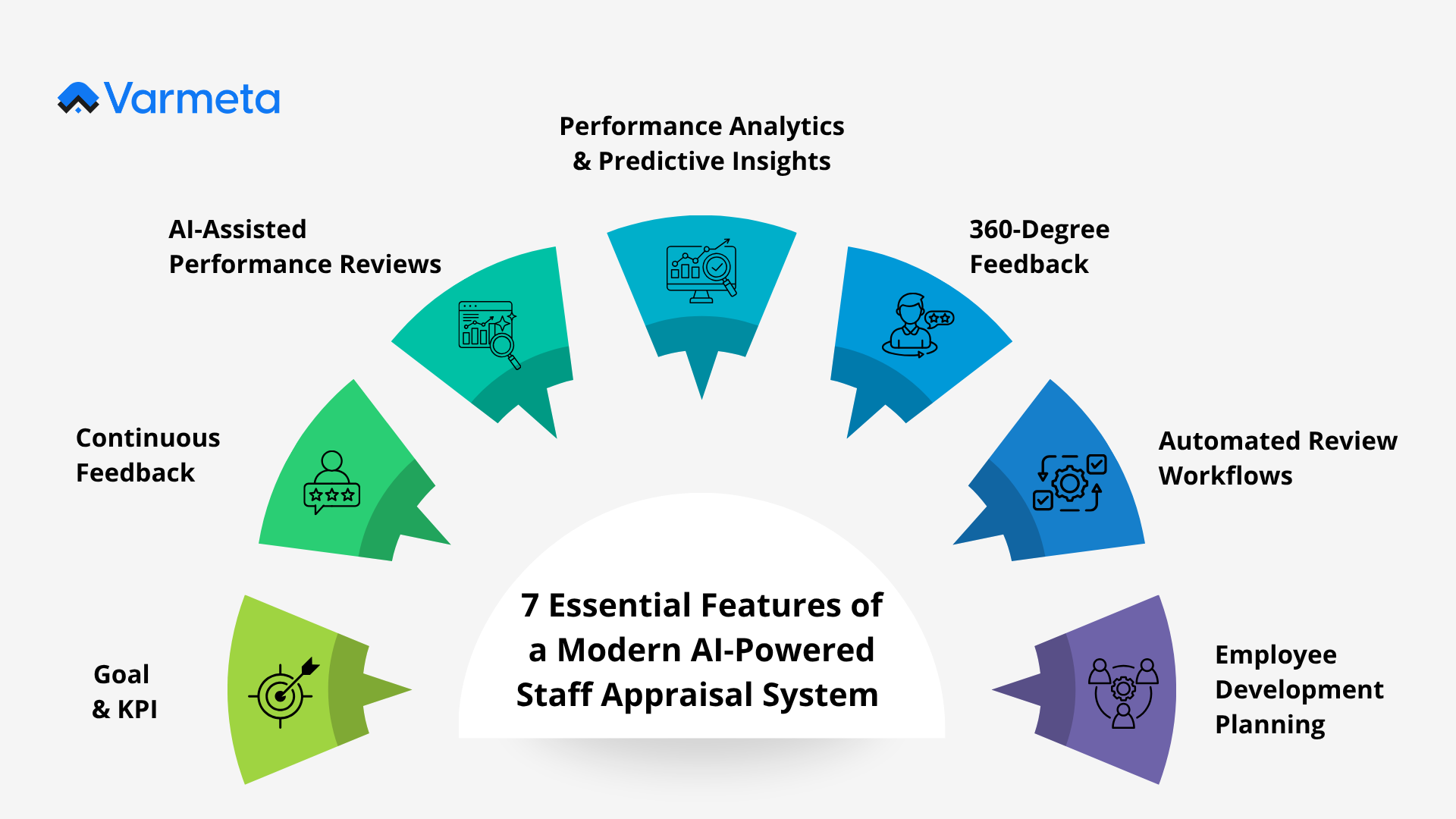
7 Essential Features of a Modern AI-Powered Staff Appraisal System
Goal & KPI Management
Effective performance management starts with clearly defined goals and measurable objectives. A modern staff appraisal system enables organizations to create, assign, and monitor individual and team goals while aligning them with broader business priorities. Instead of relying on static annual objectives, managers can update goals as business needs evolve and track progress through real-time dashboards.
According to SHRM’s The State of AI in HR 2026 Report, 8% of organizations use AI to support goal setting. Artificial intelligence further enhances goal management by helping managers create more effective performance objectives. AI can recommend SMART goals based on an employee’s role, responsibilities, and previous performance, while also suggesting ways to align individual objectives with company-wide strategies. This ensures employees work toward meaningful outcomes that support both personal development and organizational success.
By combining structured goal tracking with AI-driven recommendations, organizations can improve transparency, strengthen accountability, and make performance evaluations more objective and data-driven.
Continuous Feedback
Continuous feedback has become one of the defining features of a modern staff appraisal system. Instead of waiting for annual or quarterly reviews, managers and employees can exchange feedback regularly through ongoing check-ins, project updates, and performance conversations. This approach allows organizations to recognize achievements promptly, address performance issues before they escalate, and keep employees aligned with changing business priorities.
Artificial intelligence makes continuous feedback even more effective by analyzing feedback from multiple sources and transforming it into meaningful insights. AI can automatically summarize comments, identify recurring strengths and improvement areas, highlight performance trends over time, and surface key themes that managers might otherwise overlook. These capabilities help managers deliver more balanced, evidence-based feedback while reducing the time spent reviewing large volumes of performance data.
By combining continuous feedback with AI-powered analysis, organizations can foster a culture of ongoing development, improve employee engagement, and make performance conversations more timely, objective, and actionable. SHRM said that 9% of organizations have implemented AI to assist with drafting performance review comments.
AI-Assisted Performance Reviews
A modern staff appraisal system addresses challenges of the traditional system by integrating artificial intelligence into the review process. AI can automatically summarize feedback collected from multiple sources, identify key accomplishments and recurring performance patterns, and generate well-structured appraisal comments based on objective data. It can also recommend personalized development goals by analyzing an employee’s strengths, skill gaps, and historical performance.
Rather than replacing managerial judgment, AI serves as an intelligent assistant that helps managers prepare more consistent, evidence-based, and constructive performance reviews. By reducing administrative effort and improving the quality of evaluations, AI-assisted performance reviews enable managers to spend more time coaching employees and supporting their long-term development.
Performance Analytics & Predictive Insights
Modern staff appraisal systems do more than collect performance data, they transform it into actionable insights that support better decision-making. Performance analytics dashboards provide managers and HR teams with a clear view of employee progress, goal achievement, review completion rates, and overall workforce performance. By centralizing this information in one platform, organizations can monitor trends more effectively and make informed talent management decisions.
Artificial intelligence takes performance analytics a step further through predictive insights. By analyzing historical performance data, feedback patterns, and employee behavior, AI can identify high-potential talent, detect early signs of disengagement, and predict potential performance risks before they become larger issues. These insights enable managers to take proactive action, whether by providing additional coaching, recognizing outstanding performers, or offering targeted development opportunities.
With AI-powered analytics, organizations can move beyond reactive performance reviews and adopt a more strategic, data-driven approach to workforce planning and employee development.
360-Degree Feedback
A modern staff appraisal system should provide a well-rounded view of employee performance rather than relying solely on a manager’s perspective. A 360-degree feedback feature collects input from multiple sources, including managers, peers, direct reports, and, where appropriate, customers. By incorporating diverse viewpoints, organizations can gain a more balanced and comprehensive understanding of an employee’s strengths, areas for improvement, and overall contribution.
Artificial intelligence enhances 360-degree feedback by processing large volumes of qualitative comments and transforming them into meaningful insights. AI can summarize feedback from different reviewers, identify recurring themes and areas of consensus, and highlight inconsistencies that may require further discussion. Some advanced systems also help detect potential evaluation bias, making performance reviews more objective and consistent.
By combining multi-source feedback with AI-powered analysis, organizations can improve the fairness of performance evaluations, strengthen employee development, and provide managers with clearer, data-driven insights for making talent decisions.
Automated Review Workflows
Managing performance reviews manually can be time-consuming and prone to delays, especially as organizations grow. A modern staff appraisal system streamlines the entire appraisal process by automating routine tasks such as scheduling review cycles, assigning evaluation forms, sending reminders, managing approval workflows, and notifying employees and managers of upcoming deadlines. This reduces administrative workload while ensuring that performance reviews are completed consistently and on time.
Artificial intelligence further enhances workflow automation by identifying overdue reviews, recommending optimal review schedules based on organizational needs, and prioritizing tasks that require immediate attention. AI can also monitor workflow progress in real time and alert HR teams to potential bottlenecks before they impact the appraisal cycle.
Organizations can improve operational efficiency, reduce manual errors, and allow HR professionals and managers to spend more time on meaningful performance conversations rather than administrative tasks.
Employee Development Planning
The modern staff appraisal system should do more than evaluate past performance, it should help employees grow and prepare for future opportunities. Employee development planning connects appraisal outcomes with personalized learning and career progression, enabling organizations to turn performance reviews into meaningful development conversations. Instead of ending with an evaluation score, the appraisal process becomes the starting point for continuous improvement.
Artificial intelligence plays a key role in making development planning more personalized and data-driven. By analyzing performance reviews, competencies, and career aspirations, AI can identify skill gaps, recommend relevant training programs, suggest future career paths, and propose development goals tailored to each employee. These recommendations help managers create more targeted development plans while ensuring employees receive the support they need to succeed, so that organizations can strengthen employee engagement, improve retention, build critical skills, and create a workforce that is better prepared for future business needs.
How to choose the right staff appraisal system
Choosing the right staff appraisal system depends on your organization’s size, business objectives, and performance management strategy. Rather than selecting a platform with the most features, focus on the capabilities that address your current challenges while supporting future growth.
For Startups and Small Businesses
Smaller organizations often need a simple and cost-effective solution that is easy to implement and manage. Look for a staff appraisal system that includes:
- Goal and KPI tracking
- Continuous feedback tools
- Automated review reminders
- User-friendly interface with minimal training
- Basic reporting and performance dashboards
For Small and Medium-Sized Enterprises (SMEs)
As teams grow, performance management becomes more structured. SMEs should prioritize systems that improve consistency and provide better visibility into employee performance. Key features include:
- Goal and competency management
- Performance analytics and reporting
- Automated review workflows
- 360-degree feedback
- Integration with existing HR software
For Large Enterprises
Large organizations require scalable platforms capable of managing complex appraisal processes across multiple teams or locations. In addition to core performance management features, consider solutions that offer:
- AI-powered performance insights
- Predictive analytics and workforce planning
- Advanced workflow automation
- Seamless integration with HRIS, payroll, LMS, and talent management systems
- Customizable appraisal frameworks and enterprise-grade security
Regardless of your organization’s size, the best staff appraisal system is one that aligns with your business goals, delivers a positive user experience, and supports continuous employee development. As AI becomes an increasingly important part of HR technology, choosing a solution with intelligent automation and data-driven insights can help future-proof your performance management strategy.
The future of staff appraisal systems is AI-driven
Artificial intelligence is rapidly reshaping the way organizations manage employee performance. While early staff appraisal systems primarily focused on digitizing manual review processes, the next generation of platforms is designed to provide intelligent assistance throughout the entire performance management cycle. Rather than simply recording evaluation results, AI helps organizations generate insights, identify trends, and support more informed talent decisions.
In the coming years, AI will play an even greater role in modern staff appraisal systems by helping organizations:
- Automate performance reviews through AI-generated summaries, review drafts, and workflow assistance.
- Detect potential evaluation bias by identifying inconsistent scoring patterns and highlighting areas that may require further review.
- Recommend personalized learning and development opportunities based on employee performance, competencies, and career goals.
- Predict future performance trends by analyzing historical data, employee engagement, and productivity patterns.
- Support workforce planning by identifying high-potential employees, critical skill gaps, and future leadership candidates.
Rather than replacing managers, AI enhances their ability to make fair, consistent, and data-driven decisions. By reducing administrative workload and providing actionable insights, AI allows managers to spend less time on paperwork and more time coaching, developing, and engaging their teams. As AI capabilities continue to evolve, organizations that adopt intelligent staff appraisal systems will be better positioned to build a high-performing, future-ready workforce.
Conclusion
A modern staff appraisal system is no longer just a tool for conducting performance reviews. By combining automation, analytics, and AI-powered capabilities, it enables organizations to deliver continuous feedback, make more informed talent decisions, and support long-term employee development. Choosing a solution with the right features can help businesses create a more efficient, transparent, and future-ready performance management process.
Discover AI-Powered HR Solutions with Varmeta
Looking to modernize your performance management process? At Varmeta, we help organizations leverage AI to streamline HR operations, automate performance reviews, generate actionable workforce insights, and support data-driven talent decisions. Explore our AI-powered solutions to build a smarter, more effective staff appraisal process for your business.
FAQs
What is a staff appraisal system?
A staff appraisal system is a platform that helps organizations evaluate employee performance, track goals, collect feedback, and support employee development through a structured appraisal process.
What are the essential features of a modern staff appraisal system?
Key features include goal and KPI management, continuous feedback, AI-assisted performance reviews, performance analytics, 360-degree feedback, automated workflows, and employee development planning.
How does AI improve a staff appraisal system?
AI helps automate administrative tasks, summarize performance feedback, identify trends, detect potential bias, recommend development opportunities, and provide data-driven insights for better decision-making.
How do I choose the right staff appraisal system?
Choose a solution that aligns with your organization’s size, business goals, and HR processes. Prioritize ease of use, scalability, AI capabilities, and integration with your existing HR systems.