As the crypto landscape matures, flashy whitepapers and hype-driven launches are no longer enough. What separates projects that endure from those that disappear is a solid economic engine, tokenomics.
Tokenomics, short for token economics, refers to the design and structure of a blockchain’s native token: how it’s created, distributed, used, and governed. It’s the blueprint that shapes user incentives, investor confidence, and long term ecosystem health.
In this blog, we’ll explore core strategies that form the foundation of sustainable tokenomics, key principles every serious crypto project must understand to create lasting value in an increasingly competitive and decentralized world.
Defining tokenomics in blockchain
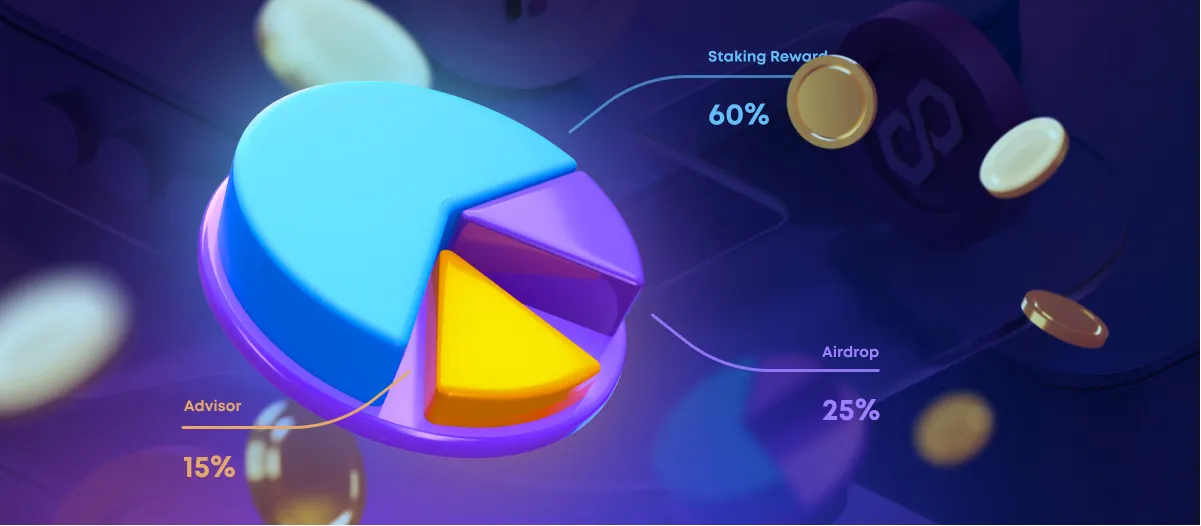
Tokenomics, the economic design behind blockchain-based tokens, is what turns code into real-world value. It defines how tokens are created, distributed, used, and governed, shaping the behaviors of users, investors, and communities. In today’s decentralized world, tokenomics isn’t a side feature. It’s the foundation that determines whether a project thrives, scales, or quietly fades away.
At its core, tokenomics blends elements of supply mechanics, utility, distribution models, and governance systems. Together, these components form the economic engine of blockchain ecosystems. When done well, they align incentives across all stakeholders, encourage healthy participation, and support long-term ecosystem growth.
The evolution of token design in web3
Tokenomics has come a long way since Bitcoin introduced a fixed-supply, incentive-driven monetary model in 2009. Ethereum expanded the landscape by making tokens programmable through standards like ERC-20 and ERC-721, giving rise to everything from ICOs to NFTs.
The emergence of DeFi and DAOs brought further innovation yield farming, staking, governance rights, and liquidity mining became tools for bootstrapping ecosystems and incentivizing users. NFTs then redefined value with digital ownership and uniqueness. Today, modern tokenomics integrates ideas from behavioral economics, game theory, and systems design to create smarter, more adaptable frameworks.
Core components of tokenomics
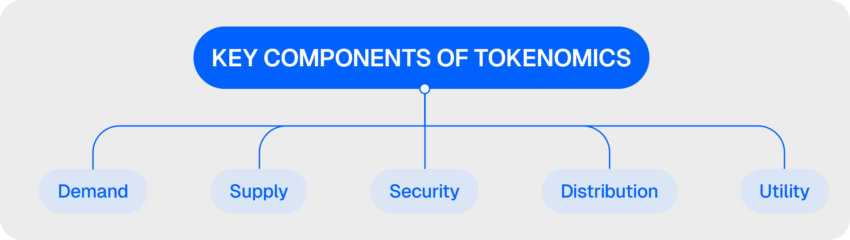
Demand
A token’s value begins with demand, the desire to hold, use, or trade it. Demand can be driven by factors like utility, scarcity, rewards, or access to unique features. Sustainable tokenomics focuses on generating consistent and growing demand, whether through staking, governance rights, or access to exclusive ecosystem functions.
Supply
Token supply can be fixed, inflationary, deflationary, or algorithmically adjusted. Supply models influence scarcity, token velocity, and long term price dynamics. For example, Bitcoin’s hard cap encourages holding, while some DeFi tokens use controlled inflation to reward participation and bootstrap liquidity.
Security
Economic security ensures the integrity of a blockchain network. This includes protecting against manipulation, preventing centralization, and aligning incentives for validators or participants. In PoS and DeFi systems, slashing mechanisms, bonding requirements, or smart contract audits play key roles in securing token-based economies.
Distribution
How tokens are initially and continuously distributed matters greatly. Fair and transparent distribution through mechanisms like airdrops, community grants, staking rewards, or token sales, builds trust and decentralization. Poor distribution can lead to concentration of power, dumping, or disillusioned communities.
Utility
Utility defines the actual use cases of a token: from transaction fees and staking to accessing services or voting on protocol upgrades. The stronger and more integrated the utility, the more valuable and sticky the token becomes. Tokens without clear utility risk being seen purely as speculative assets, which harms long term adoption.
Mechanics that drive ecosystem value
Effective tokenomics is more than a structure, it’s a dynamic system that drives behavior.
- Token creation & distribution: Built through smart contracts, tokens are launched with predefined rules around supply and allocation.
- Value generation: Demand, scarcity, and utility determine value. Burn mechanisms and buybacks help maintain price dynamics.
- Incentives: From staking rewards to liquidity mining, incentives align user contributions with ecosystem growth.
- Protocol compatibility: Tokenomics must suit the blockchain’s consensus mechanism PoW, PoS, or hybrid, to ensure economic security.
Market impact and behavior shaping
Tokenomics directly affects how tokens are perceived, traded, and held. Models with capped supply may encourage long term holding, while inflationary tokens often incentivize active participation. Design choices like vesting schedules, lock up periods, and reward emissions impact liquidity, volatility, and community trust.
Incentivization goes beyond speculation. Projects that embed meaningful engagement loops staking, voting, community rewards keep users active and invested. Poorly designed models, on the other hand, lead to short-lived hype, volatility, and user drop-off.
Challenges and the road ahead
Despite its potential, tokenomics faces key hurdles:
- Regulatory uncertainty around token classification (utility vs. security).
- Overreliance on speculative demand instead of functional use.
- Design complexity requires multi-disciplinary expertise.
- Smart contract vulnerabilities or economic exploits.
Looking forward, we’ll likely see more adaptive and data-driven models, enhanced by AI, dynamic incentives, cross-chain interoperability, and community-driven governance. Sustainability, fairness, and long-term alignment will define the next era of tokenomics.
Tokenomics as the engine of web3
Tokenomics is not a passing trend, it’s the core architecture that powers digital economies. From Bitcoin’s scarcity to Ethereum’s composability and DeFi’s incentive loops, it remains the engine behind every successful protocol.
Projects that design thoughtful tokenomics anchored in real utility, sound distribution, and participatory governance will build ecosystems that grow with trust and resilience. As we move deeper into a decentralized future, tokenomics becomes more than a framework. It becomes the language of value itself.
Varmeta – Excellent in every block
Website: var-meta.com
Linkedln: https://www.linkedin.com/company/var-meta/