AI in real estate has moved well past chatbots and basic automation. According to Delta Media’s 2025 industry survey, over 87 percent of brokerages are now actively using AI tools, up 7 percent from the year before, and the conversation has shifted from whether to adopt AI to how deeply to redesign the business around it.
According to McKinsey’s latest analysis on where AI is creating real value in real estate, AI could unlock between $430 billion and $550 billion in value across the real estate value chain. That estimate has grown sharply from earlier projections, and McKinsey’s partners are explicit about why: the real opportunity isn’t task automation, it’s coordinating multiple agents to redesign entire workflows, like leasing, maintenance, and asset management, end to end rather than layering AI onto a single step at a time.
In this article, we’ll explore how AI agents are transforming modern real estate, the key benefits they bring, and what the future holds for AI in real estate as the industry moves from isolated tools toward full workflow transformation.
Understanding AI agents in real estate

AI agents are software systems built to automate tasks, analyze large volumes of data, and surface insights that help buyers, sellers, and real estate professionals make faster, better decisions. They range from simple rule-based chatbots to more advanced systems that plan and execute multi step work on their own.
It helps to separate two terms that get used almost interchangeably but mean different things. Generative AI creates new content based on patterns learned from training data, things like listing descriptions, marketing images, or virtual staging. Agentic AI is different: it performs tasks autonomously, making decisions or taking multi step actions on a person’s behalf, such as monitoring incoming leads, prioritizing follow ups, and completing a workflow without someone manually triggering each step. Most platforms now combine both: generative AI for content, agentic AI for action.
AI agents come in different forms, each serving a unique purpose in the industry:
- Chatbots & Virtual assistants: AI-powered chatbots and assistants provide instant responses to customer inquiries, schedule property viewings, and even guide users through mortgage processes. These tools enhance customer experience by offering 24/7 support without human intervention.
- Predictive analytics tools: These AI systems analyze historical market trends, property values, and buyer behaviors to predict future demand and pricing fluctuations. Investors and agents use these insights to make data-driven decisions rather than relying solely on intuition.
- Automated property management solutions: AI is also being used in rental management, where it helps landlords and property managers with tenant screening, maintenance scheduling, and rental pricing adjustments.
So, what powers these AI agents? The key technologies behind them include:
- Machine Learning (ML): AI systems improve over time by learning from real estate market trends, buyer behavior, and pricing models.
- Natural Language Processing (NLP): Enables AI agents to understand and respond to human queries in a conversational way, making interactions with chatbots more natural and intuitive.
- Computer vision: AI can analyze property images, floor plans, and virtual tours, helping buyers evaluate listings more effectively.
- Big data & cloud computing: AI agents rely on massive datasets to make accurate predictions about property prices, market demand, and investment risks.
The table below breaks down how these capabilities map to the data they rely on and the results they deliver in practice.
| AI capability | Data inputs | Results in practice |
|---|---|---|
| Predictive analytics | Historical sales, market trends, neighborhood data, interest rates | Data-driven pricing, demand forecasting, investment risk assessment |
| Natural language processing | Customer inquiries, property data, transaction documents | Chatbots, faster client responses, automated contract review |
| Discovery & personalization | Buyer preferences, lifestyle data, search behavior | Personalized property recommendations, neighborhood insights |
| Planning & automation | Task lists, compliance documents, property records | Automated sales workflows, transaction checklists, risk flagging |
| Content generation | Property images, 3D scans, text prompts | Property descriptions, marketing assets, virtual staging |
With these technologies, AI agents are becoming smarter, faster, and more capable of handling complex real estate tasks, making them an essential tool for modern real estate professionals.
How AI agents are transforming real estate
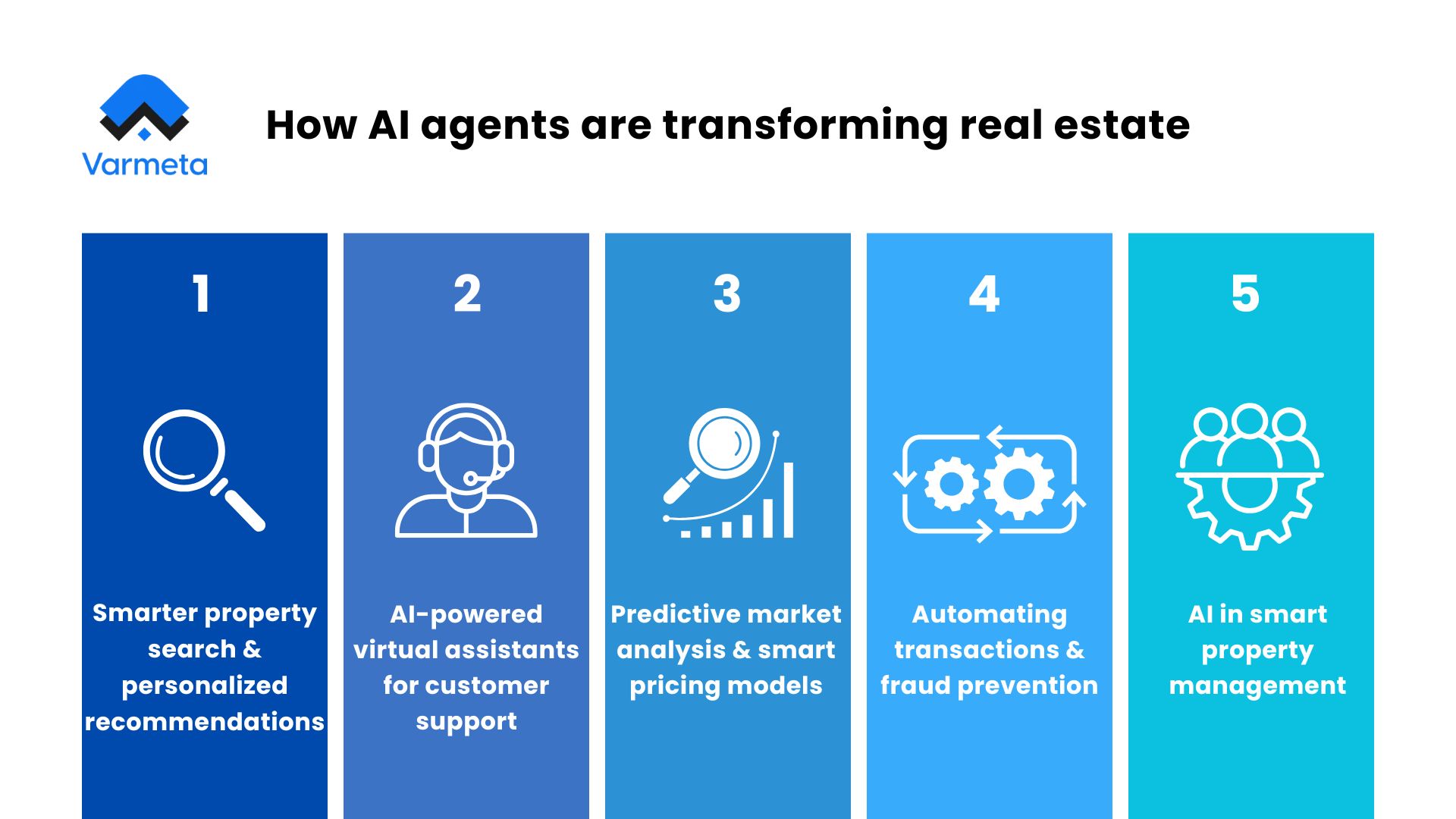
AI is changing real estate at almost every step, from how buyers first find a home to how a transaction finally closes. Here’s how AI agents are reshaping the industry:
1. Smarter property search & personalized recommendations
Searching for a property can be overwhelming, but AI agents and AI-driven platforms are making it easier by delivering personalized recommendations based on a buyer’s preferences, search history, and budget. These intelligent systems analyze millions of listings in real time, filtering out irrelevant properties and surfacing the most relevant options. The shift toward AI in real estate marketing is also changing how buyers evaluate a listing before ever contacting an agent: Matterport’s research found that 62 percent of US buyers consider a virtual tour the single most influential factor in their decision making, and 71 percent said they’d make an offer based on a 3D tour alone, without a single in-person visit.
2. AI-powered virtual assistants for customer support
Buyers and sellers used to wait hours, sometimes days, for a reply from a real estate agent. AI-powered virtual assistants and AI agents now handle inquiries, provide instant property details, and even help schedule viewings in real time, working around the clock so potential buyers get an immediate response, which helps increase engagement, nurture leads, and improve conversion rates.
3. Predictive market analysis & smart pricing models
AI is taking the guesswork out of pricing by using big data analytics to forecast market trends and property values. AI agents and predictive analytics tools analyze historical sales data, economic indicators, and buyer demand to generate accurate price predictions. This benefits both buyers and sellers, sellers can price their properties competitively, while buyers can make informed investment decisions based on data-driven insights provided by AI agents.
4. Automating transactions & fraud prevention
Real estate transactions involve a significant amount of paperwork and due diligence. AI agents and AI-driven document processing tools streamline this process by automatically verifying contracts, extracting key information, and detecting errors or inconsistencies. AI agents are also playing a crucial role in fraud detection and risk assessment, helping financial institutions and real estate agencies identify suspicious transactions and prevent fraud before it happens.
5. AI in smart property management
For landlords and property managers, AI agents now handle work that used to take a property manager hours each week. AI-powered rental management systems help with tenant screening, ensuring that only reliable tenants are approved. Once a property is rented, AI-driven tools handle automated maintenance requests, sending alerts when repairs are needed before a minor issue turns into a costly problem. Predictive maintenance, powered by AI agents, helps property owners save time and reduce operational costs while improving tenant satisfaction.
6. Moving from single tools to full workflow redesign
The points above describe what most firms are doing with AI in real estate today: automating individual steps. McKinsey’s research points to a bigger shift already underway among the leaders in the space. Instead of adding a chatbot here and a pricing tool there, these firms are redesigning entire workflows, like taking a lead from first contact all the way through a signed lease, with a coordinated set of agents handling the full process and a human stepping in only at the moments that genuinely need judgment. Firms making this shift are reporting 10 to 20 percent improvements in metrics like net operating income, cycle times, and operating costs, gains that piecemeal automation alone rarely produces.
Asset management shows the same pattern at portfolio scale. A property portfolio generates a constant stream of inspection reports, lease abstracts, vendor invoices, and tenant correspondence that traditionally gets reviewed and filed by different people at different times. Once that data sits in one connected system instead of scattered across separate buildings and spreadsheets, an asset manager can spot a maintenance pattern across an entire portfolio or flag every lease about to expire across dozens of properties at once, the kind of cross-property insight a single point tool focused on one building was never built to surface.
This is also why survey numbers like the 87 percent adoption figure can be misleading on their own. A firm can use AI in real estate every day, in the form of a chatbot and a pricing tool, while never touching the workflow redesign that produces the bigger gains. Counting tools in use says less about a business than checking whether the handoffs between teams have actually changed.
With AI agents handling everything from property searches and market predictions to contract processing and property management, real estate professionals can focus on what truly matters, building relationships and closing deals. AI isn’t just improving real estate; it’s redefining the way the industry operates.
The benefits of AI agents in real estate

AI cuts cost and time across the business by automating repetitive tasks, surfacing deeper data insights, and improving how clients are handled. Here’s how AI agents are driving major benefits in real estate:
1. Increased efficiency and time savings
Real estate transactions involve countless moving parts, from listing management to contract processing. AI automates many of these routine and repetitive tasks, freeing up valuable time for agents, brokers, and property managers. AI chatbots can handle inquiries instantly, while document automation streamlines paperwork, reducing delays in deals. McKinsey has found that firms applying AI to back-office work like financial reporting are cutting 60 to 80 percent of the time that used to go into aggregating and compiling that data by hand.
2. Improved decision-making with data-driven insights
The real estate market is constantly shifting, and AI helps professionals stay ahead by analyzing vast amounts of data. AI-driven analytics provide accurate market forecasts, property valuation models, and buyer behavior insights, making it easier to price properties competitively and identify profitable investment opportunities. For buyers and sellers, AI offers transparency, decisions are now backed by real-time market intelligence rather than gut instinct alone.
3. Enhanced customer experience and engagement
Today’s buyers and renters expect instant responses and seamless interactions, and AI delivers just that. AI-powered virtual assistants provide 24/7 support, answering questions, scheduling property tours, and guiding clients through the buying or renting process. These tools offer a personalized experience, remembering user preferences and making intelligent recommendations. With AI handling inquiries and follow-ups, real estate professionals can engage more effectively with serious clients, leading to higher satisfaction and conversion rates.
4. Cost reductions for real estate professionals
Running a real estate business comes with significant operational costs, but AI helps cut expenses by reducing the need for manual labor. AI-powered marketing automation, lead generation, and transaction processing mean fewer administrative burdens and lower staffing costs. Predictive maintenance in property management also prevents expensive repairs by detecting issues early. By streamlining workflows and reducing inefficiencies, AI allows real estate firms to maximize profitability while delivering better services.
From boosting efficiency and decision-making to enhancing customer experiences and cutting costs, AI in real estate is becoming a baseline expectation rather than a differentiator on its own. Those who embrace it well, not just adopt it, are gaining the real competitive edge.
Challenges and limitations of AI in real estate

AI brings real gains to real estate, but it comes with genuine challenges and limitations too, from ethical concerns to organizational resistance. Here are the key hurdles real estate professionals need to consider:
1. Ethical concerns and data privacy issues
AI thrives on data, but when it comes to real estate, this raises serious concerns about privacy, security, and ethical use. AI systems collect vast amounts of information, including buyer preferences, financial details, and even behavioral patterns, which, if not properly secured, can be vulnerable to cyber threats and misuse. McKinsey’s real estate partners put this bluntly: if an agent is built on top of erroneous or dirty data, it will take action based on that data and produce an erroneous outcome, and there’s no substitute for clean, governed data infrastructure underneath any AI deployment. Biased algorithms can also unintentionally reinforce discrimination in property recommendations and lending decisions, leading to unfair advantages or exclusions for certain groups.
2. The need for human oversight and expertise
Despite AI’s impressive capabilities, it cannot fully replace human expertise, at least not yet. Real estate is an industry built on relationships, negotiations, and emotional intelligence, which AI currently lacks. AI tools may analyze property values and predict market trends, but they don’t understand human emotions, motivations, or cultural nuances in the same way a seasoned real estate professional does. McKinsey’s own framing is useful here: if there are two feet of water on a tenant’s floor at three in the morning, that tenant wants a responsive, empathetic person on the line, not an AI agent. This means AI should be seen as an enhancement, not a replacement, with human experts providing the final judgment and guiding complex negotiations.
3. Adoption barriers and organizational resistance
While some real estate professionals are embracing AI, others remain skeptical or resistant to change. McKinsey identifies three specific barriers slowing firms down even when budget isn’t the issue: organizational inertia and risk aversion that keeps teams waiting for error rates to fall before they’ll experiment, treating AI as an IT project rather than a change to the operating model itself, and underinvesting in the trust and safety guardrails that real data governance requires. Without senior business ownership and a clear link between AI investment and actual profit and loss impact, many firms end up with tools that look impressive in a demo but never change how the business actually runs.
None of these problems rule out AI in real estate. They just set the actual bar for doing it well: clean, governed data, human judgment kept in the loop for the moments that need it, and an adoption plan that goes beyond buying a tool and hoping the team uses it.
Future trends: What’s next for AI in real estate?
As AI continues to evolve, its role in real estate is only set to grow, bringing even more innovation, efficiency, and intelligence to the industry. Here are some of the key trends shaping the future of AI in real estate:
1. Generative AI in real estate marketing
Marketing is one of the most time-consuming yet crucial aspects of real estate, and AI is taking it to the next level. Generative AI is now being used to create high-quality listing descriptions, targeted ad copy, and even virtual staging for properties, often pulled directly from 3D property scans rather than written from scratch. Instead of spending hours crafting marketing materials, agents can leverage AI to produce engaging, personalized content that speaks directly to potential buyers.
2. AI-Powered smart homes and IoT integration
The future of real estate isn’t just about buying and selling properties, it’s also about how we live in them. AI is playing a major role in smart home technology, with voice assistants, automated lighting, and energy-efficient climate control becoming standard features in modern homes. Through Internet of Things (IoT) integration, AI can learn homeowner habits, optimize energy usage, and even enhance security through real-time monitoring and predictive alerts.
3. Blockchain and AI in property transactions
One of the biggest pain points in real estate is the complexity and time-consuming nature of transactions. AI, combined with blockchain technology, has the potential to revolutionize property transactions by enabling secure, transparent, and automated smart contracts. With AI handling identity verification, fraud detection, and risk assessments, and blockchain ensuring tamper-proof records, real estate deals could become faster, safer, and more efficient than ever before. It’s the kind of infrastructure work covered in more depth in Varmeta’s piece on agentic AI, where the agent’s usefulness depends heavily on the quality of the data and records sitting underneath it.
Conclusion
AI in real estate has moved past the proof of concept stage, and the bar for what counts as meaningful adoption has moved with it. The first wave was about individual tools: a chatbot here, a pricing model there. The current wave, the one McKinsey estimates could unlock $430 billion to $550 billion in value, is about redesigning entire workflows, leasing, operations, asset management, end to end, with agents and people working in partnership rather than AI bolted onto the side of an old process.
The firms capturing the most value aren’t the ones with the flashiest demo. They’re the ones doing the harder work underneath: clean data, a senior owner accountable for the result, and a willingness to measure success by actual business outcomes like faster lease conversions or fewer vacancy days, not by how many people opened the app. For real estate professionals deciding where to focus next, that’s the more useful question to ask than whether to adopt AI at all.