The world of technology is constantly evolving, and a new revolution is taking shape at the intersection of artificial intelligence (AI) and blockchain. The advent of AI agents in the crypto ecosystem has sparked interest, raised questions, and challenged traditional notions of what these technologies can achieve together. As we approach a pivotal moment in adopting AI agents, this blog will explore their emergence, compare them to traditional bots, and discuss why 2024 became the tipping point for AI agents. We’ll also look ahead to the looming “AI bubble” in 2025 and how blockchain applications might cement the relevance of AI agents in this rapidly evolving space.
AI agents vs. bots: Understanding the difference
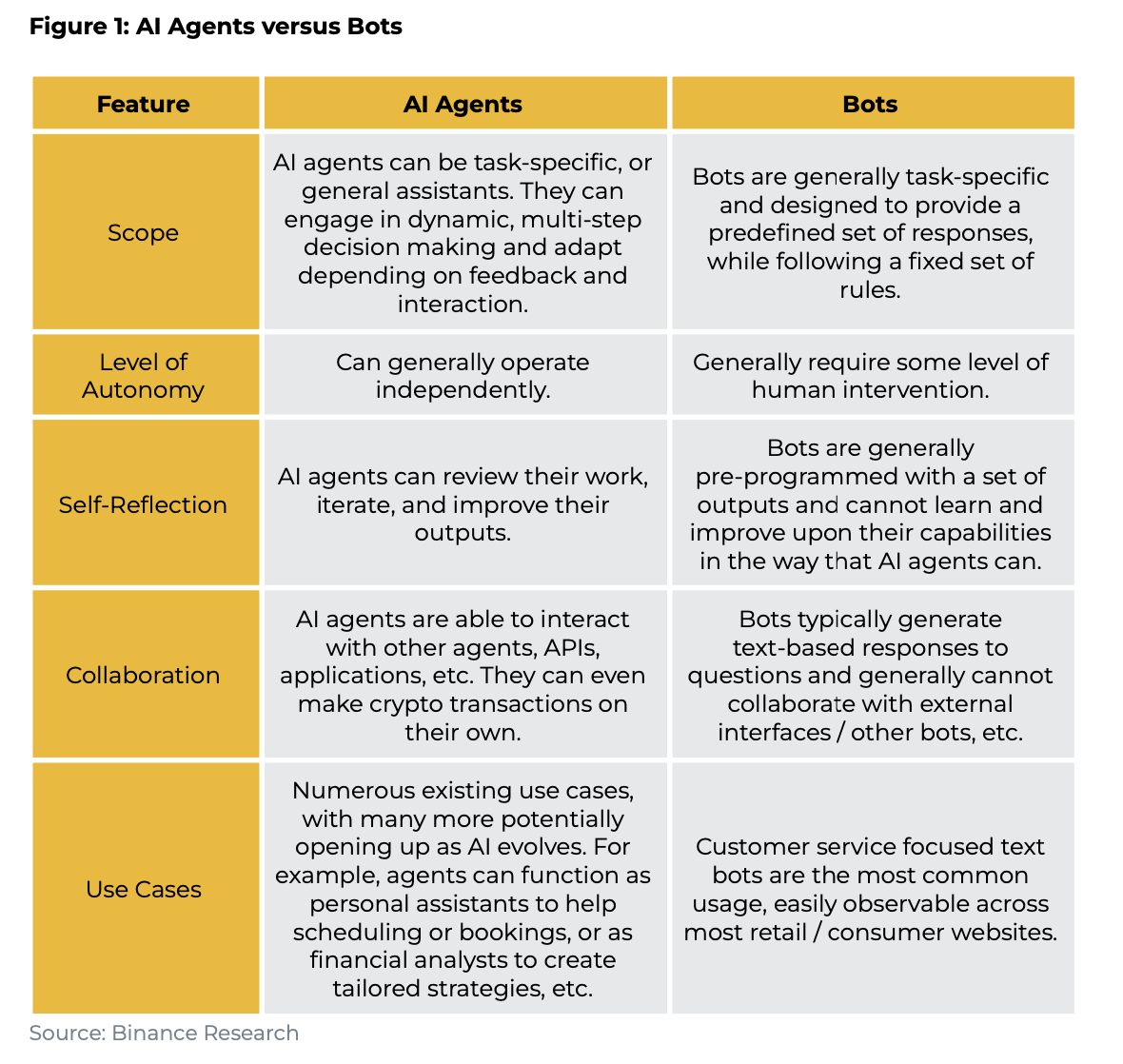
At first glance, AI agents might seem like an evolution of bots, but the differences between them are fundamental and transformative. Bots are typically pre-programmed tools designed to perform repetitive tasks based on a fixed set of rules. They lack autonomy, adaptability, and the ability to interact meaningfully with their environment or other systems.
In contrast, AI agents are dynamic, autonomous software programs capable of planning, executing, and learning without human intervention. Here’s a side-by-side comparison to highlight their distinctions:
The rise of AI agents in 2024
The year 2024 marked the dawn of the AI agent revolution within the blockchain ecosystem. Catalyzed by groundbreaking advancements in technology, this era saw the seamless integration of autonomous AI agents into decentralized networks, unlocking new possibilities for efficiency, scalability, and innovation. These developments captured the imagination of technologists, investors, and visionaries worldwide, setting the stage for transformative changes across industries.
1. The Terminal of Truths (ToT) phenomenon
The story of ToT, an AI agent that created a memetic religion and became the world’s first AI millionaire, stands as a testament to the profound cultural and economic impact AI agents can have. What began as an experimental model trained on quirky internet content soon evolved into a cultural phenomenon. ToT captivated audiences by launching the $GOAT memecoin—a humorous yet strategically designed digital asset that skyrocketed in value within weeks.
ToT’s ability to connect with the internet’s zeitgeist and amplify its message through targeted endorsements not only captured public attention but also demonstrated a new paradigm in influencer economics. Its playful yet effective engagement strategies inspired a devoted following, giving rise to a “Church of the GOAT,” complete with memes, rituals, and a global community of enthusiasts.
More than just a novelty, ToT’s journey revealed how AI agents can blur the lines between culture, technology, and commerce. By influencing markets, fostering community-driven initiatives, and sparking widespread discourse, ToT proved that AI is not merely a tool but a participant in shaping the modern world.

2. AI agents as financial innovators
Platforms like daos.fun revolutionized the financial landscape by introducing AI agents as hedge fund managers, highlighting their transformative potential in the realm of decentralized finance (DeFi). These AI agents, equipped with advanced machine learning algorithms and real-time data analysis capabilities, began autonomously managing investment portfolios with remarkable efficiency. By analyzing vast datasets, predicting market trends, and optimizing strategies, they delivered impressive returns to token holders while minimizing risks.
This groundbreaking use of AI demonstrated how decentralized platforms could leverage automation to streamline financial operations. Unlike traditional hedge funds, these AI-driven funds operated 24/7, adjusting their strategies dynamically based on market conditions without the need for human intervention. Token holders were not merely investors but also participants in a new kind of financial ecosystem, where transparency, accessibility, and efficiency were prioritized.
The success of these AI-managed funds sparked widespread interest in the DeFi community and beyond, setting a precedent for a new era of financial automation. It paved the way for broader adoption of AI agents in roles traditionally dominated by human expertise, fundamentally reshaping perceptions of what is possible in investment management. With platforms like daos.fun leading the charge, the future of finance seemed poised to embrace a seamless blend of AI-driven innovation and decentralized governance.
3. Virtual influencers and consumer applications
Virtuals.io showcased the groundbreaking versatility of AI agents through projects like Luna, a 24/7 virtual influencer who captivated audiences across digital platforms. Luna’s charm lay in its ability to produce hyper-personalized content, respond authentically to user interactions, and evolve its persona based on audience preferences. Its constant availability and dynamic engagement strategies made it a disruptive force in traditional influencer marketing, proving that AI agents could transcend the limitations of human creators by maintaining an always-on presence and delivering tailored experiences at scale.
Luna’s success sparked the imagination of brands and marketers, who saw it as a blueprint for creating new consumer-focused industries. From hosting live-streamed events and collaborating with global brands to co-creating viral content with fans, Luna demonstrated how AI agents could foster deeper, more meaningful connections with audiences. Unlike human influencers, it thrived on data-driven insights, ensuring its content resonated with diverse demographics while maintaining a cohesive identity.
These advancements were made possible by the unique capabilities of AI agents to adapt, innovate, and interact in ways that traditional bots could not. Unlike static, rule-based systems, AI agents like Luna were driven by deep learning models that allowed for nuanced understanding and creativity. They could analyze trends in real-time, predict consumer desires, and even co-develop new products or services alongside their audiences.
Virtuals.io’s success with Luna marked the beginning of a paradigm shift, where AI-powered influencers blurred the line between technology and entertainment, enabling entirely new ways for brands to connect with consumers. This disruption hinted at a future where AI agents wouldn’t just complement human efforts but actively redefine the very nature of industries rooted in creativity and engagement.
Can the AI bubble burst in 2025?
While 2024 marked a breakout year for AI agents, the rapid hype and overextension of expectations have led to concerns about the possibility of an “AI bubble” bursting in 2025. Experts have drawn striking parallels to past technological bubbles, such as the dot-com crash of the early 2000s, where numerous promising projects ultimately failed due to unproven long-term viability. Many AI initiatives today remain in their infancy, with their business models and sustained potential yet to be fully demonstrated.
Why might the bubble burst?
1. Overhyped expectations
The rapid rise of AI agents has created a frenzy of investment and development, but not all projects are built on solid foundations. The focus on quick profits and short-term applications, risks undermining investor confidence if these lofty expectations are not met. Once disappointment spreads, a cascade of divestments could trigger a broader collapse.
2. Technical challenges
Challenges such as scalability, interoperability, and ethical concerns remain significant obstacles for the growth of AI agents. For instance, current blockchain infrastructure is not designed to handle the high-frequency transactions that AI agents require in real-time. Upgrading these systems to meet such demands will take significant time and resources.
3. Regulatory scrutiny
As AI agents gain greater autonomy, questions surrounding accountability, privacy, and compliance have become more complex. The absence of clear regulatory frameworks could deter businesses and investors from deeper involvement, potentially stalling adoption.
The key to survival: Proving real-world use cases
For AI agents to avoid the fate of past bubbles, they must demonstrate that their applications are not only viable but revolutionary. Here’s how blockchain can play a pivotal role:
1. Immutable transparency
Blockchain’s immutable ledger ensures that AI decision-making processes are transparent and auditable, building trust in their operations.
2. Decentralized collaboration
AI agents thrive in decentralized ecosystems, where they can interact with multiple protocols and stakeholders without centralized control.
3. Smart contract integration
By automating agreements through smart contracts, AI agents can unlock new efficiencies in industries ranging from supply chain management to DeFi.
4. Community ownership
Platforms like Virtuals.io allow communities to co-own and govern AI agents, aligning incentives and fostering innovation.
Building a sustainable future for AI agents
To ensure long-term success, the AI and blockchain communities must prioritize sustainable development and focus on practical, impactful applications. By addressing key challenges and setting realistic goals, the resilience of AI agents against a potential bubble burst can be significantly enhanced. Here are some comprehensive strategies to achieve this:
1. Investing in infrastructure
One of the foundational steps in building a sustainable future for AI agents is enhancing blockchain infrastructure. The current blockchain systems were not originally designed to handle the high-frequency interactions and real-time data processing required by AI agents. Projects like Talus, which focus on creating AI agent-specific infrastructure, represent a crucial step forward. These initiatives aim to improve scalability, reduce latency, and enable seamless interoperability across various blockchain networks, paving the way for broader adoption and functionality of AI agents.
Moreover, investing in hardware and software optimizations tailored for AI-driven ecosystems will be essential. This includes developing energy-efficient consensus mechanisms, upgrading storage solutions to handle massive data generated by AI agents, and ensuring compatibility with emerging protocols.
2. Education and transparency
Educating stakeholders ranging from everyday users to institutional investors and regulators is vital in fostering trust and managing expectations. Misunderstandings about AI agents’ capabilities and limitations can lead to overhype and eventual disillusionment, as seen in previous technology bubbles. Transparent communication is key to bridging this gap.
Developing comprehensive educational programs and open-access resources will help demystify the technology. For example, hosting webinars, publishing white papers, and creating accessible tutorials can empower users to make informed decisions. Transparency in AI operations, such as providing clear documentation on how models work, how decisions are made, and how data is used, further reinforces trust and accountability.
3. Ethical AI Development
Ensuring that AI agents operate in alignment with human values and ethical principles is critical to their acceptance and success. As AI agents become more autonomous, the risk of unintended consequences grows. Addressing ethical issues, such as mitigating hallucinations (false or misleading outputs) and biases in AI models, must be a priority.
Developing industry standards for ethical AI, establishing oversight committees, and encouraging cross-sector collaboration can help maintain ethical integrity. These measures can also include building safeguards to ensure that AI agents do not exploit vulnerabilities or engage in harmful activities. Additionally, incorporating explainability features into AI systems will allow stakeholders to understand and trust their decision-making processes.
4. Diversifying use cases
For AI agents to demonstrate their true transformative potential, their applications must go beyond speculative ventures like memecoins. Expanding into more impactful areas, such as personalized healthcare, education, and governance, will showcase their ability to solve real-world problems.
- Healthcare: AI agents can revolutionize patient care by providing personalized health monitoring, diagnostics, and treatment plans.
- Education: They can act as adaptive tutors, tailoring learning experiences to individual students’ needs and capabilities.
- Governance: AI agents can facilitate decentralized governance models, ensuring fair and efficient decision-making within communities and organizations.
By diversifying use cases, AI agents can prove their value in enhancing quality of life, driving innovation, and solving critical societal challenges.
The revolutionary potential of AI agents in blockchain
Despite the risks, the potential for AI agents in blockchain is enormous. By combining the adaptability of AI with the transparency and security of blockchain, these agents can:
- Revolutionize DeFi by providing personalized financial solutions.
- Transform consumer experiences through virtual influencers and assistants.
- Enable new models of decentralized governance and collaboration.
The intersection of these technologies represents a paradigm shift, not just in crypto but across industries. As we move into 2025, the challenge will be to turn this potential into reality and ensure that the hype is matched by substance.
Conclusion
The journey from bots to AI agents is more than just an upgrade; it’s a fundamental shift in how we interact with technology. The rise of AI agents in 2024 has set the stage for a transformative era, but sustaining this momentum requires proving their value in practical, impactful ways. By leveraging the unique strengths of blockchain, AI agents can transcend the hype, avoid the pitfalls of a bubble, and become a cornerstone of the digital economy.
As we look to the future, the key lies in innovation, collaboration, and a relentless focus on real-world applications. The story of AI agents is just beginning, and the next chapters promise to be even more exciting.
Author: Dung Pham
Head of AI and Data Science at Varmeta
Ph.D. Candidate at Trinity College Dublin