As a pioneer in cryptocurrency, Bitcoin remains foundational in the Layer 1 blockchain space. Introduced in 2009 by an anonymous individual or group known as Satoshi Nakamoto, Bitcoin (BTC) is the first decentralized digital currency and the cornerstone of blockchain technology.
BTC’s main strengths lie in its pioneering blockchain infrastructure, which provides high security and immutability. It is the most widely recognized and adopted cryptocurrency, serving multiple roles as a store of value, a medium of exchange, and a digital investment.
Often referred to as “digital gold”, Bitcoin’s limited supply of 21 million BTC and decentralized nature make it an increasingly popular reserve asset. Its utility extends beyond payments, appealing to both investors and institutions seeking a hedge against traditional financial risks.
One of Bitcoin’s defining features is the Bitcoin Halving event, which occurs approximately every four years. This event reduces block rewards for miners, further enhancing the scarcity of newly mined Bitcoin and reinforcing its role as a scarce and valuable asset.
 Layer 1 blockchains are foundational networks that form the backbone of the blockchain world, supporting a wide range of applications and services. This article will dive into the top Layer 1 blockchains to consider in 2024, highlighting their unique features and potential impact on the cryptocurrency ecosystem
What is a layer 1 blockchain?
A layer 1 blockchain, also known as the base layer, is the core network where transactions are finalized and recorded. Unlike Layer-2 scaling solutions, which are built on top of existing blockchains to improve scalability and transaction speed, Layer 1 protocols are independent networks with their own consensus mechanisms and security models. These networks are essential for ensuring secure, transparent, and decentralized transaction processing, making them indispensable in the evolving world of digital assets.
What makes layer 1 networks unique?
Layer-1 blockchains are the foundational framework of the crypto world, offering several key benefits for the operation and growth of the digital economy:
- Decentralization and Security: Layer1 blockchains provide decentralization, security, immutability, and transparency, ensuring that no single entity controls the network, transactions are permanent and accurate, and all transactions are visible to foster trust and accountability.
- Independent Operation: Layer 1 blockchains operate independently, executing transactions and smart contracts without relying on external systems. They also employ various consensus mechanisms, like Proof of Work (PoW) or Proof of Stake (PoS), to validate transactions and maintain network integrity.
- Native Tokens: Most Layer1 blockchains support native tokens that are essential to the network’s economy, used for transaction fees, staking, and governance, thereby enhancing the network’s utility and value.
- Developer Flexibility: As foundational layers in blockchain technology, Layer 1 blockchains receive widespread approval and integration into various systems and services. They provide a flexible platform for developers to build a range of decentralized applications (dApps).
- Network Effects and Congestion Resistance: Popular Layer1 blockchains benefit from strong network effects, often handling congestion better than Layer 2 solutions, as increased users add value and utility to the network. Layer2 solutions rely on Layer 1 to finalize transactions. While Layer-2s can alleviate immediate congestion issues, they still depend on the foundational security and finality provided by Layer 1 blockchains.
Top Blockchain Layer 1 Networks to Watch
We have compiled a list of the best Layer 1 networks to follow based on popularity, market capitalization, on-chain activity, adoption, and the market performance of their native cryptocurrencies in 2023:
1. Solana (SOL)
- Solana TVL: $1.65 billion USD
- SOL Market Capitalization: $41 billion USD
- SOL Price Increase (1 year): 306%
Known for its high throughput and low transaction fees, Solana stands out as a powerful Layer 1 blockchain. Its innovative Proof of History (PoH) consensus mechanism, combined with Proof of Stake (PoS), enables extremely high transaction processing speeds and network efficiency, making it a popular choice for decentralized applications (dApps). The SOL token is primarily used for paying transaction fees and executing smart contracts on the Solana blockchain. Additionally, it is staked by validators and delegators to secure the network through the Proof of Stake consensus mechanism. At the time of writing, Solana has surpassed XRP to become the fifth-largest cryptocurrency by market capitalization.
In 2023, Solana’s blockchain ecosystem saw significant advancements, further strengthening its position in the crypto sector. The launch of Solana Improvement Documents (SIMD) formalized a process for developers to propose protocol improvements, with 79 SIMDs written since its inception. The development of Firedancer, a major upgrade for Solana’s validator, targets a substantial increase in transaction speed. Solana’s decentralization and network security are underscored by over 2,000 nodes and a commitment to validator diversity. The successful integration of Helium into Solana’s platform in 2022 also demonstrated strong support for decentralized systems.
The Solana ecosystem has also experienced a surge of diverse projects, including memecoins and related airdrops (e.g., the BONK airdrop), DeFi protocols (notably liquid staking protocols like Marinade Finance and Jito), NFT marketplaces, and unique applications like Raydium, Orca, STEPN, Star Atlas, Audius, and The Graph.
Jupiter, a key player in Solana’s DeFi ecosystem, made significant strides by launching Jup Tokens and developing a world-class routing engine. Partnerships with Google Cloud and AWS aim to enhance network transparency and simplify the deployment of RPC nodes and consensus.
Finally, the launch of Solana Mobile Saga and its partnership with Helium Mobile demonstrate Solana’s dedication to expanding its ecosystem and integrating advanced technologies. The Solana Saga smartphone sold out after the announcement of a BONK airdrop for owners in December 2023.
2. Avalanche (AVAX)
- Avalanche TVL: $781 million USD
- AVAX Market Capitalization: $12 billion USD
- AVAX Price Increase (1 year): 69%
Avalanche (AVAX) is a high-performance, scalable Layer 1 blockchain platform designed for decentralized applications and customizable blockchain networks. Known for its rapid transaction processing speed, Avalanche achieves finality in under two seconds, which is one of its core strengths. Its unique consensus mechanism, combining elements of Classical and Nakamoto consensus, delivers a powerful mix of security, scalability, and decentralization, making Avalanche a noteworthy player in the blockchain space. The AVAX token is used for transaction fees, network security through staking, participation in consensus, and as the base unit of account across various subnets within the Avalanche ecosystem.
In 2023, the Avalanche (AVAX) ecosystem experienced significant growth, with AVAX’s price rising substantially, boosting market value and trading activity. The Avalanche C-Chain set a new record with an estimated total of 3.07 million transactions, reflecting the network’s increasing adoption. Inscription transactions accounted for over 50% of all transactions on the Avalanche network, significantly raising transaction fees. Within just five days, Avalanche users paid an impressive $13.8 million in transaction fees related to the creation and transfer of inscription-linked tokens. This increase in network activity, linked to higher block space demand, led to a surge in transaction costs.
The network also saw a notable rise in AVAX token burns, driven by the increase in inscriptions and transactions. On November 19, Avalanche’s C-Chain set a new all-time high with 2.3 million daily transactions, compared to an average of 450,000 daily. The rise of ASC-20 tokens led the Avalanche Mainnet to process over 40 transactions per second, with a block time-to-finality of around one second. Major partnerships, such as with J.P. Morgan’s Onyx blockchain, played a key role in Avalanche’s growth, demonstrating the network’s utility and recognition across various sectors.
3. Kaspa (KAS)
- Kaspa TVL: N/A
- KAS Market Capitalization: $2.4 billion USD
- KAS Price Increase (1 year): 1400%
Kaspa (KAS) is a decentralized blockchain network that uses a novel consensus mechanism called “GHOSTDAG,” enabling rapid transaction processing and scalability. The network’s strength lies in its high block speed and instant finality, allowing for significantly faster and more scalable operations compared to traditional blockchain architectures. Kaspa (KAS) is primarily used for paying transaction fees within the network and as a transaction medium, driving the network’s economic activity and serving as a reward to incentivize miners to secure the system.
In 2023, Kaspa (KAS), as an emerging cryptocurrency, made substantial advancements within its ecosystem. The shift to the Dag Knight consensus mechanism, an evolution of the GHOSTDAG protocol, marked a leap in blockchain efficiency, delivering faster confirmation and transaction speeds. Kaspa transitioned from GoLang to Rust to fully harness the capabilities of modern computing hardware, aiming for unprecedented block and transaction processing speeds—a development that supports high-performance mobile wallets to meet the demand for mobile-friendly cryptocurrency solutions. Kaspa also increased the number of blocks and transactions processed per second, with Rust playing a crucial role in this improvement.
The native KAS token saw a remarkable price increase of over 1,800% in 2023, reflecting growing interest in the Kaspa ecosystem. Enhancements to enable P2P communication for storage nodes allow for extended data retrieval and access to a wider range of historical data sets. Plans are also underway to establish Kaspa as a fast, scalable, and secure Layer 1 PoW cryptocurrency, focusing on building a robust platform for smart contracts and decentralized applications. These developments underscore Kaspa’s commitment to advancing blockchain technology and enhancing the utility and efficiency of its network.
4. Bitcoin (BTC)
- Bitcoin TVL: $302.04 million USD
- BTC Market Capitalization: $841 billion USD
- BTC Price Increase (1 year): 86%
As a pioneer in cryptocurrency, Bitcoin remains foundational in the Layer 1 blockchain space. Introduced in 2009 by an anonymous individual or group known as Satoshi Nakamoto, Bitcoin (BTC) is the first decentralized digital currency and the cornerstone of blockchain technology.
BTC’s main strengths lie in its pioneering blockchain infrastructure, which provides high security and immutability. It is the most widely recognized and adopted cryptocurrency, serving multiple roles as a store of value, a medium of exchange, and a digital investment.
Often referred to as “digital gold”, Bitcoin’s limited supply of 21 million BTC and decentralized nature make it an increasingly popular reserve asset. Its utility extends beyond payments, appealing to both investors and institutions seeking a hedge against traditional financial risks.
One of Bitcoin’s defining features is the Bitcoin Halving event, which occurs approximately every four years. This event reduces block rewards for miners, further enhancing the scarcity of newly mined Bitcoin and reinforcing its role as a scarce and valuable asset.
In 2023, the Bitcoin ecosystem saw several notable developments, reflecting its continuous evolution in the crypto world. The launch of the Bitcoin Ordinals protocol enabled the minting of non-fungible tokens (NFTs) directly on the Bitcoin blockchain, including tokens like ORDI, SATS, RATS, and DOVI. Despite challenges, infrastructure advances and developer incentives have emerged as catalysts to accelerate growth within the Bitcoin ecosystem.
Various Bitcoin sidechains and Layer 2 solutions, such as Stacks, have been introduced to address Bitcoin’s limitations in supporting smart contracts, opening new possibilities for complex ecosystem activities and DeFi applications. The ecosystem has explored opportunities in derivative protocols like Atomicals and ARC20, utilizing Bitcoin’s smallest unit, the satoshi, to represent tokens. Taproot Assets, released by Lightning Labs, leverages data within UTXO scripts on the Bitcoin network to record various assets, showcasing Bitcoin’s flexibility.
5. Internet Computer (ICP)
- Internet Computer TVL: $33 million USD
- ICP Market Capitalization: $5 billion USD
- ICP Price Increase (1 year): 110%
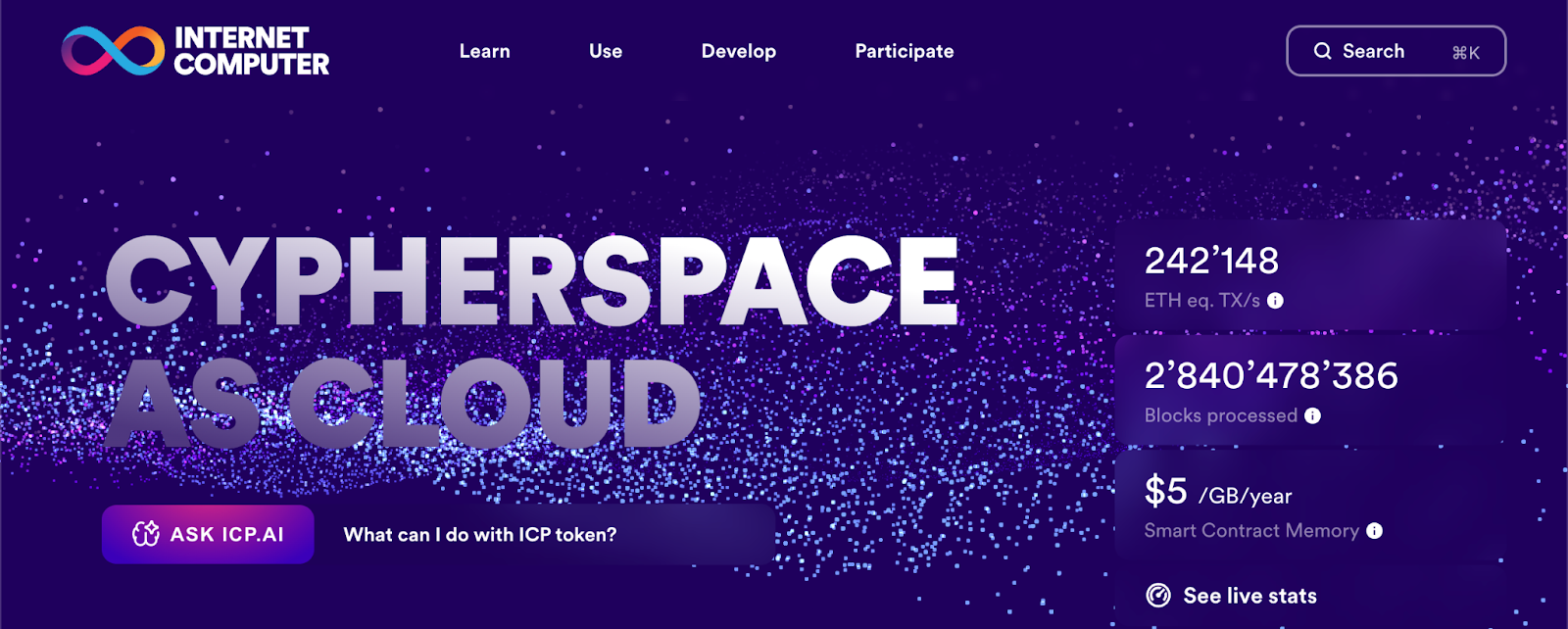
Internet Computer (ICP) is a blockchain-based platform developed by the DFINITY Foundation, designed to expand the capabilities of traditional blockchains by enabling on-chain storage of smart contracts and entire software systems. The platform’s strength lies in its unique consensus mechanism, which enables high transaction throughput and scalability. Its unique selling point (USP) is the ambitious goal of reinventing the Internet by creating a serverless, decentralized cloud computing environment. The ICP token is primarily used to process transactions and smart contracts on the network, reward network participants, and govern the protocol through the Network Nervous System (NNS).
In 2023, the Internet Computer (ICP) ecosystem saw significant advancements that enhanced its decentralized computing capabilities. The integration of WebSockets enabled real-time interaction for applications, while expanded stable memory allowed for more complex applications. Now, Canisters (containers) can make secure HTTPS calls to Web 2.0, broadening smart contract applications. Direct integration with the Bitcoin network has simplified cross-blockchain transactions, eliminating the need for intermediaries.
The Internet Computer ecosystem now supports permissionless token issuance for DAO governance, supported by the Service Nervous System (SNS), which can drive DAO participation. The DFINITY Foundation has continued to fuel growth by granting funding for new services and solutions. Additionally, the rise of community projects and NFTs, including social media platforms and marketplaces, has reflected the ecosystem’s natural innovation and growth.
Related article: Blockchain and AI: Use cases you never heard before
6. Sei (SEI)
- Sei TVL: $10.44 million USD
- SEI Market Capitalization: $1.4 billion USD
- SEI Price Increase (1 year): 7283%
Sei (SEI) is a specialized Layer 1 blockchain designed primarily for DeFi applications, offering a high-speed and efficient environment for financial transactions and trading. The network’s strengths include its focus on optimized order book functionality and an integrated native matching engine, which serves as a unique selling point (USP) by significantly reducing latency and improving the efficiency of decentralized exchanges (DEX) and other financial protocols. The SEI token is used in the ecosystem to pay transaction fees, participate in network governance, and for staking purposes, playing a key role in maintaining and operating the network.
In 2023, the Sei network strengthened its presence in the blockchain and cryptocurrency sector with a series of strategic developments. The Sei Ecosystem Fund increased to $120 million with a $50 million investment from Foresight Ventures to support diverse Web3 applications in NFTs, gaming, and DeFi, following a $30 million fundraising round from various investors. Sei’s growth strategy focuses on penetrating the Asian market, leveraging the region’s technological sophistication, high cryptocurrency adoption rates, and partnerships such as Graviton in India.
On the technological front, Sei has excelled in chain-level optimizations to enhance the performance and scalability of trading applications and decentralized exchanges, making it an attractive choice for developers. Additionally, the Sei Ecosystem Fund supports early-stage founders and teams, promoting innovation and expansion within its ecosystem.
7. Sui (SUI)
- Sui TVL: $488 million USD
- SUI Market Capitalization: $1.8 billion USD
- SUI Price Increase (1 year): -65%
Sui is a new blockchain platform designed for high throughput and scalability, focusing on supporting numerous decentralized applications with fast and efficient performance. The network’s strengths lie in its innovative consensus mechanism and the use of the Move programming language, providing enhanced security and flexibility for developers. These features, combined with its ability to process a high volume of transactions at low costs, serve as the network’s unique selling point (USP). The SUI token is used in the ecosystem to pay transaction fees, participate in network governance, and for other utility purposes as the network grows.
In 2023, the Sui ecosystem expanded significantly with strategic token reallocations to strengthen the community and DeFi applications, redirecting 157 million SUI tokens towards various initiatives. After launching its mainnet and listing on major exchanges, including KuCoin, Sui demonstrated its scalability with a record 65.8 million transactions in a single day and a peak TVL (Total Value Locked) of $188 million, entering the top 10 blockchains based on total value locked (TVL).
The introduction of zkLogin revolutionized user access to dApps with enhanced privacy by utilizing Web 2 social accounts. Additionally, the TurboStar program on the decentralized exchange Turbo was launched to drive ecosystem project growth through fundraising support, awareness enhancement, and presale access while implementing investor protections and offering zero commission fees for Sui projects.
8. Aptos (APT)
- Aptos TVL: $171 million USD
- APT Market Capitalization: $2.9 billion USD
- APT Price Increase (1 year): -45%
Aptos is a Layer 1 blockchain developed with a focus on providing high scalability, reliability, and usability for decentralized applications. A key strength of the network is its use of the Move programming language for secure and flexible smart contract development, and the project’s unique selling point (USP) lies in its highly efficient parallel execution engine, which enhances transaction speed and throughput. The APT token is primarily used for transaction fees on the Aptos network, network governance participation, and staking for network security.
In 2023, the Aptos (APT) ecosystem experienced significant growth, supported by a skilled team and over $400 million in funding from notable investors such as Tiger Global and PayPal Ventures. Aptos’ technological capabilities, highlighted by the Move programming language and parallel execution for scalable transaction processing, contributed to an impressive TVL surpassing $85 million, reflecting growing trust and adoption. Network activity surged, with transactions frequently reaching hundreds of thousands and a sharp increase in new accounts.
Expansion and strategic partnerships enriched the ecosystem: Aptos integrated Sushi to strengthen decentralized financial services, partnered with Coinbase Pay for seamless transactions in the Petra wallet, and ventured into gaming and entertainment with Microsoft, NEOWIZ, MARBLEX, and Lotte Group. Additionally, Aptos introduced a new Digital Asset Standard for real-world applications and upgraded infrastructure with an Indexer for NFT notifications and MSafe’s advanced multi-signature solution features.
9. Polkadot (DOT)
- Polkadot TVL: $162 million USD
- DOT Market Capitalization: $8.5 billion USD
- DOT Price Increase (1 Year): -0.29%
Polkadot is a multi-chain blockchain platform that enables different blockchains to transfer messages and value in a trustless manner, sharing unique features while aggregating security. The platform’s strengths include interoperability, scalable multi-chain architecture, and the connectivity and security of its network of specialized blockchains (parachains). This is the platform’s primary advantage. The DOT token serves several key functions within the Polkadot network, including governance participation, staking for network security, and bonding to connect parachains.
In 2023, the Polkadot (DOT) ecosystem saw a wave of innovation and growth, highlighted by a record 19,090 developer contributions on GitHub in March, enhancing applications and network security. The introduction of parathreads provided a cost-effective model for blockchains, while Next-Generation Scheduling improved the network’s scalability and flexibility.
Polkadot 2.0 was announced, promising upgrades in scalability, governance, and interoperability. Network staking activity increased by 49% with new Nomination Pools, expanding user participation and network security. Notable integrations include Circle’s USDC and the launch of the Rocco Testnet, aimed at optimizing transactions and user experience. The ecosystem also expanded with five new parachains, technological improvements in scalability, and initiatives to attract institutional investors, including services from Zodia Custody.
10. Cosmos (ATOM)
- Cosmos TVL: $1.6 million USD (CosmosHub)
- ATOM Market Capitalization: $3.6 billion USD
- ATOM Price Increase (1 year): -36%
Cosmos is a decentralized network of independent blockchains designed to address scalability and interoperability issues in blockchain technology. The network’s strength lies in its Inter-Blockchain Communication (IBC) protocol, which enables different blockchains to interact and share data while maintaining their sovereignty. This is considered the project’s unique selling point (USP). The ATOM token is primarily used for staking, securing the network, and governance, giving holders a say in decisions about the network’s future.
In 2023, the Cosmos (ATOM) ecosystem saw significant growth with key developments such as the introduction of Interchain Security, enhancing security for smaller blockchains in the network. Cosmos Hub’s online activity surged, averaging 500,000 daily transactions and 20 million ATOM in transaction volume, reflecting its growing popularity. The Theta upgrade introduced Interchain Accounts, enhancing cross-chain interactions, while the Rho upgrade brought Liquid Staking and an NFT module, expanding the network’s functionality.
The Cosmos Hub 2.0 whitepaper outlined a new vision for the Hub and the evolving role of the ATOM token. A $26.4 million allocation from the Interchain Foundation for Interchain Stack development in 2024 and optimistic views from investors like Arthur Cheong, particularly considering dYdX’s migration and Noble’s integration of USDC, indicate promising capital flow and potential for further ecosystem expansion.
Varmeta – Dedicated Blockchain Development Partner for Aptos and Sui
The Varmeta development team has had the privilege of collaborating directly with two renowned Layer 1 blockchains, Aptos and Sui, on high-impact SDK projects. These projects have received praise from leading engineers. Moreover, David- Head of Engineering at Aptos, shared his appreciation:
Varmeta helped us scale our engineering efforts in building the Aptos C++/Unreal SDK. The team built a robust solution that not only leverages proper language styling but is performant and efficient. The success of this collaboration has motivated us to explore continued collaboration with the Varmeta team.
Below are the SDKs developed by Varmeta: