Generative AI chatbots have revolutionized how businesses connect with their audiences, delivering human-like conversations that are reshaping industries like customer service, e-commerce, and beyond. What once felt like science fiction is now a booming reality. By 2023, the global chatbot market had skyrocketed to a value of $5.7 billion, and it’s showing no signs of slowing down, with a projected growth rate of 22.3% annually through 2032. This rapid ascent is fueled by groundbreaking advancements in large language models (LLMs) such as GPT-4 and PaLM 2, enabling these chatbots to provide responses that feel more natural, intuitive, and contextually aware than ever before.
Businesses have quickly caught on, leveraging generative AI chatbots to redefine customer interactions, streamline operations, and even automate sales and marketing strategies. The impact has been staggering: a recent report highlighted that chatbot adoption as a brand communication channel surged by 92% between 2019 and 2020. Back in 2019, only 11% of brands were engaging customers through chatbots, but just a year later, that number had nearly doubled to 25%. This trend underscores the growing recognition of chatbots as essential tools for boosting engagement and efficiency.
In this blog, we’ll dive into the top 5 generative AI chatbots dominating the market today. From their innovative features to their transformative applications across industries, these AI-driven tools are setting the stage for the future of intelligent communication. Whether you’re a business leader, tech enthusiast, or simply curious about the evolution of AI, you’re in the right place. Let’s get started!
What is a Generative AI chatbot?
A generative AI chatbot is an advanced type of artificial intelligence designed to engage in human-like conversations. Unlike traditional chatbots that rely on pre-programmed responses or decision trees, generative AI chatbots use sophisticated machine learning models to create responses on the fly. These chatbots don’t just retrieve information—they generate new, contextually relevant, and often creative replies based on the input they receive.
At the heart of generative AI chatbots are technologies like natural language processing (NLP) and large language models (LLMs), such as GPT (Generative Pre-trained Transformer). These models are trained on massive datasets, enabling them to understand nuances in language, interpret complex queries, and provide meaningful answers. This makes them versatile tools for various applications, from customer service and education to creative content generation and personal assistance.
In simpler terms, generative AI chatbots are conversational systems that think on their feet. Whether you’re asking for restaurant recommendations, troubleshooting a tech issue, or brainstorming ideas, these chatbots can adapt their responses to your specific needs, making interactions more dynamic, engaging, and human-like than ever before.
Key features of a Generative AI chatbot
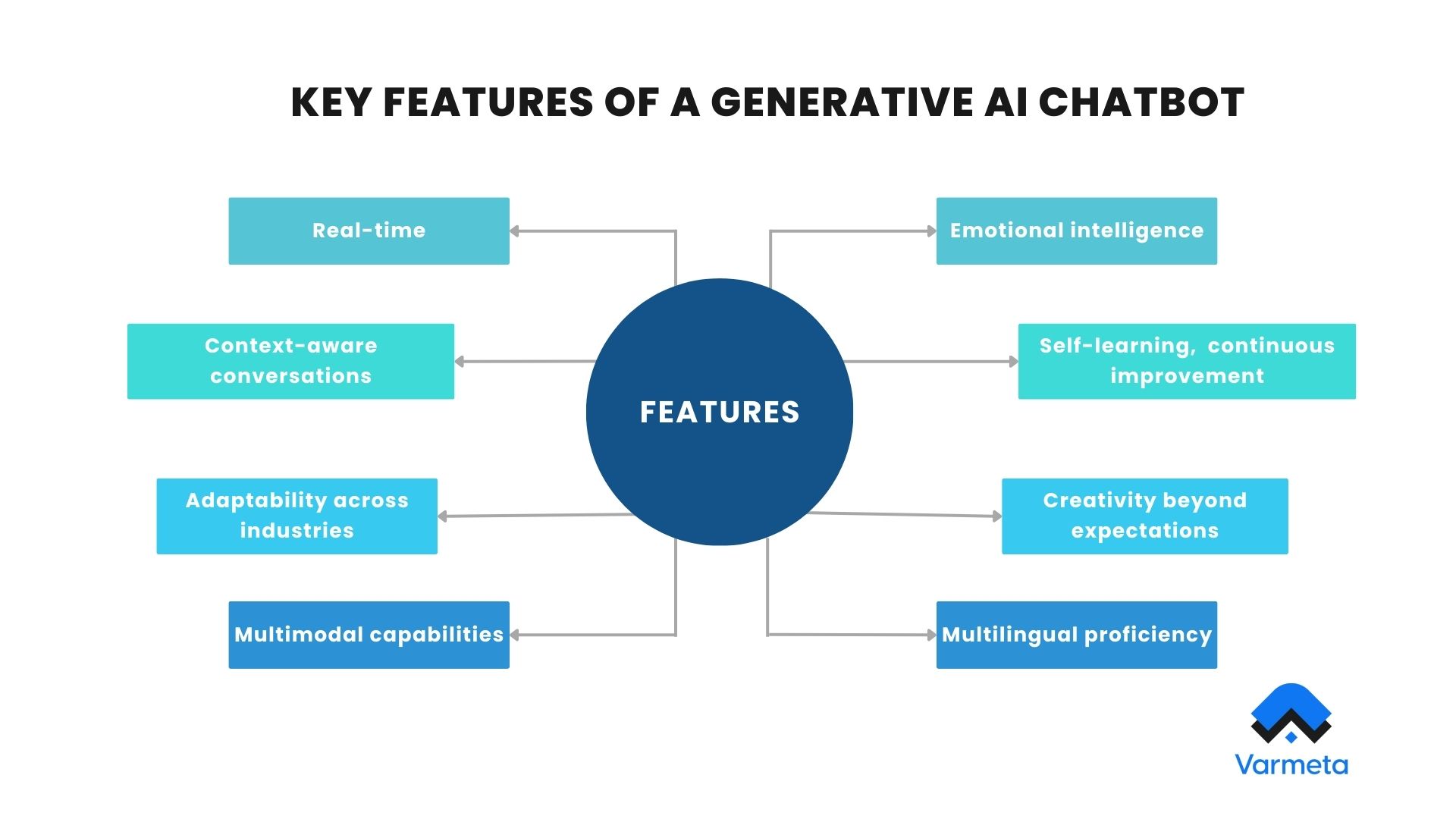
Generative AI chatbots are redefining the way we interact with technology, offering a seamless blend of intelligence, creativity, and adaptability. But what makes them stand out from traditional chatbots? Let’s dive into the standout features that are capturing the attention of users and businesses worldwide.
Real-time, context-aware conversations
Generative AI chatbots don’t just respond, they understand. By analyzing the context of a conversation in real time, they craft responses that feel natural and tailored to the situation. Whether you’re switching topics mid-chat or diving into complex queries, these bots keep up effortlessly.
Imagine this: You ask a chatbot about your flight details, then casually mention you need hotel recommendations. The chatbot doesn’t miss a beat, seamlessly shifting from flight data to suggesting top-rated hotels nearby.
Adaptability across industries
From healthcare to e-commerce, generative AI chatbots are versatile powerhouses. They can be customized for specific industries, offering medical advice, guiding online shoppers, or even assisting developers with coding problems. Their ability to adapt to various use cases makes them invaluable for businesses aiming to enhance customer experiences.
For example: An online store can use a generative AI chatbot to help customers find products, track orders, and even suggest complementary items, just like a personal shopping assistant.
Multimodal capabilities
Generative AI chatbots are no longer confined to text. They can process and generate responses in multiple formats, including voice, images, and even video. This multimodal functionality creates richer, more engaging interactions.
If you ask your chatbot for recipe suggestions, and it not only lists them but also sends you a step-by-step cooking video. That’s more than a chatbot, it’s a digital assistant that speaks your language.
Emotional intelligence
What sets the best chatbots apart is their ability to recognize and respond to human emotions. By analyzing tone, sentiment, and language, they adjust their replies to suit the mood of the conversation. Whether you’re excited, frustrated, or curious, these chatbots strive to respond in a way that feels empathetic and supportive.
For instance: You express frustration about a delayed delivery. Instead of offering a generic reply, the chatbot acknowledges your concern, apologizes sincerely, and promptly offers solutions.
Self-learning and continuous improvement
Generative AI chatbots don’t just rely on what they were initially trained on, they evolve. Using machine learning techniques, they improve over time by analyzing new data, refining their responses, and learning from user interactions. This makes them smarter, faster, and more accurate with each conversation.
A chatbot that gets better at predicting your preferences the more you use it. By your third interaction, it already knows you prefer eco-friendly product options or specific types of recommendations.
Creativity beyond expectations
These chatbots can do more than just answer questions—they can write poems, craft emails, generate marketing copy, and brainstorm ideas. Their ability to think outside the box makes them not just assistants but collaborators in creative processes.
For instance: A marketing team brainstorming for a campaign can use a chatbot to generate catchy taglines, compelling social media captions, or even script ideas for a promotional video.
Multilingual proficiency
In an increasingly globalized world, language barriers are a thing of the past. Generative AI chatbots can communicate fluently in multiple languages, opening doors to a broader audience and ensuring seamless interactions across regions.
You’re running a global e-commerce platform, and your chatbot can handle customer queries in Spanish, Mandarin, and French, all with the same level of expertise.
The magic of generative AI chatbots lies in their ability to blend intelligence, creativity, and adaptability. These features aren’t just technical specifications, they’re what make these chatbots human-like, intuitive, and indispensable for both personal and professional use. Whether you’re a business aiming to transform customer experiences or a user seeking smarter, faster assistance, these capabilities redefine what’s possible in human-AI interaction.
Generative AI chatbots aren’t just tools, they’re partners in a digital age that demands efficiency and personalization.
The influence of AI Chatbots in many different industries
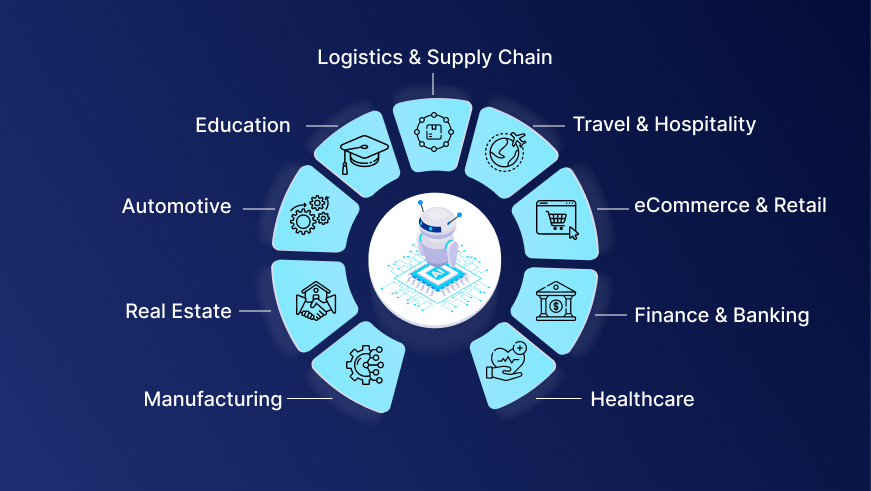
AI chatbots have gone beyond being simple conversational tools to becoming powerful drivers of change across industries. Their ability to understand, respond, and even predict human needs is transforming how businesses engage with customers, employees, and processes. Let’s explore how AI chatbots are reshaping some of the world’s most dynamic industries.
In healthcare: A lifeline for patients and providers
AI chatbots in healthcare are doing more than just answering basic questions. They’re helping patients book appointments, reminding them to take medications, and even offering initial health assessments based on symptoms. Imagine being able to message a chatbot at midnight about a worrying symptom and getting a personalized response that guides you on what to do next, no waiting, no stress.
For providers, these chatbots streamline administrative tasks, freeing up valuable time for medical professionals to focus on care delivery. The result? A system that’s faster, more efficient, and accessible to all.
In retail: Shopping made smarter
Forget browsing endlessly or waiting for customer service to answer your question. Retail chatbots are revolutionizing the shopping experience. They guide customers to exactly what they’re looking for, offer personalized product recommendations, and even assist with secure checkouts.
You’re searching for a new pair of running shoes. The chatbot not only recommends the best options for your style and budget but also throws in a suggestion for moisture-wicking socks and a discount code all in one smooth conversation.
In education: Breaking barriers to learning
Education is no longer confined to classrooms, thanks in part to AI chatbots. These bots act as personal tutors, breaking down complex topics, offering instant feedback, and tailoring learning paths to individual students. They make education more inclusive and accessible, especially for those in remote areas or with limited resources.
For instance, a student preparing for exams can rely on a chatbot to quiz them, explain difficult concepts, or suggest further reading all without the need for a human tutor.
In finance: Simplifying money matters
Managing finances can be overwhelming, but AI chatbots are making it simpler and more transparent. From helping users set budgets to offering tailored investment advice, these bots are reshaping how we interact with money.
Imagine asking your bank’s chatbot for a quick breakdown of your monthly expenses or tips on saving more, and getting an answer within seconds. Its financial literacy made it easy and accessible for everyone.
AI chatbots are not just about saving time, they’re about improving experiences. They bring speed, personalization, and efficiency to industries that desperately need innovation. As they become smarter and more intuitive, their role will only grow, shaping how we interact with businesses, services, and each other in the years to come. The future of work, commerce, and care is here, and AI chatbots are leading the charge.
Criteria for choosing the best generative AI chatbots
Selecting the right generative AI chatbot for your business is about more than just choosing a trendy solution, it’s about finding a tool that aligns with your needs, enhances efficiency, and delivers exceptional user experiences. Here are the most critical factors to consider when evaluating generative AI chatbots:
Accuracy and contextual understanding
The most important quality in a generative AI chatbot is its ability to deliver precise and context-aware responses. Look for chatbots powered by advanced language models that minimize errors, adapt to conversational nuances, and handle complex queries with ease. The best chatbots ensure users feel understood and valued in every interaction.
Seamless integration with existing systems
A chatbot’s effectiveness often depends on how well it integrates with your existing tools and platforms. Whether it’s your CRM, website, or messaging apps, the best chatbots blend effortlessly into your workflow, eliminating silos and improving efficiency across your operations.
Human-like conversational flow
The days of robotic, scripted responses are over. A top-tier generative AI chatbot should mimic human conversation, offering fluid, natural, and engaging interactions. This ensures users remain engaged and feel as though they’re speaking with a knowledgeable assistant rather than a machine.
Scalability to meet growing demands
As your business grows, so will the demands placed on your chatbot. The best generative AI chatbots are built to scale, handling increasing volumes of interactions without sacrificing speed or accuracy. Whether you’re a startup or a global enterprise, scalability is key to sustained success.
Security and privacy first
Trust is non-negotiable. Ensure the chatbot adheres to strict security protocols and complies with data privacy regulations such as GDPR or CCPA. This is especially crucial if your business deals with sensitive information like personal customer data or financial transactions.
By focusing on these core criteria, you can confidently choose a generative AI chatbot that aligns with your business needs, enhances customer engagement, and positions your operations for long-term success. The right chatbot isn’t just a tool, it’s a strategic partner in delivering exceptional experiences and driving growth.
Top 5 Generative AI chatbots to look out for in 2025
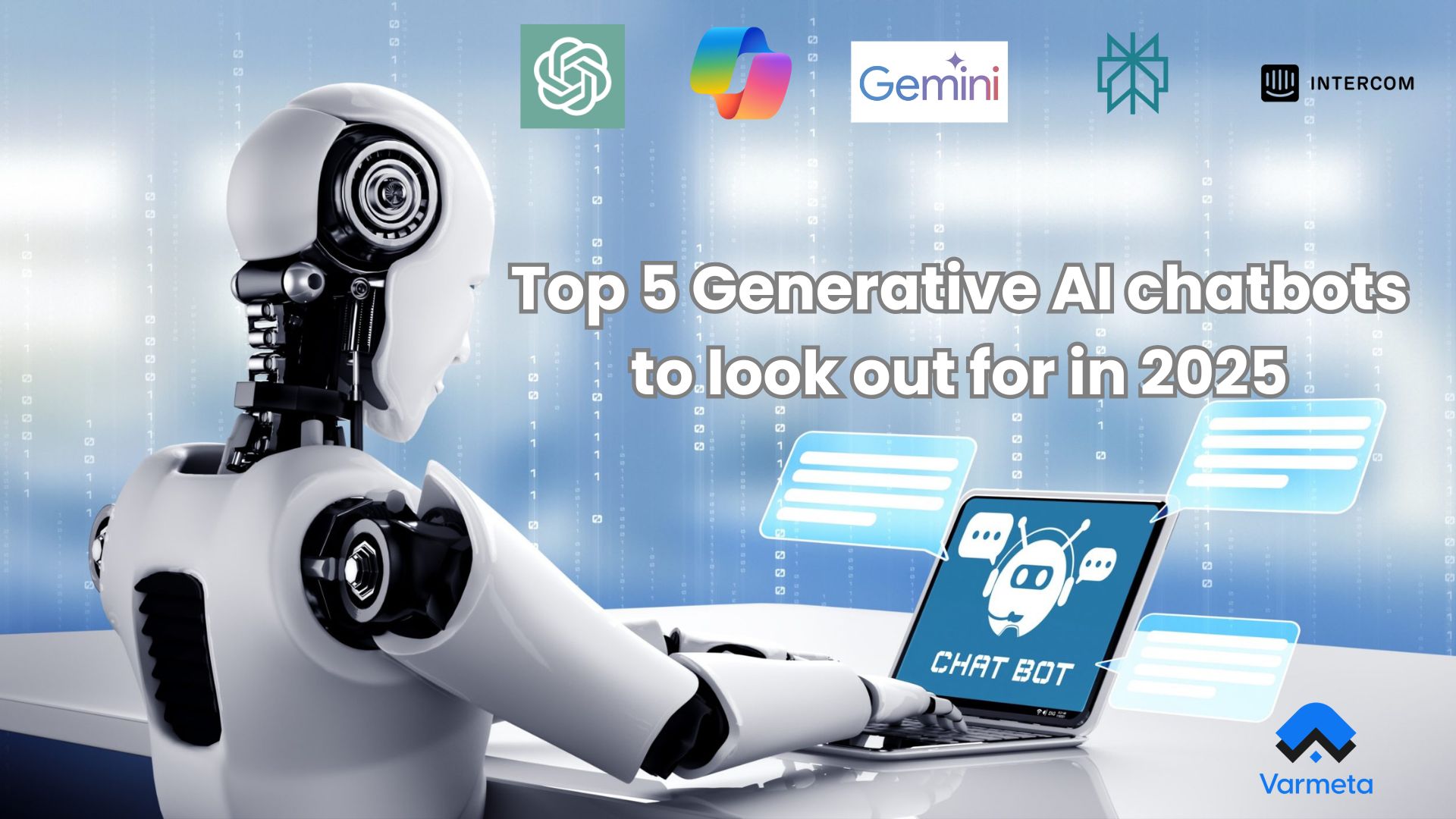
1. ChatGPT by OpenAI
Market share: 59.2%
In 2025, ChatGPT by OpenAI continues to set the standard for generative AI chatbots, solidifying its position as an industry leader. Powered by the robust GPT-4 architecture, ChatGPT is celebrated for its ability to deliver context-aware, high-quality responses, making it an invaluable tool across diverse applications such as customer support, content creation, and personal assistance.
What makes ChatGPT stand out is its versatility and adaptability. It integrates seamlessly with business platforms, supports extensive customization, and offers a highly intuitive API, enabling enterprises to tailor the chatbot to their specific needs. Whether it’s scaling to handle large volumes of interactions or understanding complex queries with precision, ChatGPT excels in delivering a human-like conversational flow that enhances user experience.
Beyond its core capabilities, OpenAI’s commitment to regular updates ensures that ChatGPT stays ahead of the curve, incorporating the latest advancements in AI technology. For businesses seeking a reliable, scalable, and intelligent chatbot solution, ChatGPT remains a top choice in the generative AI space.
2. Microsoft Copilot
Market share: 14.4%
Microsoft Copilot is an AI-driven assistant seamlessly integrated into Microsoft 365 applications, designed to transform productivity and streamline workflows. Powered by GPT-4 and advanced AI algorithms, it provides intelligent support across tools like Word, Excel, PowerPoint, and Outlook, adapting to users’ needs and making complex tasks simpler.
In Word, Copilot drafts documents, generates outlines, and refines content, saving time while enhancing quality. In Excel, it simplifies data analysis by creating formulas and visualizing data through dynamic charts, enabling users to extract insights effortlessly. For PowerPoint, it assists in creating visually compelling presentations with smart design suggestions.
In Outlook, Copilot shines by summarizing lengthy email threads, helping users quickly understand key points and respond efficiently. With its ability to adapt to specific tasks and learn from context, Microsoft Copilot is revolutionizing the way professionals work, enabling smarter, faster, and more effective results.
3. Gemini by Google
Market Share: 13.5%
Gemini by Google emerged as a standout generative AI chatbot, renowned for its ability to handle complex user interactions with remarkable precision. Gemini’s strength lies in its multi-turn conversational capabilities, which enable it to maintain context across lengthy discussions and provide coherent, intelligent responses. This makes it an ideal choice for customer support, knowledge bases, and other interaction-heavy applications.
One of Gemini’s biggest advantages is its seamless integration within Google’s ecosystem. For businesses already leveraging tools like Google Workspace, Cloud Services, or Ads, Gemini becomes a natural extension, enhancing efficiency and streamlining operations.
Gemini also shines in language comprehension and creativity, allowing it to generate not just accurate responses but also engaging, contextually relevant content. Its adaptability makes it easy to scale across different use cases, from e-commerce to education, while its strong customization options allow businesses to tailor the chatbot to their specific needs.
With its advanced AI capabilities, deep integration with Google’s services, and focus on delivering high-quality interactions, Gemini has solidified its reputation as one of the most versatile and powerful generative AI chatbots of 2025.
4. Perplexity AI
Market share: 5.6%
If ChatGPT doesn’t fully meet your needs, Perplexity AI offers a compelling alternative. This advanced conversational search engine uses cutting-edge AI and large language models to deliver precise answers tailored to your queries. Like ChatGPT, it excels at engaging in human-like conversations while interpreting context to fully understand your questions.
What sets Perplexity AI apart is its ability to search across numerous websites and articles, providing not only diverse perspectives but also the most relevant pieces of information. Its emphasis on transparency is another standout feature—answers come with citations and footnotes, allowing you to verify facts and trust the accuracy of the information. For those seeking deeper insights backed by credible sources, Perplexity AI is a reliable and robust option.
5. Intercom
Market share: 2.3%
Intercom stands out as the first truly comprehensive AI-driven customer service platform, offering an all-in-one solution for businesses. Built on a unified AI system, it combines vast datasets and cutting-edge technology to deliver exceptional functionality through three core components:
- AI agent: Available 24/7, it provides customers with instant, accurate answers to their inquiries, ensuring seamless support at all times.
- AI copilot: Designed to assist customer service agents, it enhances productivity by offering real-time suggestions, guidance, and solutions during interactions.
- AI analyst: Empowers business leaders with in-depth insights and actionable recommendations, enabling data-driven decisions that drive success.
This unique integration of AI capabilities makes Intercom an industry leader in redefining customer service excellence.
Conclusion
Generative AI chatbots are reshaping the way we interact with technology, offering intelligent, adaptable, and human-like solutions that address a wide range of needs. From revolutionizing customer service to simplifying workflows and enhancing creativity, these chatbots are leading the industry because of their ability to deliver seamless, context-aware, and scalable experiences.
For businesses, adopting these technologies isn’t just about staying current, it’s about staying ahead. Leveraging generative AI chatbots can streamline operations, improve customer satisfaction, and open doors to new possibilities. For individual users, these chatbots are tools that can simplify daily tasks, provide valuable insights, and even act as creative collaborators.
As we continue to embrace the potential of AI, now is the perfect time to explore these cutting-edge technologies and unlock their value in both professional and personal spheres. The future of innovation is here, don’t miss the opportunity to be a part of it.