Feeling overwhelmed by the endless wave of AI models coming to market this year? You’re not alone.
In 2025, the world of artificial intelligence is moving faster than ever. Every few months, major players like OpenAI, Google, Anthropic, and Meta unveil new models that push the boundaries of what AI can do. But with so many options, each promising better reasoning, broader multimodal capabilities, and faster performance, it’s easy to feel lost in the noise.
If you’re a developer, founder, researcher, or even just AI-curious, knowing which models are worth your time (and budget) is more important than ever. That’s why we’ve created this definitive guide. Below, we explore the ten most influential and widely adopted AI models of 2025, and offer clear guidance on how to choose the right one for your goals.
Whether you’re building apps, generating content, analyzing data, or automating workflows, this guide will help you cut through the complexity and make confident, informed decisions.
Choosing the right AI model in 2025
The global AI market is currently valued at 391 billion dollars and is projected to multiply fivefold by 2030. This explosive growth means more models, more choices, and higher stakes.
Here’s a simple but effective way to assess which model fits your needs.
Define your use case first
Different models shine in different areas. For content creation, language generation tools like GPT-4 or Claude work best. If you’re working with images or need creative visuals, turn to models such as DALL·E or Midjourney. For developers handling large datasets or building code-intensive applications, models like GPT-4.5, Code Llama, or Gemini 2.5 Pro are ideal. And if your goal is to build natural-sounding chatbots or virtual assistants, consider real-time conversational models like GPT-4o or Gemini Advanced.
Evaluate performance and accuracy
Benchmarks such as MMLU, HumanEval, and GSM8K offer insights for technical users. But even for general users, it’s helpful to know which models stand out. GPT-4 remains the most reliable all-rounder. Claude 3.7 is known for its summarization and long-form handling. Gemini 2.5 Pro leads in multilingual processing and coding. For open-source fans, models like Mistral or LLaMA continue to impress in developer circles.
Consider your budget and access
Are you comfortable with subscription services? ChatGPT Plus, which offers GPT-4 access, costs around 20 dollars per month. Claude Pro and Gemini Advanced fall within similar ranges. If you’re integrating models via API, compare per-token costs and check for regional payment support, especially for startups based in India, Southeast Asia, or LATAM.
Align with your technical requirements
Some projects demand long-context memory, especially those involving legal documents, research papers, or full books. In that case, models like Claude 3.7 Sonnet or Gemini 2.5 Pro are more suitable. If you want access to tools like image analysis, real-time voice input, or code interpretation, GPT-4o is the clear leader. And if you’re building in-house AI tools or want control over hosting, open-source models such as LLaMA, DeepSeek, or Mistral are solid choices.
Top popular and powerful AI models you should know in 2025
1. GPT-4o by OpenAI

Launched in May 2024, GPT-4o is the most advanced and user-friendly model OpenAI has ever released. It combines text, audio, and image capabilities into a single, unified interface, delivering results with near-instantaneous response times. GPT-4o can speak, see, understand, and respond in real time across more than 50 languages.
It is ideal for real time applications like voice assistants, accessibility tools, customer service bots, and cross-language communication. GPT-4o’s ability to process visuals and audio, all while maintaining a conversational tone, makes it one of the most versatile AI tools available today.
2. Gemini 2.5 Pro by Google DeepMind
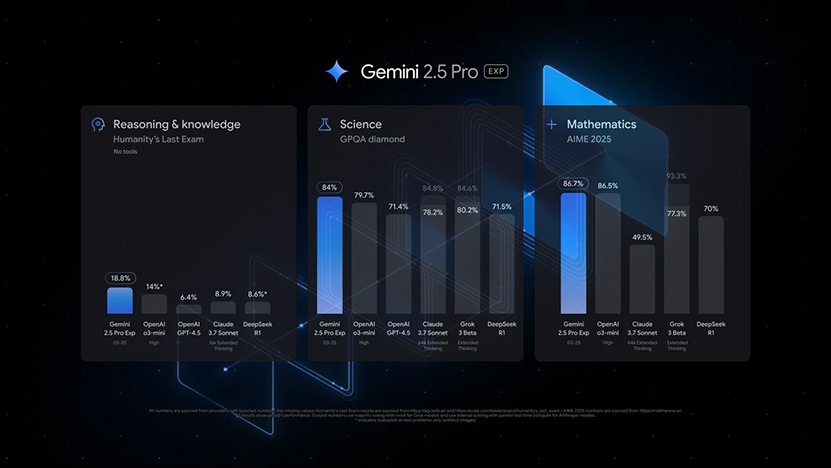
Gemini 2.5 Pro is Google’s flagship AI model in 2025. It is designed to handle complex workflows that combine reasoning, programming, text generation, and multimodal inputs. Built for advanced enterprise applications, Gemini 2.5 Pro is deeply integrated with Google Workspace, Android, and ChromeOS ecosystems.
With enhanced coding performance, support for one million token context windows, and seamless handling of structured data, Gemini 2.5 Pro is particularly valuable for developers, data teams, and multilingual global organizations.
3. Claude 3.7 Sonnet by Anthropic

Positioned as a high-performance yet cost-effective option in Anthropic’s Claude 3.5 series, Claude 3.7 Sonnet strikes an impressive balance between depth and affordability. It handles long-context tasks with a token window of up to 200,000 and shows significant improvements in visual reasoning and document comprehension.
This model excels in environments that require advanced reasoning, such as legal tech, academic research, enterprise knowledge management, and complex logistics or retail analysis.
4. DeepSeek-R1 by DeepSeek AI

Developed by a Chinese startup, DeepSeek-R1 is a rising star in the open-source AI ecosystem. Built with a focus on logic, multilingual capabilities, and affordability, it has gained global attention, even earning praise from Microsoft’s leadership for its remarkable performance-to-cost ratio.
It is especially popular among developers building custom applications with limited budgets or those working across Chinese, English, and other Asian language markets.
5. OpenAI o1

OpenAI’s O1 model is engineered for deeper, slower, and more structured reasoning. It’s not just about fast answers, it’s about right answers. This model uses chain-of-thought reasoning techniques, breaking down problems step by step in a way that feels both human and logical.
Ideal for mathematics, programming, and scientific research, O1 is also known for its enhanced safety alignment, making it a secure choice for enterprise environments where reliability and interpretability are critical.
6. OpenAI o3-mini

O3-mini is a compact, efficient version of OpenAI’s more powerful models, designed to deliver fast results while maintaining high reasoning ability. What makes it unique is its ability to adapt the depth of reasoning based on user preference, making it flexible for both lightweight and advanced tasks.
This model is often used in education, engineering, and mid-sized applications where cost-efficiency and speed are priorities, but reasoning accuracy cannot be compromised.
7. Meta AI (Llama Series)
Meta’s LLaMA 3 series continues to push the envelope in open-source AI. Designed to be fine-tuned or deployed as-is, LLaMA models are highly optimized for speed, efficiency, and custom deployment on cloud, edge, or local servers.
These models are favored by AI startups, researchers, and developers who want full control over their systems without vendor lock-in, while still achieving performance comparable to closed commercial models.
8. Gemini 1.5 Pro
While Gemini 2.5 Pro is the latest version, Gemini 1.5 Pro remains highly relevant due to its exceptional ability to handle long documents, complex media, and detailed instructions. Its one million token context window is a game-changer for use cases like summarizing entire codebases or analyzing enterprise-scale documents.
It is often deployed in compliance, finance, and technical writing teams that need depth, clarity, and memory in one place.
9. BERT by Google
BERT, despite being one of the oldest models on this list, continues to power a wide range of natural language processing tools across industries. Its bidirectional architecture enables deeper understanding of word relationships, which is essential in applications like legal contracts, search engine optimization, and sentiment analysis.
BERT’s simplicity, reliability, and strong community support make it a foundational tool in many production AI pipelines.
10. PaLM 2
PaLM 2 may not be as advanced as Gemini, but it still holds its ground as a lightweight and multilingual AI solution. Often embedded within Google’s older AI tools like Bard and Workspace assistants, PaLM 2 supports over 100 languages and offers a streamlined way to automate Q&A, summaries, and translation tasks.
Its speed and compatibility with enterprise ecosystems make it a practical choice for business users and product teams alike.
Conclusion
AI in 2025 is a foundational layer of digital business, product design, and knowledge work. But choosing the right model requires more than hype-following. It demands alignment with your technical goals, your audience, and your internal capabilities.
There’s no one-size-fits-all model. GPT-4o may be perfect for real-time assistants, but Gemini 2.5 Pro might be your go-to for multilingual dev workflows. Claude could transform how your research team summarizes reports, while LLaMA might empower your engineering team to fine-tune without cloud dependency.
At Varmeta, we help organizations navigate this complexity. Whether you’re looking to prototype, integrate, or fine-tune an AI model for your business, our team brings the strategy, technical depth, and product vision to help you succeed in the age of intelligent software.
Varmeta – Excellent in every block
Website: var-meta.com
Linkedln: https://www.linkedin.com/company/var-meta/