Generative AI is revolutionizing finance by automating tasks, enhancing decision-making, and driving efficiency. By leveraging vast financial data, AI streamlines operations, accelerates compliance checks, and reduces manual effort. McKinsey & Company estimates it could add $200–$340 billion annually to global banking, making it a game-changer.
Beyond automation, generative AI enables personalized financial insights, helping clients make smarter decisions. It also simplifies data integration, unifying transactional records and customer interactions into seamless workflows. This empowers finance teams to act with precision, agility, and stronger client engagement.
Generative AI in finance: A new era of innovation

Generative AI is redefining finance, driving growth, efficiency, and risk management through automation and data-driven decision-making. Financial leaders recognize its potential to streamline operations, enhance profitability, and improve investment strategies by analyzing complex data in real time.
One of GenAI’s biggest advantages is task automation, freeing finance professionals to focus on strategy and high-value decisions. It also personalizes financial services, delivering tailored solutions that boost customer satisfaction and loyalty at scale.
GenAI transforms profitability and risk management by enabling AI-driven financial analysis, error reduction, and real-time compliance monitoring. Traditional manual audits are being replaced by dynamic, AI-powered risk assessments, ensuring better governance, fraud prevention, and regulatory adherence.
By integrating GenAI, financial institutions gain a competitive edge, maximize operational effectiveness, and adapt to the rapidly evolving financial landscape.
The evolving role of generative AI in financial services
Generative AI is revolutionizing financial services, enhancing efficiency, customer engagement, and fraud prevention. Financial institutions are rapidly adopting AI-driven solutions to streamline operations and gain a competitive edge.
- Operational efficiency: A 75% boost in productivity, a 60% improvement in customer experience, and a 54% reduction in costs highlight AI’s transformative impact. Nearly half of senior executives expect moderate short-term gains, with adoption accelerating across the industry.
- Fraud prevention & compliance: AI-driven fraud detection is used by 13% of institutions, strengthening security and streamlining KYC, compliance reporting, and document automation.
- Adoption trends & future impact: 78% of financial firms are integrating generative AI, with 61% predicting significant value chain disruptions. Full-scale automation is expected within the next 5–10 years.
- Challenges in implementation: Identifying the most effective AI use cases remains a challenge. Institutions must focus on strategic integration to maximize AI’s potential.
As generative AI reshapes the financial sector, firms must navigate adoption hurdles while leveraging AI’s power to drive efficiency, security, and innovation.
Integrating generative AI into financial operations: Key approaches

Financial institutions can integrate Generative AI into their operations through three strategic approaches, each offering unique benefits based on their objectives, resources, and long-term vision. The right choice depends on the level of control, customization, and scalability an organization requires.
1. Building a custom in-house AI solution
This approach involves developing a proprietary Generative AI system or customizing existing AI models to fit specific financial needs. It provides full control over AI development, deployment, and compliance while ensuring seamless integration into an institution’s ecosystem.
Advantages:
- Tailored to business needs: AI solutions can be customized for compliance, fraud detection, customer service, and risk management.
- Data privacy & control: Full ownership of financial data ensures regulatory compliance and enhanced security.
- Optimized for performance: AI can enhance credit scoring, portfolio management, and automated financial forecasting.
- Competitive differentiation: Proprietary AI solutions provide a unique market advantage, making them harder to replicate.
2. Implementing AI-powered point solutions
Point solutions are ready-to-use AI tools designed for specific financial tasks, such as automating regulatory reporting, fraud detection, or managing AI-driven customer interactions. These solutions leverage pre-trained AI models, offering fast deployment with minimal development effort.
Advantages:
- Quick integration: Point solutions can be implemented rapidly within existing financial systems.
- Cost-effective: Requires lower investment compared to developing custom AI infrastructure.
- Focused on key challenges: Ideal for automating repetitive processes, such as document processing and chatbot-powered customer service.
- User-friendly: Minimal AI expertise required, making adoption easier for institutions with limited technical resources.
3. Adopting a comprehensive generative AI platform
A full-stack AI platform, provides an all-in-one solution that integrates data processing, model training, deployment, and compliance management within a single system.
Advantages:
- All-in-one solution: Offers tools for data preparation, AI deployment, and workflow automation.
- Scalable & flexible: Easily adapts to business growth and evolving AI needs.
- Faster deployment: Pre-built AI models accelerate the implementation of AI-driven processes.
- Strong compliance & security: Ensures enterprise-grade data protection and adherence to regulatory standards.
- Seamless data integration: Connects multiple financial data sources, ensuring accuracy in AI-driven insights.
As financial institutions embrace Generative AI, selecting the right approach ensures innovation, efficiency, and regulatory compliance, driving long-term value in the evolving financial landscape.
Key use cases of generative AI in finance

Generative AI is transforming financial services, making processes faster, more secure, and highly efficient. From automating operations to personalizing customer experiences, AI-driven solutions are redefining the way financial institutions analyze data, detect fraud, and optimize investments. Here’s how AI is making a significant impact in finance:
1. Automating financial operations
Manual financial processes slow down operations, increase errors, and demand extensive resources. AI-driven automation streamlines workflows, ensuring speed, accuracy, and cost efficiency:
- Smart data processing & reconciliation: AI quickly processes and reconciles large volumes of financial transactions, reducing manual intervention.
- Real-time fraud detection & monitoring: AI continuously scans transactions for anomalies and suspicious patterns, minimizing fraud risks.
- AI-driven audit & compliance automation: AI simplifies regulatory audits by automating document analysis and compliance checks.
2. AI in risk management & fraud prevention
AI is reshaping risk management, enabling financial institutions to detect fraud in real-time, assess risks, and prevent financial crimes.
- AI-powered fraud detection: Identifies unusual spending behavior and flags potential fraud before it happens.
- Anti-money laundering (AML) & cybersecurity: AI strengthens security by detecting complex fraud schemes and cyber threats.
- Predictive risk modeling: AI assesses creditworthiness and lending risks, helping banks make smarter loan decisions.
3. Personalized banking & customer service
AI is redefining customer engagement by offering hyper-personalized financial experiences.
- AI-powered chatbots & virtual financial advisors: Instantly assist customers with account management, payments, and investment guidance.
- Smart financial recommendations: AI suggests customized financial plans, budgeting tips, and investment opportunities.
- Automated wealth management: Robo-advisors analyze market trends and manage investment portfolios with minimal human intervention.
4. AI in trading & investment strategies
AI is revolutionizing the stock market, helping investors optimize portfolios and predict trends with greater accuracy.
- Algorithmic trading & market predictions: AI analyzes historical data and real-time trends, making high-speed trading more profitable.
- Portfolio optimization & risk management: AI balances investments for maximum returns while minimizing risk.
- AI-driven investment advisory (Robo-Advisors): Smart AI tools guide investors with automated, data-driven strategies.
5. Enhancing regulatory compliance & governance
Financial regulations are complex and ever-changing, making compliance a major challenge. AI simplifies and strengthens governance by ensuring real-time compliance monitoring.
- Automated KYC & AML compliance: AI verifies customer identities and detects suspicious activities in financial transactions.
- AI-powered regulatory reporting: AI compiles and submits accurate compliance reports, reducing manual workload.
- Risk & policy assessment: AI helps organizations stay ahead of regulatory changes and adapt in real-time.
Generative AI is reshaping the financial sector, driving efficiency, security, and innovation. From automating financial operations to enhancing fraud prevention, investment strategies, and compliance, AI is revolutionizing how financial institutions operate.
As AI technology advances, financial organizations that embrace AI-driven solutions will gain a competitive advantage, offering smarter, faster, and more secure financial services.
Key challenges and considerations in adopting generative AI for financial services
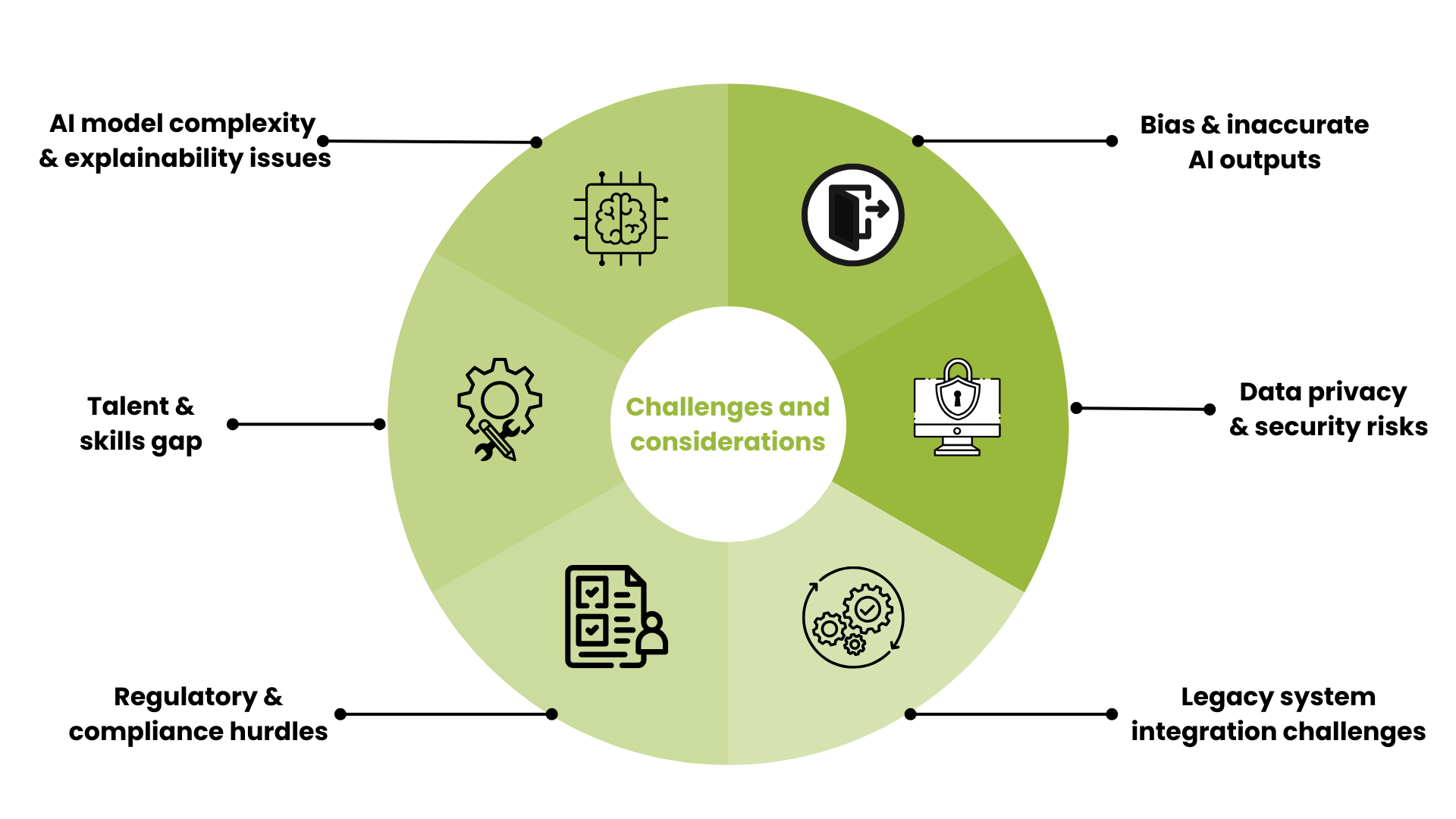 The integration of Generative AI in financial services promises greater efficiency, enhanced customer experiences, and innovative solutions. However, this transformation comes with significant challenges that financial institutions must navigate to ensure secure, compliant, and effective AI implementation.
1. Data privacy & security risks
Financial AI systems process vast amounts of sensitive data, making cybersecurity and privacy protection top priorities. The risks of data breaches, unauthorized access, and regulatory non-compliance can have severe consequences.
Key considerations:
- Implement robust encryption, secure data storage, and AI governance frameworks.
- Ensure compliance with GDPR, Anti-Money Laundering (AML) laws, and financial data protection regulations.
- Regularly audit AI models to detect and prevent security vulnerabilities.
2. Regulatory & compliance hurdles
AI regulations in finance are evolving, and compliance requirements often lag behind technological advancements. This creates uncertainty, as institutions struggle to align AI-driven operations with existing legal frameworks.
Key considerations:
- Develop adaptive AI compliance frameworks that can quickly adjust to regulatory updates.
- Engage with regulatory bodies and legal experts to ensure AI applications meet compliance standards.
- Implement AI models that support transparent reporting and auditability for regulatory oversight.
3. AI model complexity & explainability issues
Many Generative AI models operate as “black boxes”, making it difficult for finance professionals to understand how AI decisions are made. This lack of transparency reduces trust and complicates regulatory compliance.
Key considerations:
- Use explainable AI (XAI) models that provide clear reasoning behind AI-generated outputs.
- Implement model validation frameworks to ensure AI-driven decisions align with ethical and financial guidelines.
- Provide stakeholders with interpretable AI insights to increase confidence and usability.
4. Talent & skills gap
The financial industry faces a shortage of AI-skilled professionals, making it challenging to develop, implement, and maintain AI-powered solutions effectively.
Key considerations:
- Invest in AI training programs for finance professionals to bridge the knowledge gap.
- Hire or partner with AI and data science experts to oversee AI deployment and performance.
- Foster collaboration between financial analysts and AI specialists to optimize AI-human interactions.
5. Bias & inaccurate AI outputs
Generative AI models can inherit biases from training data, leading to discriminatory lending decisions, flawed risk assessments, or misleading financial advice. Additionally, AI may produce hallucinations, inaccurate or misleading information.
Key considerations:
- Regularly audit AI models for bias and fairness in decision-making.
- Use diverse, high-quality training datasets to minimize discriminatory patterns.
- Establish human oversight to validate AI-generated insights before financial decisions are made.
6. Legacy system integration challenges
Many financial institutions still rely on outdated legacy systems, making AI integration complex. Incompatible data formats and infrastructure limitations can slow down AI adoption.
Key considerations:
- Implement API-driven AI models that can interact with legacy systems without disrupting operations.
- Upgrade data architecture to enable seamless AI-driven analytics and automation.
- Use hybrid AI solutions that can work alongside existing financial technologies while enabling gradual modernization.
Despite these hurdles, proactive planning, robust compliance frameworks, and strategic AI deployment can help financial institutions harness the full potential of Generative AI. By addressing these challenges head-on, firms can:
- Enhance data security and compliance while mitigating risks.
- Improve AI transparency and decision-making accountability.
- Close the skills gap through training and expert collaboration.
- Minimize bias and errors for ethical AI-driven financial services.
- Ensure smooth AI adoption within legacy financial infrastructures.
As Generative AI continues to evolve, financial institutions that prioritize responsible AI integration will gain a competitive edge, unlocking smarter automation, better customer experiences, and stronger risk management in the digital finance landscape.
Conclusion
Generative AI is transforming finance, driving efficiency, security, and innovation across operations, risk management, customer service, and regulatory compliance. Financial institutions that strategically integrate AI will gain a competitive edge, enhance decision-making, and future-proof their services. While challenges like data security, compliance, and AI transparency remain, proactive planning and responsible AI deployment will unlock long-term value. As AI technology evolves, embracing it will be crucial for financial institutions to stay ahead in a rapidly changing industry.