Blockchain is a form of distributed ledger technology that records transactions across multiple connected computers, instead of storing everything in one central database. What that means for you is simple: once a transaction is verified and added to the chain, it becomes extremely difficult to change because the data is shared across a peer-to-peer network.
You will generally come across four primary categories of blockchain networks, which are Public, Private, Hybrid, and Consortium. These represent the main blockchain categories that businesses evaluate when deciding which type of blockchain will fit their goals. Each model handles governance, transparency, scalibitiy and security differently. While blockchain first gained attention through Bitcoin in 2009, it is not used in supply chain systems, healthcare data management, banking, or digital identity solutions.
If you are choosing a type of blockchain for a specific use, it affects who can access the network, who validates transactions, how the system performs under load, and how regularly requirements are handled. That is what Varmeta will explain in this article, so you can understand the right type of blockchain to use and why.
What Is Blockchain? Foundational Concepts for Beginners
Before you compare different blockchain network types, it helps to understand the technical foundation they all share. For example, governance rules might change from one type of blockchain to another, but the core mechanics stay the same.
A Blockchain Is a Type of Distributed Ledger
As mentioned above, at its simplest level, blockchain is a type of distributed ledger. This means that it is a shared database that is copied and synced across multiple computers so that no single party controls the record. Here, the data is organized into blocks that are cryptographically linked to one another. This is what separates blockchain from other types of distributed ledgers that do not rely on a chained block architecture. Each block contains transaction data, a timestamp, and the hash of the previous block, which makes changing historical records difficult without rewriting the chain.

When a transaction is created, it is encrypted, broadcast to the network, verified through a consensus mechanism, grouped into a block, and then permanently added to the ledger. The exact consensus model depends on the type of blockchain being used, as Proof of Work, Proof of Stake, and Byzantine Fault Tolerance systems validate transactions differently.
The network itself is maintained by different types of blockchain nodes, too. Full nodes store complete copies of the ledger and independently verify transactions; light nodes rely on full nodes for validation. Then, validator or mining nodes participate directly in consensus. Therefore, how these nodes are structured influences security, performance, and decentralization.
Blockchain Architecture Basics
Blockchain architecture defines how data moves across the network, how permissions are assigned, and how applications interact with the ledger. These architectural decisions align closely with the selected type of blockchain and reflect broader types of blockchain architecture used in practice. Public, permissioned, and hybrid blockchain architecture models, including hybrid blockchain technology, impact governance control, scalability limitations, and compliance requirements.
The 4 Types of Blockchain Networks Explained
Once you understand the basics, comparing the four main type of blockchain becomes much clearer, since each one is designed to meet different operational needs.
| Type | Access & participation | Key characteristics & strengths | Typical use cases |
| Public | Open to anyone (permissionless) | Fully decentralized, high transparency, strong security through consensus, no single point of control | Cryptocurrencies (Bitcoin, Ethereum), DeFi, NFTs, public ledgers |
| Private | Restricted to authorized users only | Centralized control, high privacy, fast transactions, easier governance | Internal enterprise systems, supply chain tracking, asset management within one organization |
| Consortium (Federated) | Limited to a group of pre-approved organizations | Semi-decentralized, collaborative governance, balances speed/privacy with shared trust | Banking consortia, industry alliances (e.g., trade finance, healthcare networks), B2B collaborations |
| Hybrid | Combines public + private elements | Flexible: sensitive data stays private while selected parts are public/transparent | Real-world applications needing both privacy & verifiability (e.g., government records, hybrid supply chains) |
Public Blockchain (Open and Permissionless)
Public blockchain networks operate as fully open systems. Anyone with internet access can join the network, validate transactions, and view records. Bitcoin and Ethereum are the most recognized examples of this type of blockchain.
Because participation is unrestricted, public blockchains eliminate reliance on central authorities. Transactions are validated through consensus algorithms such as Proof of Work or Proof of Stake. Additionally, the source code is typically open source, allowing independent verification across various types of crypto networks built on public infrastructure. Public blockchains provide network transparency and independence from single organizations. Even if the founding entity ceases operations, the network can continue as long as nodes remain active.
However, openness introduces trade-offs. While public blockchains offer strong transparency and democratic governance, they also face scalability constraints due to large node participation. They may be exposed to potential 51% attacks if a majority of validation power becomes centralized. Furthermore, Proof of Work systems can consume substantial energy.
Despite these limitations, public blockchains are widely used for cryptocurrency mining, digital asset exchange, NFTs, and decentralized finance applications. Their strength lies in public verifiability and censorship resistance.
Private Blockchain (Permissioned Blockchain)
In contrast to public systems, private blockchain networks restrict participation. This type of blockchain is commonly adopted in enterprise environments where controlled access is required. Access is granted only to approved participants, and governance is controlled by a single organization or defined authority group.
Although private blockchains maintain distributed data structures, validation is handled by selected nodes. Platforms such as Hyperledger Fabric and R3 Corda exemplify this model, and some implementations are described as a semi-private blockchain when limited external partners are permitted controlled participation.
Because the network is smaller and permissioned, private blockchains typically achieve faster transaction speeds and greater scalability. In addition, organizations can define access levels and enforce compliance controls.
At the same time, reduced decentralization introduces concerns. With fewer nodes, security resilience depends heavily on the governing organization. Source code may be proprietary, limiting independent audits. For this reason, a private blockchain is a decentralized type of blockchain in terms of distributed data storage, but centralized in governance.
Nevertheless, private blockchain networks are highly effective for healthcare record management, financial settlement systems, asset tracking, and enterprise supply chains.
Consortium Blockchain (Federated Model)
While private blockchains concentrate authority within one organization, consortium blockchains distribute governance across multiple entities. This type of blockchain represents one of the different kinds structures designed for shared enterprise control. In this model, predefined organizations share validation responsibilities.
Consensus procedures are handled by selected validator nodes representing participating members. As a result, no single entity controls the entire system. Compared to private blockchains, consortium networks offer stronger distributed trust. Compared to public blockchains, they provide controlled access and predictable performance. However, implementation requires coordination among members, which can increase governance complexity.
Consortium blockchains are commonly used in banking consortia, trade finance platforms, and multi-organization supply chain ecosystems where shared infrastructure is beneficial, offering practical blockchain types and examples for collaborative governance models.

Hybrid Blockchain (Combination Model)
A hybrid blockchain networks combine characteristics of public and private systems. They allow organizations to maintain private control over sensitive data while leveraging public verification when necessary. In practice, certain records remain confidential within the private layer, while selected transaction proofs may be anchored to a public blockchain. This approach balances transparency with confidentiality.
Hybrid blockchain architecture can reduce exposure to 51% attacks while maintaining scalable performance. However, integration complexity increases because two governance layers must be synchronized. Industries such as financial services, retail, and real estate frequently explore hybrid models to align regulatory compliance with public trust.
Real-World Examples of Blockchain Network Types
It is one thing to describe a type of blockchain in theory, but it becomes much clearer when you look at how real organizations use different blockchain network types in practice.
Bitcoin and Ethereum (Public Blockchain)
Bitcoin is the clearest example of a fully public and permissionless blockchain. Anyone can join the network, verify transactions or operate a node. Ethereum builds on this public infrastructure by adding smart contracts and decentralized applications. Together, they show how public types of blockchain networks power cryptocurrency systems, decentralized finance platforms and NFT marketplaces without depending on a central authority.
IBM Food Trust and Walmart (Private Blockchain)
In enterprise settings, governance and controlled access matter more than open participation. IBM Food Trust, built on Hyperledger Fabric, is a strong example of a private blockchain use. It allows supply chain participants to share data securely while restricting access to approved members. Walmart has reported reducing food traceability from days to seconds using this infrastructure. This is a practical demonstration of how a private blockchain prioritizes compliance, accountability, and operational speed.
R3 Corda (Consortium Blockchain)
R3 Corda represents a consortium approach. Instead of one organization controlling the system, multiple financial institutions share validation authority. The model is common in trade finance and banking, where collaboration is necessary but full public access is not acceptable.
Hybrid Identity and Real Estate Platforms (Hybrid Blockchain)
Some industries require both privacy and public verification. Hybrid blockchain architectures allow companies to keep sensitive records private while anchoring selected proofs to a public chain. Digital identity and real estate platforms often explore this structure to balance regulatory requirements with transparency.
Blockchain Categories Beyond Network Structure
When people evaluate a type of blockchain, they usually focus on governance and access control first. However, blockchain ecosystems differ in more ways than participation rules. The platform you choose, the way tokens are structured, and how nodes are configured, all influence how the system behaves in practice.
Types of Blockchain Platforms
Each type of blockchain platform is built with different priorities in mind. Ethereum has become the standard for smart contracts and decentralized applications because of its mature developer ecosystem. Then, Binance Smart Chain attracts projects looking for lower transaction costs. Hyperledger is designed for enterprise environments where permissioned access, compliance and governance matter. Solana emphasizes high throughput and performance efficiency, while Polkadot focuses on interoperability between separate chains.
Choosing among these type of blockchain platforms is less about popularity and more about alignment. The platform should match your selected type of blockchain and support the operational goals you are trying to achieve..
Types of Blockchain Tokens
Token designs also impact how a blockchain operates. Instead of existing in isolation, tokens create the economic layer of the network. For example, utility tokens typically provide access to services or applications, security tokens represent ownership stakes or financial interests tied to underlying assets, governance tokens allow holders to participate in protocol decisions, and stablecoins are designed to reduce price volatility by linking their value to external reserves or currencies.
Standards such as ERC-20, ERC-721, and ERC-115 establish the technical rules that determine how these tokens operate within Ethereum-based ecosystems. These standards shape how tokens are issued, transferred, and integrated into applications, ultimately influencing incentives, liquidity, and overall network behavior.
Types of Blockchain Nodes Explained
If you want to understand how decentralized a blockchain really is, you have to look at its nodes. Node configuration is what determines how control is distributed across different type of blockchain networks. The various nodes each carry specific responsibilities, and how they are spread across the network cirectly influences performance, resilience and governance.
Full Nodes
Full nodes store a complete copy of the blockchain ledger and independently verify all transactions and blocks according to protocol rules. Because they maintain the entire transaction history, full nodes strengthen network integrity and reduce reliance on other participants for validation.
Light Nodes
Light nodes, sometimes called lightweight clients, store only partial blockchain data and rely on full nodes to retrieve detailed information. They enable faster synchronization and reduced storage requirements, making them suitable for resource-constrained devices.
Validator or Mining Nodes
Validator nodes, or mining nodes in Proof of Work systems, participate directly in consensus by validating transactions and adding new blocks to the chain. Their role is central to network security and block production.
Master Nodes
Master nodes perform specialized functions such as transaction routing, governance participation, or enhanced service features, depending on the blockchain protocol.
The configuration and distribution of these types of blockchain nodes determine decentralization levels, throughput capacity, and overall network stability.
Types of Blockchain Applications in Industry
The way blockchain is applied in industry often depends on the type of blockchain being used and the governance model behind it. In financial services, for example, blockchain supports cross-border payments, settlement systems, and decentralized finance platforms where transaction transparency and immutability are important.
In supply chain environments, it is used to improve traceability and reduce fraud by creating shared, tamper-resistant records of product movement. Healthcare organizations rely on permissioned networks to exchange patient data while maintaining regulatory compliance. Similarly, real estate platforms explore tokenized ownership structures to simplify transfers and fractionalize assets. Finally, NFT marketplaces use blockchain to authenticate digital assets and establish verifiable ownership.
A practical example comes from Walmart’s collaboration with IBM Foods Trust, where blockchain-based tracing reduced the time required to track food products from days to seconds. That result illustrates how blockchain applications can move beyond theory and deliver measurable operational impact.
How to Choose the Right Type of Blockchain Network
Given these variations, selecting a blockchain network requires structured evaluation rather than assumptions. The decision should follow a clear assessment process:
- Assess regulatory constraints: Determine whether industry laws require data privacy, auditability, or restricted participation.
- Evaluate data sensitivity: Identify whether the information stored on-chain must remain confidential or can be publicly visible.
- Analyze transaction volume and scalability needs: Estimate expected throughput and network growth requirements.
- Define governance structure: Decide whether control should remain with one organization, a consortium of entities, or an open network.
- Calculate infrastructure and operational costs: Consider node hosting, maintenance, security audits, and long-term scaling expenses.
- Align with trust and transparency objectives: Public networks support transparency-driven ecosystems. Private networks suit internal enterprise systems. Consortium models serve collaborative industries. Hybrid networks balance compliance with public verification.
Ultimately, the chosen type of blockchain network must align with operational goals, risk tolerance, and long-term scalability planning.
Blockchain Implementation Process in Industry
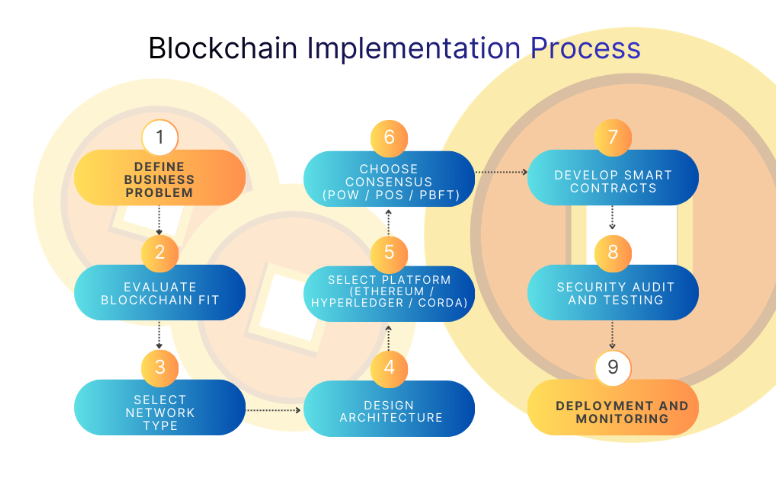
Once a network type is selected, implementation follows a structured path:
- Define a measurable business problem.
- Determine whether blockchain provides clear value over traditional databases.
- Select a consensus mechanism and blockchain platform.
- Design node configuration and permission frameworks.
- Develop and test smart contracts.
- Conduct security audits.
- Deploy the network, then monitor and optimize performance.
Throughout this process, developers must balance decentralization, scalability, and security, commonly referred to as the blockchain trilemma.
Common Misconceptions About Blockchain Types
Despite growing adoption, misunderstandings about blockchain network types remain common. The following clarifications address the most frequent assumptions:

Blockchain Is the Same as Cryptocurrency.
Cryptocurrency is one application built on blockchain. Blockchain technology supports many other use cases, including supply chain systems, healthcare data management, and identity verification.
All Blockchain Networks Are Fully Decentralized
Public blockchains are permissionless and distributed globally. However, private and consortium blockchains introduce structured governance and restricted participation.
Private Blockchains Are Automatically More Secure
Security depends on architecture, node distribution, consensus design, and implementation quality. A poorly designed private blockchain can be less secure than a well-maintained public network.
Blockchain Guarantees Anonymity
Many public blockchains are pseudonymous, not anonymous. Enterprise blockchains often require verified identities.
Clear differentiation between blockchain categories helps organizations make informed architectural decisions.
Conclusion
Blockchain technology now underpins distributed data systems across industries. Selecting the right type of blockchain requires more than technical preference; it demands alignment with governance models, regulatory obligations, scalability needs, and long-term strategy. Public, private, consortium, and hybrid networks each serve different operational priorities.
At Varmeta, we transform these complexities into actionable solutions through our specialized Blockchain consulting services.
Whether you are building DAOs, developing cross-chain bridges, or deploying CEX/DEX platforms, our experts design the ideal network architecture tailored to your business needs. We bridge the gap between technical potential and long-term operational success.
Contact us today to speak with a specialist!
FAQ
- What is a type of blockchain?
A type of blockchain refers to the governance and access structure of a blockchain network. The four primary types are public, private, consortium, and hybrid, each differing in participation rules, transparency, and control.
- What are the 4 types of blockchain networks?
The 4 types of blockchain networks are public blockchain, private blockchain, consortium blockchain, and hybrid blockchain. Each model serves different business, regulatory, and operational requirements.
- How do public and private blockchain networks differ?
Public blockchain networks allow anyone to participate in validation and transaction verification. Private blockchain networks restrict participation to approved members and are typically governed by a single organization.
- What is a hybrid blockchain architecture?
A hybrid blockchain architecture combines private control with selective public verification. Sensitive data remains permissioned, while certain records or proofs can be anchored to a public blockchain for transparency.
- Which type of blockchain is best for enterprise use?
The best type of blockchain for enterprise use depends on regulatory requirements, scalability needs, and governance preferences. Many enterprises choose private or consortium models to balance control and distributed trust.