In the rapidly evolving world of blockchain technology, interoperability has become one of the most pressing challenges. As hundreds of independent blockchain networks continue to operate in isolation, the lack of seamless communication and data exchange between them creates inefficiencies, limits scalability, and fragments liquidity. This growing need for a unified blockchain infrastructure has led to the emergence of Omnichain technology, a revolutionary approach to cross-chain interoperability that enables frictionless interaction between decentralized networks.
This article dives deep into what Omnichain is, how it works, its technical underpinnings, real-world implementations, and its potential to shape the future of decentralized ecosystems.
What is Omnichain?
Omnichain refers to a blockchain infrastructure designed to enable seamless interaction, data transfer, and transaction settlement across multiple blockchain networks. Unlike traditional single-chain or multi-chain systems where assets and data are often confined to individual chains or require complex bridging mechanisms, it provides a unified layer that abstracts away the complexities of cross-chain interactions. The goal is to create an integrated ecosystem where users and developers can engage with multiple blockchains as if they were a single entity.
The term “Omnichain” combines “omni” (meaning “all” or “universal”) and “chain” (short for blockchain), emphasizing its ambition to connect all blockchain networks into a cohesive framework. This concept is particularly significant in the context of Web3, where decentralized applications (dApps), decentralized finance (DeFi), and non-fungible tokens (NFTs) demand greater interoperability to maximize their potential.
The technical foundations of Omnichain
Omnichain systems are built on several key technical principles that distinguish them from traditional blockchain architectures. Below, we explore these foundational elements:
1. Interoperability
Interoperability is the cornerstone of Omnichain infrastructure. It enables smooth communication and data exchange between distinct blockchain networks, such as Ethereum, Binance Smart Chain, or Cosmos. This is achieved through standardized protocols or frameworks that allow blockchains with different consensus mechanisms, token standards, and use cases to interact seamlessly.
For example, an Omnichain system might use a Cross-Chain Gateway Protocol (CGP) like the one employed by Axelar Network to onboard new chains and facilitate data transfer without restrictions on their underlying rules.
2. Chain abstraction
Chain abstraction simplifies the user experience by hiding the technical complexities of interacting with multiple blockchains. Instead of requiring users to understand the intricacies of each chain (e.g., gas fees, wallet configurations), Omnichain platforms provide a unified interface. This abstraction is a key driver for mass adoption, as it aligns with the goal of onboarding billions of users to Web3.
3. Scalability
Scalability is a persistent challenge in blockchain technology. Omnichain infrastructures address this by optimizing transaction throughput across multiple chains. Techniques like sharding, efficient consensus mechanisms, or off-chain computation (e.g., via decentralized oracles) enable these systems to handle higher volumes of transactions without compromising performance.
4. Security
Security is paramount in an Omnichain ecosystem. By centralizing cross-chain interactions into a unified layer, these frameworks implement robust safeguards against threats like double-spending or bridge exploits. For instance, platforms like LayerZero use decentralized oracles to broadcast block headers on demand, ensuring secure and efficient message passing between chains.
How does it work?

At its core, an Omnichain system functions as a middleware layer or interoperability protocol that seamlessly connects multiple blockchains. Unlike traditional solutions that rely on centralized bridges or isolated networks, this technology enables fluid asset transfers, cross-chain communication, and unified smart contract execution. Here’s how it operates step by step:
1. Cross-chain messaging
Omnichain protocols facilitate the transmission of data and smart contract instructions between different blockchains. This is often achieved through relayers, lightweight endpoints, or decentralized oracles that act as intermediaries between chains. By securely passing messages, Omnichain solutions eliminate the need for users to manually switch networks, enabling a frictionless blockchain experience.
Example: A DeFi application on Ethereum can send transaction requests to a liquidity pool on Avalanche, allowing for instant cross-chain trading without requiring users to bridge assets manually.
2. Asset transfer
One of the most powerful features of Omnichain is native asset transfer between different blockchain ecosystems without reliance on centralized bridges. This capability ensures that tokens, stablecoins, and NFTs can retain their original properties and utility even when moved across chains.
Example: An NFT minted on Ethereum can be transferred to Solana while maintaining its metadata, ownership, and in-game functionality within a blockchain-based gaming ecosystem. This enhances liquidity and usability for digital assets across multiple platforms.
3. Smart contract execution
Omnichain infrastructure allows smart contracts to interact across multiple blockchains, enabling dApps to function without being restricted to a single network. This opens the door for more scalable, efficient, and interconnected decentralized applications that can leverage liquidity and data from multiple ecosystems simultaneously.
Example: A lending protocol can aggregate liquidity from Ethereum, Binance Smart Chain, and Polygon, allowing users to borrow and lend assets across multiple chains without additional conversions or manual interactions.
4. Consensus and validation
To maintain trust and integrity, Omnichain systems implement a consensus layer that validates transactions across all connected blockchains. This ensures that data transfers are accurate, secure, and free from manipulation.
- Some Omnichain models rely on decentralized validators or multi-party computation (MPC) techniques to confirm transactions.
- Others implement cryptographic proofs, such as zero-knowledge proofs (ZKPs), to verify transactions without exposing sensitive data.
By integrating cross-chain messaging, asset transfers, smart contract execution, and robust validation mechanisms, Omnichain protocols are breaking down the silos between blockchains. This paves the way for a unified, interoperable, and highly efficient Web3 ecosystem, where users, developers, and enterprises can seamlessly interact across multiple chains without barriers.
Real-world examples of Omnichain implementations
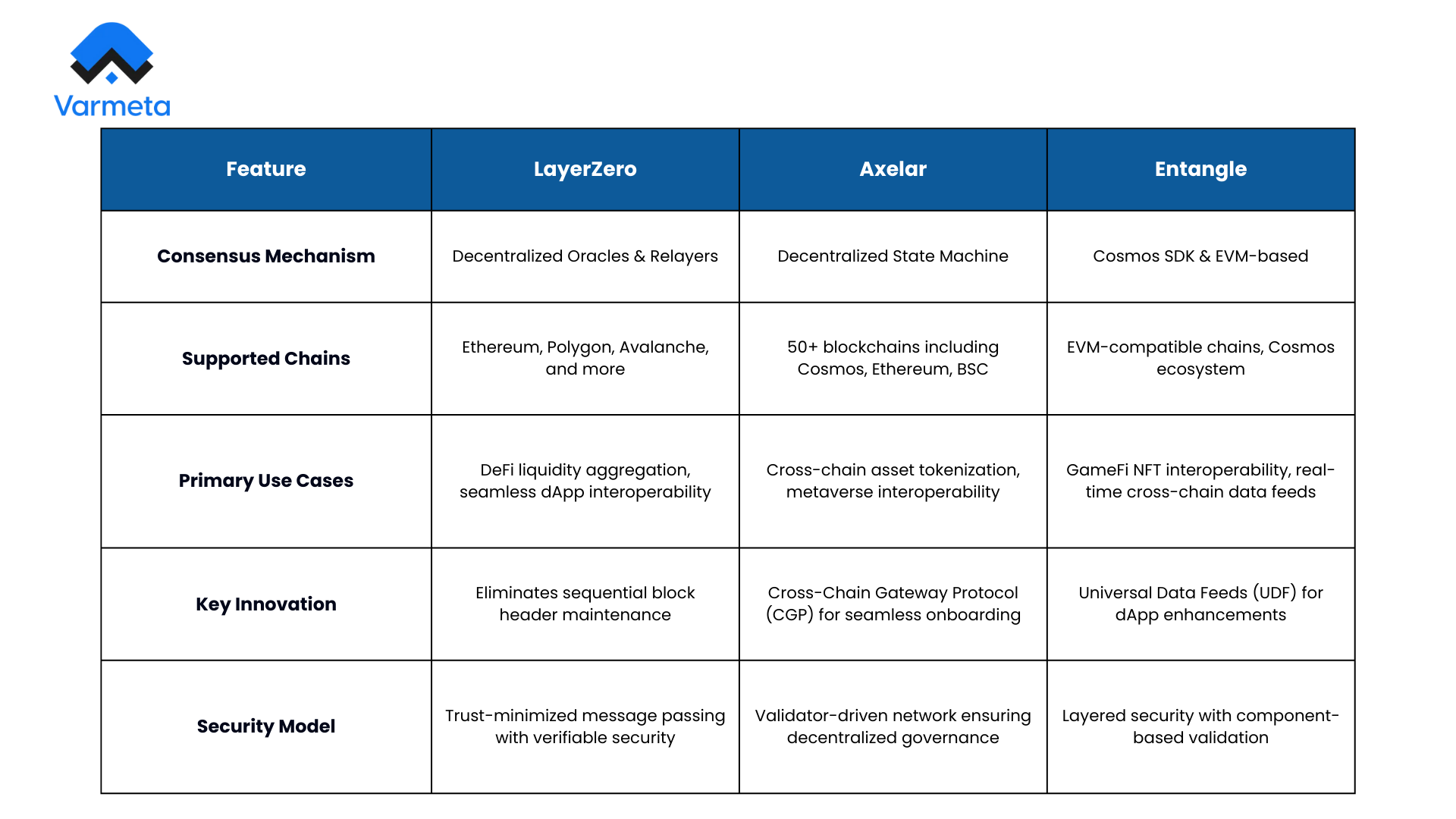
Source: Varmeta
Several projects have pioneered the Omnichain concept, each with unique approaches to solving interoperability challenges. Here are some notable examples:
1. LayerZero
LayerZero is an open-source Omnichain interoperability protocol that enables dApps to operate across multiple blockchains. It uses decentralized oracles and relayers to transmit messages between on-chain endpoints efficiently. Unlike traditional bridges, LayerZero eliminates the need for sequential block header maintenance, reducing overhead and enhancing scalability.
Use case: A DeFi protocol using LayerZero can aggregate liquidity from Ethereum, Polygon, and Avalanche into a single pool, simplifying user access.
2. Axelar network
Axelar serves as a decentralized state machine handling cross-chain requests. Its Cross-Chain Gateway Protocol (CGP) allows seamless onboarding of new chains, making it a versatile Omnichain solution. Axelar supports critical Web3 use cases like asset tokenization and metaverse interoperability.
Evidence: Axelar has integrated with over 50 blockchains, demonstrating its ability to scale and connect diverse ecosystems.
3. Entangle
Entangle leverages the Cosmos SDK and EVM modules to provide an Omnichain connector for developers. Its modular architecture, built on layered approaches, component-based development, and standardized interfaces offers flexibility and customization. Entangle’s Universal Data Feeds (UDF) enhanced dApp functionality by providing high-quality, real-time data across chains.
Use case: In GameFi, Entangle enables NFTs to move across blockchains and upgrade dynamically based on player interactions.
Benefits and challenges of Omnichain
Omnichain technology is redefining blockchain interoperability, offering seamless connectivity across multiple networks. By enabling assets, data, and smart contracts to function across different blockchains, Omnichain solutions enhance efficiency and usability in decentralized ecosystems. However, this innovation comes with both significant advantages and technical hurdles.
Benefits
- Enhanced user experience
Omnichain streamlines blockchain interactions by allowing users to operate within a single, unified interface. Instead of navigating multiple chains and wallets, users can seamlessly transfer assets and execute transactions across networks without additional complexity. This significantly lowers barriers to entry for new participants in the blockchain space.
- Increased liquidity & market efficiency
Omnichain protocols facilitate frictionless asset and data transfers, enhancing liquidity across decentralized finance (DeFi) and NFT marketplaces. By enabling assets to move freely between blockchains, Omnichain solutions help prevent liquidity fragmentation and improve overall market efficiency, allowing traders and investors to access deeper pools of capital.
- Greater developer flexibility
Developers benefit from Omnichain technology by being able to build truly interoperable applications. Instead of deploying and maintaining separate smart contracts for each blockchain, developers can create single-instance contracts that interact across multiple networks. This reduces development costs, simplifies maintenance, and accelerates the innovation cycle for decentralized applications (dApps).
- Improved scalability & network efficiency
By distributing transaction loads across multiple blockchains, Omnichain architectures alleviate congestion on any single network. This leads to improved transaction speeds, reduced gas fees, and a more scalable blockchain ecosystem. Instead of forcing high traffic onto one chain, users and developers can leverage multiple networks dynamically.
Challenges
- Security vulnerabilities & cross-chain risks
One of the most pressing concerns in Omnichain technology is security. Cross-chain bridges, a key component of interoperability, have historically been prime targets for asset loss, network disruptions, and user distrust. Ensuring secure communication between chains requires continuous advancements in cryptographic security and decentralized validation mechanisms.
- Complexity in implementation & maintenance
Building and maintaining an Omnichain infrastructure requires extensive technical expertise. Unlike traditional single-chain applications, Omnichain dApps must integrate multiple networks, each with its own consensus mechanisms, security models, and transaction finality rules. Developers must navigate these complexities to ensure seamless functionality, which can increase development time and operational costs.
- Adoption & ecosystem integration
The effectiveness of Omnichain technology depends on broad industry adoption. While interoperability solutions are gaining traction, widespread implementation requires cooperation between blockchain projects, validators, and developers. Additionally, some networks may be hesitant to adopt Omnichain protocols due to security concerns or governance restrictions, slowing the pace of integration.
The future of Omnichain
The Omnichain paradigm is poised to play a pivotal role in the evolution of Web3, driving the next wave of blockchain interoperability. As blockchain adoption accelerates, industries like DeFi, gaming, and supply chain management will require seamless cross-chain functionality to operate efficiently. The ability to move assets, execute smart contracts, and share data across multiple networks without friction will become essential for scaling decentralized applications.
Projects like Gravity (developed by Glaze) exemplify this shift by integrating zero-knowledge proofs (ZKPs) and high-performance execution layers, pushing toward full-chain abstraction. This approach eliminates the need for users and developers to interact with multiple blockchains manually, instead enabling a fluid, interconnected network where transactions occur seamlessly across different ecosystems.
Looking ahead, Omnichain could serve as the missing link between decentralized and traditional finance, allowing assets to move effortlessly between on-chain and off-chain systems. This integration would enable a hybrid financial ecosystem where tokenized real-world assets, stablecoins, and institutional-grade financial instruments interact across decentralized and regulated markets. However, to realize this vision, continued innovation in security, scalability, and standardization is crucial. Robust cross-chain validation mechanisms, scalable transaction processing, and unified protocols will be the key to ensuring that Omnichain solutions reach their full potential and drive the future of Web3 adoption.
Conclusion
Omnichain represents a transformative step forward in blockchain technology, addressing the silos that have long hindered interoperability. By providing a unified framework for cross-chain communication, asset transfer, and smart contract execution, it paves the way for a more connected and efficient decentralized future. While challenges remain, the technical advancements and real-world implementations of Omnichain demonstrate its potential to redefine how we interact with blockchain networks.
As of February 20, 2025, the Omnichain revolution is well underway, and its impact will only grow as the industry continues to mature. Whether you’re a developer, investor, or enthusiast, understanding Omnichain is key to staying ahead in the Web3 landscape.