In a world where blockchain and AI technologies are no longer futuristic ideas but active tools reshaping systems of governance, finance, and identity, the announcement from UNDP (United Nations Development Programme) and Exponential Science Foundation is particularly significant. In 2026, via a new initiative called the Government Blockchain Academy, governments will receive structured support to adopt crypto and blockchain tools more effectively. The implications stretch far beyond policy, they signal how Web3 infrastructure might integrate with public sector responsibilities in digital identity, fund transparency, and civic technology.
1. What the academy aims to do
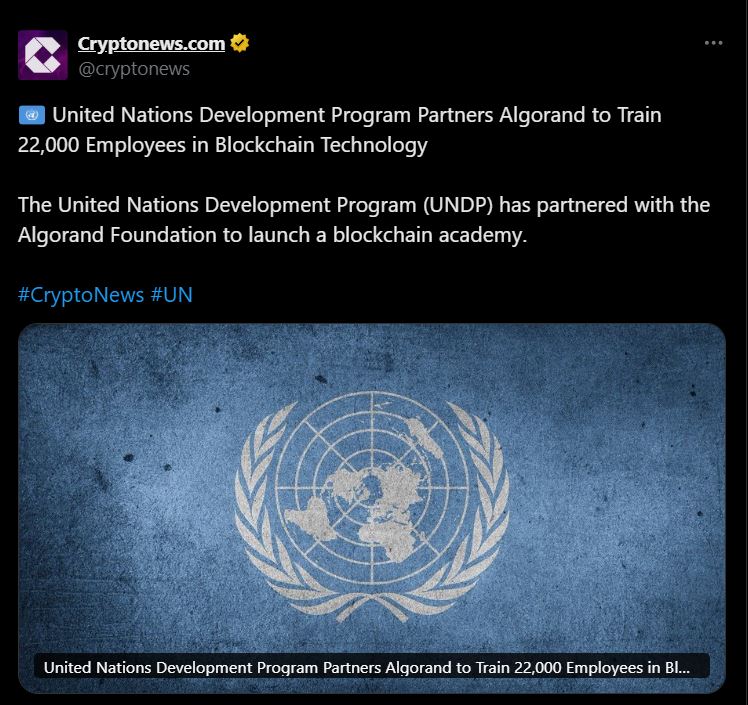
The Government Blockchain Academy is slated to begin actual country-level programs in 2026, with preparatory work, including curriculum development and stakeholder engagement happening through 2025. Its mission is ambitious: to bridge the gap between experimentation and full-scale deployment of blockchain, AI, and crypto-based systems within public institutions globally.
The Academy promises a diverse mix of training formats: in-person workshops, online courses, leadership forums, and advisory partnerships. Governments will not just be passive recipients; they will be engaged in co-designing solutions suited to local challenges, whether those are in supply chain transparency, secure public fund ledgers, climate reporting, or digital identity systems. The Academy also pledges incubation support and infrastructure alignment with national priorities.
2. Why this matters: Key themes & strategic drivers
- From trials to implementation
Many governments have dabbled in blockchain pilots, exploring proofs-of-concept in identity verification, land registration, or payments. However, scaling those pilots into robust, usable, and trusted systems has proven difficult. The Academy signals a push towards closing that gap, providing not just technical knowledge, but also frameworks for accountability, risk mitigation, and scalable deployment.
- Aligning transparency & governance
One of the core rationales for the Academy is to enhance transparency and accountability. Public funds, identity systems, and government data are powerful areas where blockchain can deliver once oracles and governance structures are handled properly. This initiative reflects growing global demand not only for innovation, but for ethically sound use of technology that protects data, resists corruption, and enables auditability.
- Local relevance & adaptive learning
Not all countries need the same type of blockchain applications. What works for a small, digitally advanced economy may not suit a larger, lower-income one with infrastructure gaps. The Academy’s design, emphasizing local use cases and stakeholder input, suggests it understands that one-size-fits-all doesn’t work. Adaptivity will likely be a major success factor.
3. Challenges & risks to watch
While the vision is compelling, there are several structural and operational challenges the initiative will need to address for real impact:
- Capacity & expertise gaps:
Many governments lack staff with sufficient experience in blockchain, smart contracts, governance, or cryptography. Training programs must not only convey concepts but also build sustainable in-house expertise.
- Regulatory & legal frameworks:
Blockchain and crypto regulation is uneven across jurisdictions. Designing enforcement, liability, and legal clarity (for example, in smart contract disputes, data privacy, or cross-border operations) will be complex.
- Infrastructure & inclusivity:
Secure internet, stable electricity, cyber security mechanisms, and digital identity systems are not uniform across the globe. Ensuring equitable access to both the training programs and resulting technologies is essential.
- Trust, standards, & interoperability:
For public systems (tax, identity, benefits disbursement, etc.), citizens must trust that the systems are fair, auditable, and interoperable. Developing standards (technical, governance, data privacy) will be necessary to avoid fragmentation or misuse.
4. What it means for Varmeta & web3 builders
For companies, teams, and organizations working in the Web3 space, Varmeta included, this initiative offers multiple strategic signals:
- Collaboration with Government becomes more important:
Policymakers will increasingly seek partners who understand both technology and public sector constraints. Those who offer advisory, technical infrastructure, or even facilitation may find new opportunities.
- Design for trust and compliance:
Platforms must prioritize transparency, auditability, data protection, and ethical considerations. Building with these in mind from the start will provide competitive advantage and reduce friction when interacting with government or regulated sectors.
- Focus on use cases with public value:
Identity management, public funds tracking, land registries, supply chain, climate reporting use cases that deliver tangible value to citizens and society may receive priority support and engagement.
- Preparedness for standards & governance:
As governments adopt these tools, standardization of identity, data formats, and security practices will likely accelerate. Being ready to comply or help define standards will be a differentiator.
Conclusion
The launch of the Government Blockchain Academy by UNDP and Exponential Science Foundation is more than a training initiative; it is a major turning point in how governments will engage with blockchain, AI, and crypto technologies. It signals a shift from experimentation toward responsible implementation, from policy debate toward operational frameworks.
For nations, it means capacity building; for communities, it means systems that are more transparent and accountable; for builders like Varmeta, it means a mandate to design with rigor, ethics, and context. As 2026 approaches, those who prepare now with clarity of values, standards, and use-cases stand to lead in shaping a future where technology serves public good.
Varmeta – Excellent in every block
Website: var-meta.com
Linkedln: https://www.linkedin.com/company/var-meta/