Artificial Intelligence (AI) has transformed the way we interact with technology, enabling machines to perform tasks that were once thought to require human intelligence. Among its many advancements, AI has unlocked the ability to create entirely new content—be it images, text, or even music. This is achieved through generative models, a class of machine learning models designed to generate data that mimics the real world.
Within this domain, Generative adversarial networks (GANs) stand out as a groundbreaking innovation. Introduced by Ian Goodfellow in 2014, GANs have revolutionized how AI creates realistic content. Unlike traditional generative models, GANs employ a unique “adversarial” framework where two neural networks—the generator and the discriminator—compete in a dynamic process to produce data that is indistinguishable from reality. This competition drives incredible advancements in realism and creativity, making GANs a cornerstone of generative AI.
This guide aims to demystify Generative adversarial networks (GANs) by breaking down their core concepts, explaining how they work, and exploring why they are so significant in AI today. Whether you’re new to AI or simply curious about the buzz surrounding GANs, this beginner-friendly guide will provide you with a clear and accessible understanding of this transformative technology.
What are generative adversarial networks?
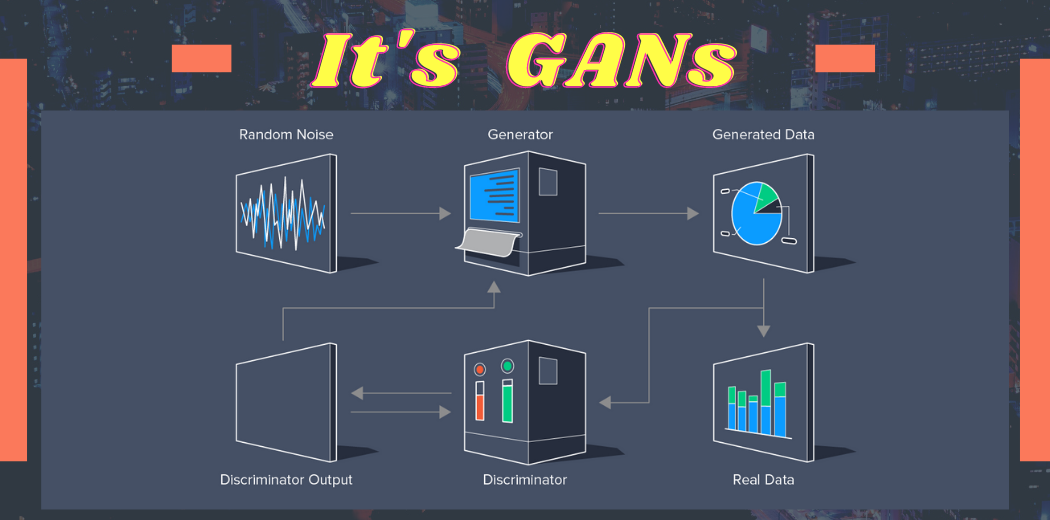
At their core, Generative adversarial networks (GANs) are a powerful machine learning framework designed to create new, realistic data by mimicking patterns found in existing datasets. The concept behind GANs is unique because it pits two neural networks against each other in a competitive process. These two networks, the generator and the discriminator, work together in an adversarial relationship to produce increasingly accurate and realistic outputs.
How do generative adversarial networks (GANs) work?
The power of Generative adversarial networks (GANs) lies in their unique structure, where two neural networks—the generator and the discriminator—engage in a dynamic, adversarial process. This interaction allows GANs to create highly realistic data that mimics the original dataset. Here’s a breakdown of how each component functions and how the training process unfolds:
The generator
The generator is the creative force within a GAN. Its primary purpose is to generate new data that resembles the real dataset, such as images, audio, or text. However, the generator starts with a significant handicap: it knows nothing about the original data. Instead, it begins by using random noise as input and attempts to create data that could pass as genuine.
- Purpose: The generator’s role is to “fool” the discriminator by producing outputs that are as close to real data as possible.
- Output: Initially, the generator creates crude, unrealistic outputs, such as blurry or nonsensical images. Over time, as it learns from the discriminator’s feedback, these outputs become increasingly realistic.
The discriminator
The discriminator is the evaluator, tasked with determining whether a piece of data is real (from the actual dataset) or fake (produced by the generator). This network acts as a critical gatekeeper, challenging the generator to improve continuously.
- Purpose: The discriminator serves as a binary classifier, assigning a probability score to determine whether a given input is genuine or generated.
- Goal: Its ultimate goal is to distinguish between real and fake data with as much accuracy as possible, forcing the generator to produce better results.
The training process
The training process is the heart of generative adversarial networks, where the generator and discriminator engage in an adversarial “game.” This iterative process drives both networks to refine their abilities:
- Initial steps: The generator produces fake data, which is evaluated by the discriminator. The discriminator compares this data against real examples and provides feedback in the form of classification accuracy.
- Feedback loop: The generator uses the discriminator’s feedback to improve its outputs, learning to create data that is more likely to be classified as real. Simultaneously, the discriminator updates its parameters to better identify subtle flaws in the generator’s outputs.
- Iterative refinement: Over multiple iterations, this feedback loop leads to incremental improvements in both networks. The generator becomes more skilled at producing realistic data, while the discriminator sharpens its detection abilities.
- Convergence: Ideally, this process continues until the generator produces data that is indistinguishable from real data, effectively “fooling” the discriminator completely.
The interaction between the generator and discriminator is what makes GANs so effective. The generator’s creativity and the discriminator’s scrutiny drive each other to excel, resulting in outputs that can replicate the complexity and diversity of real-world data. This adversarial framework is what sets GANs apart from other generative models, making them a cornerstone of modern AI.
By leveraging this iterative “game,” Generative adversarial networks have transformed how machines generate new content, enabling applications that range from hyper-realistic image synthesis to groundbreaking advancements in AI-driven creativity.
Why were GANs developed?
Traditional machine learning algorithms and neural networks, while powerful, face a critical limitation: their vulnerability to noise and slight distortions in data. Even minor changes to input data can cause these models to misclassify images or fail at recognizing patterns accurately. For example, adding imperceptible noise to an image can dramatically increase the chances of a neural network making incorrect predictions. This limitation highlighted the need for more robust models, ones capable not only of recognizing data but also of generating and understanding new data patterns.
This challenge laid the groundwork for the development of Generative Adversarial Networks (GANs). Unlike traditional models, GANs are designed to generate data that is indistinguishable from real-world examples. The core idea behind GANs is to enable neural networks to visualize, learn, and create new patterns that mimic the original training data. Instead of solely focusing on classification or recognition, GANs produce entirely new samples that are highly realistic, making them invaluable for tasks like image synthesis, video generation, and audio modeling.
Advancements with GANs
As GANs gained traction, innovations in their frameworks and applications expanded their capabilities significantly:
PyTorch generative adversarial networks
The introduction of frameworks like PyTorch revolutionized the way GANs are developed and implemented. PyTorch provides a flexible and user-friendly environment, empowering researchers and developers to design and train GANs with dynamic computational graphs. This feature simplifies experimentation, allowing for intuitive adjustments during development and leading to faster creation of high-quality synthetic data.
3D generative adversarial networks
The advent of 3D GANs extended the functionality of traditional GANs to three-dimensional data, unlocking a new realm of possibilities. These models generate lifelike 3D objects and environments, making them crucial for industries such as gaming, virtual reality, and medical imaging. With 3D GANs, developers can create hyper-realistic 3D models and scenes that closely resemble real-world counterparts, enhancing applications in simulation, design, and entertainment.
The significance of GANs
GANs address critical gaps in traditional neural networks by not only improving robustness against noise but also advancing the ability to generate new data patterns. By creating synthetic data that closely mimics real-world data, GANs have become essential tools in a variety of fields, from producing high-resolution images for creative industries to generating augmented datasets for AI training.
Through innovations like PyTorch and 3D GANs, Generative Adversarial Networks have cemented their place as transformative technology, empowering applications that were previously unattainable with conventional machine learning approaches. Today, GANs continue to push the boundaries of AI, driving advancements in realism, creativity, and functionality across industries.
What are the types of generative adversarial networks (GANs)?

Over the years, various types of Generative adversarial networks (GANs) have been developed to address specific challenges and applications. While all GANs share the same foundational architecture, an adversarial relationship between a generator and a discriminator, different variants enhance or adapt this structure to achieve specialized tasks. Below are some of the most prominent types of GANs and their unique contributions:
1. Vanilla GAN
The Vanilla GAN is the original model introduced by Ian Goodfellow in 2014. This foundational architecture consists of two components:
- Generator: Creates synthetic data that mimics real-world examples.
- Discriminator: Evaluates whether the data is real or generated.
The generator and discriminator engage in an adversarial “game,” improving iteratively until the generated data becomes indistinguishable from real data. While it laid the groundwork for modern GANs, the Vanilla GAN often struggles with issues like training instability and mode collapse, leading to the development of more advanced variants.
2. Conditional GAN (cGAN)
A Conditional GAN (cGAN) enhances the original GAN architecture by adding conditional inputs to both the generator and discriminator. These inputs can include class labels or specific attributes, enabling more controlled data generation.
- Key feature: Generates data tailored to specific conditions, such as creating images of a particular category (e.g., cats or dogs) based on the input label.
- Applications:
- Text-to-image synthesis (e.g., generating an image of a “red car”).
- Targeted product design or customization.
By providing precise control over the generated output, cGANs have become invaluable in domains requiring specific, conditional data generation.
3. Deep convolutional GAN (DCGAN)
Deep Convolutional GANs (DCGANs) leverage convolutional neural networks (CNNs) to improve the quality and realism of generated data, particularly images. CNNs are adept at capturing spatial hierarchies in data, making DCGANs a popular choice for visual tasks.
- Key feature: Utilizes convolutional layers instead of fully connected layers for both the generator and discriminator, enabling the creation of high-quality images.
- Applications:
- Image generation and enhancement.
- Video synthesis.
- AI-generated artwork.
DCGANs are widely regarded as a significant milestone in GAN research due to their ability to produce sharp and detailed outputs.
4. StyleGAN
StyleGAN is a groundbreaking GAN variant developed to generate ultra-realistic images with fine control over style and attributes. Unlike other GANs, StyleGAN separates high-level features (e.g., pose or facial structure) from low-level details (e.g: texture or lighting), offering unprecedented customization capabilities.
- Key feature: Provides a “style” control mechanism, allowing users to manipulate specific aspects of the generated output without altering others.
- Applications:
- Face generation with controllable attributes (e.g: age, expression).
- Fashion design and customization.
- High-resolution image synthesis.
StyleGAN has set a new standard in image generation, particularly in industries where precision and realism are critical.
5. CycleGAN
CycleGAN stands out for its ability to perform image-to-image translation without paired training data. Unlike traditional GANs that require aligned datasets, CycleGAN works with unpaired data, making it incredibly versatile for style transfer and domain adaptation.
- Key feature: Enables transformations between two domains (e.g., converting horse images to zebra images) without the need for paired examples.
- Applications:
- Style transfer (e.g: converting photos to paintings).
- Image enhancement (e.g: improving photo quality).
- Medical imaging (e.g: converting MRI scans to CT scans).
CycleGAN’s ability to work in an unsupervised manner has opened new avenues for image processing and enhancement across various fields.
The evolution of Generative adversarial networks (GANs) has led to the creation of diverse variants, each tailored for specific applications. From the foundational Vanilla GAN to the sophisticated StyleGAN and CycleGAN, these models showcase the flexibility of the GAN architecture. Whether it’s generating high-quality images with DCGANs, enabling precise control with cGANs, or transforming domains with CycleGANs, GANs continue to drive innovation in AI-powered creativity, content generation, and scientific research.
By adapting to unique challenges and leveraging specialized architectures, GANs have become an indispensable tool in machine learning, constantly pushing the boundaries of what machines can generate.
Applications of generative adversarial networks (GANs)
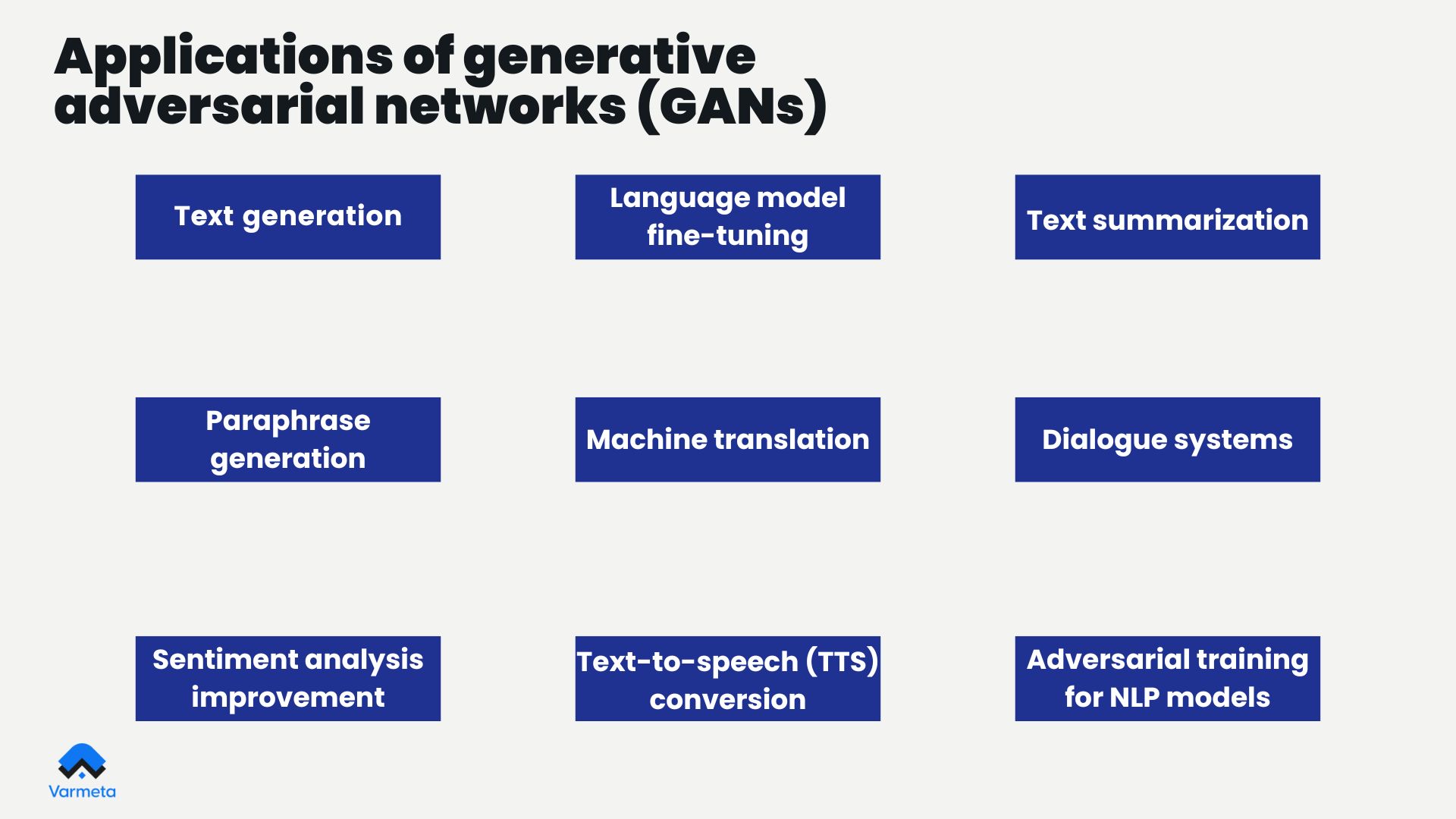
Generative adversarial networks (GANs), first introduced in the seminal paper by Ian Goodfellow, have revolutionized various fields of artificial intelligence by enabling the creation of realistic synthetic data. While GANs are widely known for their groundbreaking applications in image generation, their potential in other domains, such as natural language processing (NLP) and beyond, is equally transformative. By leveraging the adversarial process between the generator and the discriminator, GANs can produce outputs that closely mimic real-world data, opening up a wide range of possibilities.
Here are some of the key applications of GANs across different areas, particularly in NLP and related fields:
-
Text generation
GANs are increasingly being used to generate coherent, human-like text, providing creative solutions for tasks such as narrative writing, content creation, and chatbot dialogues. The adversarial training helps refine the fluency and relevance of the generated text.
Example: AI-generated stories or conversational agents that adapt to different contexts.
-
Paraphrase generation
In tasks requiring text variation, GANs are employed to produce paraphrases of a given sentence while maintaining the original meaning. This is particularly useful for data augmentation in NLP, enabling better model training and evaluation.
Example: Enhancing training datasets for sentiment analysis or machine translation models.
-
Sentiment analysis improvement
GANs play a crucial role in adversarial training, where they generate challenging examples to test and improve sentiment analysis models. This helps models detect subtle differences in sentiment and improve their robustness against biased or ambiguous inputs.
Example: Creating adversarial text samples to improve accuracy in detecting sarcasm or nuanced sentiments.
-
Language model fine-tuning
GANs are utilized to fine-tune small language models, enhancing their fluency, coherence, and adaptability in specific text generation tasks. This makes the outputs more contextually relevant and natural.
Example: Refining chatbot responses or improving summarization models.
-
Machine translation
In machine translation, GANs improve the accuracy and fluency of translations, particularly for low-resource languages. By minimizing translation errors and generating high-quality parallel data, GANs support better cross-lingual understanding.
Example: Enhancing translation systems for indigenous or underrepresented languages.
-
Text-to-speech (TTS) conversion
GANs enhance the naturalness and intelligibility of speech synthesis models, making the generated speech sound more human-like. The adversarial feedback helps reduce artifacts and improve tonal variations in TTS systems.
Example: Creating realistic voiceovers for virtual assistants or audiobooks.
-
Text summarization
GANs assist in summarization tasks by generating concise yet informative summaries of lengthy documents or articles. The adversarial mechanism ensures that summaries retain critical information while eliminating redundancies.
Example: Summarizing long research papers or legal documents for quick understanding.
-
Dialogue systems
GAN-based architectures are applied to chatbots and conversational agents, enabling more engaging and context-aware interactions. By generating adversarial responses, GANs help improve the diversity and relevance of dialogue.
Example: Creating customer service chatbots capable of handling nuanced and context-specific queries.
-
Adversarial training for NLP models
GANs generate adversarial examples to test and train NLP models, making them more resilient to errors and improving their ability to generalize across various tasks. This ensures robustness against noisy or unexpected inputs.
Example: Testing language models with adversarial text samples to improve their fault tolerance.
Beyond NLP: Broader applications of GANs
While this list focuses on NLP, Generative adversarial networks have applications in other fields as well, including image-to-text synthesis, video generation, and even biomedical research. Their ability to generate high-quality synthetic data makes GANs a versatile tool in AI-powered innovation.
GANs are not just limited to improving existing tasks—they are paving the way for entirely new applications in creative, analytical, and communicative technologies, solidifying their role as a cornerstone of modern AI.
Conclusion
Generative adversarial networks (GANs) have emerged as one of the most innovative and transformative advancements in artificial intelligence. By leveraging an adversarial training process between a generator and a discriminator, GANs excel at creating new, realistic data that closely mimics the original dataset. This unique mechanism, where two neural networks continuously challenge and improve each other, enables GANs to produce outputs ranging from lifelike images to coherent text and even 3D models.
The versatility of generative adversarial networks is evident in their widespread applications. From revolutionizing content creation in industries like art and gaming to advancing fields such as healthcare and natural language processing, GANs are driving innovation at an unprecedented pace. Their ability to generate synthetic data has not only enhanced existing AI models but also paved the way for groundbreaking solutions to complex challenges.
As we look to the future, the role of GANs in the AI landscape will only continue to grow. Their potential to redefine creativity, improve model robustness, and enable new forms of data synthesis is immense. For those inspired by the possibilities, now is the perfect time to dive deeper into GANs. Explore their architecture, experiment with frameworks like TensorFlow or PyTorch, and test out pre-built GAN models to gain hands-on experience.
In essence, Generative Adversarial Networks are more than just a technological breakthrough, they are a testament to the creative potential of AI. Whether you’re an AI enthusiast, a researcher, or a developer, GANs offer an exciting opportunity to push the boundaries of what machines can achieve. Start exploring today and be a part of this transformative journey in the world of artificial intelligence.