What is vertical integration in supply chain terms, in the simplest possible definition? It’s when a company takes direct ownership of two or more stages of its own supply chain instead of relying on outside vendors for those stages. A furniture maker that starts cutting its own lumber, or a car company that starts building its own batteries, is practicing vertical integration. It’s one of the oldest strategic playbooks in business, and in 2026 it’s having an unusual second moment, partly because of a technology that shares its name in spirit if not in meaning: vertical AI.
This article covers what vertical integration actually involves, where it tends to pay off and where it doesn’t, and why the rise of vertical AI agents is changing the calculation for companies deciding whether to own more of their own supply chain.
What is Vertical Integration in Supply Chain?
A supply chain runs from raw materials at one end to the customer at the other, usually through several independent companies along the way: suppliers, manufacturers, distributors, retailers. Vertical integration means a single company absorbs two or more of those steps into its own operations rather than buying or selling across a market boundary.
There are three recognized forms. Backward integration means moving upstream, toward suppliers and raw materials. Tesla designing and producing its own battery cells instead of buying them from a third party is backward integration. Forward integration means moving downstream, toward distribution and the end customer. A brewery that opens its own chain of pubs, rather than selling kegs to independent bars, is integrating forward. Balanced integration is both directions at once, which only a company sitting somewhere in the middle of a chain can pursue.
Apple is the standard reference case: it designs its own chips, an upstream move, while also running its own retail stores, a downstream move, giving it control over a larger share of the value chain than almost any other consumer hardware company.
The classic motivations are control, cost, and consistency. Owning the upstream supply removes a layer of price negotiation and reduces exposure to a supplier’s own disruptions. Owning the downstream channel gives a company direct access to customer data and a more consistent brand experience than a third party retailer would deliver. McDonald’s backward integration into its agricultural supply network, securing potato and beef sourcing years in advance, is a textbook example of using ownership to control input quality and price volatility rather than negotiating for it every season.
Why Vertical Integration is back on the table in 2026
Vertical integration fell out of fashion for a long stretch. Through the 1990s and 2000s, the dominant strategic advice was the opposite: specialize, outsource everything outside your core competency, and let the market handle the rest through long, distributed supplier networks. That advice made sense when global trade was stable, shipping was cheap and predictable, and a company could assume a supplier in another country would deliver on time, year after year.
That assumption has been breaking down. Supply chain leaders now operate with tariff policy that shifts quarter to quarter, ongoing geopolitical fragmentation affecting semiconductors and critical minerals specifically, and climate driven disruptions to shipping lanes and agricultural yields. According to a 2026 supply chain trends analysis from Dataiku, 78 percent of supply chain leaders expect disruptions to intensify over the next two years, but only a quarter feel prepared for that reality. Against that backdrop, owning your own upstream supply or downstream distribution stops looking like inefficient empire building and starts looking like basic risk management.
The semiconductor and EV battery industries are the clearest current examples. TSMC and Intel have each committed tens of billions of dollars to new fabrication plants on US soil, decisions that only make economic sense once a company decides that depending on a small number of overseas facilities for a strategically critical input is a risk worth eliminating, not a cost worth optimizing away. Automakers have followed the same logic with battery cells specifically, since a single delayed shipment from one cathode supplier can halt an entire vehicle line. Vertical integration in these sectors isn’t really about cost anymore. It’s about making sure the thing you need to build your product still exists when you need it.
The real costs and risks
None of this makes vertical integration a free strategy, and it’s worth being honest about where it goes wrong.
It is capital intensive by definition. Acquiring or building out a new stage of the supply chain, a factory, a fleet of trucks, a network of stores, requires upfront investment that a company avoids entirely when it simply pays another business for that service on a per unit basis. It also reduces flexibility. A company that owns its manufacturing is committed to that manufacturing even if a better, cheaper third party option appears later. And it can create internal conflicts of interest: a retailer that vertically integrates backward into manufacturing now competes for shelf space and attention with its own former suppliers, who may become wary of working with a company that’s increasingly also their competitor.
History offers a clear cautionary example. General Motors spent much of the twentieth century vertically integrating almost every stage of its production, eventually building its own steel mills, glass plants, and parts divisions. For decades that scale advantage worked in its favor. Once the market shifted toward smaller, specialized suppliers who could innovate faster and cheaper than an internal division facing no outside competition, the same structure that had been GM’s strength became the reason it struggled to adapt, carrying fixed costs and internal bureaucracy that leaner, more horizontally organized competitors didn’t have.
The strategic question every company has to answer honestly is whether the stage of the supply chain it’s considering owning is actually a source of competitive advantage, or just a cost center it would rather control than negotiate with. Owning a stage of the chain that doesn’t differentiate your product is usually a worse use of capital than investing in the part that does.
Backward, forward, and balanced integration compared
| Type | Direction | What it controls | Classic example | Primary risk |
| Backward integration | Upstream, toward suppliers | Raw materials, components, manufacturing inputs | Tesla producing its own battery cells | High capital cost, reduced supplier flexibility |
| Forward integration | Downstream, toward customers | Distribution, retail, direct customer relationships | A brewery opening its own pubs | Channel conflict with existing retail partners |
| Balanced integration | Both upstream and downstream | The full value chain from input to end sale | Apple’s own chips and own retail stores | Highest capital intensity, hardest to reverse |
What is Vertical AI, and why the overlapping name
The word vertical shows up everywhere in enterprise technology right now, and it means something genuinely different from vertical integration in supply chain strategy, even though the two concepts are increasingly discussed in the same breath.
Vertical AI refers to AI agents and software built for one specific industry or workflow, as opposed to horizontal AI, which is general purpose and works across many industries with the same underlying model. ChatGPT and Claude, used as general assistants, are horizontal. A tool like Harvey, built specifically for legal research and contract review, or Hippocratic AI, built specifically for patient facing healthcare tasks, is vertical.
Vertical AI agents are trained or configured around industry specific data, terminology, compliance rules, and software integrations that a general purpose model has no built in knowledge of.
Industry analysts are treating this as one of the defining enterprise technology shifts of 2026. IBM’s overview of AI agents in supply chain notes that organizations investing more heavily in AI driven supply chain operations have reported revenue growth 61 percent higher than their peers, a gap large enough that it has changed how seriously procurement and operations leaders treat the category.
Gartner and McKinsey research cited across the industry projects that more than 40 percent of enterprise AI deployments in 2026 will be vertical first rather than built on a general purpose model alone.
The real relationship between Vertical Integration and Vertical AI
The two terms share a word, not a definition, but the connection between them is more than coincidence once you look at what each one actually requires to work.
Vertical AI agents need deep, structured, end to end data about one specific domain to be useful. That’s their whole value proposition over a horizontal model: an agent trained on a single industry’s data, terminology, and workflow outperforms a general purpose model on that industry’s tasks, but only if it has access to clean data spanning the full process it’s meant to reason about. A company that has vertically integrated its supply chain, owning its own sourcing, manufacturing, and distribution, already has exactly that kind of unified, end to end operational data sitting inside one organization rather than scattered across a dozen independent suppliers and distributors who have no obligation to share it.
Vertical integration, in other words, is one of the most reliable ways a company ends up with the kind of proprietary, structured dataset that a vertical AI agent actually needs.
The relationship runs the other way too. One of the classic costs of vertical integration is coordination overhead: once a company owns sourcing, manufacturing, and distribution directly, it also owns the job of keeping all of those functions synchronized, which used to require layers of human planners and middle management. Vertical AI agents are increasingly absorbing exactly that coordination work.
At Hannover Messe 2026, SAP demonstrated agents that connect design, planning, procurement, manufacturing, and logistics into a single orchestrated system rather than separate departmental silos, specifically aimed at the kind of multi stage operation a vertically integrated company runs. Microsoft has built a similar case around what it calls an intelligence layer spanning a company’s full supply chain estate, arguing that the value only appears once an organization unifies data across stages it actually controls.
Put plainly: vertical integration creates the conditions, in the form of owned, end to end data, that make vertical AI agents effective, and vertical AI agents reduce the operating cost that has historically made vertical integration harder to justify. A company that vertically integrates without ever connecting that data into a coordination layer is leaving most of the strategic value on the table. A company deploying vertical AI on top of a fragmented, multi-vendor supply chain it doesn’t control is working with worse, messier data than a vertically integrated competitor would have.
Vertical AI agents already working inside owned supply chains
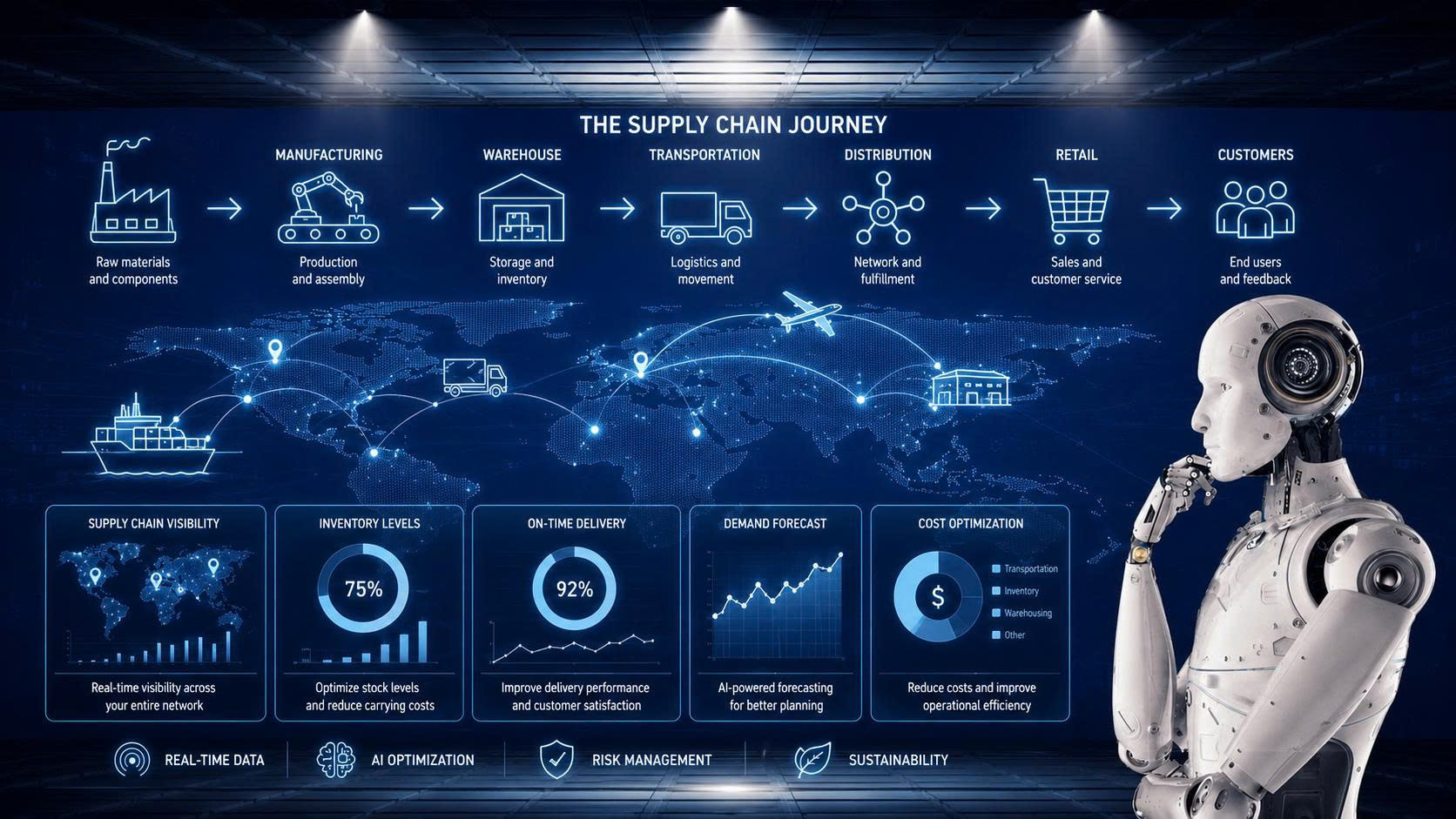
A medical device manufacturer cited in recent supply chain research is using AI agents to automate supplier scoring and quote validation across its own owned manufacturing network, work that would be far harder to automate cleanly across a network of arm’s length, independently operated suppliers. Resilinc, a supply chain risk intelligence platform, runs predictive models that map vulnerabilities across a company’s supplier network and flag disruption risk before it reaches production, a capability that gets meaningfully sharper the more of that network the company actually owns and can instrument directly.
A transportation company described in recent supply chain research now runs its entire buying process through an agent that requests quotes from approved suppliers and ranks the responses automatically, work it could only automate this cleanly because the supplier qualification rules and historical pricing data already lived inside systems the company itself controlled end to end.
The same pattern shows up whenever a company decides to build its own vertical AI agent instead of buying an off the shelf one. The agent is only as good as the data it can see, and a vertically integrated company can hand it a complete, end to end view of sourcing, production, and distribution because all of that already sits inside one organization. A company that hasn’t integrated has to stitch that same view together from several outside partners first, which is a slower and messier starting point.
It’s also why agentic AI services aimed at manufacturing and logistics clients, like the kind Varmeta offers, tend to start with a data readiness review before building anything: an agent built on top of fragmented, multi-vendor data rarely performs as well as one built on a company’s own unified operational record.
What this means for companies deciding whether to integrate
For a company weighing vertical integration in 2026, the AI layer changes the math in a specific way. The traditional case against integrating backward or forward was coordination cost: more owned stages meant more internal complexity to manage. That cost is dropping, fast, for companies willing to pair ownership with the agent layer now available to manage it. That doesn’t make integration free, the capital cost of owning a factory or a distribution network hasn’t gone anywhere, but it does shift the break even point. A company that previously concluded integration wasn’t worth the operational headache should run that calculation again with 2026 tooling in mind, because the headache it was avoiding is smaller than it used to be.
The reverse is also worth saying plainly. A company that integrates today without planning for the data and coordination layer underneath it is signing up for the capital cost of ownership while leaving the actual operational benefit on the table.
How to decide whether to integrate
Three questions cut through most of the noise. Does owning this stage of the supply chain protect something customers actually notice, like quality, speed, or reliability, or does it just move a cost from one column to another? Is the data this stage generates something a competitor could never get access to once you own it, the kind of proprietary asset that would make a future vertical AI agent meaningfully better? And can the company actually staff and govern the new operation, or is the plan to integrate now and figure out coordination later, which is exactly the trap that makes vertical integration expensive instead of valuable.
A company that answers yes to the first two questions, and has a real plan for the third, is looking at a genuinely strong case for integrating. A company that can only answer yes to the first one is probably looking at an expensive distraction wearing a strategy’s clothing.
The practical takeaway for 2026
Vertical integration in supply chain strategy and vertical AI in enterprise technology answer two different questions: one is about who owns which stage of production, the other is about how specialized your software needs to be to do useful work inside one industry. But in 2026, they’ve become two halves of the same decision. The data that makes a vertical AI agent good at its job is the same data a vertically integrated company already owns, and the coordination problem that has always made vertical integration expensive is the same problem vertical AI agents are now built to absorb. Companies evaluating either move on its own are answering only half the question.
Frequently Asked Questions
1. What is vertical integration in supply chain terms?
Vertical integration is when a single company takes direct ownership of two or more stages of its own supply chain (like raw materials, manufacturing, or retail) instead of relying on external vendors.
2. What is the difference between backward and forward integration?
- Backward integration moves upstream toward suppliers (e.g., an EV maker producing its own batteries).
- Forward integration moves downstream toward the customer (e.g., a brewery opening its own pubs to sell its beer directly).
3. What is Vertical AI?
Vertical AI refers to AI software and agents built specifically for one narrow industry or workflow (like Harvey for legal work), whereas horizontal AI is general-purpose (like standard ChatGPT or Claude).
4. How do vertical integration and Vertical AI connect?
They are two sides of the same coin. A vertically integrated company owns its entire supply chain data, which is the exact end-to-end, proprietary data needed to train an effective Vertical AI agent.
5. How does Vertical AI make vertical integration easier?
Historically, owning more of your supply chain meant massive management headaches. Vertical AI agents drastically lower these costs by automatically coordinating logistics, procurement, and planning across all owned stages in real time.