As the regulatory landscape surrounding crypto assets becomes more defined, stablecoins are emerging as one of the most promising developments in the digital finance world. Backed by real-world assets like the U.S. dollar, stablecoins are no longer just tools for crypto traders, they’re rapidly becoming essential bridges between traditional finance and the decentralized economy.
Stablecoins surge into the financial mainstream
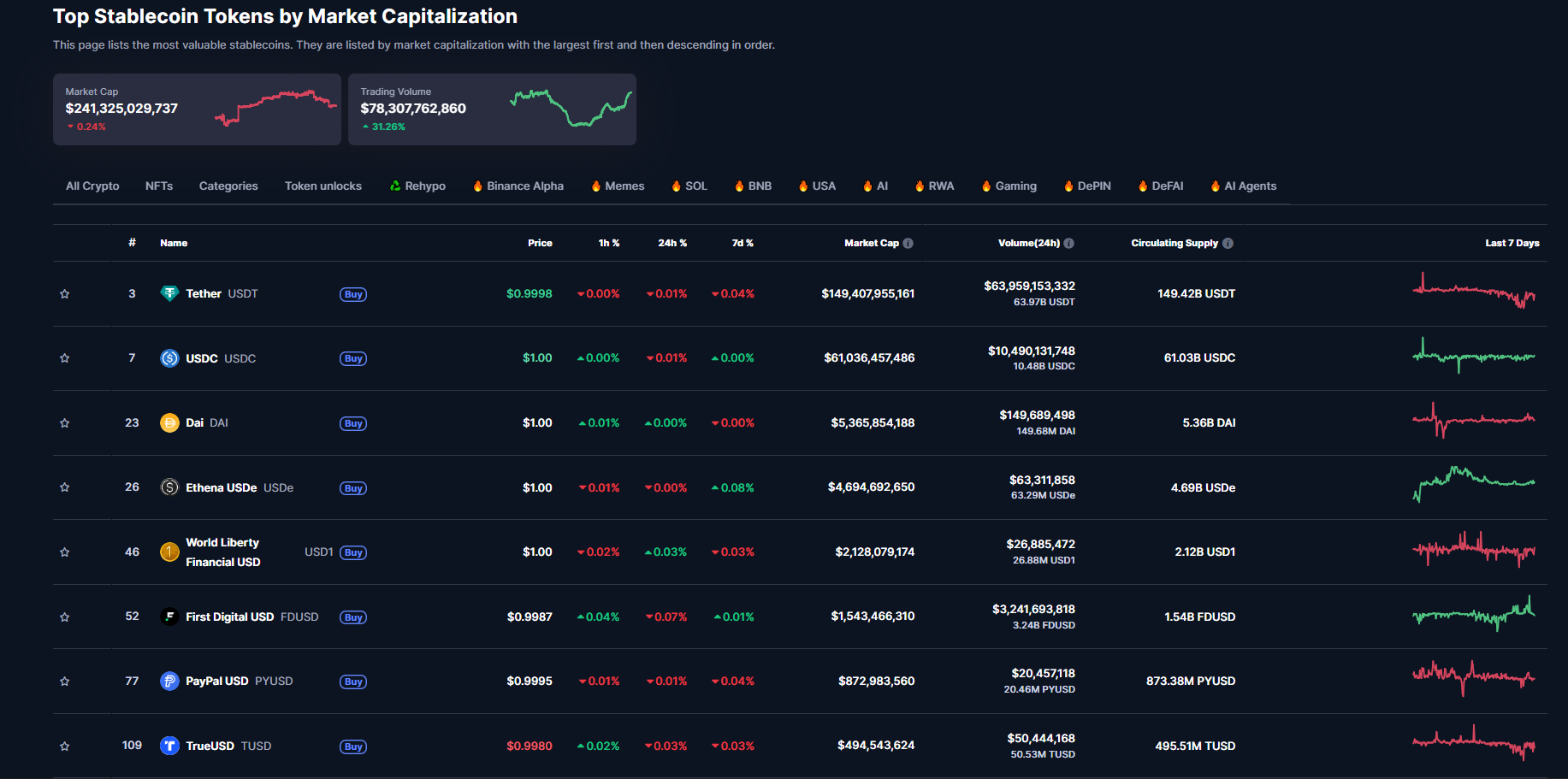
In recent years, stablecoins have gained significant traction thanks to growing support from financial institutions, fintech giants, and even national governments. Their appeal lies in their ability to combine the reliability of fiat currencies with the speed and efficiency of blockchain technology. With regulatory frameworks such as the EU’s Markets in Crypto-Assets (MiCA) now in effect, and legislative proposals like the STABLE Act and GENIUS Act under review in the United States, the groundwork for stablecoin integration is being laid across global financial systems.
Let’s explore five major stablecoin initiatives that are rapidly expanding their global influence.
1. Tether: Strategic return to the U.S. market
Tether (USDT), the world’s largest stablecoin by market share, has long been a dominant force in crypto liquidity. Despite past controversies around transparency and compliance, Tether is actively planning a strategic comeback in the U.S. market.
In an interview with CNBC on April 30, CEO Paolo Ardoino revealed that Tether is preparing to launch a new U.S.-compliant stablecoin, designed to meet specific domestic regulatory requirements. “A domestic stablecoin will be different from the international version,” Ardoino stated, signaling a new chapter as U.S. policymakers, including the Trump administration, show increasing openness to digital assets.
2. USD1: A politically charged contender
One of the most controversial new entrants is USD1, a dollar-backed stablecoin launched in March 2025 by World Liberty Financial (WLFI). Supported by figures linked to the Trump family, the token is live on both BNB Chain and Ethereum.
Despite its rapid rise, USD1 has already surpassed $2 billion in market capitalization according to CoinMarketCap, its political ties have sparked concern. Lawmakers are now questioning whether political influence could impact stablecoin regulation moving forward.
3. Avit: The first bank-issued U.S. stablecoin
In a major milestone for institutional adoption, Custodia Bank and Vantage Bank (Texas) jointly launched Avit, the first U.S. bank-issued stablecoin, on March 25. Built on Ethereum as an ERC-20 token, Avit is positioned as a “real U.S. dollar”, fully backed by demand deposits, similar to money held in bank accounts.
Custodia CEO Caitlin Long emphasized that Avit represents a turning point where traditional banking formally embraces blockchain. The stablecoin is already being introduced in the U.S., U.K., and Europe, adding institutional legitimacy to this evolving asset class.
4. Stripe and the return to crypto payments
Global payments leader Stripe re-entered the crypto space with a bold move: the rollout of a new USD-backed stablecoin product on April 28. This marks Stripe’s return after its earlier attempt to support Bitcoin payments in 2014.
The initiative gained momentum following Stripe’s $1 billion acquisition of Bridge, a stablecoin payment network founded by former Coinbase executives. Bridge competes with SWIFT, offering faster, lower-cost cross-border transactions. Stripe already supports USDC payments in over 70 countries, and with this new push, it aims to create a global, decentralized payment infrastructure.
5. UAE’s digital dirham
In the Middle East, Abu Dhabi is leading the charge with the tokenization of the UAE Dirham. On April 28, three major institutions, International Holding Company, Abu Dhabi Developmental Holding, and First Abu Dhabi Bank, announced a new Dirham-backed stablecoin project.
The token will be launched on ADI, a non-profit blockchain network operated by Sirius International Holding, whose market cap exceeds $243 billion. The initiative is set to transform trade, finance, and cross-border commerce in the region, pushing the Dirham into the digital era and positioning the UAE as a stablecoin innovation hub.
Global integration accelerates
The stablecoin movement isn’t limited to tech startups and crypto exchanges. Major global payment networks are now jumping in. On April 28, Mastercard partnered with OKX to launch a crypto-powered payment card, allowing users to spend stablecoins like cash.
Just two days later, Visa announced a collaboration with Stripe and Bridge to roll out stablecoin-based payments across six Latin American markets, including Argentina, Colombia, and Mexico. In Asia, Japan’s SBI VC Trade is awaiting final approval to offer USDC trading, positioning itself among the first in the country to support regulated stablecoins.
Stablecoins are going mainstream
Stablecoins are no longer experimental tools confined to the crypto industry, they’re rapidly becoming integral parts of the global financial ecosystem. With clear legal guidance emerging and both public and private sectors aligning behind the technology, stablecoins are positioned to reshape how money moves in the digital age.
As adoption accelerates, stablecoins are expected to play a crucial role in bridging centralized finance (CeFi) and decentralized finance (DeFi). The momentum is undeniable and for stablecoins, the global race has only just begun.