AI-powered agents are revolutionizing the crypto space by analyzing market data, identifying patterns, and making real-time decisions all without human intervention. These intelligent programs seamlessly integrate with blockchain networks to automate trading, token swaps, portfolio management, and interactions with DeFi platforms. By removing manual processes, AI enhances speed, efficiency, and user experience in the ever-evolving digital asset ecosystem.
Beyond trading, AI agents serve as personal financial assistants, capable of executing trades, managing portfolios, and handling thousands of transactions simultaneously. Their ability to process massive amounts of blockchain data allows them to optimize trading strategies, detect market trends, and even offer personalized financial services. Advanced security technologies like multi-party computation (MPC) ensure asset protection while minimizing risks.
However, as AI becomes more deeply embedded in crypto, challenges arise. Issues surrounding data privacy, security, and regulatory compliance pose potential risks for users. While AI offers incredible advantages, understanding these challenges is essential to using AI agents responsibly.
In this blog, we’ll explore how AI agents are transforming customer service, trading, and financial management in crypto, as well as the key benefits and risks they bring. Let’s dive in!
What are AI agents in crypto?

AI agents in crypto are intelligent, automated systems that analyze market data, execute transactions, and interact with blockchain networks without human intervention. These agents leverage machine learning, smart contracts, and real-time data processing to make informed decisions, optimize trading strategies, and improve blockchain security.
Unlike traditional trading bots that simply follow pre-set rules, AI agents are adaptive and self-learning. They can identify market patterns, adjust strategies based on trends, and even predict price movements using historical and real-time data. This makes them far more advanced than basic algorithmic trading bots, which rely on fixed conditions and cannot react dynamically to changing market conditions.
Beyond trading, AI agents are also transforming DeFi, portfolio management, security, and customer service in the blockchain space. They can automate yield farming strategies, detect suspicious activities, manage liquidity pools, and even provide personalized financial recommendations. As AI continues to evolve, these agents are becoming an essential part of the Web3 ecosystem, enhancing efficiency, security, and decision-making across decentralized platforms.
How do crypto AI agents work?
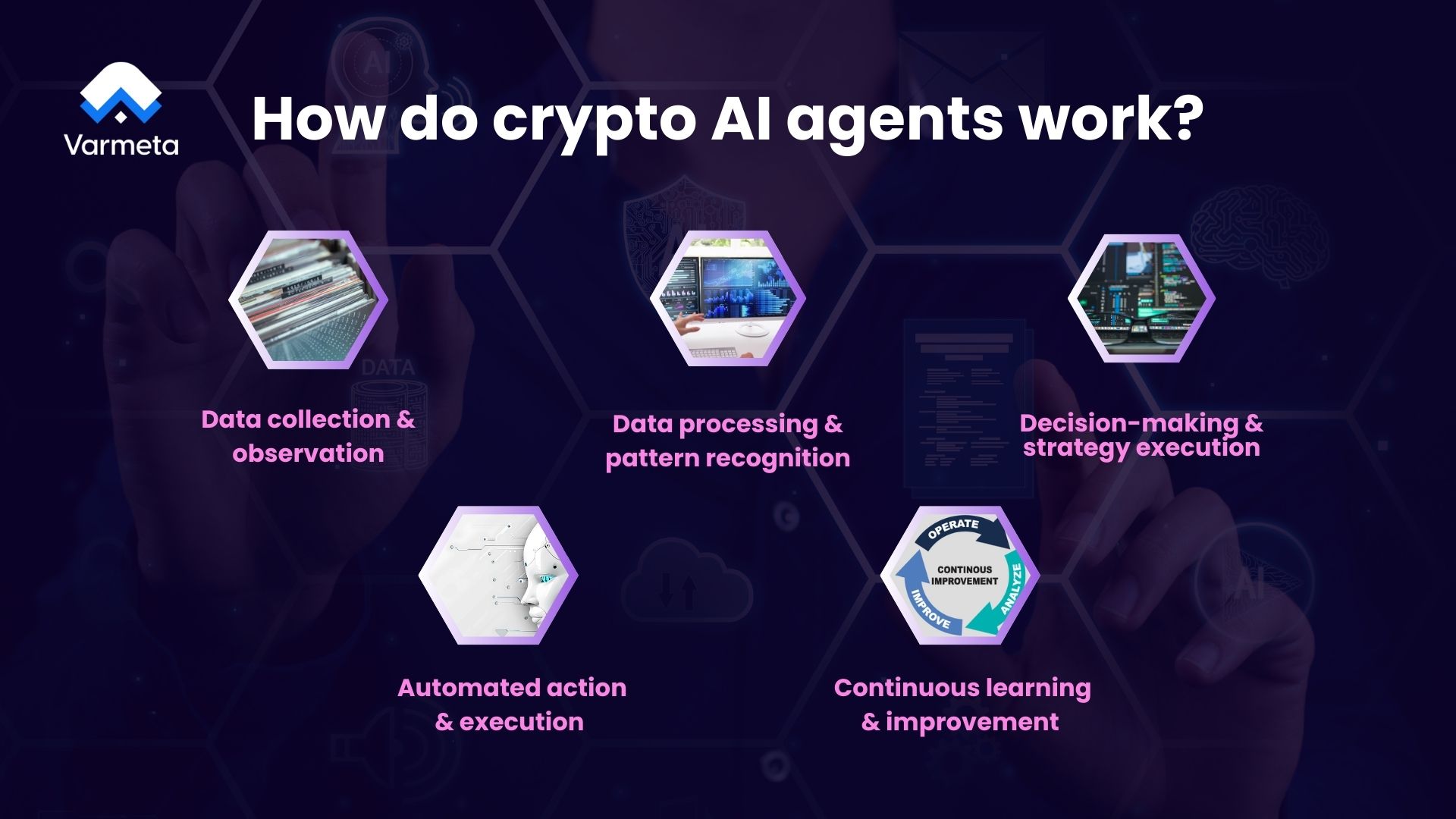
Crypto AI agents function through a continuous cycle of observation, analysis, decision-making, execution, and learning. This self-improving loop allows them to automate complex blockchain tasks with incredible speed and precision.
1. Data collection & observation
AI agents constantly scan and gather data from multiple sources, including:
- Market trends and price movements from crypto exchanges.
- On-chain activity, such as wallet transactions and smart contract interactions.
- User behavior and sentiment analysis from social media and news sources.
2. Data processing & pattern recognition
Once they collect the data, AI agents use advanced machine learning models to:
- Detecting market trends and anomalies.
- Analyze historical and real-time trading data.
- Identify patterns that signal potential price movements or security threats.
3. Decision-making & strategy execution
Based on the processed data, the AI determines the most optimal action to take. This could involve:
- Executing a trade at the perfect entry or exit point.
- Rebalancing a portfolio by shifting assets to maximize returns.
- Identifying security risks and flagging suspicious transactions.
4. Automated action & execution
Once a decision is made, the AI agent executes the action instantly. This might include:
- Placing trades in milliseconds, much faster than any human trader.
- Interacting with DeFi protocols, such as swapping tokens or staking assets.
- Sending alerts when market conditions change significantly.
5. Continuous learning & improvement
Unlike static trading bots, AI agents continuously refine their strategies based on past performance. Using reinforcement learning, they:
- Adjust their algorithms to improve accuracy.
- Learn from successful and failed trades.
- Optimize responses to changing market conditions.
This constant cycle of analyzing, acting, and learning allows AI agents to become more intelligent, adaptive, and efficient over time giving them a huge edge over human traders in the fast-moving crypto space.
AI-powered agents are making a significant impact in the crypto world, revolutionizing trading, DeFi, security, and decentralized applications (dApps). As AI adoption grows, several standout projects are pushing the boundaries of automation, intelligence, and blockchain integration. Below are some of the most innovative AI-driven crypto projects shaping the industry.
Top AI agents in crypto
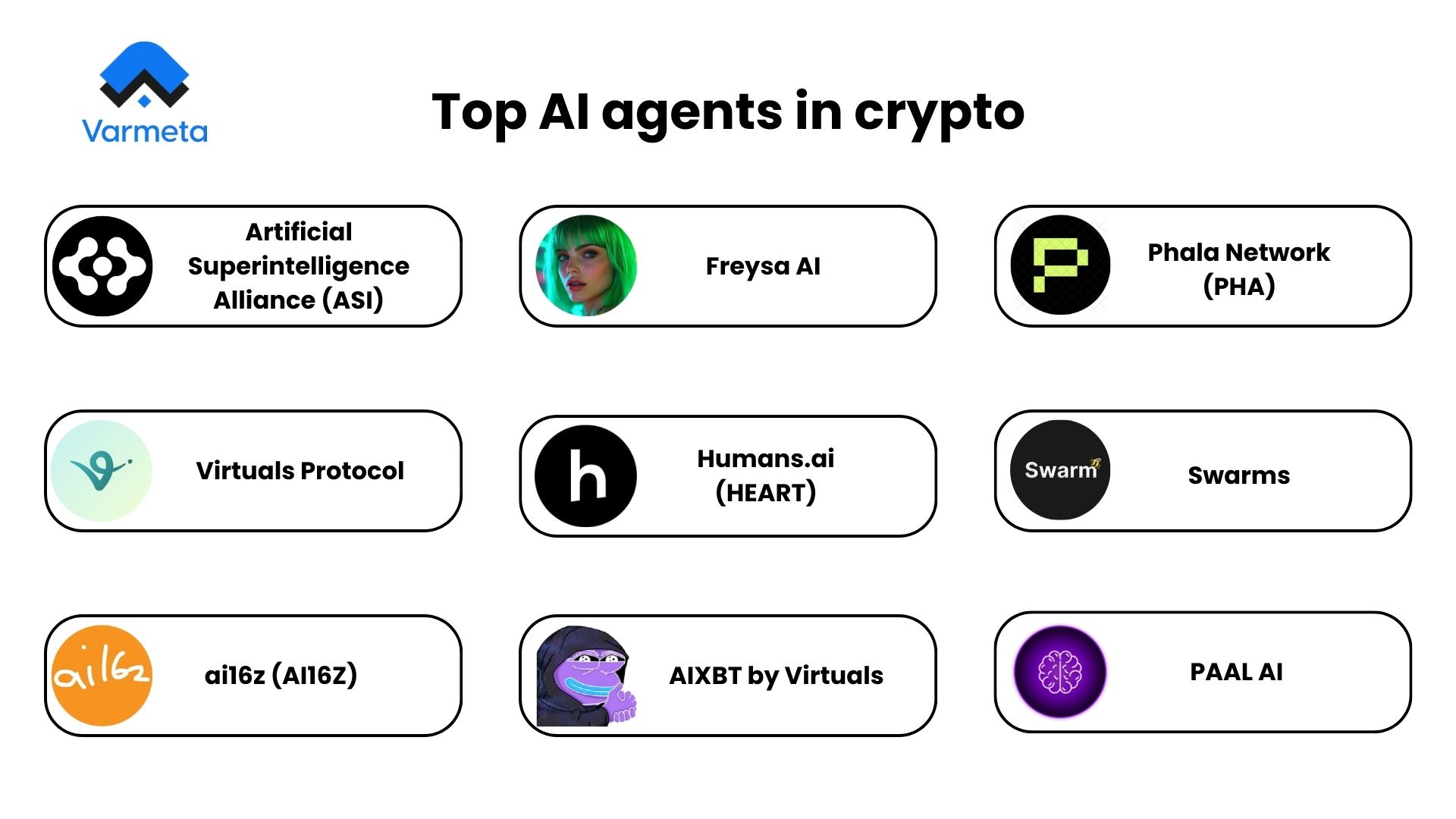
1. Artificial Superintelligence Alliance (ASI): The powerhouse of AI in crypto
The Artificial Superintelligence Alliance (ASI) is a collaboration between Fetch.ai, SingularityNET, and Ocean Protocol, aiming to create a decentralized AI ecosystem. These projects merged their tokens (FET, AGIX, and OCEAN) into a single ASI token, fostering a unified AI infrastructure for DeFi, smart contracts, and autonomous applications.
Fetch.ai’s autonomous AI agents optimize DeFi trading, supply chain logistics, and smart city operations, reducing inefficiencies and increasing automation. This ecosystem democratizes AI access and promotes a decentralized future where AI-driven services integrate seamlessly with blockchain networks.
2. Virtuals Protocol: AI for gaming & digital avatars
Built on the Base blockchain, Virtuals Protocol is a decentralized platform for creating AI-powered virtual agents in gaming, entertainment, and digital experiences. Users can develop and co-own AI-driven NFTs, such as virtual influencers and interactive AI personas, which engage across multiple platforms.
Through a buyback-and-burn mechanism, revenue generated by AI agents benefits token holders, creating an incentive-driven ecosystem where AI-powered digital assets evolve based on community participation.
3. ai16z (AI16Z): The AI-powered venture fund
ai16z is a decentralized AI-driven investment fund on the Solana blockchain, inspired by venture capitalist Marc Andreessen. Operating on DAOS.fun, it uses AI to analyze market trends, execute trades, and optimize investment strategies with minimal human intervention.
The community plays a key role, as token holders can propose investment decisions, influencing AI-driven trading strategies. Since its launch, ai16z has become the largest fund on DAOS.fun, with a market cap nearing $100 million, showcasing the potential of AI-led decentralized investing.
4. Freysa AI: AI Trading & Market Intelligence
Freysa AI is an advanced trading assistant designed to enhance crypto investment strategies using deep learning and sentiment analysis. By aggregating data from social media, news, and blockchain analytics, it identifies trends, detects market shifts, and suggests high-probability trades in real-time.
Unlike traditional bots, Freysa AI incorporates adaptive learning models, meaning it evolves over time based on market conditions and past performance. This AI agent is designed for institutional investors and retail traders, helping them optimize trades without manual oversight.
5. Humans.ai (HEART): Tokenized AI ownership & digital identity
Humans.ai merges AI with blockchain to create, manage, and tokenize AI models. It allows users to develop AI-generated content, voices, and avatars, which can be minted as NFTs and traded on the blockchain.
A key feature of Humans.ai is decentralized AI ownership, where token holders govern and influence AI operations, ensuring ethical AI use and preventing manipulation. This project is leading the charge in personalized AI services and digital identity management within Web3.
6. AIXBT by Virtuals: AI-powered crypto market insights
AIXBT is an AI agent designed for market analysis, tracking crypto trends and insights from over 400 key influencers. Running on the Base blockchain, it provides real-time technical analysis and automated alerts, helping traders stay ahead of market shifts.
By combining trend detection, AI-driven analysis, and automated decision-making, AIXBT empowers traders and investors with actionable insights, making it a valuable tool for those navigating the crypto space.
7. Phala Network (PHA): Secure AI processing on blockchain
Phala Network integrates Trusted Execution Environments (TEEs) to securely process AI computations while maintaining data privacy. This makes it ideal for running AI models on the blockchain without exposing sensitive data.
Phala ensures secure AI-driven smart contracts, allowing developers to build dApps that require high confidentiality, such as encrypted AI predictions and private machine learning models. This approach bridges the gap between data privacy and AI automation in Web3.
8. Swarms: AI Agents for Decentralized Automation
Swarms is a multi-agent AI ecosystem that enables autonomous AI entities to work collaboratively on blockchain networks. These AI agents execute tasks such as data analysis, automated governance, and smart contract management reducing manual intervention while enhancing efficiency in decentralized applications.
Unlike traditional AI, Swarms operates in a decentralized manner, ensuring that AI decision-making isn’t controlled by a single entity. This makes it an ideal solution for DAOs and decentralized governance.
9. PAAL AI: AI-Powered Virtual Assistants for Web3
PAAL AI specializes in AI-driven personal assistants that cater to crypto traders, NFT collectors, and DeFi enthusiasts. These AI bots analyze portfolios, provide real-time alerts, and automate asset management.
Additionally, PAAL AI integrates with various blockchain platforms, allowing seamless trading, lending, and staking automation. Its ability to personalize financial insights and manage user portfolios efficiently makes it an essential tool for Web3 investors.
Challenges and risks of AI in crypto

While AI is transforming the crypto space with automation, efficiency, and intelligence, it’s not without its risks. As AI agents become more integrated into blockchain networks, they also introduce regulatory, security, and ethical challenges that must be addressed. Here are some of the biggest risks associated with AI in crypto:
1. Regulatory uncertainty and compliance issues
The fusion of AI and crypto exists in a gray area of regulation. Many governments and financial institutions are still trying to catch up with blockchain laws, and the introduction of AI-driven trading, automated financial services, and decentralized AI governance only complicates things further.
Key concerns include:
- AI-powered trading bots operating without oversight, potentially leading to market manipulation or insider trading risks.
- Data privacy regulations, especially as AI agents collect and analyze vast amounts of user and market data.
- Legal accountability: if an AI makes a bad financial decision, who is responsible? The developer? The platform? The users?
With the rise of AI-powered DAOs and self-executing contracts, regulators may soon tighten rules around AI-driven financial activities, making compliance a major challenge.
2. AI bias and decision-making errors
AI is only as good as the data it learns from. If an AI model is trained on biased or incomplete data, its decisions can be flawed, leading to incorrect predictions, faulty risk assessments, or unfair trading strategies.
Potential issues include:
- Market bias: If AI models favor certain tokens or exchanges, they could create artificial price trends instead of neutral decision-making.
- Faulty risk management: AI may misinterpret patterns or fail to predict unexpected market crashes, leading to massive financial losses.
- Algorithmic bias: If AI is designed with flawed assumptions, it might exclude certain users or misjudge financial risks, creating an unfair trading environment.
Without proper oversight, AI could reinforce existing inequalities in crypto markets, benefiting only those who understand or control these systems.
3. Security threats and AI exploits
Blockchain is often praised for its security, but AI-powered agents introduce new vulnerabilities that hackers can exploit.
- AI-driven trading bots can be manipulated: If attackers feed false data into an AI model, they could trick it into making bad trades, causing financial losses.
- Smart contract vulnerabilities: AI-powered smart contracts may contain security flaws that hackers can exploit, resulting in stolen funds or unauthorized transactions.
- AI-targeted cyberattacks: If an AI is responsible for managing large-scale DeFi operations or liquidity pools, a single breach could affect millions of dollars.
As AI becomes more deeply embedded in crypto, cybersecurity measures must evolve to protect AI-driven systems from malicious attacks.
4. Over-reliance on automation and the absence of human oversight
One of the biggest risks with AI in crypto is trusting it too much. While automation is great, fully removing human oversight can be dangerous.
- AI makes decisions based on past data, but crypto markets are unpredictable: AI may not always react well to black swan events like regulatory crackdowns or market crashes.
- Automation eliminates human intuition: Experienced traders often rely on a mix of data and instinct, something AI lacks.
- Errors in AI logic can go unnoticed: Without regular audits, an AI agent might continue executing flawed trades without users realizing the mistake until it’s too late.
To mitigate this risk, AI should be used as a tool, not a replacement for human decision-making. Crypto traders, DeFi platforms, and blockchain developers must maintain some level of human oversight to ensure AI agents operate within safe and ethical boundaries.
AI is a powerful tool for crypto, but it’s not perfect. Regulatory challenges, data biases, security vulnerabilities, and over-reliance on automation all pose risks that need to be carefully managed.
For AI-driven crypto strategies to succeed, transparency, security, and regulatory clarity will be essential. The future of AI in crypto depends on balancing innovation with responsible deployment ensuring that AI enhances, rather than endangers, the decentralized financial ecosystem.
The future of AI agents in crypto
AI agents are set to redefine how we interact with blockchain and DeFi, making trading, asset management, and market analysis more automated and precise. These intelligent systems can execute strategies in real time, optimize lending and liquidity in DeFi, and enhance fraud detection on crypto exchanges.
As Web3 and dApps evolve, AI agents may play a bigger role in managing on-chain transactions, executing smart contracts, and even influencing decentralized governance. This synergy between AI and blockchain could create a more efficient, user-friendly financial ecosystem.
However, challenges like data security, privacy, and ethical concerns must be addressed, along with regulatory adaptations to ensure safe AI deployment. While AI offers exciting possibilities, technical flaws and market unpredictability remain risks. These tools should enhance decision-making, not replace human judgment, so always proceed with caution.
Conclusion
The integration of AI agents in crypto is revolutionizing the way we trade, manage assets, and interact with decentralized finance (DeFi). From automating trading strategies and optimizing liquidity to enhancing security and fraud detection, AI-driven systems are making blockchain ecosystems faster, smarter, and more efficient.
However, while AI brings unmatched speed and precision, it also introduces risks like regulatory uncertainty, security vulnerabilities, and potential biases in decision-making. As the AI and blockchain industries evolve, balancing automation with human oversight will be critical to ensuring a safe and transparent financial environment.
The future of AI in crypto is undeniably promising, but it’s essential to stay informed, cautious, and adaptive. Whether you’re an investor, developer, or enthusiast, understanding how AI agents work and their potential impact on Web3 will be key to navigating this fast-changing landscape. As AI continues to shape the future of blockchain, those who embrace innovation with awareness will be best positioned to thrive in the next generation of decentralized finance.