AI for lead generation is reshaping how businesses attract, qualify, and convert potential customers in an increasingly competitive digital landscape. Instead of relying solely on manual processes, organizations can now leverage intelligent automation to work faster and smarter. Explore how these strategies come together in this guide from Varmeta.
Understanding AI-Powered Lead Generation
AI lead for generation is the practice of using artificial intelligence driven systems, including autonomous agents, to discover, attract, and qualify prospective customers. These technologies leverage advanced algorithms and data processing capabilities to automate routine activities, interpret large volumes of information, and uncover meaningful patterns.
As a result, sales and marketing teams can shift their attention toward building relationships with high potential leads instead of spending time on manual and repetitive tasks.
Advantages and Limitations
Understanding both the benefits and the potential drawbacks of AI for lead generation helps businesses make informed decisions and set realistic expectations before implementation.
Pros
Here are the key advantages that make AI for lead generation a powerful asset for modern marketing and sales teams.
Faster and Smarter Lead Qualification
AI for lead generation analyzes potential customers across multiple data points at the same time. It reviews factors such as company profile, industry category, technology stack, hiring activity, and digital engagement within seconds. This allows your team to quickly identify which prospects are ready for outreach and which ones require further nurturing before conversion.
Continuous Lead Nurturing
Prospects receive well timed interactions across email, social platforms, and additional digital channels. AI keeps conversations active even when your team is unavailable, preventing opportunities from slipping through the cracks. By adjusting messaging based on user behavior and engagement levels, the system sustains interest and guides leads smoothly toward purchase readiness.
Improved Conversion Precision
Predictive analytics powered by AI for lead generation pinpoint high intent prospects with exceptional accuracy. The system uncovers behavioral and contextual signals that reveal purchase readiness, even when those signals are difficult for humans to clearly define. By prioritizing leads with the strongest likelihood to convert, sales teams can significantly increase close rates and overall revenue performance.
Centralized Prospect Insights
All interactions, data points, and behavioral indicators are consolidated into a single system. This gives sales representatives a complete picture of each prospect before initiating any outreach. Monday CRM presents these insights through a clean and user friendly interface, allowing teams to prepare faster and approach conversations with greater confidence.
Live Data Enrichment
Prospect profiles are refreshed automatically as new information becomes available. Updates such as funding announcements, executive changes, and business growth signals are added directly to your CRM without manual effort. This ensures your team always has accurate, up to date context and meaningful conversation starters for every interaction.
Intelligent Sales Forecasting
AI evaluates your sales pipeline to estimate which opportunities are most likely to convert and the expected timing of each deal. This gives revenue teams greater visibility into upcoming performance and potential risks. As the system learns from your historical data and sales patterns, its predictions become increasingly accurate over time.
Cons and Solutions
Below are the common challenges of using AI for lead generation along with practical ways to overcome them.
High Send Volume, Flat Reply Rates
You are reaching many prospects, but your outreach is not generating meaningful engagement or responses.
How to fix:
- Enrich prospect data before sending
- Reduce your audience size by 30 – 50% to focus on higher-fit leads
- Increase relevance with role-based and industry-specific proof points
Strong Open Rates, Low Meeting Conversion
Your subject lines attract attention, but the message inside does not drive prospects to take action.
How to fix:
- Use one clear and specific call-to-action
- Include calendar-friendly time suggestions
- After repeated opens, escalate to a quick call or voice note
Pipeline Growth with Rising Acquisition Costs
Your pipeline is expanding, but the cost to generate opportunities is increasing.
How to fix:
- Cap enrichment spend for B-tier accounts
- Reserve premium data (such as mobile numbers) for A-tier accounts showing buying intent
How AI Delivers Results for Marketing Teams?
This section explains how AI transforms everyday marketing activities into measurable performance improvements.
Lead Creation and Acquisition
Artificial intelligence is transforming how businesses capture and convert demand. From smart chatbots that engage visitors instantly to automation platforms that sharpen targeting and prioritize high-intent prospects, AI helps organizations generate and nurture leads with higher precision and speed. Below are five powerful ways companies can leverage AI to improve lead generation performance.
Conversational Chatbots for Customer Engagement
AI-driven chatbots are reshaping the way brands interact with online audiences. These virtual assistants respond instantly to questions, help users navigate pages, and collect essential contact details for ongoing outreach.
More advanced solutions personalize conversations based on browsing patterns and intent signals, creating smoother and more relevant experiences. As a result, companies can automate early-stage engagement while converting more website visitors into qualified leads.
Audience Segmentation and Targeting
Customer segmentation plays a vital role in modern marketing, and artificial intelligence takes it to a new level of accuracy and speed. AI systems examine factors such as demographics, buying patterns, and digital interactions to categorize audiences into meaningful groups. These insights enable brands to craft highly targeted messaging that speaks directly to each segment’s interests and needs.
For instance, AI can uncover a cluster of sustainability-focused shoppers, helping marketers promote eco-friendly products or initiatives. With smarter segmentation, campaigns feel more personalized, driving stronger engagement and higher conversion rates.
AI-Based Predictive Lead Scoring
AI-driven predictive lead scoring evaluates signals like historical interactions, buying behavior, and engagement activity to estimate each prospect’s probability of conversion. This intelligence helps sales teams prioritize the most promising opportunities, increasing productivity and improving close rates.

Beyond better prioritization, predictive scoring also uncovers trends and patterns that inform smarter lead generation tactics. Over time, these insights support continuous optimization and more sustainable revenue growth.
Email Campaign Automation
Email marketing continues to be a powerful channel for lead nurturing, and artificial intelligence significantly enhances its impact. AI-powered email platforms craft highly personalized content using insights from user interests, online activity, and previous buying behavior.
They also determine the best send times to maximize opens and clicks. With automated campaigns delivering timely and relevant messages, brands stay visible to prospects and drive stronger conversions.
Social Media Monitoring and Insights
Social media channels offer immense opportunities for lead discovery, and artificial intelligence makes it easier to uncover and engage the right prospects. AI-based tools track keywords, hashtags, and online conversations to spot users showing interest in specific products or solutions.
By interpreting these signals, brands can start relevant conversations, respond to questions, and build trust with potential customers. In addition, social listening powered by AI reveals brand sentiment and highlights new opportunities for targeted outreach and growth.
Applying AI to Your Lead Generation Strategy
When implemented thoughtfully, AI solutions can reshape lead generation by increasing efficiency, precision, and overall impact. Below are practical tips to help you integrate artificial intelligence into your lead generation workflow successfully.
- Define clear objectives and pinpoint the specific lead generation challenges your business needs to solve. This clarity keeps AI initiatives aligned with your broader marketing and sales strategy.
- Select AI tools that match your priorities and confirm they integrate smoothly with your current platforms, including your CRM.
- Use marketing personalization software to deliver relevant content to distinct audience segments, driving higher engagement and stronger conversion rates.
- Train your team to use AI tools confidently by combining technical instruction with guidance on strategic application.
- Track key performance indicators like lead quality, conversion rates, and engagement to continuously refine and optimize your approach.
- Comply with data privacy regulations such as GDPR and CCPA to safeguard customer information and reinforce trust.
Essential Features of AI For Lead Generation Software
These core features define what makes an AI lead generation platform effective, scalable, and results-driven.
Intelligent Automation Functions
Automation lies at the heart of modern AI for lead generation platforms, enabling businesses to streamline repetitive and resource-heavy activities like lead qualification and lead scoring. This approach not only reduces manual effort but also improves accuracy across the entire sales funnel.
By offloading routine tasks to intelligent systems, teams can concentrate on engaging high-intent prospects and executing higher-level strategies. Many advanced tools also use behavioral triggers to automatically segment leads and initiate timely follow-ups, ensuring every opportunity is captured and no potential customer is overlooked.
Data Enhancement and Audience Segmentation
AI-powered platforms allow organizations to build deeper, more detailed customer profiles than ever before. By collecting and enriching data from multiple channels, these tools create a unified view of customer behaviors, preferences, and demographic attributes within a single dashboard. This enriched dataset enables intelligent algorithms to segment audiences with high accuracy, making it easier to deliver personalized messaging that aligns with individual interests.
As a result, campaigns become more relevant and effective, driving higher engagement and stronger conversion rates. In addition, AI-driven insights uncover trends and behavioral patterns that help businesses continuously optimize their lead generation and marketing strategies for sustainable growth.
Smooth CRM Connectivity
Tight integration between AI-powered solutions and CRM platforms plays a critical role in modern lead management. When systems are properly connected, data flows automatically between tools, giving teams a single, up-to-date view of every interaction and lead stage.
By linking AI-driven lead generation software with a CRM, businesses improve visibility, streamline collaboration between marketing and sales, and reduce manual data entry. Many advanced integrations also include predictive insights that help teams anticipate lead behavior and focus on the most promising opportunities. Together, these capabilities create a more efficient workflow, improve decision-making, and boost overall productivity.
Top AI For Lead Generation Tools to Use in 2026
Here is a curated selection of leading AI lead generation tools that businesses can rely on in 2026 to drive consistent growth.
Clay – Advanced Lead Enrichment and Workflow Automation Platform
Clay is increasingly popular with data-driven sales and growth teams because of its unmatched adaptability. More than a simple lead discovery tool, it functions as a comprehensive platform for enriching, scoring, and qualifying contacts by pulling insights from numerous data providers in one place. With an intuitive no-code environment, Clay enables users to connect APIs, design advanced filtering rules, and trigger personalized outreach workflows.
Key highlights of Clay:
- Advanced enrichment from sources such as social networks, Clearbit, Crunchbase, and other data platforms
- Visual no-code builder for creating highly customized workflows
- Seamless integrations with Zapier, Make, and leading CRM systems
- Well suited for power users and analytics-focused teams
- Requires a learning curve, but delivers strong long-term value
Apollo – B2B Lead Database and Multichannel Outreach Platform
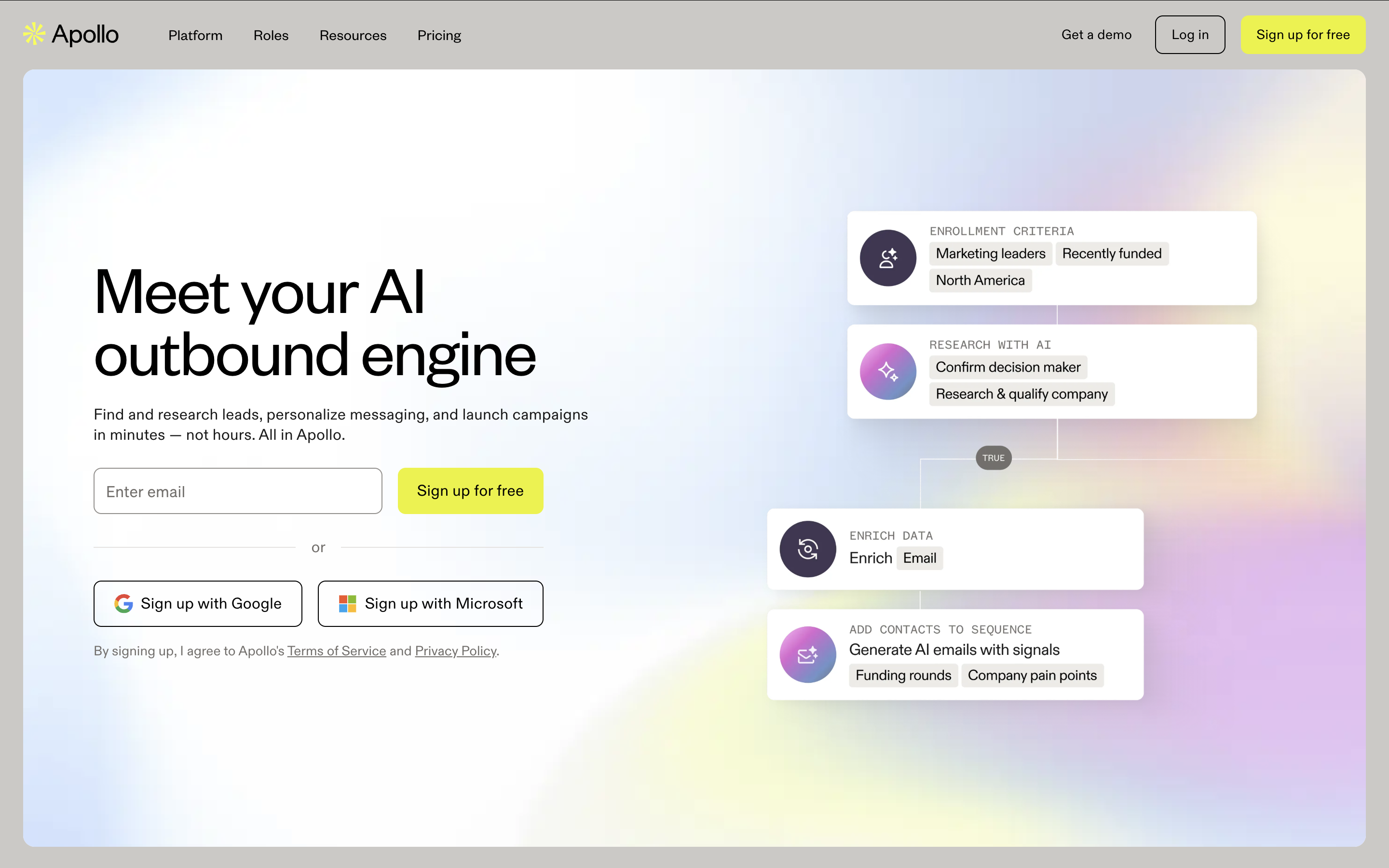
Apollo combines an extensive B2B contact database with built-in outbound engagement features, making it a practical all-in-one solution for sales and marketing teams. For organizations seeking a straightforward platform that covers both prospecting and outreach, Apollo delivers strong functionality without unnecessary complexity.
The platform supports multichannel engagement, primarily through email and calling, and provides performance analytics to help teams measure and optimize campaigns. Although its AI capabilities are relatively lightweight, Apollo stands out for its affordability and overall value.
Key highlights of Apollo:
- Access to millions of verified business contacts across multiple industries
- Automated outreach through email and phone sequences
- Real-time tracking of opens, replies, and engagement activity
- User-friendly interface with fast onboarding
- Native integrations with popular CRMs such as HubSpot and Salesforce
Lavender – AI Email Assistant for Sales Outreach
Lavender is not a complete lead generation platform, but it is a highly effective tool for sales professionals who depend heavily on email communication. It functions as a real-time writing assistant that analyzes and improves your messages for clarity, tone, and response potential, helping you create emails that drive more conversations.
The tool integrates seamlessly with Gmail and Outlook, allowing reps to optimize outreach without leaving their inbox. For SDRs and sales teams sending large volumes of emails, even minor enhancements in copy quality can lead to noticeable increases in reply rates.
What makes Lavender stand out:
- Real-time email coaching based on tone, readability, and buyer psychology
- Built-in grammar, clarity, and formatting optimization
- Native integrations with inbox platforms and popular CRMs
- Ideal for teams that already have leads and want to improve response rates
How To Build An AI-Driven Lead Generation Team?
Here are some of the most reliable and innovative AI for lead generation platforms shaping how businesses find and convert prospects in 2026.
Defining Roles and Responsibilities
An effective AI driven lead generation team combines both technical expertise and strategic marketing knowledge. Data analysts and AI professionals are responsible for maintaining models, interpreting performance data, and optimizing system accuracy.
At the same time, marketing strategists and campaign managers turn AI insights into highly targeted outreach efforts, while sales teams work closely with them to identify priority leads and convert opportunities into revenue.
Skills Development and Ongoing Training
To fully unlock the value of AI lead generation tools, team members need strong skills and practical knowledge. Training initiatives should emphasize technical competence, including working with AI platforms, analyzing data driven insights, and connecting tools with current business systems. Ongoing upskilling through workshops, online courses, and certifications helps professionals stay current with emerging AI trends and proven best practices.
Guide To Measure Performance of AI For Lead Generation Campaigns
Measuring the effectiveness of AI powered lead generation depends on monitoring the right performance indicators that reveal what is truly working. Organizations should consistently track the following metrics:
- Conversion rate, which shows the percentage of leads that become paying customers and reflects overall campaign success.
- Lead quality, which evaluates the relevance, readiness, and potential value of acquired prospects. This ensures teams focus on high impact opportunities.
- Engagement levels, which indicate how prospects interact with content, emails, and campaigns, helping assess outreach effectiveness.
Regular analysis of these metrics enables businesses to fine tune their lead generation strategies for better results. By following best practices and embracing continuous optimization, teams can stay agile and respond effectively to changing market conditions.
Detailed Comparison Between Traditional Lead Generation vs AI-Based Approaches
| Tool Category | Primary Function | Key AI Capabilities | Example Use Scenario |
| Prospecting and List Building | Discover new contacts and companies that closely match your Ideal Customer Profile (ICP) | AI-powered ICP modeling, lookalike audience creation, and real-time intent data tracking. | AI-powered ICP modeling, lookalike audience creation, and real-time intent data tracking. |
| Data Enrichment | Complete and enhance existing lead and contact records with accurate information | Automated data collection, email and contact verification, and technology stack detection | Transforming a single email address into a complete profile with job role, company size, and funding details |
| Conversational Marketing | Interact with and qualify website visitors in real time | Natural Language Processing (NLP), automated qualification flows, and instant meeting scheduling | A chatbot on your pricing page answers questions and books demos for qualified prospects |
| Predictive Analytics and Lead Scoring | Rank and prioritize leads and accounts based on their likelihood to convert | Machine learning models, behavioral pattern recognition, and predictive scoring algorithms | Automatically identifying the top 10% of inbound leads for immediate sales follow-up |
| Sales Engagement and Outreach | Automate and personalize outbound communication across multiple channels. | Generative AI email creation, sentiment analysis, and optimal send-time optimization. | An SDR uses an AI assistant to create personalized first-touch emails for 100 prospects within one hour. |
Responsible and Ethical Use of AI in Lead Generation
Implementing AI in lead generation must be guided by strong ethical principles to preserve customer trust and meet regulatory standards. Protecting personal data and complying with laws such as GDPR and CCPA are fundamental to safeguarding sensitive information. Clear and transparent AI models also promote fairness in lead scoring and automated decisions, helping organizations maintain responsible and unbiased practices.
In addition, actively identifying and reducing bias within AI systems is essential to prevent discrimination and ensure balanced outcomes. By prioritizing ethical safeguards from the start, businesses can deploy AI solutions with confidence while unlocking their full potential to enhance and scale lead generation efforts.
What’s Next for AI in Lead Generation?
The future of AI for lead generation centers on greater accuracy, operational efficiency, and scalable growth. With advanced AI marketing platforms and B2B marketing solutions, businesses can uncover new revenue opportunities while strengthening their competitive position.
Intelligent automation streamlines prospecting and nurturing, enabling teams to reach the right audiences with precision and allocate resources more strategically. As AI technologies continue to advance, adopting these solutions will be essential for driving sustainable growth and long-term success in an increasingly competitive landscape.
FAQs
Below are answers to some of the most common questions and detailed answers about using AI for lead generation.
How Quickly Can You Expect Results From AI Lead Generation?
Many businesses start noticing early benefits within 30 to 45 days, such as higher quality leads and reduced time spent on manual tasks. Stronger gains, including better conversion rates and faster pipeline movement, usually emerge after 90 to 120 days as AI systems adapt to your data and sales processes.
Which Businesses Gain The Most Value From AI Lead Management?
Organizations with complex B2B sales cycles see the greatest impact from AI driven lead management, particularly those dealing with multiple stakeholders and extended buying journeys. SaaS providers, professional service companies, and manufacturers selling high value solutions often experience the strongest improvements after adopting AI.
How Reliable Is Ai At Forecasting Lead Conversions?
Most AI systems begin with prediction accuracy of around 60% and can improve to roughly 75 to 85% after analyzing six to twelve months of historical sales data. The level of accuracy depends largely on data quality, the complexity of your sales cycle, and how consistently your team applies defined workflows.
AI for lead generation empowers businesses to streamline prospecting, improve lead quality, and drive stronger conversion outcomes through intelligent automation and data-driven insights. By applying the strategies, best practices, and ethical considerations covered in this guide, organizations can build a more efficient and scalable approach to growth. Discover more practical insights on Varmeta.