Recruiting has become increasingly challenging as businesses compete for top talent while managing growing application volumes and rising hiring costs. Traditional recruitment methods, which rely heavily on manual resume screening, scheduling, and communication, can slow the hiring process and make it difficult to scale efficiently. As a result, many organizations are turning to automated recruitment to streamline repetitive tasks, improve hiring efficiency, and enhance the candidate experience.
But does automated hiring truly outperform traditional hiring? Understanding the strengths and limitations of both approaches is essential for businesses looking to modernize their hiring process without compromising recruitment quality.
What is Automated Recruitment?

Automated recruitment is the use of software, artificial intelligence (AI), and workflow automation to streamline and optimize various stages of the hiring process. Instead of relying solely on manual tasks, organizations use automated systems to perform repetitive activities such as posting job openings, screening resumes, scheduling interviews, communicating with candidates, and tracking hiring progress.
The primary goal of automated hiring is not to replace recruiters but to reduce administrative workload, improve hiring efficiency, and enable recruitment teams to focus on higher-value activities such as candidate engagement, interviewing, and strategic decision-making. By automating routine processes, businesses can shorten time-to-hire, minimize human error, and provide a more consistent experience for candidates.
Although the terms automated recruitment and AI recruitment are often used interchangeably, they have distinct meanings.
- Automated recruitment is the broader concept of using technology to automate and optimize the overall recruitment process. It may include both rule-based automation and AI-powered capabilities.
- AI recruitment specifically refers to the application of artificial intelligence in hiring. As a key component of the broader adoption of AI for human resources, these tools can analyze resumes, match candidates with job requirements, rank applicants, generate interview questions, predict hiring outcomes, or support recruiters with data-driven recommendations.
How does Automated Recruitment work?
Automated recruitment transforms traditional hiring by automating repetitive tasks while enabling recruiters to focus on evaluating candidates and making strategic hiring decisions. Although workflows may vary depending on the organization and recruitment platform, most automated hiring systems follow a similar process from job posting to employee onboarding.
Job Posting and Distribution
The recruitment process begins with creating a job description and publishing it across multiple channels. Instead of posting vacancies manually on each platform, automated recruitment software distributes job listings simultaneously to company career pages, job boards, and social media platforms. This helps employers reach a wider talent pool while reducing administrative effort.
Resume Screening
As applications are received, the system automatically collects and organizes candidate information. Applicant Tracking Systems (ATS) and AI-powered screening tools evaluate resumes based on predefined criteria such as skills, qualifications, experience, certifications, and keywords. Rather than replacing recruiters, these tools prioritize qualified candidates, allowing hiring teams to review the most relevant applications first.
Interview Scheduling and Candidate Communication
Once shortlisted, candidates are automatically invited to the next stage of the hiring process. Automated workflows can send personalized emails, confirm interview availability, synchronize calendars, and issue reminders without requiring manual coordination. This significantly reduces scheduling conflicts and improves the overall candidate experience.
Candidate Assessment and Evaluation
Many organizations integrate online assessments, technical tests, or AI-assisted evaluations into their recruitment process. Depending on the hiring platform, automation can score assessments, generate candidate summaries, and consolidate interview feedback from multiple stakeholders. Recruiters and hiring managers then use these insights alongside their professional judgment to make informed hiring decisions.
Offer Management and Onboarding
After a candidate is selected, automated recruitment systems continue supporting the hiring journey by generating offer letters, collecting required documents, initiating background checks, and guiding new employees through onboarding tasks. This creates a seamless transition from recruitment to employment while ensuring consistency and compliance across the hiring process.
Automated Recruitment vs Traditional Recruitment
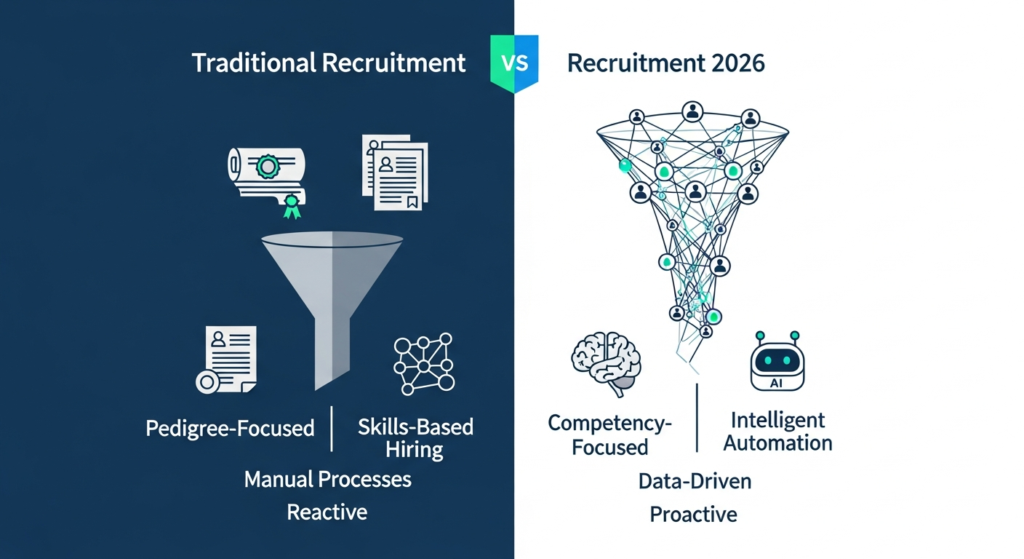
While both automated recruitment and traditional recruitment share the same goal of identifying and hiring qualified talent, they differ significantly in how recruitment tasks are managed. Traditional recruitment relies heavily on manual processes, whereas automated recruitment leverages software, AI, and workflow automation to streamline repetitive tasks and improve hiring efficiency.
The choice between the two approaches depends on factors such as hiring volume, business size, and recruitment objectives. The table below highlights the key differences.
| Criteria | Automated Recruitment | Traditional Recruitment |
| Hiring Cost | Lower long-term operational costs by reducing repetitive manual work and administrative overhead. | Higher labor costs due to manual screening, scheduling, and communication. |
| Time-to-Hire | Accelerates hiring through automated screening, interview scheduling, and candidate communication. | Longer hiring cycles because each stage requires manual coordination. |
| Candidate Experience | Faster responses, timely updates, and consistent communication throughout the recruitment journey. | Response times may vary depending on recruiter availability, potentially leading to inconsistent candidate experiences. |
| Accuracy | Delivers consistent screening based on predefined criteria and AI-driven analysis, though human oversight remains essential to minimize bias and review complex cases. | Allows recruiters to apply professional judgment and contextual evaluation but may be affected by human error or inconsistent assessments. |
| Scalability | Easily manages thousands of applications across multiple roles and locations simultaneously. | Becomes increasingly resource-intensive as hiring volume grows. |
| Human Involvement | Recruiters focus on interviews, relationship building, and final hiring decisions while automation handles repetitive tasks. | Recruiters are involved throughout every stage, from resume review to interview coordination and administrative follow-up. |
Benefits and Challenges of Automated Recruitment
Automated recruitment helps organizations improve hiring efficiency by reducing manual work and accelerating repetitive recruitment tasks. However, like any technology-driven solution, it also comes with limitations that businesses should consider before implementation. Understanding both the advantages and challenges enables organizations to adopt automation more effectively while maintaining fair and informed hiring practices.
Benefits
- Faster Hiring Process: One of the biggest advantages of automated recruitment is its ability to shorten the hiring cycle. Tasks that traditionally require hours of manual effort, such as resume screening, interview scheduling, and candidate communication, can be completed automatically, allowing recruiters to fill positions more quickly.
- Improved Recruiter Productivity: Automation eliminates repetitive administrative work, enabling recruiters to focus on higher-value responsibilities such as interviewing candidates, building relationships, and making strategic hiring decisions. This improves both team productivity and overall recruitment efficiency.
- Better Candidate Experience: Candidates benefit from quicker responses, automated interview reminders, and consistent communication throughout the recruitment journey. A smoother hiring experience can strengthen an employer’s brand and reduce the likelihood of losing qualified candidates due to delays.
- Greater Scalability: Automated recruitment platforms can process hundreds or even thousands of applications simultaneously without significantly increasing recruitment resources. This makes automation particularly valuable for organizations experiencing rapid growth or high-volume hiring.
- Data-Driven Hiring Decisions: Modern recruitment platforms provide analytics and reporting that help organizations monitor recruitment performance, identify bottlenecks, measure hiring metrics such as time-to-hire, and continuously optimize their recruitment strategy. According to LinkedIn Talent Solutions, 61% of talent acquisition professionals believe AI can improve how they measure quality of hire.
Challenges
- AI Bias and Fairness Concerns: AI-powered recruitment systems learn from historical hiring data. If that data contains existing biases, the system may unintentionally favor or disadvantage certain groups of candidates. Human oversight is therefore essential to ensure fair and inclusive hiring decisions.
- Qualified Candidates May Be Overlooked: Applicant Tracking Systems (ATS) and automated screening tools often rely on predefined criteria, keywords, or scoring models. As a result, qualified candidates with unconventional career paths or resumes that do not match specific keywords may be filtered out despite having strong potential.
- Data Privacy and Regulatory Compliance: Recruitment platforms process sensitive personal information, including resumes, contact details, employment history, and assessment results. Organizations must ensure that candidate data is collected, stored, and processed securely while complying with applicable privacy regulations and internal data governance policies.
- Technology Cannot Replace Human Judgment: Although automation significantly improves recruitment efficiency, it cannot fully evaluate qualities such as emotional intelligence, communication skills, leadership potential, motivation, or cultural fit. Final hiring decisions should always involve experienced recruiters or hiring managers who can assess these human factors alongside data-driven insights.
When should businesses adopt Automated Recruitment?

Automated recruitment is not a one-size-fits-all solution. The value it delivers depends on an organization’s hiring volume, recruitment complexity, available resources, and long-term talent acquisition strategy. While automation can significantly improve efficiency, businesses should adopt it where it solves genuine recruitment challenges rather than simply following technology trends.
Startups
For startups with occasional hiring needs, investing in a comprehensive automated recruitment platform may not be a priority. In the early stages, lightweight tools for job posting, applicant tracking, and interview scheduling are often sufficient to reduce administrative work while keeping costs under control.
However, startups experiencing rapid growth or preparing to scale their workforce can benefit from automation early, as it helps establish consistent hiring processes before recruitment demand increases.
Small and Medium-Sized Enterprises (SMEs)
SMEs often gain the greatest return from automated recruitment. As hiring becomes more frequent, manual recruitment processes can consume significant time and limit HR productivity. Automating resume screening, candidate communication, and interview scheduling allows smaller HR teams to manage higher application volumes without expanding headcount.
For many SMEs, automation provides a practical balance between operational efficiency and cost-effectiveness.
Large Enterprises
Large organizations typically manage multiple vacancies across departments, business units, or geographic locations simultaneously. Automated recruitment enables enterprise HR teams to standardize hiring workflows, improve collaboration, maintain compliance, and process thousands of applications efficiently.
When integrated with enterprise HR systems, automation also provides centralized reporting and recruitment analytics that support long-term workforce planning.
When Automated Recruitment May Not Be the Right Choice
Despite its advantages, automated recruitment is not always the best approach. Businesses may choose to rely more heavily on traditional recruitment when:
- Hiring is infrequent or limited to only a few positions each year.
- Roles require extensive relationship building, such as executive or C-level recruitment.
- Candidate evaluation depends heavily on creativity, leadership potential, or highly specialized expertise that cannot be accurately assessed through automated screening.
- The organization lacks the resources to implement, manage, or continuously optimize recruitment technology.
Conclusion
Compared with traditional recruitment, automation offers significant advantages in efficiency, scalability, and data-driven hiring. However, it is not intended to replace recruiters. The most successful organizations combine intelligent automation with human expertise to ensure hiring decisions remain fair, accurate, and aligned with business objectives.
Whether you’re a startup preparing to scale, an SME looking to improve recruitment efficiency, or an enterprise managing high-volume hiring, adopting the right level of automation can help build a more agile and future-ready recruitment process.
Ready to Modernize Your Hiring Process?
Implementing automated recruitment is more than adopting new technology, it’s about creating a hiring strategy that balances efficiency, candidate experience, and human expertise.
👉 Schedule a consultation today and discover how automation can transform your recruitment strategy.
FAQs
1. Can automated recruitment completely replace human recruiters?
No. While automation can handle repetitive tasks such as resume screening, interview scheduling, and candidate communication, it cannot fully assess qualities like emotional intelligence, cultural fit, leadership potential, or interpersonal skills. Most organizations use automation to support recruiters rather than replace them.
2. Is automated recruitment only suitable for large enterprises?
Not necessarily. Businesses of all sizes can benefit from recruitment automation, but the level of automation should match their hiring needs. Startups may only require basic applicant tracking and interview scheduling, while larger organizations often adopt end-to-end recruitment platforms with AI-powered capabilities.
3. How much of the recruitment process should be automated?
The most effective approach is to automate repetitive, time-consuming tasks while keeping people involved in high-impact decisions. Activities such as job posting, resume screening, interview scheduling, and onboarding are commonly automated, whereas interviews, final evaluations, and hiring decisions typically remain human-led.
4. Will using an ATS cause qualified candidates to be rejected?
It can happen if screening criteria are too restrictive or overly dependent on keywords. To reduce this risk, organizations should regularly review filtering rules, combine automated screening with recruiter oversight, and evaluate candidates based on multiple factors rather than keyword matches alone.
5. What should businesses consider before implementing automated recruitment?
Before adopting recruitment automation, businesses should evaluate their hiring volume, recruitment challenges, budget, existing HR systems, and compliance requirements. Choosing a solution that integrates well with current workflows and provides the right balance between automation and human oversight is often more important than selecting the platform with the most features.