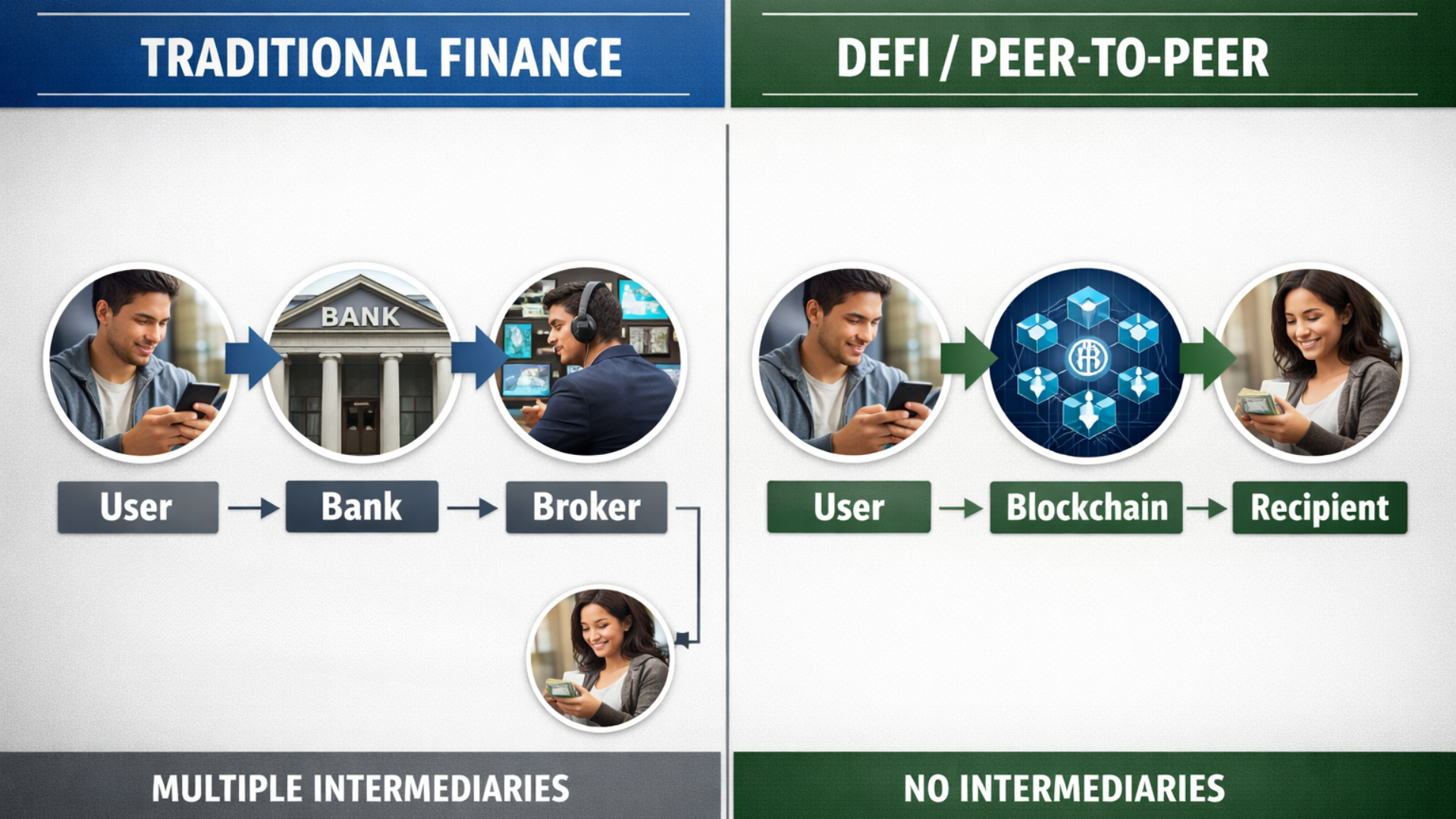
A quiet revolution is reshaping the global financial system and at the center of it stands Decentralized Finance (DeFi). According to the World Economic Forum (WEF), blockchain-based financial infrastructure has the potential to transform how value is created, stored, and transferred across the world. For millions of people who are unbanked, underbanked, or simply frustrated with slow, expensive traditional banking, DeFi offers a compelling alternative: an open, permissionless, peer-to-peer finance ecosystem that operates around the clock, no banks, no brokers, no intermediaries required.
Whether you are a curious newcomer or a business professional exploring the future of DeFi, this guide is designed specifically for you. By the end, you will understand exactly what decentralized finance is, how it works technically, its most exciting real-world use cases, the risks you need to know about, and where the future of decentralized finance is heading in 2026 and beyond.
What Is Decentralized Finance (DeFi)?
At its simplest, Decentralized Finance or DeFi is an emerging financial system built on public blockchain networks that enables anyone to access financial services directly, without relying on centralized institutions such as banks, brokerages, or payment processors. As defined by Investopedia, DeFi refers to peer-to-peer financial networks that use security protocols, software, and hardware to eliminate the need for traditional intermediaries.
The U.S. Treasury Department and regulatory bodies worldwide have described decentralized finance as a rapidly evolving ecosystem where transactions are executed automatically via code, making the financial process transparent, borderless, and accessible to anyone with an internet connection. KPMG similarly characterizes DeFi as part of a broader open finance ecosystem that mirrors the services of traditional banks: lending, borrowing, trading, and savings but operates on public blockchain infrastructure rather than inside a private institution.
Imagine sending money or taking out a loan the way you send an email, instantly, directly to the other person, without a bank in the middle. That is the essence of DeFi. It is a peer-to-peer finance model that places control of your money back in your own hands.
How Does DeFi Work?
DeFi does not run on a single piece of software. It operates on two foundational technologies that work together to create a trustless, automated blockchain financial system.
Blockchain Technology
A Blockchain is a distributed, immutable digital ledger, a database that is simultaneously maintained by thousands of computers around the world rather than by one central server. Every transaction on a blockchain is recorded in a “block,” encrypted, and linked to the block before it in an unbreakable chain. Because no single party controls the ledger, the data cannot be altered or censored without the consensus of the entire network.
In the context of decentralized finance, this means that every loan, trade, or payment executed on a DeFi platform is permanently and publicly recorded, giving users full on-chain transparency that simply does not exist in traditional banking, where transaction records are held privately inside a bank’s internal system.
Smart Contracts
If blockchain is the ledger, DeFi Smart contracts are the engine. A smart contract is a self-executing piece of code stored on a blockchain that automatically enforces the rules of an agreement when predefined conditions are met. There is no need for a lawyer, a banker, or any third party, the code executes on its own, instantly and impartially.
For example, a DeFi smart contract can automatically release a loan to a borrower the moment adequate collateral is confirmed, or distribute interest payments to lenders every time a certain block is mined.
Decentralized Finance (DeFi) vs. Traditional Finance (TradFi): What’s the Difference?
The contrast between Decentralized finance (DeFi) and Traditional finance (TradFi) goes beyond just technology, it is a difference in philosophy, power, and access. The table below summarizes the key distinctions.
| Criteria | DeFi (Decentralized Finance) | TradFi (Traditional Finance) |
| Control | Self-custody of funds, you hold your own private keys and assets at all times. | Banks and institutions hold your funds in custodial accounts. |
| Speed | Near-instant settlement, most transactions confirm in seconds. | Cross-border payments can take 1–5 business days to settle. |
| Operating Hours | 24/7/365, DeFi protocols never close. | Limited business hours, dependent on local time zones and bank schedules. |
| Transparency | Full on-chain transparency, every transaction is publicly verifiable on the blockchain. | Private, internal ledgers, only the institution has full visibility. |
| Access | Permissionless, anyone with a smartphone and internet can participate globally. | Requires identity verification, credit history, and geographic eligibility. |
| Fees | Smart contract fees (gas fees), often lower than traditional transaction costs. | Bank fees, wire fees, FX conversion fees, and broker commissions. |
The DeFi vs traditional finance comparison reveals that while TradFi offers regulatory protection and familiarity, DeFi wins on openness, speed, and the elimination of gatekeepers. In the ongoing debate of DeFi vs CeFi (Centralized Finance), the key insight is that these two models are increasingly converging, with major institutions beginning to build bridges between both worlds.
Popular Use Cases: What Can You Do With DeFi?
Understanding DeFi examples and DeFi use cases is the fastest way to grasp why this technology matters. Below are the four most impactful categories, each of which serves as a gateway into a much deeper world, and each representing a potential topic for in-depth future exploration.
DeFi Lending and Borrowing
DeFi Lending and Borrowing replaces the traditional bank loan with a fully automated, peer-to-peer process. Platforms such as Aave and Compound allow users to deposit crypto assets into a shared liquidity pool, where other users can borrow against that capital in exchange for paying interest. The lender earns yield; the borrower receives capital, all without a credit check, without a loan officer, and without waiting days for approval.
This is particularly transformative for the 1.4 billion adults globally who remain unbanked. A farmer in Southeast Asia or a small business owner in Africa can now access capital through decentralized finance using nothing more than a smartphone and a few dollars’ worth of crypto as collateral.
Decentralized Exchanges (DEXs)
A Decentralized Exchange (DEX) is a peer-to-peer trading platform that allows users to swap one cryptocurrency for another directly from their own wallets without depositing funds into a centralized exchange that could be hacked or frozen. Uniswap, the world’s largest DEX by trading volume, pioneered the Automated Market Maker (AMM) model, where liquidity is provided by users rather than a central order book.
DEXs represent one of the most successful DeFi use cases to date, processing hundreds of billions of dollars in trading volume annually. For users, they offer privacy, security of self-custody, and access to a far wider range of assets than any centralized platform can list.
Stablecoins and Real-World Assets (RWA)
Stablecoins, cryptocurrencies pegged to the value of a stable asset like the US Dollar, solve one of crypto’s biggest challenges: price volatility. In the DeFi ecosystem, stablecoins such as USDC, DAI, and USDT act as the primary medium of exchange, allowing users to participate in decentralized finance without the risk of wild price swings.
Beyond stablecoins, the tokenization of Real-World Assets (RWA), including real estate, bonds, and commodities — is rapidly becoming one of the most powerful frontiers in the open finance ecosystem. By representing physical assets as tokens on the blockchain, DeFi unlocks liquidity for markets that were previously inaccessible to ordinary investors. For a detailed look at how RWA tokenization is unfolding locally, read our comprehensive article: Real-World Asset Tokenization in Vietnam: Opportunity, Discipline, and Infrastructure
Yield Farming and Staking
Yield farming is the practice of depositing or lending crypto assets into DeFi protocols in exchange for rewards, typically paid in the protocol’s native token or a share of transaction fees. Think of it as earning interest in a savings account, but with significantly higher potential returns (and significantly higher risks).
Staking, meanwhile, involves locking up a cryptocurrency to help validate transactions on a Proof-of-Stake blockchain, in return for staking rewards. Both yield farming and staking are core pillars of how the decentralized finance ecosystem incentivizes liquidity and network participation.
Advantages and Risks of Decentralized Finance
The Benefits of DeFi
Why does DeFi matter? The answer lies in the structural advantages it offers over legacy systems:
- Global Accessibility: Any person with an internet connection can access the same financial services, regardless of their country, credit score, or economic status.
- Speed and Efficiency: DeFi transactions settle in seconds or minutes, compared to the days required by traditional wire transfers.
- Full Transparency: Every transaction is recorded on a public blockchain, allowing anyone to audit the system at any time.
- Composability: DeFi protocols can be combined like “money legos”, developers can build new financial products on top of existing protocols, accelerating innovation in the open finance ecosystem.
- Self-Custody: Unlike banks, decentralized finance platforms do not hold your assets. You control your private keys and therefore your money.
The Risks and Challenges of DeFi Security
Objectivity requires us to address the real risks of decentralized finance. One of the primary vulnerabilities in DeFi is “sloppy programming”, poorly audited smart contract code that hackers can exploit to drain funds from protocols. In 2022–2023 alone, over $3 billion was lost across various DeFi exploits and bridge hacks.
Additional risks include:
- Smart Contract Bugs: A single flaw in a smart contract’s code can be catastrophic and irreversible, unlike a bank transfer, blockchain transactions cannot be reversed once executed.
- Market Volatility: Crypto assets are highly volatile. Collateral values can drop sharply, triggering liquidations on DeFi lending platforms.
- Regulatory Risk: Decentralized finance operates in a largely unregulated space. Changing legal frameworks in major jurisdictions could significantly impact platform operations and user access.
- Complexity: For beginners, managing private keys, gas fees, and protocol risks requires a learning curve that traditional banking does not demand.
Acknowledging these challenges is not a reason to dismiss DeFi, it is a reason to approach it with informed caution and the right guidance.
The Future of Decentralized Finance (DeFi)

The future of DeFi is one of the most compelling stories in modern finance. Far from being a niche technology experiment, decentralized finance is maturing rapidly, driven by three powerful forces: artificial intelligence, institutional adoption, and regulatory clarity. Here is what the future of decentralized finance looks like:
Integration With AI Agents
One of the most exciting developments in the future of DeFi is the convergence with artificial intelligence. AI Agents, autonomous software systems capable of perceiving their environment, planning, and executing tasks independently, are beginning to transform how DeFi protocols are managed and used.
In the context of decentralized finance, AI Agents can autonomously monitor yield farming positions, rebalance portfolios, execute arbitrage strategies, and flag suspicious smart contract behavior, all in real time, 24/7, without human intervention. As AI technology advances, these agents will increasingly automate the complexity that currently makes DeFi inaccessible to casual users.
To understand the architecture and potential of AI Agents in greater depth, Varmeta’s expert team has published a comprehensive overview: What Are AI Agents? Definition, Types, and Business Applications . As that article explains, AI Agents represent the next frontier of autonomous digital operators and their application to DeFi is only just beginning.
Institutional Adoption
The future of decentralized finance is no longer a conversation happening only in startup circles. Global financial giants, from BlackRock tokenizing treasury funds on Ethereum to JPMorgan running tokenized repo transactions on its Kinexys blockchain are actively building bridges into the DeFi and tokenization space.
This institutional interest is validation at the highest level. It signals that decentralized finance is not a fringe technology, it is becoming a core part of global financial infrastructure. As liquidity from traditional finance flows into the blockchain financial system, the depth, stability, and sophistication of DeFi markets will increase dramatically.
Regulatory Evolution
Regulation is often framed as a threat to DeFi, but the more accurate view is that thoughtful regulation will ultimately make decentralized finance safer, more trustworthy, and more widely adopted. Emerging frameworks, such as the EU’s MiCA regulation and the United States’ evolving stance on digital assets (e.g. GENIUS act) are creating clearer rules for DeFi protocols, stablecoins, and tokenized assets.
Regulatory clarity reduces the uncertainty that has kept institutional investors and mainstream consumers on the sidelines. As legal frameworks mature, the future of DeFi points toward a world where decentralized finance operates alongside and increasingly in partnership with the regulated financial system.
FAQs About Decentralized Finance (DeFi)
1. Is DeFi safe for beginners?
DeFi carries real risks, including smart contract bugs, protocol hacks, and high market volatility. For beginners, it is safest to start with small amounts, use only established platforms like Aave or Uniswap, and thoroughly research any protocol before depositing funds. Never invest more than you can afford to lose.
2. Do I need crypto to use DeFi?
Yes. To interact with most DeFi protocols, you need a cryptocurrency wallet (such as MetaMask) and crypto assets, typically ETH or a stablecoin like USDC to pay for transactions and access services. You can purchase crypto through a centralized exchange and then transfer it to your self-custody wallet to begin using decentralized finance applications.
3. What is the difference between Crypto and DeFi?
Cryptocurrency (crypto) refers to the digital assets themselves, like Bitcoin or Ethereum, used as money or stores of value. Decentralized Finance (DeFi) is the broader ecosystem of financial applications built on top of blockchain networks that use these crypto assets. In short: crypto is the currency; DeFi is the financial system built around it.
Conclusion: Why DeFi Matters Now More Than Ever
Decentralized Finance (DeFi) is not just a technology trend, it is a fundamental reimagining of how the world manages, transfers, and grows wealth. From DeFi lending and borrowing that opens credit markets to the underserved, to decentralized exchanges that put users in control of their own trading, to AI-powered automation that represents the exciting future of DeFi, the transformation of the global financial system is well underway.
The future of decentralized finance will be shaped by how effectively innovators, regulators, and users work together to build an open finance ecosystem that is genuinely safer, more inclusive, and more efficient than what came before. Understanding DeFi today is not optional, it is essential for anyone who wants to navigate the financial world of tomorrow.
Explore more in-depth articles on Varmeta’s blog to continue your journey into the decentralized finance space:
- About Blockchain Smart Contracts — The Engine Powering DeFi
- Real-World Asset Tokenization in Vietnam — DeFi Meets the Physical World
- What Are AI Agents? — The Future of Automated DeFi
Ready to Build on Blockchain or DeFi?
If your business is looking to integrate Blockchain or Tokenization technology, build secure DeFi platforms, or needs expert consulting on Blockchain and DeFi solutions, Varmeta’s specialist team is ready to help.