Real-world asset (RWA) tokenization is increasingly viewed as a structural shift in global financial markets rather than a short-term technological trend. By transforming traditional assets, such as real estate, financial instruments, commodities, or carbon credits into blockchain-based digital representations, tokenization promises improved transparency, operational efficiency, and access to capital.
In Vietnam, discussions around tokenization have accelerated in recent years. Policymakers, enterprises, and technology providers are paying closer attention to how blockchain-based financial infrastructure could be deployed. Yet the prevailing tone is not one of rapid experimentation. Instead, Vietnam appears to be pursuing a carefully calibrated approach: advancing innovation while maintaining regulatory discipline and systemic stability.
This article examines Vietnam’s emerging position on real-world asset tokenization, the regulatory logic behind it, and why an infrastructure-first mindset may give the country a long-term advantage.
Understanding real-world asset tokenization
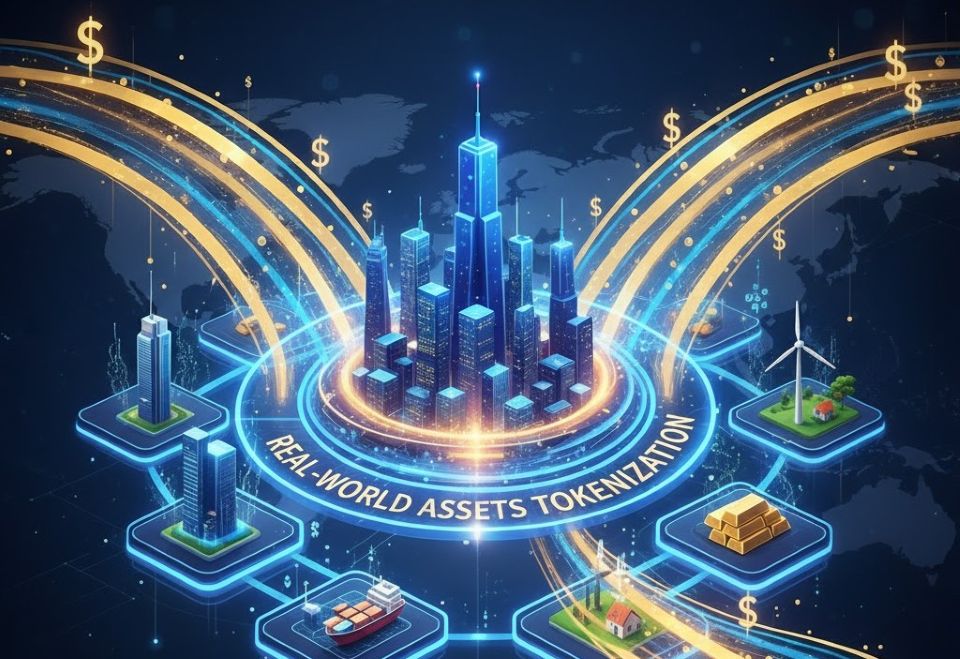
Real-world asset tokenization refers to the digital representation of physical or traditional financial assets on a blockchain. Each token corresponds to a defined legal or economic interest in an underlying asset. These tokens can then be issued, transferred, settled, or used as collateral within a digital financial system.
Unlike purely digital crypto assets, RWAs are directly linked to real economic value. This linkage introduces additional complexity. Tokenization must account for legal ownership, custody, governance, valuation, and regulatory oversight. As a result, RWA tokenization sits at the intersection of technology, finance, and public policy.
For this reason, tokenization is not simply a technical upgrade. It represents a potential redesign of how markets issue, trade, and manage assets.
Vietnam’s regulatory mindset: Openness with constraints
Vietnam’s approach to RWA tokenization can be described as “open, but controlled.” Regulators have signaled a willingness to explore tokenized financial instruments, yet only within frameworks that emphasize transparency, governance, and risk containment.
Rather than integrating tokenized assets directly into the existing financial system, Vietnam is leaning toward a separation model. Early-stage RWA products are expected to operate within regulatory sandboxes or international financial centers, distinct from the domestic retail financial infrastructure.
This separation serves several purposes. It allows regulators to observe market behavior in a controlled environment. It limits systemic exposure during early experimentation. And it creates space to refine legal, operational, and supervisory mechanisms before broader adoption.
The underlying message is clear: innovation is encouraged, but not at the expense of financial stability.
Near-term focus: Sandbox-based RWA products
In the short term, the most viable path for RWA tokenization in Vietnam lies in sandbox-based deployment. This involves collaboration between domestic asset issuers, technology providers, and platforms that may receive regulatory authorization in the future.
Early RWA products are expected to meet several criteria. First, the underlying assets must be clearly defined, verifiable, and legally recognizable. Second, product structures must comply with institutional-grade standards for governance, reporting, and risk management. Third, initial distribution should prioritize foreign or professional investors rather than domestic retail participants.
This phased approach allows market participants to test tokenized structures, identify weaknesses, and adjust designs before broader rollout. It reflects a recognition that trust in financial infrastructure is built gradually, not through rapid expansion.
A structural advantage: Building from a clean slate
Vietnam’s relative lack of deeply entrenched legacy financial systems may prove to be an advantage. Many developed markets are now attempting to integrate tokenization into fragmented infrastructures built decades ago. This process is costly, complex, and often constrained by incompatible systems.
Vietnam, by contrast, has the opportunity to design tokenization frameworks from the ground up. This enables a more coherent architecture, where issuance, trading, custody, reporting, and supervision can be aligned from the outset.
Designing infrastructure in this way also supports interoperability and data consistency. These characteristics are essential for scaling tokenized markets beyond pilot stages and for maintaining regulatory confidence over time.
Tokenization as market infrastructure
A recurring misconception is that tokenization is merely a feature layered on top of existing systems. In practice, tokenization delivers its greatest value when treated as core market infrastructure.
When implemented at the infrastructure level, tokenization can support the full asset lifecycle: primary issuance, secondary trading, collateral management, corporate actions, reporting, and compliance. Blockchain becomes the shared ledger that connects these functions, rather than a standalone technical component.
This infrastructure-centric view reframes tokenization as a long-term investment in market design. It shifts the discussion away from short-term efficiency gains toward systemic resilience and scalability.
Embedded transparency and supervision
One of the most significant advantages of blockchain-based infrastructure is the ability to embed transparency directly into the system. Properly designed tokenized markets can provide regulators with real-time access to relevant data without relying solely on periodic reporting.
Capabilities such as on-chain collateral registration, standardized obligation reporting, and auditable transaction histories allow supervision to move from reactive enforcement to preventative oversight. This shift is particularly important in emerging markets, where early detection of risk can prevent broader instability.
Transparency, in this context, is not a byproduct. It is a design principle.
The importance of institutional standards
For RWA tokenization to gain credibility, it must meet institutional expectations. This includes clear legal enforceability, secure custody solutions, robust governance frameworks, and reliable settlement mechanisms.
Without these elements, tokenized assets risk being perceived as experimental or speculative rather than as legitimate financial instruments. Vietnam’s cautious rollout reflects an understanding that institutional confidence is essential for long-term success.
By insisting on institutional-grade standards from the outset, Vietnam increases the likelihood that early RWA products will be scalable rather than isolated experiments.
Managing the risk of premature scale
While tokenization offers efficiency and liquidity benefits, premature scaling introduces significant risks. Poorly structured products can expose investors to unclear ownership rights, weak governance, or operational failures.
Vietnam’s decision to limit early RWA offerings to controlled environments and professional investors helps mitigate these risks. It also allows regulators and market participants to build experience before extending access to a broader audience.
In financial markets, credibility is cumulative. Early missteps can undermine confidence for years.
Technology’s role: Enabler, not shortcut
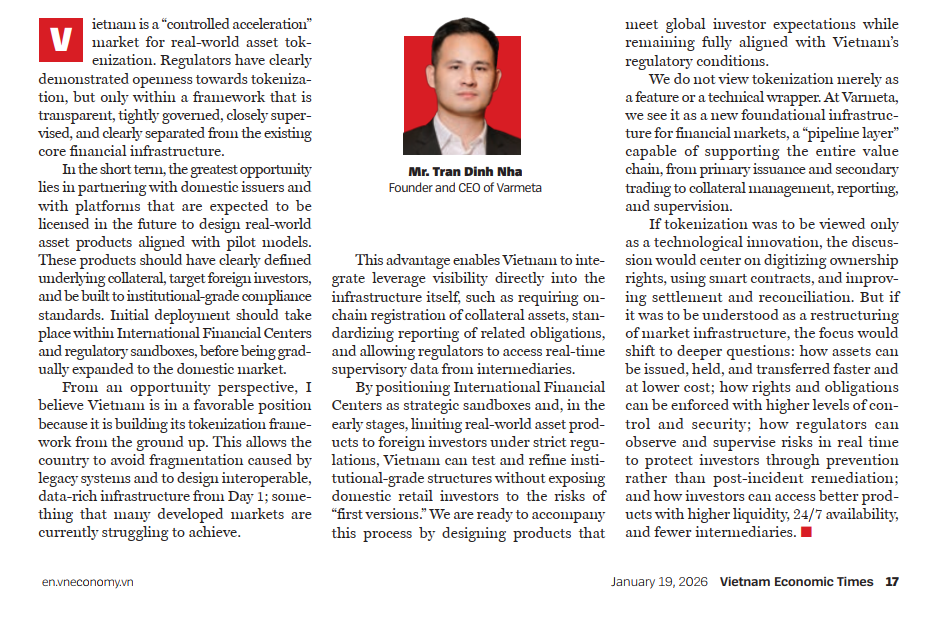
Mr. Nha Tran – Founder & CEO, Varmeta
Technology is a critical enabler of tokenization, but it cannot substitute for governance. Blockchain platforms, smart contracts, and digital custody solutions must be designed to support regulatory objectives, not bypass them.
At Varmeta, tokenization is approached as an infrastructure challenge rather than a standalone product. This perspective prioritizes system architecture, interoperability, security, and compliance-by-design. Technology, in this view, is the mechanism through which policy and market structure are implemented.
From innovation narrative to market restructuring
If tokenization is framed solely as a technological innovation, discussions tend to focus on faster settlement or digital ownership. While these benefits are real, they represent only part of the picture.
When tokenization is understood as market restructuring, the implications are broader. It affects how assets are issued and transferred, how rights and obligations are enforced, how regulators monitor risk, and how investors access liquidity. This perspective aligns tokenization with long-term financial modernization rather than short-term efficiency gains.
Looking ahead
Vietnam’s approach to real-world asset tokenization reflects a balance between ambition and caution. By emphasizing controlled experimentation, institutional standards, and infrastructure-first design, the country is positioning itself to capture the benefits of tokenization without compromising market stability.
The opportunity is substantial. So is the responsibility. If executed with discipline, Vietnam could emerge not only as an adopter of tokenization, but as a reference model for emerging markets seeking to modernize financial infrastructure in a measured and sustainable way.
Frequently asked questions
1. What is an example of a tokenized real world asset?
Common examples of RWAs include tokenized government securities (like U.S. Treasury bills), real estate properties, private credit instruments, and corporate invoices.
2. Is BTC mining legal in Vietnam?
Yes, Vietnam legalized crypto, effective January 1, 2026. A new law recognizes digital assets, taking effect on January 1, 2026. Regulations will require anti-money laundering (AML) and cybersecurity compliance
3. How big is the fintech market in Vietnam?
The Vietnam fintech market size was valued at USD 19.35 Billion in 2025 and is projected to reach USD 63.25 Billion by 2034, growing at a compound annual growth rate of 14.06% from 2026-2034.
Varmeta – Excellent in every block
Website: var-meta.com
Linkedln: https://www.linkedin.com/company/var-meta/