As companies build increasingly complex software products, they often need engineers who can bridge the gap between product development and real-world customer use. This is the role of the Forward Deployed Engineer.
What is a Forward Deployed Engineer? If you’re curious about how this role works and the challenges it comes with, this guide explains it all down to help you understand what it really means to be a Forward Deployed Engineer.
What is a Forward Deployed Engineer (FDE)?
If you’re exploring modern engineering roles that go beyond traditional software development, a great place to start is understanding the Forward Deployed Engineer.
Defining the Forward Deployed Engineer Role
The Forward Deployed Engineer (FDE) represents a hybrid role at the intersection of software engineering and information technology, characterized by direct engagement within client organizations to develop, tailor, and implement technical solutions.
In contrast to traditional software engineers, the FDE integrates technical expertise with a comprehensive understanding of the client’s operational environment and specific domain.
Table: The difference between the Forward Deployed Engineer and the traditional architect/engineer
| Aspect | Forward Deployed Engineers (FDEs) | Traditional Architects/Engineers |
| Customer Engagement | Work in close collaboration with client organizations, embedding themselves within daily workflows to gain a deep understanding of operational constraints and business processes. | Generally operate from an external, advisory position, basing their understanding of client needs on information collected through formal meetings and documentation. |
| Role in Implementation | Take an active role in developing and deploying solutions, converting prototypes into production-ready systems that can be immediately adopted by users. | Primarily focus on system design, planning, and requirements definition, with less direct involvement in hands-on implementation. |
| Requirements | Requirements evolve progressively through experimentation, rapid prototyping, and continuous interaction with stakeholders. | Requirements are generally established at the beginning of the project and serve as the main foundation for development. |
| Working Model | Frequently dedicate substantial time to a single customer engagement, including working on-site and participating directly in the customer’s day-to-day operations. | Often support multiple clients simultaneously and provide guidance without being deeply embedded in the operational activities of any single organization. |
| Speed of Delivery | Emphasize rapid execution and early deployment of functional versions, enabling organizations to realize benefits within days or weeks. | Commonly follow longer development and implementation cycles before delivering measurable value. |
| Required Competencies | Combine software engineering capabilities with product thinking and a strong understanding of business needs. | Rely primarily on technical expertise and architectural knowledge. |
| Ownership | Maintain responsibility for achieving measurable business outcomes and remain involved until the deployed solution demonstrates tangible results. | Responsibility commonly concludes once the designed features or deliverables have been completed and handed over. |
| Operating Approach | Prioritize adaptability and quick execution, especially in dynamic fields such as AI. | Generally adhere to more structured planning and advisory processes, placing less emphasis on rapid operational adaptation. |
Why Demand for the FDE Role Is Rising
The FDE role was notably popularized by Palantir Technologies, which utilized these engineers to deliver tailored solutions within highly complex environments. While the term is rooted in Palantir’s history, comparable roles exist at other major tech firms under titles such as customer engineer (at Google and OpenAI).
By 2026, demand for the Forward Deployed Engineer has increased substantially, driven by the growing complexity of enterprise AI adoption. This development is punctuated by OpenAI’s introduction of “The Deployment Company,” an initiative designed to embed FDEs within customer organizations. These engineers support the construction of workflows centered on artificial intelligence and facilitate the integration of systems with organizational data structures.
The Evolution of the Forward Deployed Engineer Role
Take a look at some key stages in the evolution of the FDE role to comprehend how it has developed and where it’s headed next.
Origins: The Palantir Era (Early 2010s)
- The Forward Deployed Engineer (FDE) role first emerged at Palantir Technologies in the early 2010s. At that time, the company deployed engineers directly to government sites, where secure and air-gapped environments made remote collaboration impossible.
- Internally referred to as “Deltas,” these engineers focused on implementing Palantir’s products on customer premises.
The AI Resurgence (2025–2026):
- While roles with comparable responsibilities, including Customer Engineer and Solutions Architect, were present throughout the industry, the Forward Deployed designation saw a significant resurgence during 2025 and 2026.
- Industry demand rose sharply. According to data shared with Business Insider, in April 2025, job postings for FDEs on Indeed were 543% above their January 2025 baseline. By April 2026, that figure had climbed to 5,230% above January 2025 levels, representing roughly a 729% year-over-year increase. This expansion was driven by the rapid development of large language models and the corresponding need to adapt general-purpose AI systems into tailored, agent-based workflows that address the distinct operational needs of organizations.
- In response to these developments, companies including OpenAI and Anthropic expanded their FDE teams, placing engineers directly within client organizations to support implementation. OpenAI formalized this strategy in 2026 by establishing The Deployment Company, an initiative designed to assist enterprises in constructing workflows that leverage AI capabilities at the core of their operations.
Evolution of Scope:
As the AI landscape matured, the responsibilities of FDEs have expanded beyond their initial focus on on-site implementation. FDEs now serve as strategic partners in the adoption of AI across organizations.
FDEs now play a central role in enabling organizations to transition from experimental AI projects to the integration of intelligent systems within daily operations. In addition, FDEs contribute to product development by providing feedback from customer deployments, which informs future product strategies.
Consequently, the skill set required for FDEs has shifted toward applied AI expertise. This includes model evaluation, orchestration, continuous optimization, and the design of AI solutions that function effectively within complex business environments.
What Does a Forward Deployed Engineer (FDE) Do?
FDEs participate in every phase of a system’s lifecycle, drawing on both technical expertise and strong communication skills. Their core responsibilities include the following:
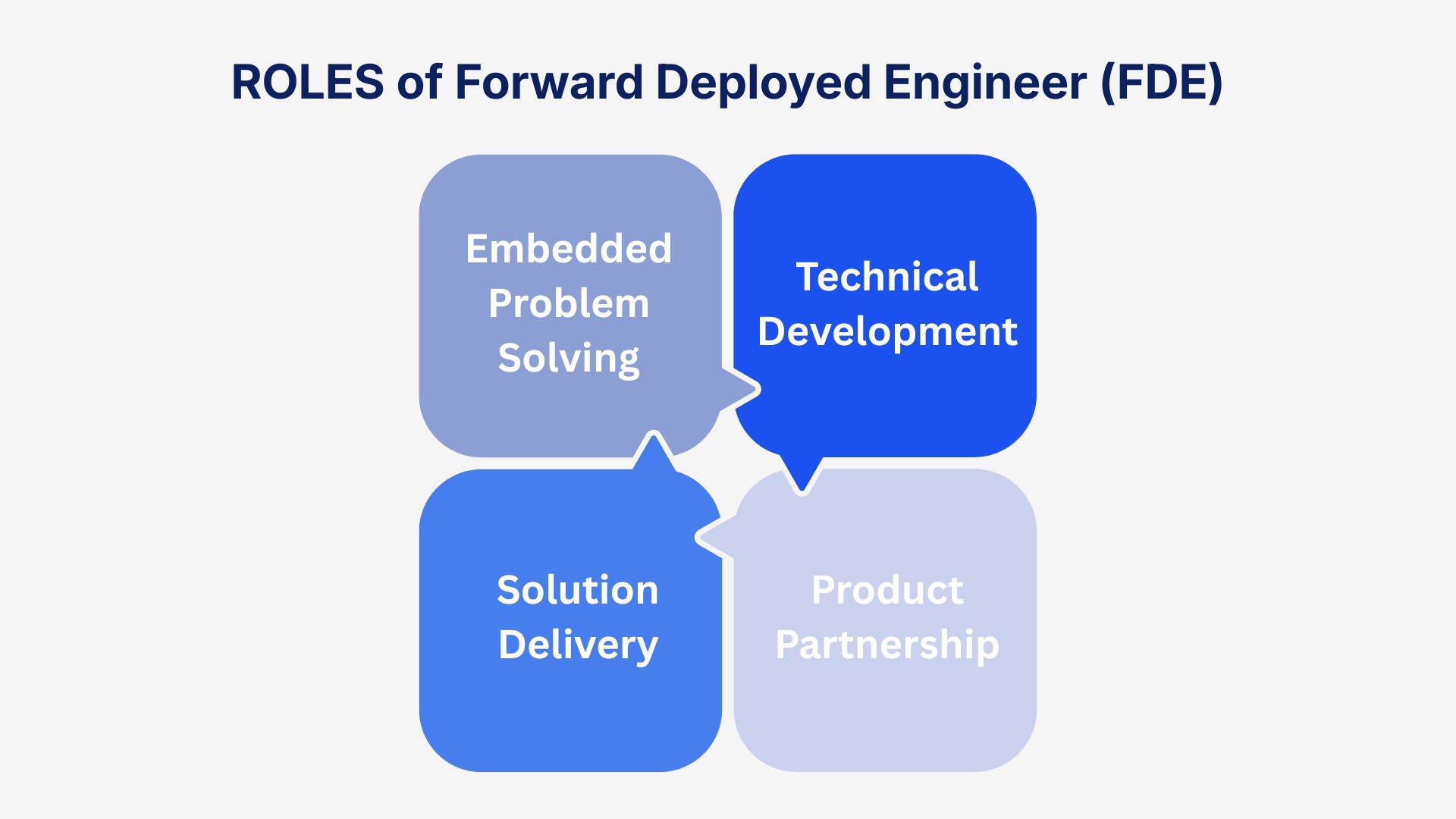
Embedded Problem Solving:
- FDEs are embedded within the customer’s operational environment, enabling them to develop a direct understanding of organizational constraints and user needs. By collaborating closely with end users and observing decision-making processes, they move beyond documentation to validate assumptions through iterative testing and real-time feedback.
- FDEs address complex integration challenges by linking products to legacy systems, specialized data flows, and custom business logic that standard interfaces cannot accommodate.
Technical Development:
- FDEs assume the combined roles of software engineer and technical architect, taking direct ownership of implementation. In the context of AI, they adapt general-purpose language models to create agent-based workflows tailored to specific business requirements. Their work includes writing code in languages such as Python, Apex, and JavaScript, integrating with APIs, and configuring data pipelines.
- FDEs also resolve issues in production environments and deploy necessary fixes. For AI-driven solutions, they oversee additional layers of complexity, including prompt engineering, model evaluation, and ongoing optimization.
Solution Delivery:
- FDE engagements are characterized by a structured lifecycle. The process begins with a detailed assessment of the client’s existing systems and the operational challenges that impact performance. Drawing on these insights, FDEs design solutions that align with the customer’s operational context and select technologies that best address identified needs.
- Implementation involves configuring data pipelines and deploying new features into production environments. Following deployment, FDEs provide training and support to client teams to facilitate effective adoption. The solution is then subject to ongoing refinement and optimization to ensure it delivers sustained and measurable business value.
Product Partnership:
- FDEs function as a critical link between customers and the vendor’s internal product teams. They translate broad or ambiguous business objectives into precise engineering requirements that guide development efforts.
- Through direct involvement in real-world deployments, FDEs identify product limitations, defects, and unmet needs. These findings are communicated to the vendor, supporting the ongoing enhancement of the core product and ensuring that future versions more effectively meet customer requirements.
Core Skills for a Forward Deployed Engineer Role in 2026
The FDE role requires the need for both technical expertise and interpersonal skills. Operating at the intersection of technology development and customer operations, FDEs must demonstrate the ability to navigate both engineering complexities and business imperatives.
The skills required for this role can be grouped into five areas:
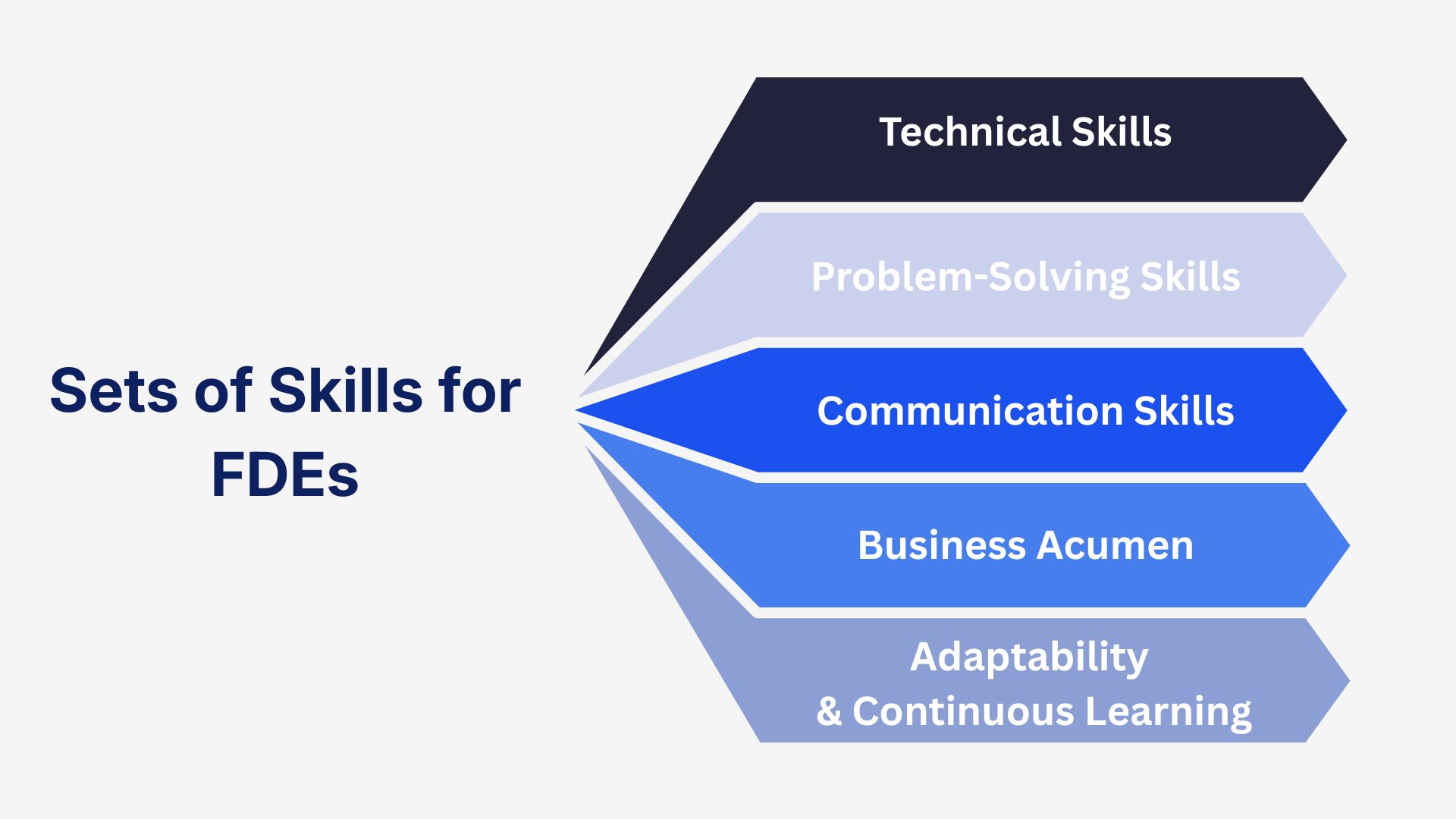
Technical Skills
- FDEs are expected to possess a broad range of technical capabilities that enable them to operate effectively across diverse systems and technologies.
- Proficiency in software development is essential, encompassing familiarity with programming languages such as Python, Apex, and JavaScript, as well as expertise in APIs and data integration processes.
- In contemporary AI environments, practical knowledge of building and refining agent-based workflows, experimenting with prompts for large language models, and managing model evaluation and orchestration is increasingly required.
- Of equal importance is the ability to make pragmatic engineering decisions and determine when a solution is sufficiently effective to meet immediate operational needs.
Problem-Solving Skills
- Problem-solving remains a fundamental competency for FDEs, who frequently encounter situations in which requirements are not fully defined and customers may be unable to specify their technical needs. In these circumstances, FDEs must analyze unfamiliar challenges, develop solutions in real time, and serve as reliable technical authorities.
- Strong analytical skills are required to translate ambiguous business challenges into clear technical requirements and to communicate technical outcomes in a manner that informs business decision-making.
Communication Skills
- Because FDEs work directly with customers, effective communication is indispensable. FDEs must be able to explain sophisticated technical concepts in language that is accessible to business and executive stakeholders.
- Strong interpersonal skills are required to manage stakeholder expectations and to provide constructive feedback when requests are technically unfeasible or misaligned with the client’s fundamental objectives.
Business Acumen
- FDEs must understand more than technology alone. They need business awareness to investigate the underlying reasons for customer requests and identify the root causes of workflow problems.
- Furthermore, they require product thinking to recognize which observations from customer engagements should be communicated to internal product teams to improve the vendor’s core offerings.
Adaptability & Continuous Learning
- The rapidly evolving nature of AI and agentic technologies requires FDEs to be highly adaptable. They must respond effectively to shifting priorities and emerging requirements that emerge during implementation while maintaining delivery momentum.
- The commitment to continuous learning is essential, enabling them to quickly understand unfamiliar systems, work effectively with legacy platforms, and continually acquire new knowledge as both technologies and customer environments advance.
Challenges of Being an FDE
The challenges arise from the demanding nature of embedded engineering work, the expectations of rapid delivery, and the structural constraints of deeply integrated deployments.
Professional and Technical Difficulties
- Misconceptions regarding the core responsibilities of FDEs: FDEs are often perceived as extensions of pre-sales or advanced support teams, rather than as engineers tasked with delivering production-grade systems. This mischaracterization often limits their involvement to demonstration or presentation activities, thereby diminishing the value of their technical expertise.
- Balancing rapid delivery with long-term system reliability: While clients frequently seek expedited outcomes, accelerated implementation schedules can undermine the robustness of deployed systems. Accordingly, FDEs are required to assess the trade-offs between immediate solutions and sustainable architectural decisions and to clearly communicate the consequences of prioritizing speed over stability.
Intense Pressure and Responsibility
- FDEs are typically responsible for entire solutions from start to finish, which means they cannot easily isolate themselves from failures in adjacent systems. If something breaks, they are often expected to investigate and resolve it regardless of where the underlying issue originated.
- In certain sectors, the environments they work in carry extremely high stakes, including sectors where system reliability can directly affect human safety or critical operations. As a result, there is a continual expectation that these engineers exercise sound judgment and maintain composure in high-pressure situations.
- FDEs also regularly collaborate with non-technical stakeholders, many of whom may be experiencing considerable operational demands. In these circumstances, effective expectation management, clear communication, and the establishment of trust are as critical as the technical aspects of the role.
- The position may also require mobility and flexibility in scheduling. In certain instances, engineers are required to devote a substantial portion of their time to travel or to working directly at customer locations.
Strategic Trade-Offs for Client Organizations
- Reduced flexibility in choosing alternative vendors: The deep integration of a particular vendor’s technology into essential workflows can result in dependence on that ecosystem. This dependence may impede future efforts to transition to other solutions.
- Long-term sustainability: The effectiveness of an FDE engagement depends on whether the client organization can independently maintain and extend the system after the engineer leaves. In cases where internal capacity is lacking, the value of the implemented solution may diminish over time as direct support concludes.
- Governance-related tension: The flexibility inherent in the FDE approach offers significant advantages in dynamic AI environments that benefit from rapid iteration. However, this same adaptability may be at odds with organizations that prioritize strict governance, formal release protocols, and system stability. In these settings, the agile characteristics of FDE work can introduce operational risks that must be carefully managed.
Use Cases That Don’t Fit the FDE Model
- The FDE model is not appropriate for all operational contexts and may prove inefficient in certain cases. Where client systems are already well-defined and require little to no customization, adding an embedded engineer can increase costs without corresponding benefits.
- Similarly, environments characterized by frequently shifting priorities or unstable workflows also present challenges. In such circumstances, solutions developed through the FDE model may become obsolete before they are fully implemented. The ongoing adaptation required by this approach may not correspond to the organization’s capacity for change.
Is Forward Deployed Engineering a Sustainable Career Path?
In the immediate future, the FDE role appears highly sustainable, driven by significant and accelerating demand across the technology sector.
Several elements indicate that the FDE role will remain important in some form:
- Professionals in these roles are relatively rare because they possess a unique combination of advanced technical expertise, communication skills, and client engagement skills. This blend of abilities is highly valued in the labor market, and compensation levels often reflect this scarcity, with some roles commanding very high salaries.
- The position offers opportunities for upward mobility, as FDEs play a direct role in influencing product direction. FDEs are consistently challenged by unfamiliar systems and complex, ill-defined problems, which necessitate developing adaptability and broad technical competence. This can build a highly flexible skill set that opens doors to leadership positions, startup founding, or senior consulting roles.
- Another factor contributing to the role’s durability is that, while the title may be relatively recent, the core function of assisting customers with the adoption and integration of complex software systems has long existed under various designations. That demand for such expertise is likely to persist, regardless of changes in nomenclature or organizational branding.
- As the field continues to develop, the FDE role is expected to further specialize into distinct AI engineering disciplines. For example, new roles may emerge such as LLMOps Engineers or Evals Engineers, reflecting the increasing complexity and specialization within the domain.
Although demand for these roles remains robust, questions persist regarding their long-term stability. A consideration is that organizations may increasingly seek to develop internal AI engineering capacity, reducing reliance on external embedded engineers over time. While firms often engage FDEs to support initial implementation, the responsibility for ongoing system management and development is expected to transition to in-house teams.
At the same time, the role is experiencing strong growth due to the increasing complexity of integrating advanced AI systems into existing enterprise environments. This surge in demand is currently creating many opportunities. Looking ahead, the sustainability of this trend will likely depend on whether integration challenges persist or if future tools simplify the process and reduce the need for specialized engineering support.
Final Thoughts
Forward-deployed engineering is characterized by a demanding and dynamic work environment that appeals to individuals who seek variety, are comfortable with ambiguity, and value direct engagement with clients.
The sustainability of this career path over the long term is determined by an individual’s capacity for sustained high-intensity work, as well as the importance placed on mobility and continuous problem-solving under pressure. While the position offers big opportunities for professional growth and impact, it also introduces structural constraints that may shape how long someone chooses to remain in it.
FAQs
What is a Forward Deployed Engineer’s salary?
As of 2026, based on ZipRecruiter data, the average annual salary for a Forward Deployment Engineer in the United States is around $110,000, while top earners can make over $160,000/year.
Do forward-deployed engineers travel?
The job is often associated with intense workloads and frequent travel, sometimes requiring engineers to spend most of their time away from a fixed office or home base. Over time, this degree of mobility may prove challenging to sustain, particularly for individuals seeking more stable routines.
What is the salary of Forward Deployed Engineer at OpenAI?
Published listings from OpenAI show compensation of up to $280,000 annually for a Forward Deployed Engineer with 5+ years of engineering or technical deployment experience, including customer-facing work.